牛津译林版(2019)必修第一册Unit 3 Getting along with others Section B Grammar and usage教案

资源下载
  1. 二一教育资源

牛津译林版(2019)必修第一册Unit 3 Getting along with others Section B Grammar and usage教案

资源简介

Unit 3 Getting along with others
Grammar and usage教学设计
科目:英语 课题:Grammar and usage 课时:1课时
教学目标与核心素养:
知识目标:在语境中学习理解限制性定语从句的用法;
能力目标:获取更多主题语境的信息,加深对主题意义的理解;
情感目标:了解限制性定语从句的用法,同时学会如何维持良好的人际关系。
教学重难点
教学重点:掌握限制性定语从句及关系代词的具体用法
教学难点:在日常交际中能够灵活地使用限制性定语从句描述人和事物
课前准备:多媒体,黑板,粉笔
教学过程:
一、Pre-class
1. Greeting
2. Leading-in
教师活动:教师让学生阅读第34页的文章,并回答下面问题。
What are the pros and cons of making friends online
Pros: People may be able to make many friends online.
Cons: Friendships online can be very shallow.
Texting and messaging cannot replace face-to-face chatting.
Sharing experiences on social media is not enough to express one's values.
"Liking" friends' photos online doesn't develop the connection with them.
学生活动:根据第34页文章完成表格。
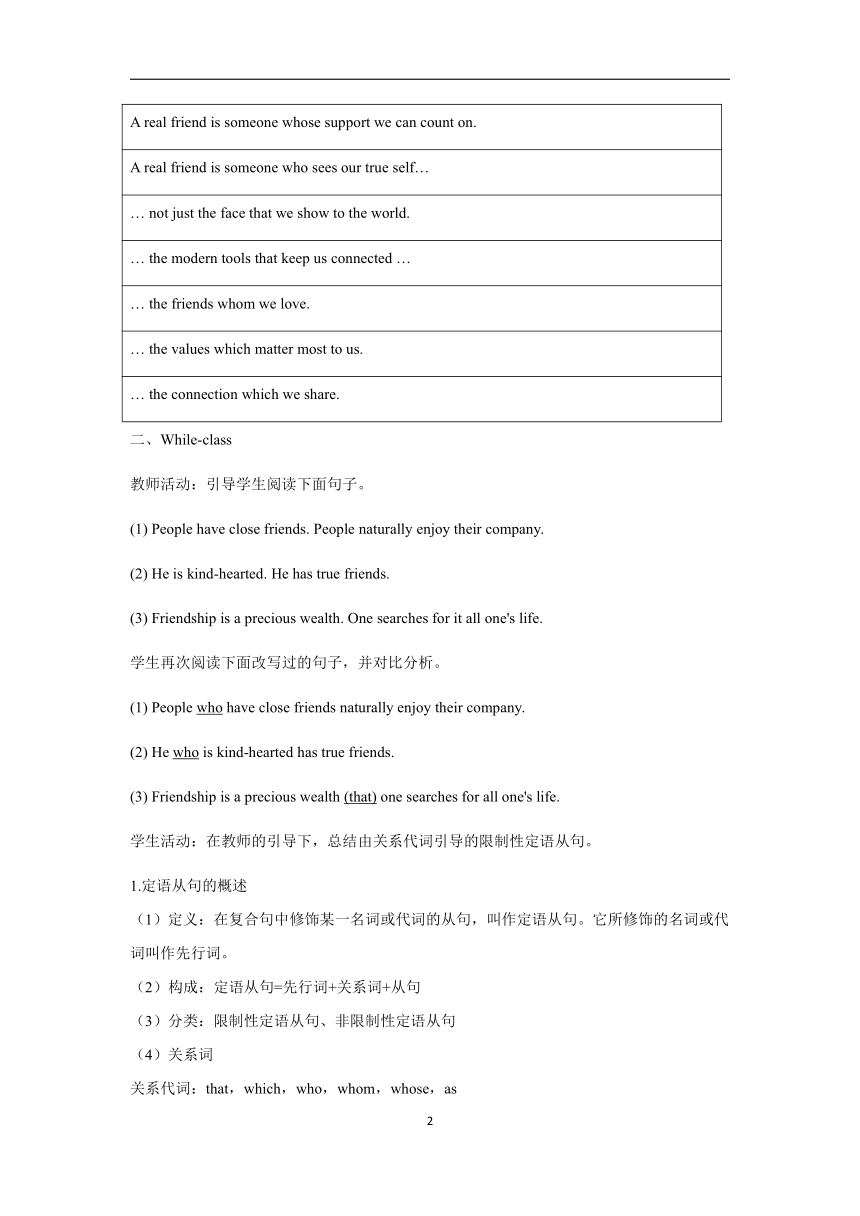
A real friend is someone who walks in…
A real friend is someone whose support we can count on.
A real friend is someone who sees our true self…
… not just the face that we show to the world.
… the modern tools that keep us connected …
… the friends whom we love.
… the values which matter most to us.
… the connection which we share.
二、While-class
教师活动:引导学生阅读下面句子。
(1) People have close friends. People naturally enjoy their company.
(2) He is kind-hearted. He has true friends.
(3) Friendship is a precious wealth. One searches for it all one's life.
学生再次阅读下面改写过的句子,并对比分析。
(1) People who have close friends naturally enjoy their company.
(2) He who is kind-hearted has true friends.
(3) Friendship is a precious wealth (that) one searches for all one's life.
学生活动:在教师的引导下,总结由关系代词引导的限制性定语从句。
1.定语从句的概述
(1)定义:在复合句中修饰某一名词或代词的从句,叫作定语从句。它所修饰的名词或代词叫作先行词。
(2)构成:定语从句=先行词+关系词+从句
(3)分类:限制性定语从句、非限制性定语从句
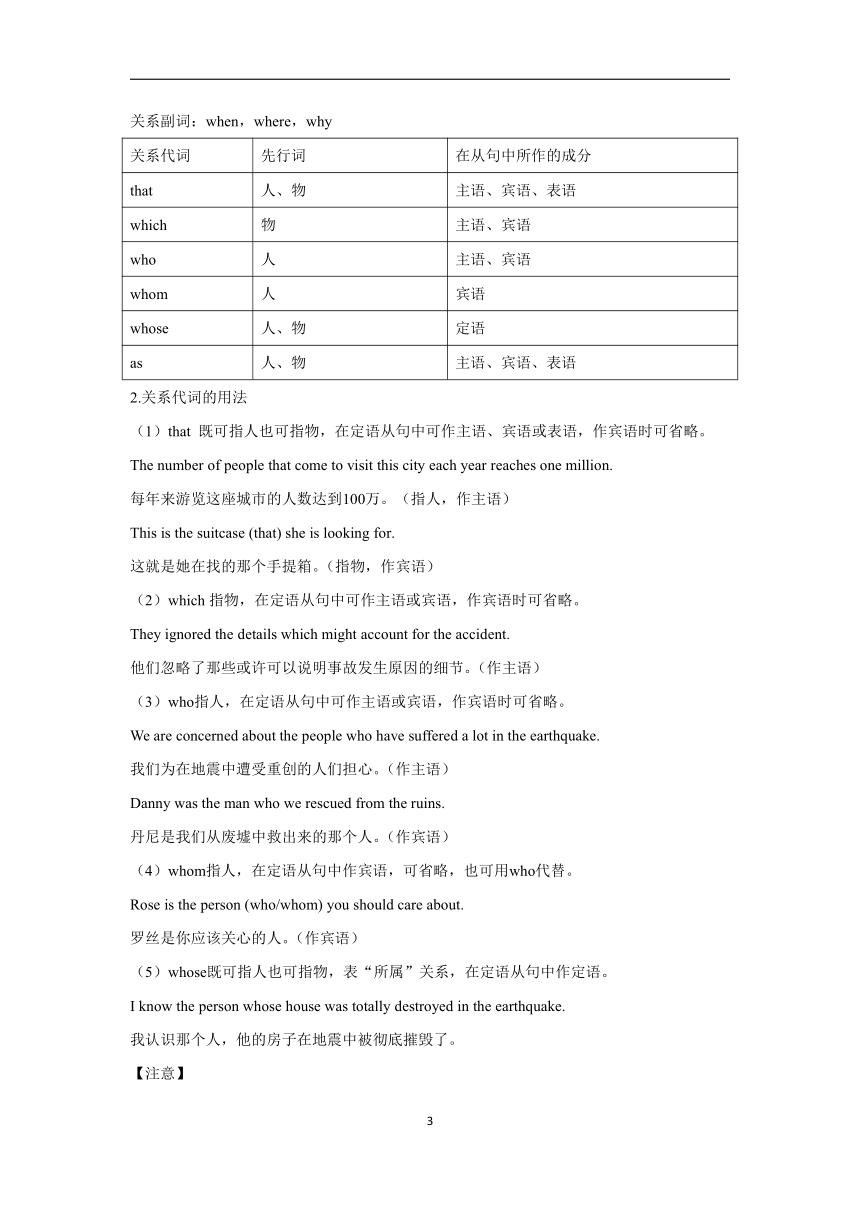
(4)关系词
关系代词:that,which,who,whom,whose,as
关系副词:when,where,why
关系代词 先行词 在从句中所作的成分
that 人、物 主语、宾语、表语
which 物 主语、宾语
who 人 主语、宾语
whom 人 宾语
whose 人、物 定语
as 人、物 主语、宾语、表语
2.关系代词的用法
(1)that 既可指人也可指物,在定语从句中可作主语、宾语或表语,作宾语时可省略。
The number of people that come to visit this city each year reaches one million.
每年来游览这座城市的人数达到100万。(指人,作主语)
This is the suitcase (that) she is looking for.
这就是她在找的那个手提箱。(指物,作宾语)
(2)which 指物,在定语从句中可作主语或宾语,作宾语时可省略。They ignored the details which might account for the accident.
他们忽略了那些或许可以说明事故发生原因的细节。(作主语)
(3)who指人,在定语从句中可作主语或宾语,作宾语时可省略。
We are concerned about the people who have suffered a lot in the earthquake.
我们为在地震中遭受重创的人们担心。(作主语)
Danny was the man who we rescued from the ruins.
丹尼是我们从废墟中救出来的那个人。(作宾语)
(4)whom指人,在定语从句中作宾语,可省略,也可用who代替。
Rose is the person (who/whom) you should care about.
罗丝是你应该关心的人。(作宾语)
(5)whose既可指人也可指物,表“所属”关系,在定语从句中作定语。
I know the person whose house was totally destroyed in the earthquake.
我认识那个人,他的房子在地震中被彻底摧毁了。
【注意】
①关系代词指代先行词在定语从句中充当主语、宾语、表语或定语,因此定语从句中不能再出现关系代词所替代的名词或代词。
昨天晚上我们看的那部电影非常吓人。
The film (that/which) we saw it last night was very frightening. (×)
The film (that/which) we saw last night was very frightening. (√)
②关系代词在从句中作主语时不能省略,作宾语时可以省略。
Is that the girl (whom/who /that) you spoke of the other day
那就是你前几天所提到的女孩吗?
(6)as既可指人也可指物。在定语从句中可作主语、宾语或表语。它常用在the same … as ...,such ... as ...等结构中,as不能省略。
Such reasons as we give can persuade him to give up his foolish plan.
我们给出的这些理由可以说服他放弃他的愚蠢计划。
I'll buy the same dictionary as you have.
我将买和你的一样的词典。
【注意】
当先行词被the same修饰时,也可用that 引导定语从句,但指同一物,而不是同一类。
This is the same bike that 1 lost two months ago.
这就是两个月前我丢的那辆自行车。(同一辆自行车)
This is the same bike as I lost two months ago.
这辆自行车跟两个月前我丢的那辆一样。(同样的自行车,但不是同一辆)
(7)as引导非限制性定语从句,代替整个主句的内容。从句可放在主句前、主句后或主句中间。As you know, she is a stubborn girl, and I can't persuade her to change her mind.
你知道,她是一个倔强的女孩,我不能说服她改变主意。
My grandfather is fond of talking about the good old days, as is often the case with old people.
我爷爷喜欢谈论过去的美好时光,这种情况在老年人中较为常见。
【归纳】
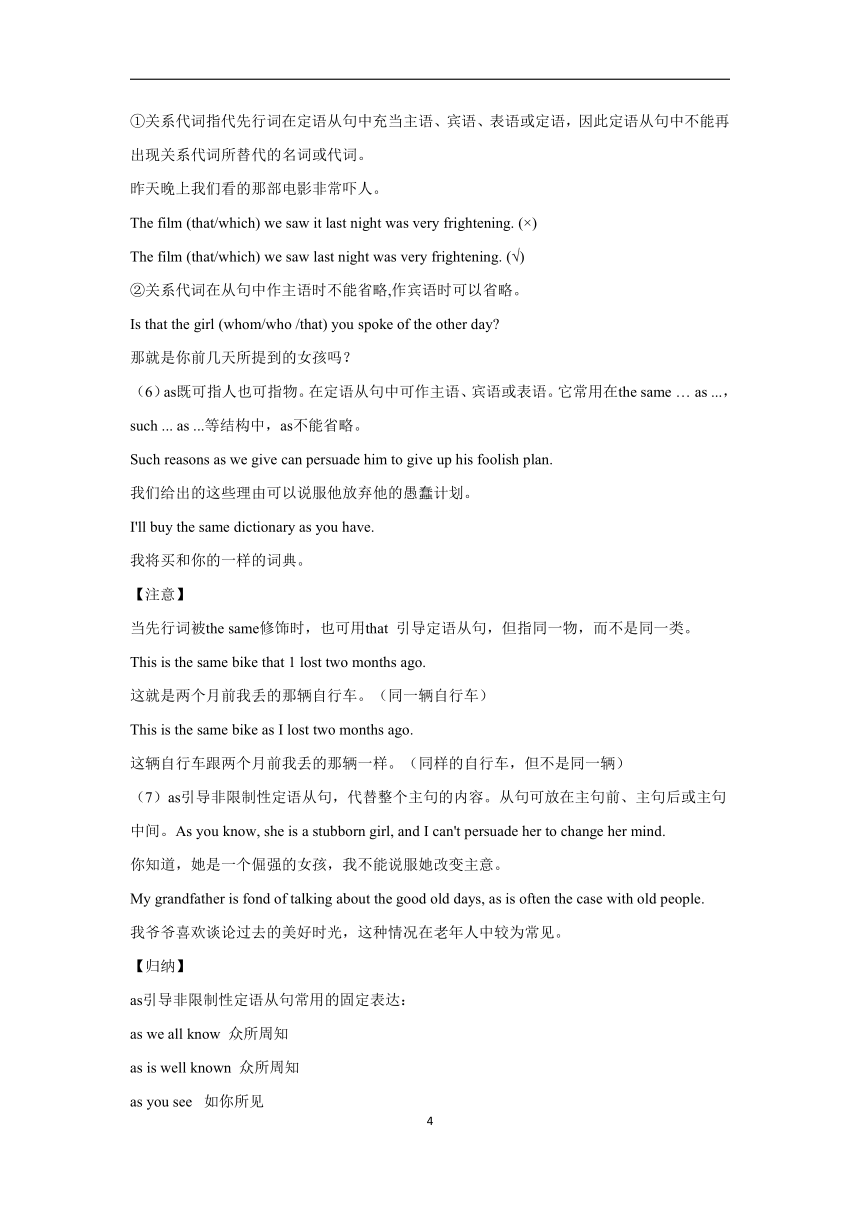
as引导非限制性定语从句常用的固定表达:
as we all know 众所周知
as is well known 众所周知
as you see 如你所见
as we expect 正如我们预料的那样
as often happens 正如经常发生的那样
as I can remember 正如我所记得的
as has been said before 如前所述
as is/ was expected 正如预料的那样
as can be seen 正如所见
as is often the case情况常常是这样
3.宜用 that不宜用which引导定语从句的情况
(1)当先行词指物且被序数词或形容词最高级修饰时。The first thing that you should do is call the police right away.
你应该做的第一件事就是马上报警。
This is the most delicious food that I have ever had.
这是我吃过的最美味的食物。
(2)当先行词是all,any,little,few,much,everything,anything,nothing,none 等不定代词或被这些词修饰时。
All that can be done has been done.
一切能做的都已经做了。
Tell me everything that you know.
把你知道的一切都告诉我吧。
Please send us any information that you have about the subject.
有关这个主题的任何资料都请寄给我们。
(3)当先行词指物且被 the only,the very,the last,the same等修饰时。
The only thing that she could do was to go to the police for help.
她唯一能做的事就是去求助警察。
This is the very book that I want to buy.
这就是我想买的那本书。
【注意】
以上三种情况有一个共同特点,就是先行词或先行词之前的修饰语往往带有“唯一”或者“全部”的概念,以致无法做出选择。因为关系代词which也是疑问代词,表示“哪一个”,含有选择意味,所以用that引导万无一失。
(4)当先行词既包括人又包括物时。
Sometimes we should ignore the persons and things that upset us.
有时,我们应该不理会让我们不快的人和事。
(5)当主句是以who或者which开头的特殊疑问句时。
Which of the books that you bought is the most useful for my writing
你买的书中哪一本对我的写作最有用?
4.宜用which不宜用that引导定语从句的情况
(1)引导非限制性定语从句时。
Football, which is an interesting game, is very popular all over the world.
足球是一项有趣的运动,在全世界非常受欢迎。
(2)当关系代词前有介词时。
This is the house in which Mo Yan once lived.
这就是莫言曾经住过的房子。
(3)当先行词本身就是that时。
That which you told him is what we want to know. 你告诉他的事情就是我们想知道的。
(4)在限制性定语从句中,如果有两个定语从句,其中一句的关系代词是that,那么另一句的关系代词宜用which。
Let me show you the novel that I borrowed from the library which was newly open.
让我给你看看我从新开的图书馆借来的小说。
5.宜用who不宜用that引导定语从句的情况
(1)当先行词是指人的不定代词时,如one,ones,anyone,no one,nobody,anybody等。
Is there anyone in your class who is good at singing
你们班有人擅长唱歌吗
(2)在there be结构中,先行词指人时。
There is a young lady who is in a state of shock.
有位年轻女士休克了。
(3)当先行词是people,those时。
People who want to travel abroad should apply for a passport first.
想要出国旅行的人应该先申请护照。
The students you should learn from are those who graduated from famous universities.
你应该向那些从著名大学毕业的学生学习。
(4)一个句子中带有两个定语从句且先行词都为人时,其中一个定语从句的关系代词是that,另一个宜用who。
The boy that you met last night is the group leader who studies very hard.
昨晚你遇到的那个男孩就是那个学习非常努力的组长。
6.定语从句中的主谓一致
(1)关系代词在从句中作主语时,定语从句谓语动词的单复数形式根据先行词的形式确定。
The old town has narrow streets and small houses that are built close to each other.
旧城区的街道狭窄,房子小,彼此挨得很近。
I'm fond of the piece of music which is popular with the teenagers.
我喜欢在青少年中流行的那支曲子。
(2)one of +复数名词+定语从句(复数谓语)
the only one of +复数名词+定语从句(单数谓语)
He is one of the students who have a good command of French.
他是精通法语的学生之一。(the students为先行词)
He is the only one of the students who has a good command of French.
他是学生中唯一精通法语的。(the only one为先行词)
三、After-reading
教师活动:指导学生完成第35页B1。
1. Common interests provide rich ground. Many friendships grow from rich ground.
Common interests provide rich ground (that/which) many friendships grow from.
Common interests provide rich ground from which many friendships grow.
2. When friends' communication is warm and open, friendships grow best.
Friendships grow best between friends whose communication is warm and open.
3. Friendships are like flowers. These flowers need to be taken good care of.
Friendships are like flowers (that/which) need to be taken good care of.
4. A relationship with a true friend will surely produce fruit. You can count on a true friend.
A relationship, with a true friend (who/whom/that) you can count on will surely produce fruit.
5. You have been helped by others. To make friends, you should help others in the same way.
To make friends, you should help others the way (that/in which) you have been helped by others.
学生活动:完成第35页B2。
(1) which/that (2) whose (3) who/that (4) which/that (5) which (6) whom/that (7) who/that
Are Huck Finn and Jim true friends Why do you think so
Yes, they are. Because Huck refuses to give Jim to those slave catchers.
四、Summary
归纳总结由关系代词引导的限制性定语从句的用法。
五、作业布置
完成B3活动的写作。
参考答案:
My best friend is Hannah. I met her in a park in which I play badminton. One day, the friend who I normally play with had to go home early, and I was about to leave too. That was the moment when Hannah came up to me and asked if I wanted to play with her. We got on really well and soon became close friends. I know she is someone that I can rely on in times of difficulty.
2

展开更多......

收起↑

资源预览