上海市杨浦区2020-2022届(三年)高三二模英语试题汇编:阅读理解(含答案)

资源下载
  1. 二一教育资源

上海市杨浦区2020-2022届(三年)高三二模英语试题汇编:阅读理解(含答案)

资源简介

上海市杨浦区
2020-2022届(三年)高三二模英语试题分类汇编
阅读理解
上海市杨浦区2022届高三二模英语试卷
Section B
Directions: Read the following three passages. Each passage is followed by several questions or unfinished statements. For each of them there are four choices marked A, B, C and D. Choose the one that fits best according to the information given in the passage you have just read.
(A)
I fell in love with the minister’s son the winter I turned fourteen. He was not Chinese. When I found out that my parents had invited the minister’s family over for Christmas Eve dinner, I cried. What would Robert think of our shabby Chinese Christmas What would he think of our noisy Chinese relatives who lacked proper American manners What terrible disappointment would he feel upon seeing not a roasted turkey and sweet potatoes but Chinese food
On Christmas Eve I saw that my mother had outdone herself in creating a strange menu. She was pulling back lines out of the backs of fleshy prawns. The kitchen was littered with piles of raw food: a fish with bulging eyes begging not to be thrown into a pan of hot oil, a bowl of soaking dried fungus(菌菇)back to life, a plate of squids(鱿鱼)whose backs were crisscrossed with knife markings so they resembled bicycle tires.
And then they arrived — the minister’s family and all my relatives. Robert said hello, and I pretended he was not worthy of existence. Dinner threw me deeper into despair. My relatives licked the ends of their chopsticks and reached across the table, dipping them into the dozen or so plates of food. Robert and his family waited patiently for plates to be passed to them. My relatives whispered with pleasure when my mother brought out the whole steamed fish. Robert made faces. Then my father poked his chopsticks just below the fish eye and pulled out the soft meat. “Amy, your favourite,” he said, offering me the tender fish cheek. I wanted to disappear. I remained silent for
the rest of the night.
After everyone had gone, my mother said to me, “You want to be the same as American girls on the outside. But inside you must always be Chinese. You must be proud you are different. Your only shame is to have shame.”
56. The writer felt ________ upon knowing that the minister’s family had been invited over for Christmas Eve dinner.
A. excited B. worried C. disappointed D. confused
57. In the second paragraph, the writer described the kitchen scene in such a way as to ________.
A. paint a vivid picture of how busy her mother was
B. explain the reason why her mother created such a menu
C. support the claim that the Christmas menu was strange
D. introduce the typical Chinese dishes served on Christmas Eve
58. What can be inferred about the writer based on what happened during the dinner
A. She suffered greatly during the dinner.
B. She hated eating the fish cheek below the eye.
C. She regretted not talking more with Robert.
D. She was picky about the Christmas menu.
59. Why did the writer’s mother have a talk with her that night
A. To inform her of the cultural gap between the east and the west.
B. To share her understanding of the word “shame”.
C. To encourage her to become integrated into the local community.
D. To urge her to be proud of her Chinese roots.
(B)
(
www.AQUILA.co.uk
)
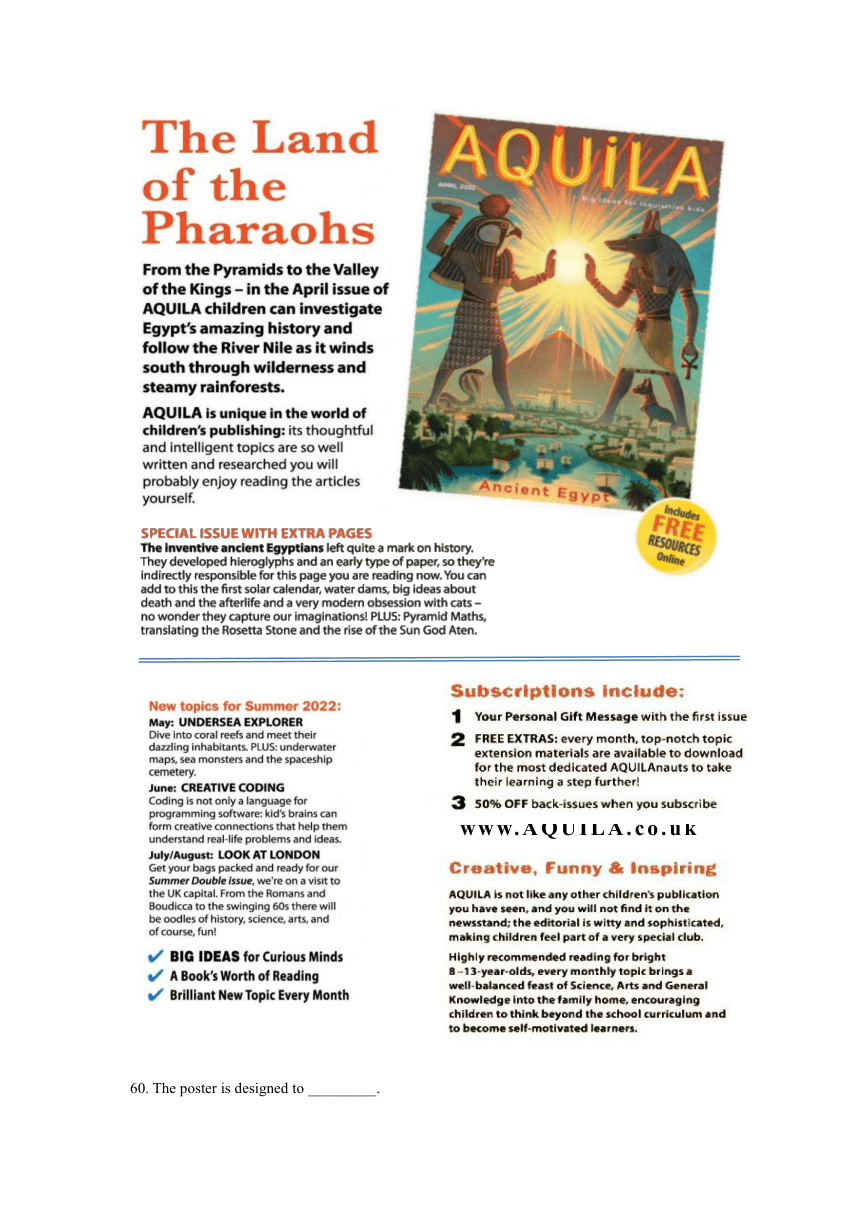
60. The poster is designed to _________.
A. advertise the special issue of Ancient Egypt
B. introduce “The Land of the Pharaohs”
C. promote a children’s publication, AQUILA
D. feature summer topics of AQUILA 2022
61. Which issue will you like most if you are interested in marine life
A. April issue. B. May issue. C. June issue. D. July/August Issue.
62. Which way enables you to get the most issues with the same amount of money
A. Purchasing the back-issues.
B. Downloading online issues.
C. Subscribing to the double issues.
D. Buying current issues at the newsstand.
(C)
Parents, teachers and caregivers have long suspected the magic of storytelling to calm kids. Researchers have now quantified the biological and emotional benefits of a well-told tale.
“We know that narrative has the power to transport us to another world,” says Guilherme Brockington from Brazil’s Federal University. “Earlier research suggested that stories help children process and regulate their emotions — but this was mostly conducted in a laboratory, with subjects answering questions while lying inside functional MRI machines. There are few studies on biological and psychological effects of storytelling in a more commonplace hospital setting.”
So investigators working in several Brazilian hospitals split a total of 81 patients aged 4 to 11 into two groups, matching them with storytellers who had a decade of hospital experience. In one group, the storyteller led each child in playing a riddle game. In the other, youngsters chose books and listened as the storyteller read them aloud. Before and after these sessions, the researchers took spit samples from each child, then asked them to report their pain levels and conducted a free-association word quiz.
Children in both groups benefited measurably from the interactions; they showed lower levels of cortisol — the stress-related hormone and higher levels of oxytocin, which is often described as a feel-good hormone. Yet kids in the storytelling group benefited significantly more: their cortisol levels were a quarter of those in the riddle group, and their oxytocin levels were nearly twice as high. Those who heard stories also reported pain levels dropping almost twice as much as those in the riddle group, and they used more positive words to describe their hospital stay.
The study demonstrates that playing games or simply interacting with someone can relax kids and improve their outlook but that hearing stories has an especially dramatic effect. The researchers “really tried to control the social interaction component of the storyteller, which I think was the key,” says Raymond Mar, a psychologist at York University who was not involved in the new research.
Next, the investigators plan to study how long these effects last, along with storytelling’s potential benefits to kids with particular illnesses such as cancer. For now Brockington says the results indicate storytelling is a low-cost and extremely efficient way to help improve health outcomes in a variety of settings. Mar agrees. “It’s very promising and scalable,” he says, “and possibly generalizable.”
63. What is the second paragraph mainly about
A. The effects of story-telling on children.
B. The limitations of the earlier research.
C. The methods used in earlier studies.
D. The major breakthroughs achieved so far.
64. The underlined word “scalable” in the last paragraph is closest in meaning to _________.
A. accessible B. comparable C. adjustable D. readable
65. Which of the following is TRUE about the study conducted in Brazilian hospitals
A. It measured participants’ blood levels.
B. It divided subjects into groups of 81.
C. It quantified the benefits of story-telling.
D. It compared impact of two types of story-telling.
66. The conclusion drawn from the study is that ________.
A. listening to stories reduces pain and stress in hospitalized kids
B. interacting with others improves sick kids’ mental sharpness
C. story telling has potential benefits for kids with cancers
D. riddle guessing is as effective as storytelling in helping sick kids
上海市杨浦区2021届高三二模英语试卷
Section B
Directions: Read the following three passages. Each passage is followed by several questions or unfinished statements. For each of them there are four choices marked A, B, C and D. Choose the one that fits best according to the information given in the passage you have just read.
(A)
“Uncle Chuchu, look!” Uncle Chuchu turns to where Preet is pointing. She quickly eats up the chips on his plate. He always falls for this tnck!
Chuchu is the pet name Preet has given him. Uncle Chuchu is the kindest person in Preet's world. He is also her best friend. One day, Preet sees Uncle Chuchu scoop (抓起) handfuls of candies from ajar and drop them from his bedroom window. She watches in amazement as he ducks under the windowsill, trying hard not to laugh.
Cries of delight float up from the street!
At the end of the lane is a school. When the lunch bell rings. Uncle Chuchu secretly drops candies down to the school children as they pass under his window.
After lunch. Uncle Chuchu walks back to his office with his briefcase. When he passes the children playing, he doesn't look at them. So, the children never guess that the hand that sends them candies every day belongs to this thin, solemn man!
But one day, Uncle Chuchu has a terrible pain in his stomach. As he's taken to the hospital, he presses Preet's hand one last time...
Now, Preet sits in Uncle Chuchu’s empty room. His yoga mat is on the floor. She remembers that long ago one day when she had walked in and found a pair of long legs poking into the air.
“Help!” Preet had yelled. “Uncle Chuchu is hurt!” Mom and Grandma had rushed into the room and burst out laughing! “He's not hurt.” Mom said. “He's doing yoga!” Grandma said. “Yoga,” repeated Preet. She had watched with wondering eyes as Uncle Chuchu lifted his body on the palms of his hands, like a bird about to fly away!
Preet's eyes are wet. Nobody can fill the Uncle Chuchu-shaped hole in her heart.
56. The scene described in the first paragraph is intended to show readers _____.
A. that Uncle Chuchu is easily fooled by others
B. what fun Preet used to have with Uncle Chuchu
C. how Preet enjoyed eating snacks such as chips
D. that Uncle Chuchu always treated Preet equally
57. The underlined word "duck” m the second paragraph means.
A. hide B. hang C. drag D. mark
58. Why did Uncle Chuchu drop candies from his bedroom window
A. He didn't want to eat up all the candies.
B. He was too shy to greet the children directly.
C. He wanted to bring delight to the children.
D. He took pity on the homeless children in the street.
59. What is the best title for the story
A. Uncle Chuchu’s Yoga Mat B Preet’s Farewell to Uncle Chuchu
C. Preet's Innocent Childhood D. Uncle Chuchu’s Jar of Candies
60. On which day of the tour, do travelers get to experience the rainforest in the day and stay in Westin Resort for the night
A. Day 3. B. Day 4. C. Day 5. D. Day 6.
61. Which of the following is TRUE about the Panama 8-Day Tour
A. It is priced at $1295 including tax. B. It is only available to domestic travelers.
C. It was first launched to the public in 1952. D. The tour package includes airport transfers.
62. The purpose of the advertisement is to.
A. remind travelers of key information B. promote the Panama& Canal Tour
C. advertise a series of Caravan Tours D. describe the appeal of Panama City
(C)
In 2018 biologist Jann Vendetti published a paper that described the discovery of five species of non-native snails and slugs (蜗牛和鼻涕虫) in Southern California. The research would not have been possible without some 1,200 volunteers who uploaded nearly 10,000 photos to the SLIME project (Snails and Slugs Living in Metropolitan Environments) on an app called iNaturalist.
“So the entire existence of that paper is dependent upon these citizen scientists. How do you credit those people ” said Greg Pauly from the Natural History Museum of Los Angeles. “There are some very specific requirements that a lot of journals and a lot of academic societies use. And those requirements largely would exclude nonprofessional scientists. And to me, that's absurd.” That’s why Pauly, together with Vendetti, and several Australian biologists are arguing that criteria must change to recognize citizen scientists as authors on scientific journal articles.
They propose what they're calling “group co-authorship.” The author list on Vendetti’s snail-and-slug paper includes the phrase “citizen science participants in SLIME.” But the phrase is absent when you look up the paper on Google Scholar. The publication software simply isn't equipped to handle that kind of authorship, and so it erases the group's vital contribution.
In another case, several years ago in Australia, a team of researchers tried to condition native lizards not to eat the poisonous cane toads. The only reason it was successful was because they partnered with the traditional landowners in northwestern Australia, and this group was called the Balanggarra Rangers.
Several journals flat-out refused to allow for the inclusion of the Rangers as group co-authors. Eventually, the researchers did convince the editors of some journals to allow it, but the group's title was shortened, as if it was a first and last name, in online indexing software: “B. Rangers.”
The researchers argue that these errors and omissions don't only make the critical contributions of a native community as invisible, they could also be seen as showing prejudice.
“If the person who had made that contribution was a graduate student who was trying to pursue a career in the sciences, we would all say, "Oh, of course that person should be a co-author5. But we don't necessarily extend that same line of reasoning to citizen scientists.
Allowing for group co-authorship is not a new idea. In 2004 the journal Nature published a paper titled “Initial Sequencing and Analysis of the Human Genome. It listed as the sole author the “International Human Genome Sequencing Association.” “So let’s just choose this group-authorship model and turn it into group co-authorships. This really shouldn't be that hard.”
63. What can be learned about Vendetti s snail-and-slug paper
A. It is the first paper to credit citizen scientists on the title page.
B. It describes snails and slugs living in metropolitan environments.
C. It is available on the publication software Google Scholar.
D. It includes 10,000 photos of snails and slugs in Southern California.
64. What can be inferred about Balanggarra Rangers
A. They are familiar with native animals and plants.
B. They make a living by hunting native lizards.
C. They are good business people.
D. They are world famous as B. Rangers.
65. Why is the example of a graduate student mentioned in the 7th paragraph
A. To point out the omissions in the line of reasoning.
B. To highlight the contribution of a native community.
C. To argue against showing favor for a particular group.
D. To prove that not crediting citizen scientists is unfair.
66. The author \ purpose of writing the article is to _____.
A. expose the unfair practice in the scientific community
B. call for the wide recognition of group co-authorship
C. call on more people to become citizen scientists
D. explain the origin of the term group co-authorship
上海市杨浦区2020届高三二模英语试卷
Section B
Directions: Read the following three passages. Each passage is followed by several questions or unfinished statements. For each of them there are four choices marked A, B, C and D. Choose the one that fits best according to the information given in the passage you have just read.
(A)
For almost 500 years, people have wondered what deadly disease wiped out most of the Aztecs (阿芝特克人). The locals called it cocolizthi, and now a team of scientists think they know exactly what that was. The outbreak is considered to be one of the deadliest epidemics (传染病)in human history. For centuries, its cause has been debated by historians. New evidence suggests that the Aztecs died from a type of bacteria called salmonella enterica.
An international team of scientists came to this conclusion after analysing the skeletons (骨骼) of 29 Aztecs buried in a cocoliztli cemetery in the Oaxaca region of Mexico. The scientists obtained samples from the teeth of ten of the skeletons. They compared these with their database of bacteria and found traces of salmonella enterica.
Salmonella enterica can cause enteric fever, of which typhoid (伤寒)is a type. Today, there are around 21 million cases of typhoid worldwide and it is considered a global threat.
The Aztecs were fierce hunter-gatherers who settled in what is now Mexico at the beginning of the 13th century. From their incredible capital city Tenochtitlan(now Mexico City),the Aztecs fought wars with other tribes until they ruled much of the region.
The Aztecs ended up controlling large parts of Mesoamerica--now much of Mexico and Central America--until Spanish explorers arrived in 1519 and brought with them advanced weapons and deadly diseases. The team believe that the domesticated animals, such as goats and horses, which the explorers brought with them carried the deadly bacteria.
By 1545,not even 30 years after the Spanish had arrived, Mexico's Aztec nation started coming down with a terrible illness. Symptoms included high fever, headaches and bleeding from the eyes, nose and mouth. Within five years, up to 15 million people---more than 80%of the population at the time--had died from the mystery illness they called cocoliztli. The Aztec people had no immunity (免疫) to fight the disease.
“We cannot say with certainty that salmonella enterica was the cause of the cocolizti epidemic,” said Kirsten Bos from the Max Planck Institute for the Science of Human History in Germany.” We do believe that it should be considered a strong candidate."
36. Which helped the scientists come to the conclusion.
A. Certain traces of deadly diseases carried by goats and horses
B. Extensive comparison of Aztecs buried in a cocoliztli cemetery
C. Definite discoveries of infected tooth samples from the database
D. Small amounts of certain bacteria in the teeth of the skeletons
37. Which of the following is TRUE about the Aztecs
A. They had a population of about 15 million around 1545.
B. Their livelihood depended on raising domesticated animals.
C. Their population dropped sharply in the middle 16th century.
D. They won the wars with the Spanish despite being poorly equipped.
38. The underlined word “it” in the last paragraph refers to_
A. cocolizti epidemic B. salmonella enterica C. the typhoid D. the Max Planck Institute
39. The passage is mainly about
A. how the Aztecs got infected with salmonella enterica
B. why the Aztecs had no immunity to fight typhoid
C. which reason caused the Aztecs to abandon their native land
D. what led to the military and economic decline of the Aztecs
(B)
40. By using the app released by SOLEIF, people can
A. watch a video about the statue's history
B. appreciate the exhibits in the museum
C. view the statue from different angles
D. see a life-size model of the statue
41. Where can we find both apps and popular videos
A.
B.
C. Apple's iPad
D. SOLELF
42. The following words can be used to describe the Xploro app EXCEPT
A. entertaining
B. interactive
C. informative
D. sensitive
(C)
American writer A.N.DEVERS was at a rare-book fair in New York City in 2015 when she noticed a Joan Didion title selling for just $25. Then she saw the price tag of a novel by the equally famous Cormac McCarthy: about $600. “I realized we don’t value women’s work the same way we do men’s,” Devers says. “It’s depressing. But it’s also exciting, because I can do something about it.”
Three years later after moving to London and joining the U.K.’s booming rare-book trade, Devers opened the red doors of her new bookstore, the Second Shelf. Located in a quiet courtyard off the busy streets of London’s Soho, the store almost exclusively stocks rare books by women (alongside a handful of male-authored books about women). The focus is modern fiction: Elizabeth Bowen novels, romances by Rosamunde Pilcher, poetry by Ntozake Shange.
Devers’ skill for finding overlooked jewels was polished during a childhood of Visits to yard sales in towns across the U.S., a result of her family’s following her father’s Air Force job. Some of her most sought-after recent finds were works by Miriam Tlali, the first black woman to publish a novel in South Africa. Devers hit on her 1975 debut in a charity store and quickly sourced and sold 15 more Tlali books.
In collecting these works, the Second Shelf is correcting a historical imbalance that has allowed women’s literary achievements to be eclipsed. Bookdealers have tended to be men; much of the trade’s early material was collected by “country gentlemen who ran estates and amassed libraries of books to show their wealth and intelligence,” Devers says. She argues that they’ve been like their peers in other male-led creative industries — including television, film and the news media — in that “they focus on themselves.”
That past contributes to a plain absence of women’s work among the books considered to be valuable cultural objects. In January, the Second Shelf went viral (走红) on Twitter after Devers pointed out that only nine books by women appeared in a list, produced by a trade website, of the 500 biggest sales at auction in the books-and-paper field last year. Even among more recently published works, a 2018 study found, titles by women are on average priced 45% lower than books by men.
In recent years, calls have gone out to read only books by women for a year and for universities to expand their curriculums. The observance of Women’s History Month in the U.S. has also made March a time for publishers to suggest fitting reading lists. Devers’ shop is the physical site of that movement challenging the current situation. “We’ve been taught to find value in something really narrow,” she says. “It’s time to explore something different.”
43. The first paragraph tells the readers _________.
A. why Devers named her shop the Second Shelf
B. how Devers was exposed to rare book trade
C. what motivated Devers to open the Second Shelf
D. where Devers first came across women’s literary works
44. The underlined word “eclipse” in the fourth paragraph means_________.
A. fully exposed
B. partially concealed
C. seriously treated
D. roughly explained
45. Which may explain the absence of the great literary works by women
A. The trade used to be dominated by men.
B. Women writers’ ideas conflict with the bookdealers’.
C. Males tend to be productive in the creative industry.
D. The majority of male readers don’t read modern fiction.
46. What can be inferred from the passage
A. In recent years, university curriculums have emphasized books by women.
B. Women’s History Month has pushed women writers to be more productive.
C. More physical bookstores like Devers’ are needed to change the situation.
D. The Second Shelf is helping turn a page for women in literature.
答案:
上海市杨浦区2022届高三二模英语试卷
56-59 B C A D
60-62 C B A
63-66 B A C A
上海市杨浦区2021届高三二模英语试卷
56-59 B ACD 60-62 CDB 63-66 CADB
上海市杨浦区2020届高三二模英语试卷
【答案】36. D 37. C 38. B 39. A
【解析】
【分析】这是一篇说明文。关于阿兹特克人当年因为何种疾病而出现大面积死亡一直是众说纷纭,最近的研究表明这似乎与沙门氏菌有着极大的关联。
【36题详解】
细节理解题。根据第二段最后两句“The scientists obtained samples from the teeth of ten of the skeletons. They compared these with their database of bacteria and found traces of salmonella enterica.”可知,科研人员从阿兹特克人的骨骼上采样,通过比对发现了沙门氏菌存活的痕迹,就是据此做出了推断。故选D项。
【37题详解】
细节理解题。根据第六段“By 1545…Within five years, up to 15 million people---more than 80%of the population at the time--had died from the mystery illness they called cocoliztli.”可知,1545年开始到其后5年,也就是16世纪中叶,超过80%的阿兹特克人都被疾病夺走了性命,人口数量急剧下降。故选C项。
【38题详解】
词义猜测题。根据最后一段引用的原话“We cannot say with certainty that salmonella enterica was the cause of the cocolizti epidemic”可知,研究人员虽然不能确定沙门氏菌就是当年流行病的罪魁祸首,但“它”应该是一个有力的候选者,显然这里的it就指代沙门氏菌。故选B项。
【39题详解】
主旨大意题。根据第一段的最后一句“New evidence suggests that the Aztecs died from a type of bacteria called salmonella enterica.”可知,本文主要讲述新的研究表明沙门氏菌可能才是导致阿兹特克人大量死亡的原因,围绕发现的证据详述了阿兹特克族群出现疾病流行的经过,A选项“阿兹特克人是如何感染沙门氏菌的”能够反映文章主要内容,符合主题。故选A项。
【点睛】词义猜测题是阅读理解中常见的一种题型,要求考生准确理解文中某些关键单词或词组的含义,包括对超纲词义的推断以及熟词生义的猜测,需要通过上下文得出其在特定场合的含义。猜测词义的方法一般有以下几种:1.通过构词法(派生、合成、转化)猜测。2.通过已有的同义词或反义词猜测,即在上下文找出该生词的其他表示方法,由此推断其含义。3.通过同位语猜测。4.通过解释性的词语,如that is,that is to say,in other words等,以及标点符号,如破折号、括号等引出的对该词的解释性词、句猜测。5.通过具体语境中体现出来的某种关系,如因果关系、转折关系等进行猜测。第3小题属于指代猜测的类型,一般要从上文中找寻指代对象,这里的逻辑结构是比较清楚的,引用研究人员的话,就是围绕着沙门氏菌与结论的联系而进行叙述,显然it指代的就是前文中的salmonella enterica,即可得出正确答案。
【40~42题答案】
【答案】40. C 41. A 42. D
【解析】
【分析】这是一篇应用文。文章选取了网页上的一个专栏,介绍了几种不同功用的手机应用和网站。
【40题详解】
细节理解题。根据New York’s Statue of Liberty goes AR部分的“It uses augmented-reality(AR)technology to bring the famous statue to wherever you are.”可知,SOLEIF开发的这个app能让用户实时参观自由女神像。故选C项。
【41题详解】
细节理解题。在提供考拉视频的Get the Lowdown for Koalas部分和介绍app的New York’s Statue of Liberty goes AR部分都给出了这个链接,可见这个网站是既能提供app下载也能观看热门视频的。故选A项。
【42题详解】
细节理解题。根据App helps young people in hospital部分的“A new app is helping young hospital patients to understand more about their treatment,using games,augmented-reality(AR)technology and a chatbot that answers their questions.”可知,这个手机应用能介绍治疗的相关信息(符合informative),提供游戏(符合entertaining),有聊天机器人(符合interactive)。故选D项。
【答案】43. C 44. B 45. A 46. D
【解析】
【分析】这是一篇说明文。文章主要讲述Devers发现女性文学作品没有得到和男性作品同等的待遇,决定为女性作品做些事情。
【43题详解】
主旨大意题。由第一段中的“I realized we don’t value women’s work the same way we do men’s,” Devers says. “It’s depressing. But it’s also exciting, because I can do something about it.”可知,“我意识到,我们并不像重视男性工作那样重视女性的工作,” Devers说。“这是令人沮丧的。但这也很令人兴奋,因为我可以为此做些什么。”由此可见,第一段告诉读者是什么驱使Devers开设了the Second Shelf。故选C。
【44题详解】
词句猜测题。分析本句可知,“hat has allowed women' s literary achievements to be eclipsed.”在句子作定语,对名词a historical imbalance进行修饰说明,a historical imbalance表示的是历史的不平衡,由此可测,这种不平衡引起女性文学成就遭到不好的待遇,eclipsed应该表达的是一种不好的语境,结合选项,选项B,表示的是有偏见地被隐藏,符合语境。故选B。
【45题详解】
细节理解题。由第四段的第二句Bookdealers have tended to be men; much of the trade’s early material was collected by “country gentlemen who ran estates and amassed libraries of books to show their wealth and intelligence,”可知,书商一直倾向于是男性,许多的贸易早期资料被乡绅收集,他们经营房地产并且积累了一图书馆的书去显示他们的财富和智慧。由此可见,贸易过去常常被男性控制,导致了女性文学作品的缺失。故选A。
【46题详解】
推理判断题。由第四段的第一句In collecting these works, the Second Shelf is correcting a historical imbalance that has allowed women' s literary achievements to be eclipsed.和最后一段的第三句Devers’ shop is the physical site of that movement challenging the current situation.可知,在收集这些作品的时候,书店the Second Shelf 正在纠正历史的不平衡,这个不平衡已经让女性文学成就变得黯然失色了。Devers的书店是那场挑战现状的运动的实质性地点。由此可见,Devers的书店The Second Shelf一直在为女性文学的改变提供帮助。故选D。
【点睛】词义猜测题解题技巧之一:利用定语从句的语法功能解题。定语从句是对句中某个名词进行修饰说明,我们可以通过对名词的理解或者定语从句的理解,推测要猜测的词义。如本小题2,分析本句可知,“hat has allowed women' s literary achievements to be eclipsed.”在句子是定语从句,对名词a historical imbalance进行修饰说明,a historical imbalance表示的是历史的不平衡,由此可测,这种不平衡引起女性文学成就遭到不好的待遇,eclipsed应该表达的是一种不好的语境,结合选项,选项B,表示的是有偏见地被隐藏,符合语境,故选B。

展开更多......

收起↑

资源预览