译林版八年级下册Module 5 Cartoons 单元检测(含解析)

资源下载
  1. 二一教育资源

译林版八年级下册Module 5 Cartoons 单元检测(含解析)

资源简介

译林版八下英语 Unit 5 单元检测
一、单项选择
You can use "_____" to be more polite.
A.please B.hello C.wow D.yeah
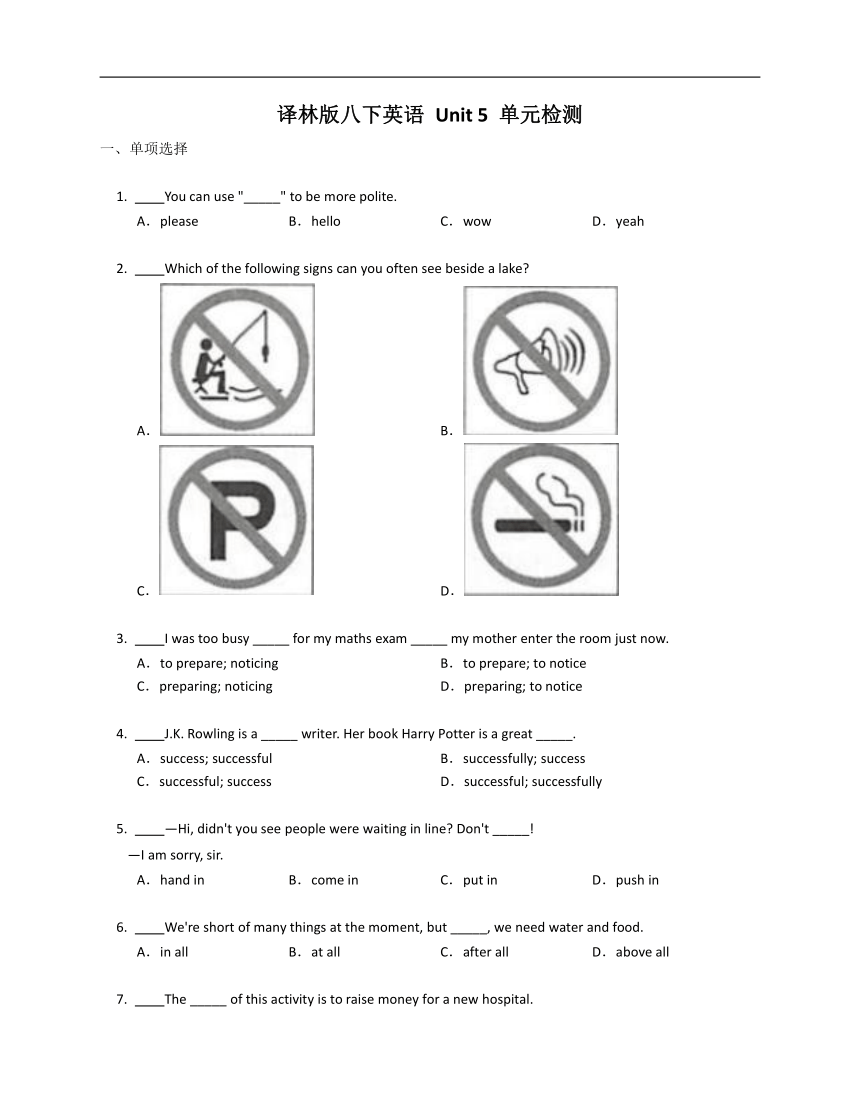
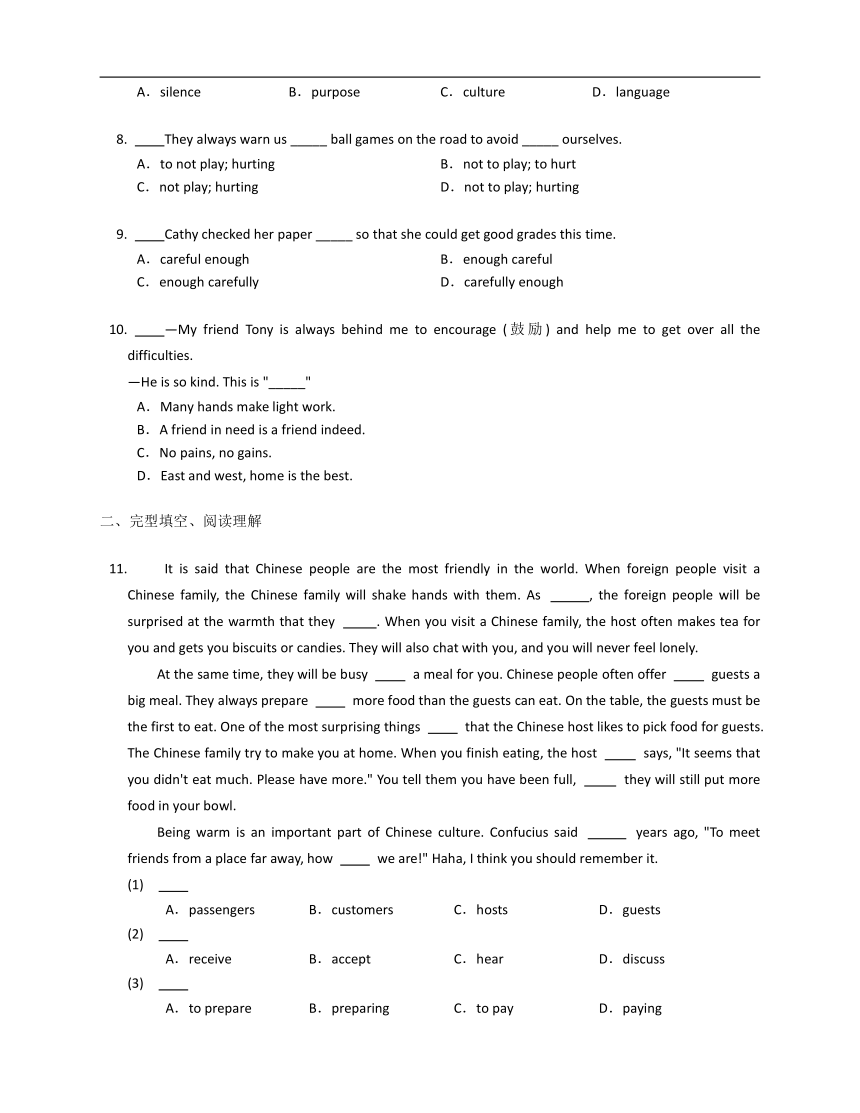
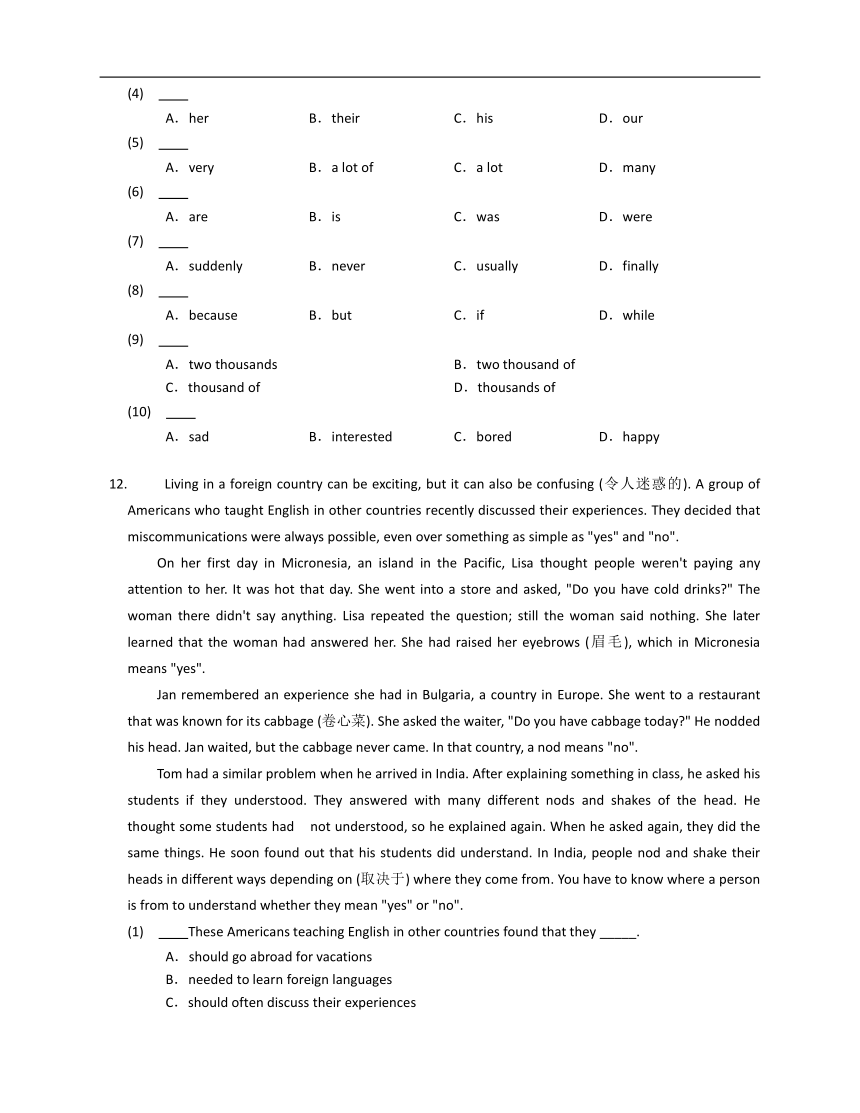
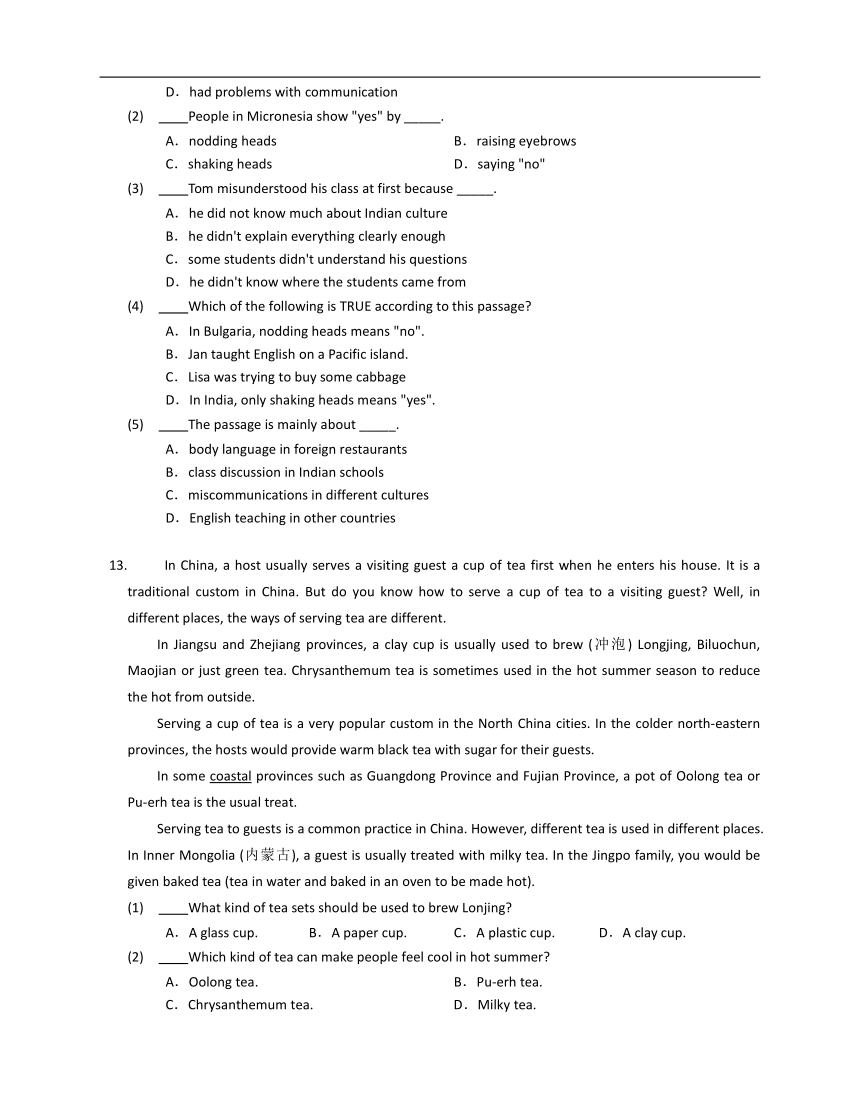
Which of the following signs can you often see beside a lake
A. B.
C. D.
I was too busy _____ for my maths exam _____ my mother enter the room just now.
A.to prepare; noticing B.to prepare; to notice
C.preparing; noticing D.preparing; to notice
J.K. Rowling is a _____ writer. Her book Harry Potter is a great _____.
A.success; successful B.successfully; success
C.successful; success D.successful; successfully
—Hi, didn't you see people were waiting in line Don't _____!
—I am sorry, sir.
A.hand in B.come in C.put in D.push in
We're short of many things at the moment, but _____, we need water and food.
A.in all B.at all C.after all D.above all
The _____ of this activity is to raise money for a new hospital.
A.silence B.purpose C.culture D.language
They always warn us _____ ball games on the road to avoid _____ ourselves.
A.to not play; hurting B.not to play; to hurt
C.not play; hurting D.not to play; hurting
Cathy checked her paper _____ so that she could get good grades this time.
A.careful enough B.enough careful
C.enough carefully D.carefully enough
—My friend Tony is always behind me to encourage (鼓励) and help me to get over all the difficulties.
—He is so kind. This is "_____"
A.Many hands make light work.
B.A friend in need is a friend indeed.
C.No pains, no gains.
D.East and west, home is the best.
二、完型填空、阅读理解
It is said that Chinese people are the most friendly in the world. When foreign people visit a Chinese family, the Chinese family will shake hands with them. As , the foreign people will be surprised at the warmth that they . When you visit a Chinese family, the host often makes tea for you and gets you biscuits or candies. They will also chat with you, and you will never feel lonely.
At the same time, they will be busy a meal for you. Chinese people often offer guests a big meal. They always prepare more food than the guests can eat. On the table, the guests must be the first to eat. One of the most surprising things that the Chinese host likes to pick food for guests. The Chinese family try to make you at home. When you finish eating, the host says, "It seems that you didn't eat much. Please have more." You tell them you have been full, they will still put more food in your bowl.
Being warm is an important part of Chinese culture. Confucius said years ago, "To meet friends from a place far away, how we are!" Haha, I think you should remember it.
(1)
A.passengers B.customers C.hosts D.guests
(2)
A.receive B.accept C.hear D.discuss
(3)
A.to prepare B.preparing C.to pay D.paying
(4)
A.her B.their C.his D.our
(5)
A.very B.a lot of C.a lot D.many
(6)
A.are B.is C.was D.were
(7)
A.suddenly B.never C.usually D.finally
(8)
A.because B.but C.if D.while
(9)
A.two thousands B.two thousand of
C.thousand of D.thousands of
(10)
A.sad B.interested C.bored D.happy
Living in a foreign country can be exciting, but it can also be confusing (令人迷惑的). A group of Americans who taught English in other countries recently discussed their experiences. They decided that miscommunications were always possible, even over something as simple as "yes" and "no".
On her first day in Micronesia, an island in the Pacific, Lisa thought people weren't paying any attention to her. It was hot that day. She went into a store and asked, "Do you have cold drinks " The woman there didn't say anything. Lisa repeated the question; still the woman said nothing. She later learned that the woman had answered her. She had raised her eyebrows (眉毛), which in Micronesia means "yes".
Jan remembered an experience she had in Bulgaria, a country in Europe. She went to a restaurant that was known for its cabbage (卷心菜). She asked the waiter, "Do you have cabbage today " He nodded his head. Jan waited, but the cabbage never came. In that country, a nod means "no".
Tom had a similar problem when he arrived in India. After explaining something in class, he asked his students if they understood. They answered with many different nods and shakes of the head. He thought some students had not understood, so he explained again. When he asked again, they did the same things. He soon found out that his students did understand. In India, people nod and shake their heads in different ways depending on (取决于) where they come from. You have to know where a person is from to understand whether they mean "yes" or "no".
(1) These Americans teaching English in other countries found that they _____.
A.should go abroad for vacations
B.needed to learn foreign languages
C.should often discuss their experiences
D.had problems with communication
(2) People in Micronesia show "yes" by _____.
A.nodding heads B.raising eyebrows
C.shaking heads D.saying "no"
(3) Tom misunderstood his class at first because _____.
A.he did not know much about Indian culture
B.he didn't explain everything clearly enough
C.some students didn't understand his questions
D.he didn't know where the students came from
(4) Which of the following is TRUE according to this passage
A.In Bulgaria, nodding heads means "no".
B.Jan taught English on a Pacific island.
C.Lisa was trying to buy some cabbage
D.In India, only shaking heads means "yes".
(5) The passage is mainly about _____.
A.body language in foreign restaurants
B.class discussion in Indian schools
C.miscommunications in different cultures
D.English teaching in other countries
In China, a host usually serves a visiting guest a cup of tea first when he enters his house. It is a traditional custom in China. But do you know how to serve a cup of tea to a visiting guest Well, in different places, the ways of serving tea are different.
In Jiangsu and Zhejiang provinces, a clay cup is usually used to brew (冲泡) Longjing, Biluochun, Maojian or just green tea. Chrysanthemum tea is sometimes used in the hot summer season to reduce the hot from outside.
Serving a cup of tea is a very popular custom in the North China cities. In the colder north-eastern provinces, the hosts would provide warm black tea with sugar for their guests.
In some coastal provinces such as Guangdong Province and Fujian Province, a pot of Oolong tea or Pu-erh tea is the usual treat.
Serving tea to guests is a common practice in China. However, different tea is used in different places. In Inner Mongolia (内蒙古), a guest is usually treated with milky tea. In the Jingpo family, you would be given baked tea (tea in water and baked in an oven to be made hot).
(1) What kind of tea sets should be used to brew Lonjing
A.A glass cup. B.A paper cup. C.A plastic cup. D.A clay cup.
(2) Which kind of tea can make people feel cool in hot summer
A.Oolong tea. B.Pu-erh tea.
C.Chrysanthemum tea. D.Milky tea.
(3) When you are visiting a friend in _____, you might be offered warm black tea with sugar.
A.Suzhou B.Changchun C.Hangzhou D.Guangzhou
(4) What does the underlined word "coastal" in Paragraph 4 mean
A.内陆的 B.边境的 C.沿海的 D.沿河的
(5) The passage is mainly about _____.
A.the ways of serving tea in China
B.different kinds of tea in China
C.the ways of drinking tea in China
D.the reasons for serving tea in China
In Britain you may often hear "Drop in any time" or "Come to see me soon", but you can't really do that. People just say those things to make you feel welcome. It is better to telephone before visiting someone at home. If you receive a written invitation to an event that says "RSVP", you should reply to let the person who sent the invitation know whether or not you plan to go.
You should never accept an invitation unless you really plan to go. You may refuse by saying, "Thank you for inviting me, but I will not be able to come." If after accepting, you are unable to go, be sure to tell those who are expecting you as soon as possible that you will not be there.
Though it is not necessarily expected that you give a gift to your host, it is considered polite to do so, especially if you have been invited for a meal. Flowers, chocolate, or a small gift are all appropriate (合适的). A thank-you note or telephone call after the visit is also considered polite and is an appropriate way to express your appreciation for the invitation.
(1) What can you do when a British friend says, "Drop in any time"
A.Visit him or her at any time.
B.Say no time to him or her seriously.
C.Visit him or her soon.
D.Telephone him or her before visiting.
(2) What does the underlined word "RSVP" probably mean in Chinese
A.请自便 B.请回复 C.请接受 D.请来访
(3) What should you do if your British friend sends you an invitation but you do not want to go
A.Do not give him or her an answer.
B.Tell another friend to go instead of you.
C.Tell him or her that you can't be there for some reason.
D.Tell him or her that you don't want to go there.
(4) Which of the following is considered impolite in Britain
A.Refuse the invitation without telling anyone.
B.Buy small presents when invited.
C.Write a thank-you note after a visit.
D.Give a telephone call after a visit.
(5) Where would you probably see this passage
A.In an invitation. B.In a guidebook.
C.On a poster. D.On a postcard.
三、根据提示填空
All of us should love our lives and (遵守) the traffic rules.
Bai Yansong and Wang Ning are famous (主持人) from CCTV.
He started a (对话) with her.
Can you (表达) yourself clearly in English, Wei Hua
What's the (目的) of the meeting Do you know
Can't you see the sign "No (park)"
Liu Xiaohua is a (success) singer as well as an actor.
After several hours of (discuss), they let the report through in the end.
Tom didn't mean to be (polite) when he shouted. He was just too excited.
Over the years I've come to the (conclude) that she's a very great musician.
我们应该避免打断别人说话。
这个演讲的目的是教我们如何学好外语。
你嘴里塞满东西说话是不礼貌的。
在公共场所请你压低声音说话。
不要到处乱扔垃圾。
Recently, a group of primary school students from Michigan, the US decided to write letters to their headmaster, Karyn Benner, asking if they could get a therapy dog for the school. Their actions led to something truly amazing!
Actually, the students explained in those letters why they thought a therapy dog would make a change to the school, which made the headmaster begin to think about this idea. Then she set out to visit some local dog shelters (收容所), hoping to find a perfect pup to surprise the students.
It was at the Humane Society of Muskegon County that Karyn met the right pup—Buddy. She at once knew he was the right dog for her school, so she decided to adopt (收养) him. Since then, Buddy has gone on to become a big presence(存在) in many of the kids' lives.
"Buddy cheers teachers up who have had a difficult moment," said Karyn. "When students show bad behavior, our teachers sometimes are unable to calm them down in a timely manner, but when Buddy comes in, the students just melt (融化) in a matter of minutes. When students are sad, Buddy often goes to them and lies next to them or brings them a toy to play," Karyn added.
Buddy made a big difference to the school so that Karyn decided to share his story with the Petco Foundation, in which hundreds of thousands of dollars were handed out as grants to support animal shelters and animal welfare organizations that need all the help they can get.
Karyn and her students help more animals in this way, which makes their school life more meaningful.
(1) How did students express their desire (愿望) for a therapy dog
(2) Where did Karyn Benner find Buddy
(3) What does the underlined sentence in Paragraph 4 mean
(4) Did Buddy only help students at school
(5) Why did Karyn decide to share Buddy's story
come, different, excite, go, good, live, loud, low, mean, nature, time, west
As an old saying goes, "When in Rome (罗马), do as the Romans do." I learned the of this when I studied in Russia.
One day I invited some of my Chinese friends to a famous local restaurant in Moscow. My guests and I were about visiting Red Square and happy about our meeting. We had a warm chat until the waiter told me that we were talking too loudly. We turned our voices . But this didn't last long. The waiter came over to us two more with the same message.
How bad an impression (印象) we must have left on the local people! In China, it's and important for a host to make a atmosphere (气氛). However, in Russia and countries, having a meal in a public place means you must keep your voice low. You need to be polite to others.
I felt bad about this. Even though we tried our , it was very difficult to develop a new habit in a short time.
Russians have their own special habits. My Russian friend, Andrey always looks around and thinks for a while before leaving home. I asked him why he did this. "Aha," Andrey said, "in Russia, people always take about a minute over things and plans in their minds before leaving. So they won't leave anything necessary behind."
Finding the between cultures is much fun. I'd like to keep my eyes and mind open.
(1)
(2)
(3)
(4)
(5)
(6)
(7)
(8)
(9)
(10)
四、写作
目前,你所在的学校正在积极参与创建全市文明校园活动,请你以校学生会的名义就“创建文明校园”这一主题,根据下列提示用英语写一封 80 词左右的倡议书。
要点提示如下:
1. 保持教室的整洁,不乱扔垃圾:
2. 不在公共场所大声喧哗,图书馆保持安静;
3. 遵守交通规则,排队等候;
4. 举止有礼,互帮互助:
5. ……
Dear schoolmates,
Our school is trying to be a better place for all of us. We know good manners are really important. And we can do something for it.
Let's start from ourselves!
The Students' Union
答案
1. 【答案】A
【解析】考察情景交际。句意:为了更有礼貌,你可以用“please”。please 用于客气地请求;hello 是打招呼用语;wow 表示惊奇或钦佩;yeah 常用于表示对别人的回应,故选 A。
2. 【答案】A
【解析】句意:下面哪个标志可以经常在湖边看到?选项 A 表示“禁止钓鱼”;选项 B 表示“禁止鸣笛”;选项 C 表示“禁止停车”;选项 D 表示“禁止吸烟”。故选 A。
3. 【答案】D
【解析】句意:我太忙着准备我的数学考试,没注意到我妈妈刚才进了房间。be busy doing sth. 意为“忙于做某事”;too…to… 意为“太……而不能……”,故选 D。
4. 【答案】C
【解析】句意:J.K. 罗琳是一位成功的作家。她的书《哈利·波特》非常成功。第一个空修饰名词 writer,故填形容词 successful;不定冠词 a 后面跟可数名词单数,故第二个空需要填名词 success。故答案选 C。
5. 【答案】D
【解析】句意:——喂,你没看到人们在排队吗?别插队!——对不起,先生。hand in 上交;come in 进来;put in 投入;push in 插队。根据句意可知选 D。
6. 【答案】D
【解析】句意:我们目前缺很多东西,但最重要的是,我们需要水和食物。above all 意为“最重要的是”。
7. 【答案】B
【解析】silence 沉默;purpose 目的;culture 文化;language 语言。由“为一所新医院筹集资金”可知,此处指“这个活动的目的”。故选 B。
8. 【答案】D
【解析】句意:他们总是警告我们不要在路上玩球类运动,以避免伤害我们自己。warn sb. not to do sth. 警告某人不要做某事;avoid doing sth. 避免做某事。
9. 【答案】D
【解析】句意:凯西足够认真地检查了她的试卷,以便她这次能取得好成绩。修饰动词短语“checked her paper”需要用副词 carefully,而 enough 通常放在被修饰的副词之后,故选 D。
10. 【答案】B
【解析】考查交际用语。句意:——我的朋友托尼总是在我身后鼓励、帮助我克服一切困难。——他是那么好。这就是“患难见真情。” A 项:人多好办事;B 项:患难见真情:C 项:不劳无获;D 项:金窝银窝,不如自家的草窝。故选 B。
11. 【答案】
(1) D
(2) A
(3) B
(4) B
(5) C
(6) B
(7) C
(8) B
(9) D
(10) D
【解析】
(1) 本文是一篇说明文。这篇短文介绍的是外国人在中国家庭做客时,受到中国家庭热情款待的情况。文章展示了一些中国人的待客之道和饮食习俗以及礼节。
考查名词的词义辨析。句意:作为客人,外国人会对他们所接收到的热情而感到惊讶。passenger 乘客;customer 顾客;host 主人;guest 客人。根据“When foreign people visit a Chinese family, the Chinese family will shake hands with them.”可知,外国人拜访中国的家庭,外国人应该是“客人”。
(2) 考查动词的词义辨析。receive 收到,受到;accept 接受;hear 听;discuss 讨论。根据“When you visit a Chinese family, the host often makes tea for you and gets you biscuits or candies. They will also chat with you, and you will never feel lonely.”可知,这里指外国人会“受到”热情款待。
(3) 考查动词的词义辨析和非谓语动词的用法。根据上文“When you visit a Chinese family, the host often makes tea for you and gets you biscuits or candies.”可知,在中国家庭做客,主人为客人提供茶、饼干或糖果之后,应该是开始“准备”饭菜,故用动词 prepare。固定用法:be busy doing sth. 意为“忙于做某事”。
(4) 考查代词的词义辨析。句意:中国人经常给他们的客人提供大餐。主语是 Chinese people,是复数名词短语,故此处应用形容词性物主代词 their,意为“他们的”。
(5) 句意:他们准备的食物总是比客人吃的多得多。very 意为“非常”,常用来修饰形容词或副词;a lot of 意为“许多”,修饰可数名词复数或不可数名词;a lot 意为“许多”,修饰形容词或副词的比较级;many 意为“许多”,修饰可数名词复数。由句中的 more food 可知,此处用 a lot。
(6) 考查主谓一致和动词的时态。句意:最令人惊讶的事情之一是中国主人喜欢为客人夹菜。one of… 意为“……之一”,作主语时,谓语动词要用单数形式,此处是陈述事实,故用一般现在时,用 is。
(7) 考查副词的词义辨析。句意:当你吃完后,主人通常会说“你好像没吃多少,请多吃点。”suddenly 突然;never 从不;usually 通常;finally 最后。根据“It seems that you didn't eat much, please have more.”及生活常识可知,这是中国人“通常”劝客人吃东西的说法,故用 usually。
(8) 考查连词的用法辨析。但他们还是会在你的碗里放更多的食物。because 因为;but 但是;if 如果;while 当……时。根据上文“你告诉他们你已经吃饱了”可知,空格前后分句之间是转折关系,应用 but 连接。
(9) 考查数词的用法辨析。thousand 意为“千”,其前有具体数字时,thousand 之后不加 -s,也不与 of 连用,故排除选项 A 和 B。thousands of 表示约数,意为“成千上万的”。
(10) 考查形容词的词义辨析。此处表示:有朋自远方来,不亦乐乎!sad 伤心的;interested 感兴趣的;bored 无聊的;happy 开心的,根据句意可知,此处表达的是开心的。
12. 【答案】
(1) D
(2) B
(3) A
(4) A
(5) C
【解析】
(1) 这篇短文主要讲述的是身处不同文化中时常发生的交流失败现象。
细节理解题。根据第一段中的“They decided that miscommunications were always possible”可知选 D。
(2) 细节理解题。根据第二段中的“She had raised her eyebrows, which in Micronesia means 'yes'.”可知选 B。
(3) 推理判断题。通读最后一段我们可以知道汤姆起初误解他的学生们是因为他对印度文化不了解。故选 A。
(4) 细节理解题。根据第三段中的“in Bulgaria”和“In that country, a nod means 'no'.”可知 A 是正确的。故选 A。
(5) 主旨大意题。这篇短文主要讲述的是身处不同文化中时发生的交流失败现象。故选 C。
13. 【答案】
(1) D
(2) C
(3) B
(4) C
(5) A
【解析】
(1) 本文是一篇说明文。文章介绍了中国一些地方给来访的客人上茶的方式和种类。
细节理解题。由文章第二段中“a clay cup is usually used to brew Longjing”可知,龙井茶是用陶土杯冲泡的。
(2) 细节理解题。根据文章第二段中“Chrysanthemum tea is sometimes used in the hot summer season to reduce the hot from outside.”可知,菊花茶在炎热的夏天能使人们感到凉爽。
(3) 推理判断题。根据第三段中“In the colder north-eastern provinces, the hosts would provide warm black tea with sugar for their guests.”可知,在更加寒冷的东北省份,主人为客人提供加糖的温红茶。长春是一个北方的寒冷的城市,所以主人为客人提供加糖的温红茶。
(4) 词义猜测题。根据画线词后“such as Guangdong Province and Fujian Province”以及广东和福建都是沿海省份,可知“coastal”表示“沿海的”意思。
(5) 主旨大意题。通读全文可知,这篇文章主要介绍了中国一些地方给客人上茶的方式。
14. 【答案】
(1) D
(2) B
(3) C
(4) A
(5) B
【解析】
(1) 本文是一篇说明文。短文主要介绍了关于在英国如何接受或拒绝邀请的一些文化习俗以及需要注意的问题。
细节理解题。由短文第一段的前三句可知,当英国朋友说“Drop in any time”时,只是为了让你感到受欢迎。你去之前最好打个电话,故选 D。
(2) 词义猜测题。根据第一段的最后一句“…you should reply to let the person who sent the invitation know whether or not you plan to go.”可知,你应该回复,让发出邀请的人知道你是否打算去。故选 B。
(3) 细节理解题。根据第二段中的“You may refuse by saying, ‘Thank you for inviting me, but I will not be able to come.' 你可以拒绝,说:‘谢谢你邀请我,但我不能来。’”可知选 C。
(4) 细节理解题。根据第二段中的“If after accepting, you are unable to go, be sure to tell those who are expecting you as soon as possible that you will not be there.”可知,如果拒绝了别人的邀请,又不告诉任何人,是不礼貌的。故选 A。
(5) 推理判断题。根据文章内容可知,这篇短文主要讲述了在英国社会交际中应该注意的一些问题,故最有可能出自一本生活指南,故选 B。
15. 【答案】obey
16. 【答案】hosts
17. 【答案】conversation
18. 【答案】express
19. 【答案】purpose
20. 【答案】parking
【解析】句意:难道你看不见“禁止停车”的标志吗?No parking 意为“禁止停车”。
21. 【答案】successful
【解析】句意:刘晓华是一名成功的歌手,也是一名成功的演员。结合语境可知,此处应填 success 的形容词形式,successful 意为“成功的”。
22. 【答案】discussion
【解析】句意:经过几个小时的讨论后,他们终于通过了这个报告。在介词 of 之后填 discuss 的名词形式 discussion,意为“讨论”。
23. 【答案】impolite
【解析】句意:当汤姆大喊时不是故意不礼貌的。他只是太兴奋了。polite 的反义词为impolite,意为“不礼貌的”。
24. 【答案】conclusion
【解析】句意:这些年来我得出的结论是她是一位非常伟大的音乐家。短语 come to the conclusion 意为“得出结论”。
25. 【答案】We should avoid cutting in on others.
26. 【答案】The purpose of the talk is to teach us how to learn foreign languages well.
27. 【答案】It's impolite of you to speak with your mouth full.
28. 【答案】When you speak in public, pleaase keep your voice down.
29. 【答案】Don't throw litter everywhere.
30. 【答案】
(1) By writing letters to their headmaster.
(2) At a local dog shelter./ At the Humane Society of Muskegon County.
(3) Buddy has become important to many kids.
(4) No./ No, it also helped teachers.
(5) She wanted to call on people to help animals.
【解析】
(1) 本文是一篇新闻报道。短文介绍了美国密歇根州的一所学校收养了一只治疗犬,对学生和老师都有所帮助。
由短文首句“Recently, a group of primary school students…decided to write letters to their headmaster…get a therapy dog for the school.”可知学生们是写信给校长表达愿望。
(2) 由第二段最后一句“Then she set out to visit some local dog shelters”或第三段第一句“It was at the Humane Society of Muskegon County that Karyn met the right pup—Buddy.”可知答案。
(3) 原句句意“从那时起,Buddy 就成了很多孩子们生活中的一个重要的存在”,说明 Buddy 对于孩子们很重要。
(4) 通读短文第四段可知,Buddy 不仅对孩子很重要,它也能帮助老师。
(5) 通读短文第五段可推知,Karyn 分享 Buddy 的故事,目的是希望人们帮助动物。
31. 【答案】
(1) meaning
(2) excited
(3) lower
(4) times
(5) natural
(6) lively
(7) Western
(8) best
(9) to go
(10) differences
【解析】
(1) 本文是一篇记叙文。文章主要讲述的是作者和他的一些中国朋友在莫斯科的一家饭店就餐时,因为说话声音太大,给当地人留下了不好的印象,从而告诉我们去外国旅游或学习时,要入乡随俗,尊重当地的风俗习惯。
联系上下文可知,作者通过在俄罗斯学习期间的一次亲身经历体会到“入乡随俗”这句话的含义。故用名词 meaning,意为“含义”。
(2) 联系下文的“happy about our meeting”可判断他们对于参观红场感到很激动。故用形容词 excited,意为“激动的;兴奋的”。
(3) 联系 上文“服务员告诉我,我们说话声音太大了”可判断,我们压低说话声。故用形容词 low 的比较级 lower,意为“(声音)更低的”。
(4) 由上句“但是这种情况没有持续太长时间”可判断,服务员又出于同一种目的提醒了我们两次。故用名词 time 的复数形式 times,意为“次”。
(5) 句意:在中国(用餐时),对于东道主来说,营造一种活跃的气氛是正常且重要的。名词 nature 意为“自然”,这里用其形容词形式 natural,意为“自然的;正常的”。
(6) 联系下文“必须压低说话声”,并结合“However (然而)”可判断,这里指“活跃的气氛”,故用形容词 lively,意为“活跃的”。
(7) Western countries 意为“西方国家”。
(8) 固定短语 try one's best 意为“尽某人最大努力”。句意:尽管我们已经尽最大努力了,但短时间内养成一个新的习惯是很难的。
(9) 在俄罗斯,人们在离开之前,总是花费大约一分钟的时间来仔细检查一下他们脑海中的事情和计划。固定用法“take+时间+to do sth.” 意为“花一段时间做某事”。
(10) 句意:发现文化之间的差异是很有趣的。用形容词 different 的名词复数形式 differences,意为“不同;差异”。
32. 【答案】Dear schoolmates,
Our school is trying to be a better place for all of us. We know good manners are really important. And we can do something for it.
In order to make our school more beautiful, we should keep our classrooms clean every day. Remember not to drop litter everywhere. And we should remember not to laugh or talk loudly in public places. When we are in the library, we must keep quiet. It's also important to follow traffic rules everywhere and queue for our turn. We should always behave politely and help each other. Good manners make our school better, as well as us.
Let's start from ourselves!
The Students' Union

展开更多......

收起↑

资源预览