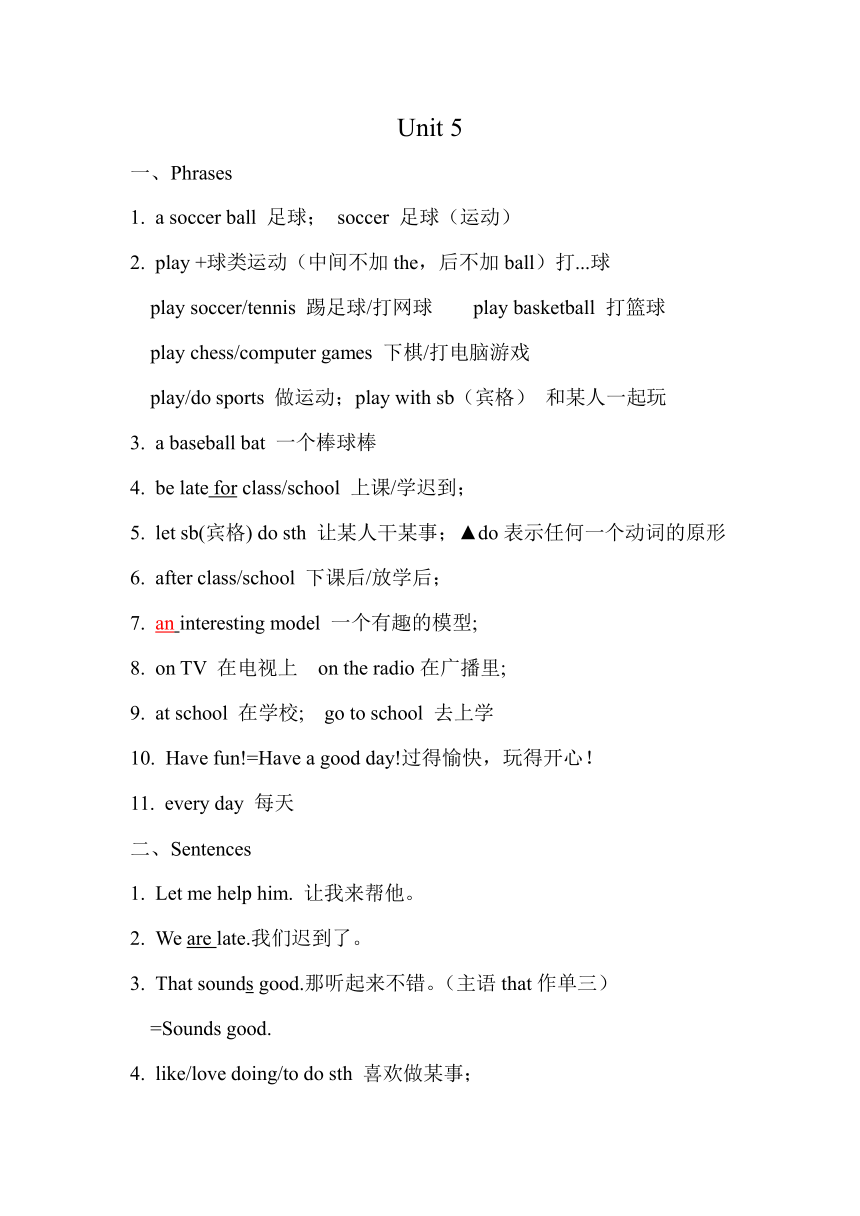
资源简介 Unit 5Phrasesa soccer ball 足球; soccer 足球(运动)play +球类运动(中间不加the,后不加ball)打...球play soccer/tennis 踢足球/打网球 play basketball 打篮球play chess/computer games 下棋/打电脑游戏play/do sports 做运动;play with sb(宾格) 和某人一起玩a baseball bat 一个棒球棒be late for class/school 上课/学迟到;let sb(宾格) do sth 让某人干某事;▲do表示任何一个动词的原形after class/school 下课后/放学后;an interesting model 一个有趣的模型;on TV 在电视上 on the radio在广播里;at school 在学校; go to school 去上学Have fun!=Have a good day!过得愉快,玩得开心!every day 每天SentencesLet me help him. 让我来帮他。We are late.我们迟到了。That sounds good.那听起来不错。(主语that作单三)=Sounds good.like/love doing/to do sth 喜欢做某事;I like playing /to play sports. 我喜欢做运动。We are in the same class. 我们在同一个班。(same前必须加the)We like the same color. 我们喜欢同样的颜色。It’s +adj+for sb(宾格)+to do.做某事对某人来说怎么样It’s easy/difficult for me to watch TV.看电视对我来说很容易/难。Grammar动词和介词(of, for, with, about, in, on, under, after, at)后人称用宾格。with带有I go to the library with my schoolbag . 我带着书包去图书馆。和...一起Tom plays ping-pong with his friend. Tom和他的朋友一起打乒乓球。 =Tom and his friend play ping-pong.▲ and /with 和 ,区别如下:and 作连词,并列词语和句子;前后词语地位相等with 作介词,后跟名词或代词(代词用宾格);前后词语地位不等Tom and Mary are in the room. (Tom和Mary是主语,都是主角)Tom with Mary is in the room. (Tom是主语,主角,Mary不是主语,配角)look/see/watchlook 强调“看”这个动作,后+at表示“看....”; look at the planesee强调“看”得结果,表示“看到...”watch后加电视节目或者比赛,表示“观看”。疑问句和否定句中,用动词原形。▲Eg: He has a watch.He doesn’t have a watch.Does he have a watch 5.▲ 动词句变一般疑问句口诀:一加二改三问号, 动词变原形一加:在句首加do/does, 主语是单三加does, 不是加do。二改:句中“我”改成“你”。(I/we—you; my—your; our—your )谓语动词改原形三问号:句尾加问号Eg: 1) I have a cat.Do you have a cat 主语非单三,加doHe likes blue.Does he like blue 主语单三,加does动词句变否定句口诀:在主语和动词之间加don’t或doesn't, 动词变原形。▲Eg: 1) I have a cat.I don’t have a cat.主语非单三,加don’tHe likes blue.He doesn’t like blue.主语单三,加doesn’t 展开更多...... 收起↑ 资源预览
 资源预览
资源预览
 资源预览
资源预览