牛津译林版(2019)选修一Unit 1 Food matters Grammar and Usage & Integrated Skills教案

资源下载
  1. 二一教育资源

牛津译林版(2019)选修一Unit 1 Food matters Grammar and Usage & Integrated Skills教案

资源简介

Unit 1 Food Matters
Grammar and Usage & Integrated Skills 教学设计
教学目标与核心素养:
知识目标:确定被动语态在过去进行时和过去完成时的用法;学习过去进行时和过去完成时的被动语态规则;
能力目标:使用正确的时态完成相关的任务;
情感目标:在新的语境中使用过去进行时和过去完成时的被动语态。
教学重难点
教学重点:确定被动语态在过去进行时和过去完成时的用法;学习过去进行时和过去完成时的被动语态规则;
教学难点:在新的语境中使用过去进行时和过去完成时的被动语态。
课前准备:多媒体,黑板,粉笔
教学过程:
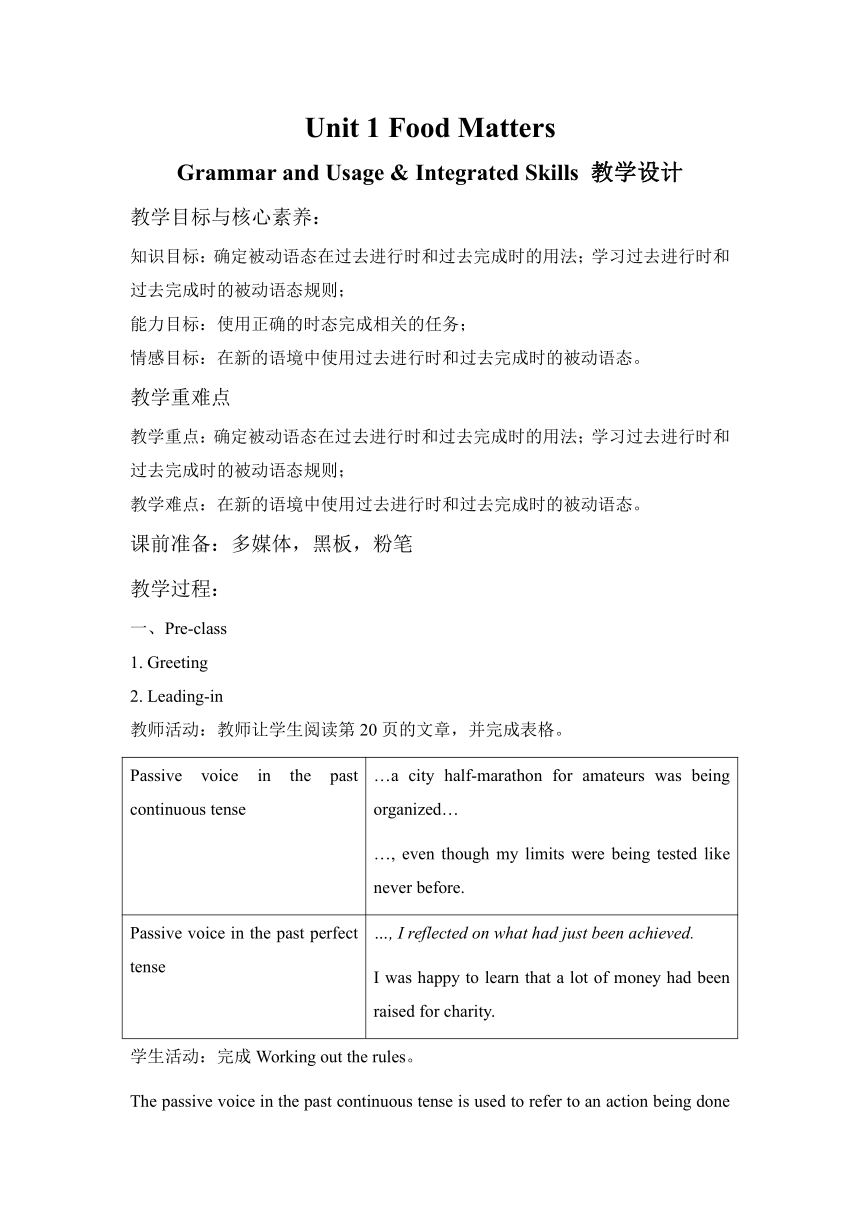
一、Pre-class
1. Greeting
2. Leading-in
教师活动:教师让学生阅读第20页的文章,并完成表格。
Passive voice in the past continuous tense …a city half-marathon for amateurs was being organized… …, even though my limits were being tested like never before.
Passive voice in the past perfect tense …, I reflected on what had just been achieved. I was happy to learn that a lot of money had been raised for charity.
学生活动:完成Working out the rules。
The passive voice in the past continuous tense is used to refer to an action being done at a specific time in the past. The verb form is "___________"
The passive voice in the past perfect tense is used to express an action completed before a past time. The verb form is"___________"
答案:was/were being done;had been done
二、While-class
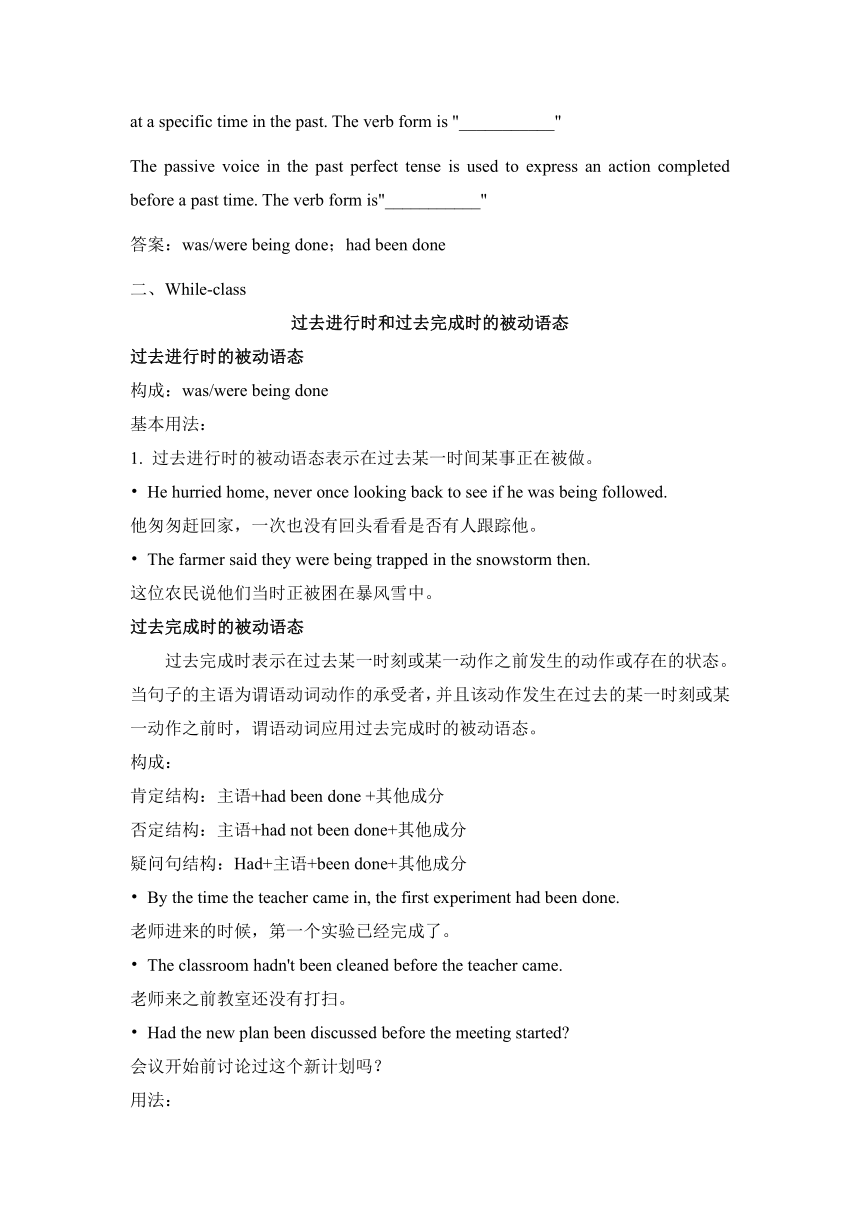
过去进行时和过去完成时的被动语态
过去进行时的被动语态
构成:was/were being done
基本用法:
1. 过去进行时的被动语态表示在过去某一时间某事正在被做。
He hurried home, never once looking back to see if he was being followed.
他匆匆赶回家,一次也没有回头看看是否有人跟踪他。
The farmer said they were being trapped in the snowstorm then.
这位农民说他们当时正被困在暴风雪中。
过去完成时的被动语态
过去完成时表示在过去某一时刻或某一动作之前发生的动作或存在的状态。当句子的主语为谓语动词动作的承受者,并且该动作发生在过去的某一时刻或某一动作之前时,谓语动词应用过去完成时的被动语态。
构成:
肯定结构:主语+had been done +其他成分
否定结构:主语+had not been done+其他成分
疑问句结构:Had+主语+been done+其他成分
By the time the teacher came in, the first experiment had been done.
老师进来的时候,第一个实验已经完成了。
The classroom hadn't been cleaned before the teacher came.
老师来之前教室还没有打扫。
Had the new plan been discussed before the meeting started
会议开始前讨论过这个新计划吗?
用法:
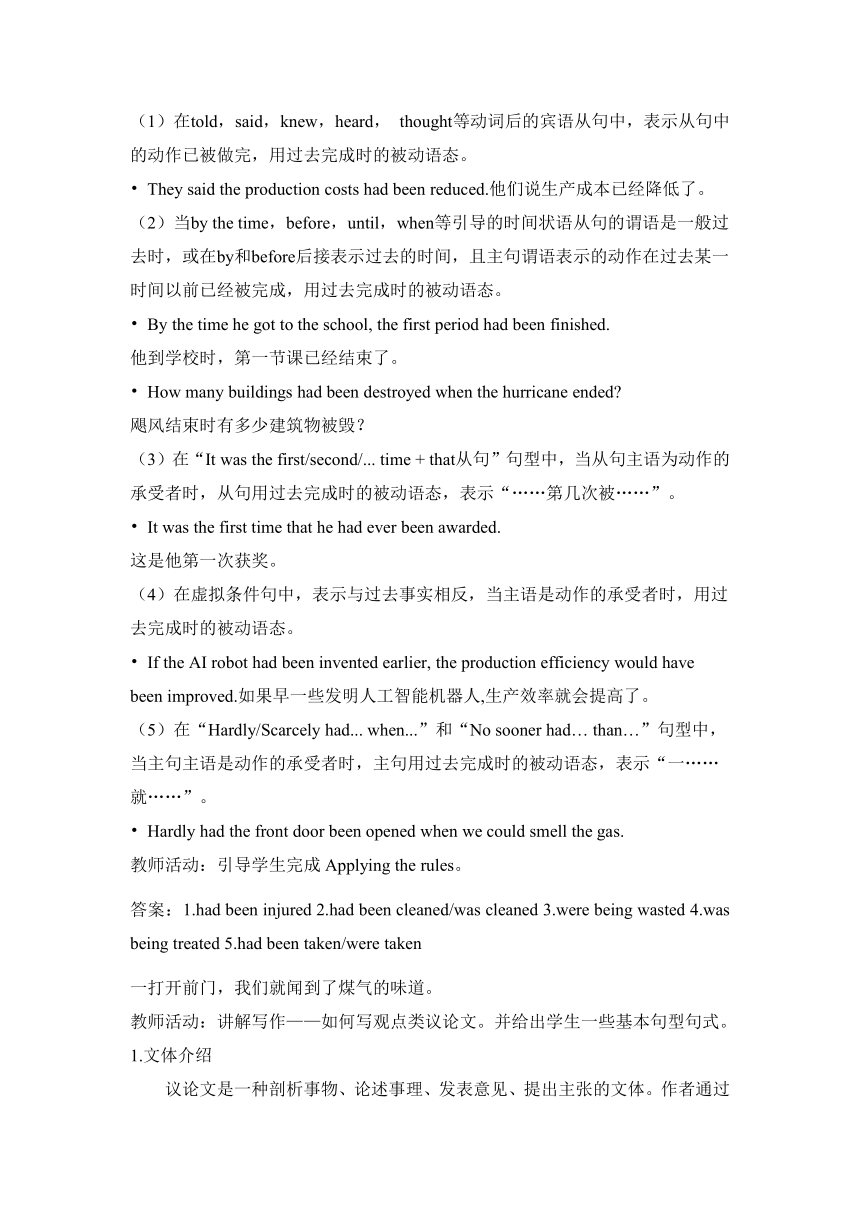
(1)在told,said,knew,heard, thought等动词后的宾语从句中,表示从句中的动作已被做完,用过去完成时的被动语态。
They said the production costs had been reduced.他们说生产成本已经降低了。
(2)当by the time,before,until,when等引导的时间状语从句的谓语是一般过去时,或在by和before后接表示过去的时间,且主句谓语表示的动作在过去某一时间以前已经被完成,用过去完成时的被动语态。
By the time he got to the school, the first period had been finished.
他到学校时,第一节课已经结束了。
How many buildings had been destroyed when the hurricane ended
飓风结束时有多少建筑物被毁?
(3)在“It was the first/second/... time + that从句”句型中,当从句主语为动作的承受者时,从句用过去完成时的被动语态,表示“……第几次被……”。
It was the first time that he had ever been awarded.
这是他第一次获奖。
(4)在虚拟条件句中,表示与过去事实相反,当主语是动作的承受者时,用过去完成时的被动语态。
If the AI robot had been invented earlier, the production efficiency would have been improved.如果早一些发明人工智能机器人,生产效率就会提高了。
(5)在“Hardly/Scarcely had... when...”和“No sooner had… than…”句型中,当主句主语是动作的承受者时,主句用过去完成时的被动语态,表示“一……就……”。
Hardly had the front door been opened when we could smell the gas.
教师活动:引导学生完成Applying the rules。
答案:1.had been injured 2.had been cleaned/was cleaned 3.were being wasted 4.was being treated 5.had been taken/were taken
一打开前门,我们就闻到了煤气的味道。
教师活动:讲解写作——如何写观点类议论文。并给出学生一些基本句型句式。
1.文体介绍
议论文是一种剖析事物、论述事理、发表意见、提出主张的文体。作者通过摆事实、讲道理、辨是非,来确定文章论述观点正确与否,以此树立或否定某种观点。
议论文文体的三要素包括论点、论据和论证。论点即作者对所论述的问题所持的见解和主张,通常在首段点明论点;论据是用来证明论点的事实和道理的根据;论证就是用论据来说明论点的方法和过程。
在写议论文时,应注意使论点鲜明,论据充分。在说明道理时,时态通常用一般现在时;若是通过生活中的实例来举例分析,时态则可用一般过去时。
2.篇章结构
议论文一般可分为三个部分:
第一部分:导入——引出话题,点明观点;
第二部分:主体——给出论据,说明理由;
第三部分:结尾——总结全文,重述文章观点。
3.常用表达
(1)常用过渡词及短语
表示递进:what's more/in addition/besides/furthermore/moreover(另外,而且)
表示因果:therefore/thus(因此),as a result/consequently(结果是)
表示举例:for example/for instance/take...for example/such as(比如)
表示转折:but/however(但是),instead(而不是;相反),on the contrary(正相反),on the one hand...on the other hand...(一方面……另一方面……)
表示时间顺序:now/at present(目前),at the same time/inthe meantime(与此同时),later/after a while/afterwards(后来),finally/at last/eventually(最终)
表示让步:nevertheless/still(虽然如此,尽管如此)
表示总结:in conclusion/in a word/in short/to sum up/allin all(总而言之)
(2)表达个人观点的句式
I do agree with...but…我确实赞同……,但是……
I definitely believe… 我绝对相信……
Personally, I feel that…个人来看,我觉得……
I can't agree more with… 我非常赞同……
As far as I am concerned,… 在我看来,……
学生活动:播放音频,学生听完后完成B1。
答案:FFTT
学生活动:再次听音频,完成B2。
答案:(1) (2) a month (3) ten years/a decade (4) 249
(5) lifetime achievement (6) long-range shots
学生活动:根据Daniel找到的文章,回答如下问题。
Q1. Why does the author say “at any sporting event, you face two opponents”
Because on the one hand, sportspeople have to compete with their fellow players, and on the other, they must compete with themselves. But in both cases they must make the right decisions to play fair and with dignity.
Q2. Why was Monti awarded the Pierre de Coubertin Fair Play Trophy
Monti helped a British competitor who had broken a part of his bobsleigh by lending him the same part of his own. It was a remarkable, unselfish decision, which sets an example to us all.
Q3. Would you do the same if you were Monti Why or why not
Yes, I would do the same as Monti because as an athlete, I would feel responsible to demonstrate good sportsmanship, which is also in the spirit of the Olympic Games. Besides, as I would have to live with my decision, I would feel good because I played fair and helped a fellow athlete.
三、After-class
学生活动:练习写作,小组评判并展示
目前,全国很多高中都在课后开展阳光体育活动(sunshine sports)。请你给校英文报写一篇短文,分享你对高中开展阳光体育活动的看法。要点包括:
1.阳光体育活动的内容(gymnastics, Tai Chi, running exercises等);
2.此活动的好处;
3.支持开展此活动。
注意:1.词数80左右;
2.可以适当增加细节,以使行文连贯。
四、Summary
重点语法:掌握过去进行时和过去完成时的被动语态规则
写作讲解:掌握观点类议论文写作方法
五、Homework
Completing after-school exercises.

展开更多......

收起↑

资源预览