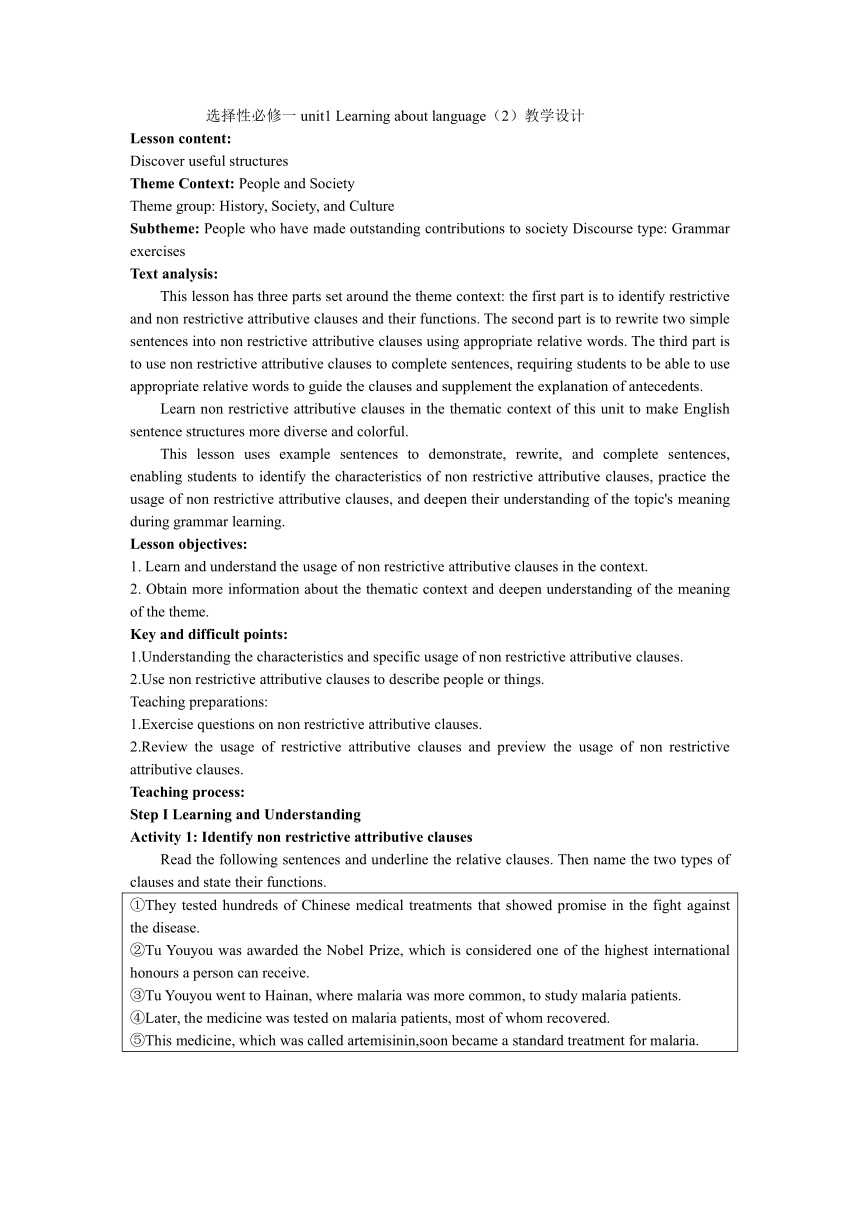
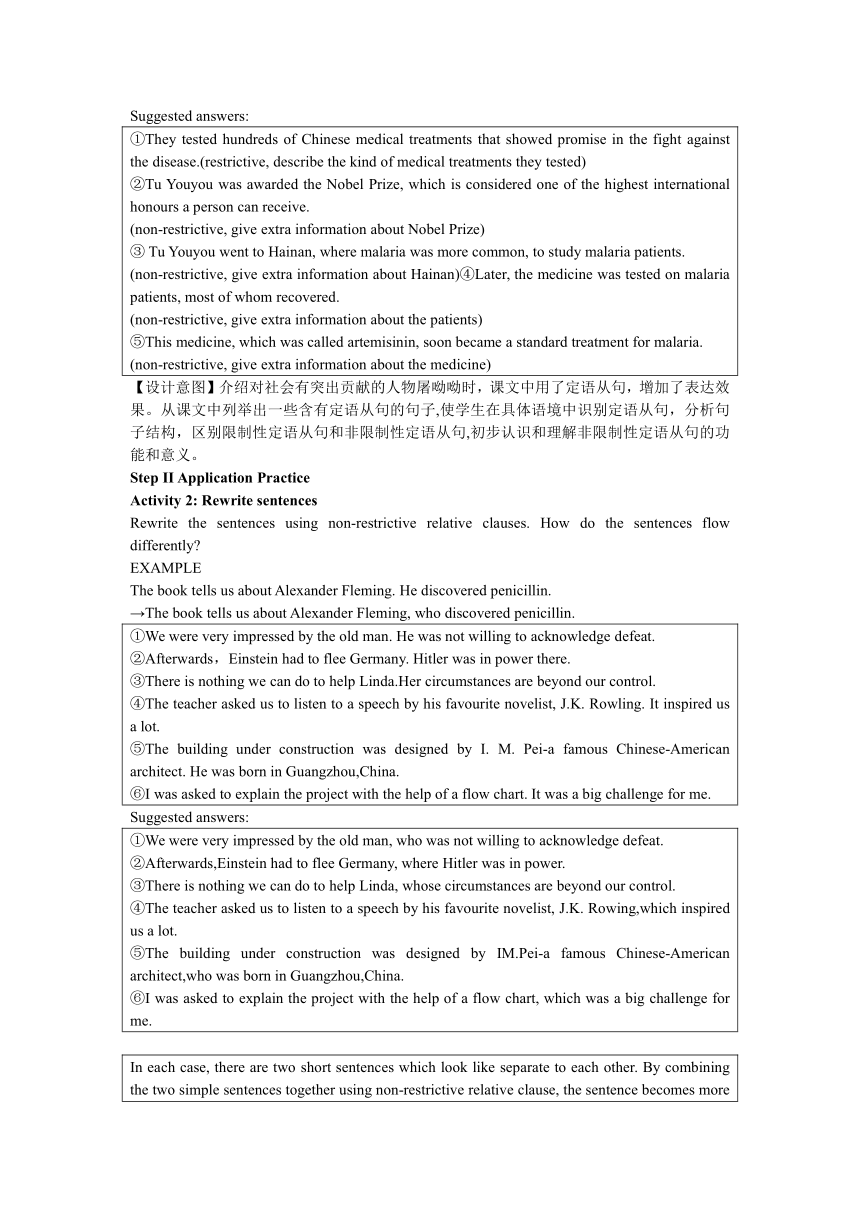
资源简介 选择性必修一unit1 Learning about language(2)教学设计Lesson content:Discover useful structuresTheme Context: People and SocietyTheme group: History, Society, and CultureSubtheme: People who have made outstanding contributions to society Discourse type: Grammar exercisesText analysis:This lesson has three parts set around the theme context: the first part is to identify restrictive and non restrictive attributive clauses and their functions. The second part is to rewrite two simple sentences into non restrictive attributive clauses using appropriate relative words. The third part is to use non restrictive attributive clauses to complete sentences, requiring students to be able to use appropriate relative words to guide the clauses and supplement the explanation of antecedents.Learn non restrictive attributive clauses in the thematic context of this unit to make English sentence structures more diverse and colorful.This lesson uses example sentences to demonstrate, rewrite, and complete sentences, enabling students to identify the characteristics of non restrictive attributive clauses, practice the usage of non restrictive attributive clauses, and deepen their understanding of the topic's meaning during grammar learning.Lesson objectives:1. Learn and understand the usage of non restrictive attributive clauses in the context.2. Obtain more information about the thematic context and deepen understanding of the meaning of the theme.Key and difficult points:1.Understanding the characteristics and specific usage of non restrictive attributive clauses.2.Use non restrictive attributive clauses to describe people or things.Teaching preparations:1.Exercise questions on non restrictive attributive clauses.2.Review the usage of restrictive attributive clauses and preview the usage of non restrictive attributive clauses.Teaching process:Step I Learning and UnderstandingActivity 1: Identify non restrictive attributive clausesRead the following sentences and underline the relative clauses. Then name the two types of clauses and state their functions.①They tested hundreds of Chinese medical treatments that showed promise in the fight against the disease. ②Tu Youyou was awarded the Nobel Prize, which is considered one of the highest international honours a person can receive. ③Tu Youyou went to Hainan, where malaria was more common, to study malaria patients. ④Later, the medicine was tested on malaria patients, most of whom recovered. ⑤This medicine, which was called artemisinin,soon became a standard treatment for malaria.Suggested answers:①They tested hundreds of Chinese medical treatments that showed promise in the fight against the disease.(restrictive, describe the kind of medical treatments they tested) ②Tu Youyou was awarded the Nobel Prize, which is considered one of the highest international honours a person can receive. (non-restrictive, give extra information about Nobel Prize) ③ Tu Youyou went to Hainan, where malaria was more common, to study malaria patients. (non-restrictive, give extra information about Hainan)④Later, the medicine was tested on malaria patients, most of whom recovered. (non-restrictive, give extra information about the patients) ⑤This medicine, which was called artemisinin, soon became a standard treatment for malaria. (non-restrictive, give extra information about the medicine)【设计意图】介绍对社会有突出贡献的人物屠呦呦时,课文中用了定语从句,增加了表达效果。从课文中列举出一些含有定语从句的句子,使学生在具体语境中识别定语从句,分析句子结构,区别限制性定语从句和非限制性定语从句,初步认识和理解非限制性定语从句的功能和意义。Step II Application PracticeActivity 2: Rewrite sentencesRewrite the sentences using non-restrictive relative clauses. How do the sentences flow differently EXAMPLEThe book tells us about Alexander Fleming. He discovered penicillin.→The book tells us about Alexander Fleming, who discovered penicillin.①We were very impressed by the old man. He was not willing to acknowledge defeat. ②Afterwards,Einstein had to flee Germany. Hitler was in power there. ③There is nothing we can do to help Linda.Her circumstances are beyond our control. ④The teacher asked us to listen to a speech by his favourite novelist, J.K. Rowling. It inspired us a lot. ⑤The building under construction was designed by I. M. Pei-a famous Chinese-American architect. He was born in Guangzhou,China. ⑥I was asked to explain the project with the help of a flow chart. It was a big challenge for me.Suggested answers:①We were very impressed by the old man, who was not willing to acknowledge defeat. ②Afterwards,Einstein had to flee Germany, where Hitler was in power. ③There is nothing we can do to help Linda, whose circumstances are beyond our control. ④The teacher asked us to listen to a speech by his favourite novelist, J.K. Rowing,which inspired us a lot. ⑤The building under construction was designed by IM.Pei-a famous Chinese-American architect,who was born in Guangzhou,China. ⑥I was asked to explain the project with the help of a flow chart, which was a big challenge for me.In each case, there are two short sentences which look like separate to each other. By combining the two simple sentences together using non-restrictive relative clause, the sentence becomes more varied and has better flow.【设计意图】通过分析两个简单句中相同的部分,然后使用恰当的关系词将其中一个相同部分替换,从句前加逗号,从而将两个简单句改写成非限制性定语从句,以此让学生在练习中感受、总结出选择非限制性定语从句关系词的技巧并正确使用。Step III Transfer InnovationActivity 3: Situational ApplicationWork in plete the sentences using non- restrictive relative clauses to give extra information. Then share them with your group members.EXAMPLEI'd like to try..., ….→I’d like to try that Chinese herbal medicine again, which seems to work best for my cough.①I would like to travel around.…., …. ②What impressed me most..., …. ③My favourite scientist is..., .…. ④Finally we arrived at..., ... ⑤My grandparents like.…., …. ⑥I wish to obtain..., ... ⑦My best friend..., ..Suggested answers: ①I would like to travel around Sichuan Province, where Jiuzhaigou locates. ②What impressed me most about the film was the ending, which was quite moving. ③My favourite scientist is Nikola Tesla, who was quite brilliant but also had some crazy ideas. ④Finally we arrived at the zoo, which was closed for repairs. ⑤My grandparents like going for outings in spring, which is good for their health. ⑥I wish to obtain a driving licence, which is necessary if you want to drive a car. ⑦My best friend came to visit last week,which was the first time I had seen him in years.【设计意图】在学习和练习了非限制性定语从句的用法之后,把语法置入现实生活情景中,学生结合自己的具体情况,用非限制性定语从句补全句子,在特定的语境中使用、理解非限制性定语从句,表达自己的想法,这加深了对非限制性定语从句用法的理解,改变了单纯的语法练习,提高了学生学习语法的兴趣。 展开更多...... 收起↑ 资源预览
 资源预览
资源预览
 资源预览
资源预览