中考英语语法复习名词数词感叹句(无答案)

资源下载
  1. 二一教育资源

中考英语语法复习名词数词感叹句(无答案)

资源简介

名词、数词、感叹句
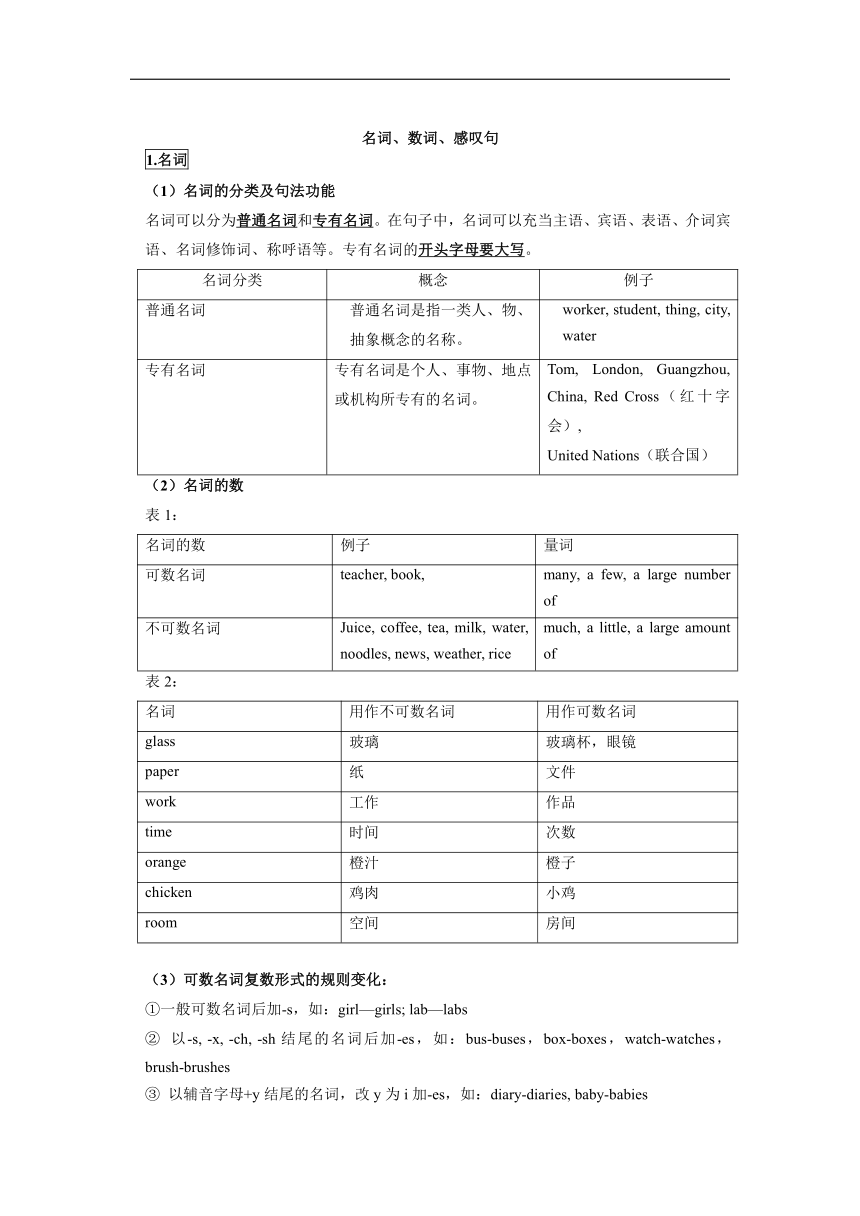
1.名词
(1)名词的分类及句法功能
名词可以分为普通名词和专有名词。在句子中,名词可以充当主语、宾语、表语、介词宾语、名词修饰词、称呼语等。专有名词的开头字母要大写。
名词分类 概念 例子
普通名词 普通名词是指一类人、物、抽象概念的名称。 worker, student, thing, city, water
专有名词 专有名词是个人、事物、地点或机构所专有的名词。 Tom, London, Guangzhou, China, Red Cross(红十字会),United Nations(联合国)
(2)名词的数
表1:
名词的数 例子 量词
可数名词 teacher, book, many, a few, a large number of
不可数名词 Juice, coffee, tea, milk, water, noodles, news, weather, rice much, a little, a large amount of
表2:
名词 用作不可数名词 用作可数名词
glass 玻璃 玻璃杯,眼镜
paper 纸 文件
work 工作 作品
time 时间 次数
orange 橙汁 橙子
chicken 鸡肉 小鸡
room 空间 房间
(3)可数名词复数形式的规则变化:
①一般可数名词后加-s,如:girl—girls; lab—labs
② 以-s, -x, -ch, -sh结尾的名词后加-es,如:bus-buses,box-boxes,watch-watches,brush-brushes
③ 以辅音字母+y结尾的名词,改y为i加-es,如:diary-diaries, baby-babies
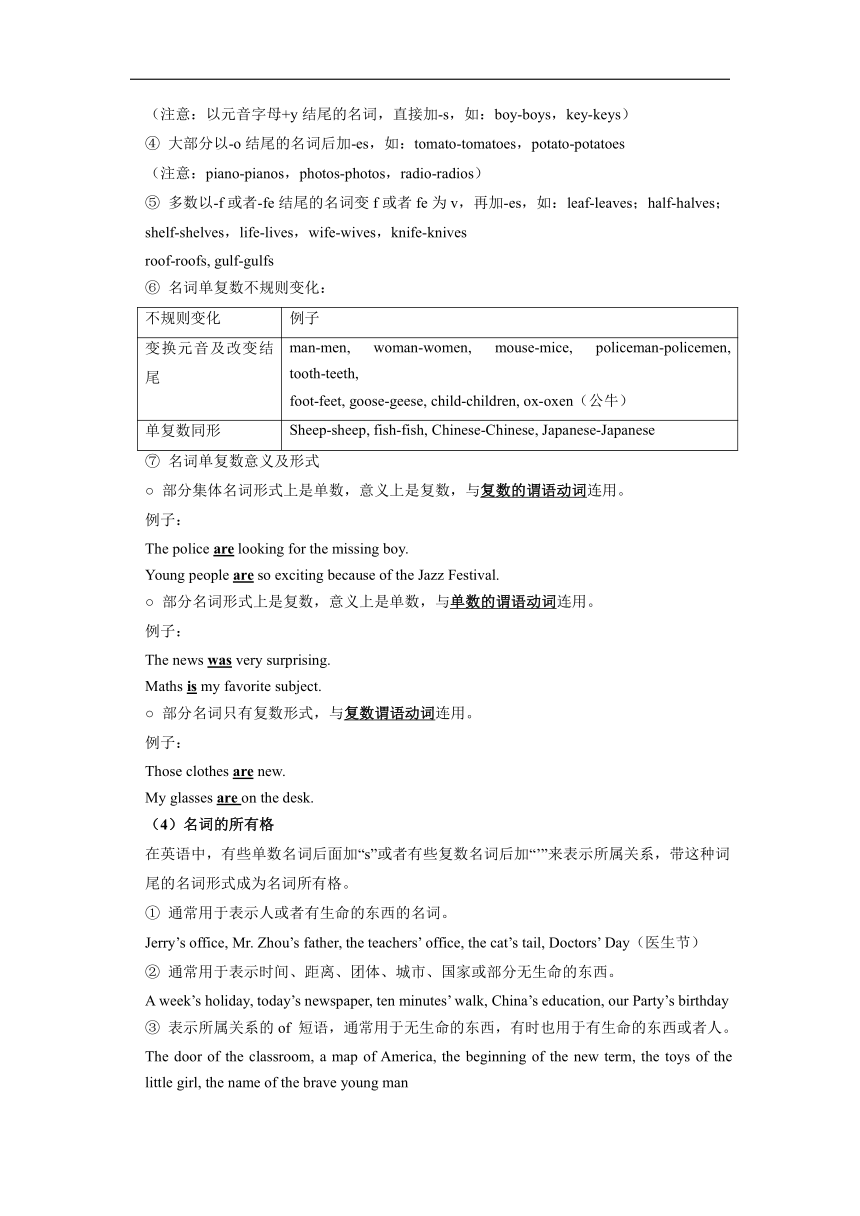
(注意:以元音字母+y结尾的名词,直接加-s,如:boy-boys,key-keys)
④ 大部分以-o结尾的名词后加-es,如:tomato-tomatoes,potato-potatoes
(注意:piano-pianos,photos-photos,radio-radios)
⑤ 多数以-f或者-fe结尾的名词变f或者fe为v,再加-es,如:leaf-leaves;half-halves;
shelf-shelves,life-lives,wife-wives,knife-knives
roof-roofs, gulf-gulfs
⑥ 名词单复数不规则变化:
不规则变化 例子
变换元音及改变结尾 man-men, woman-women, mouse-mice, policeman-policemen, tooth-teeth,foot-feet, goose-geese, child-children, ox-oxen(公牛)
单复数同形 Sheep-sheep, fish-fish, Chinese-Chinese, Japanese-Japanese
⑦ 名词单复数意义及形式
○ 部分集体名词形式上是单数,意义上是复数,与复数的谓语动词连用。
例子:
The police are looking for the missing boy.
Young people are so exciting because of the Jazz Festival.
○ 部分名词形式上是复数,意义上是单数,与单数的谓语动词连用。
例子:
The news was very surprising.
Maths is my favorite subject.
○ 部分名词只有复数形式,与复数谓语动词连用。
例子:
Those clothes are new.
My glasses are on the desk.
(4)名词的所有格
在英语中,有些单数名词后面加“s”或者有些复数名词后加“’”来表示所属关系,带这种词尾的名词形式成为名词所有格。
① 通常用于表示人或者有生命的东西的名词。
Jerry’s office, Mr. Zhou’s father, the teachers’ office, the cat’s tail, Doctors’ Day(医生节)
② 通常用于表示时间、距离、团体、城市、国家或部分无生命的东西。
A week’s holiday, today’s newspaper, ten minutes’ walk, China’s education, our Party’s birthday
③ 表示所属关系的of 短语,通常用于无生命的东西,有时也用于有生命的东西或者人。
The door of the classroom, a map of America, the beginning of the new term, the toys of the little girl, the name of the brave young man
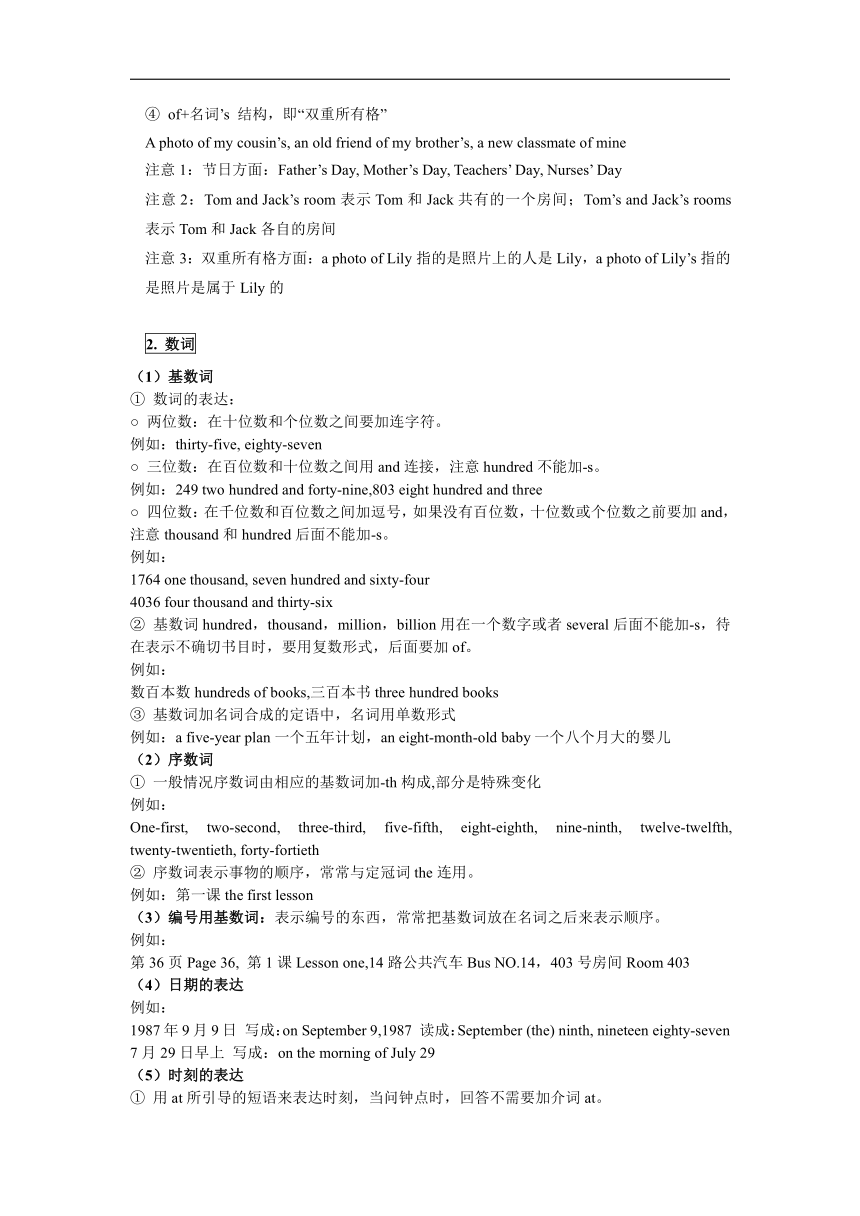
④ of+名词’s 结构,即“双重所有格”
A photo of my cousin’s, an old friend of my brother’s, a new classmate of mine
注意1:节日方面:Father’s Day, Mother’s Day, Teachers’ Day, Nurses’ Day
注意2:Tom and Jack’s room表示Tom和Jack共有的一个房间;Tom’s and Jack’s rooms表示Tom和Jack各自的房间
注意3:双重所有格方面:a photo of Lily指的是照片上的人是Lily,a photo of Lily’s指的是照片是属于Lily的
2. 数词
(1)基数词
① 数词的表达:
○ 两位数:在十位数和个位数之间要加连字符。
例如:thirty-five, eighty-seven
○ 三位数:在百位数和十位数之间用and连接,注意hundred不能加-s。
例如:249 two hundred and forty-nine,803 eight hundred and three
○ 四位数:在千位数和百位数之间加逗号,如果没有百位数,十位数或个位数之前要加and,注意thousand和hundred后面不能加-s。
例如:
1764 one thousand, seven hundred and sixty-four
4036 four thousand and thirty-six
② 基数词hundred,thousand,million,billion用在一个数字或者several后面不能加-s,待在表示不确切书目时,要用复数形式,后面要加of。
例如:
数百本数hundreds of books,三百本书three hundred books
③ 基数词加名词合成的定语中,名词用单数形式
例如:a five-year plan一个五年计划,an eight-month-old baby一个八个月大的婴儿
(2)序数词
① 一般情况序数词由相应的基数词加-th构成,部分是特殊变化
例如:
One-first, two-second, three-third, five-fifth, eight-eighth, nine-ninth, twelve-twelfth, twenty-twentieth, forty-fortieth
② 序数词表示事物的顺序,常常与定冠词the连用。
例如:第一课the first lesson
(3)编号用基数词:表示编号的东西,常常把基数词放在名词之后来表示顺序。
例如:
第36页Page 36, 第1课Lesson one,14路公共汽车Bus NO.14,403号房间Room 403
(4)日期的表达
例如:
1987年9月9日 写成:on September 9,1987 读成:September (the) ninth, nineteen eighty-seven
7月29日早上 写成:on the morning of July 29
(5)时刻的表达
① 用at所引导的短语来表达时刻,当问钟点时,回答不需要加介词at。
例如:
Annie goes to school at seven.
What time is it It’s six.
② 表示“几点过几分”(30分钟之内)用介词past
例如:
两点十三分2:13 表达成:thirteen past two
③ 表示“几点差几分”用介词to
例如:
五点五十五分 5:55 表达成:five to six
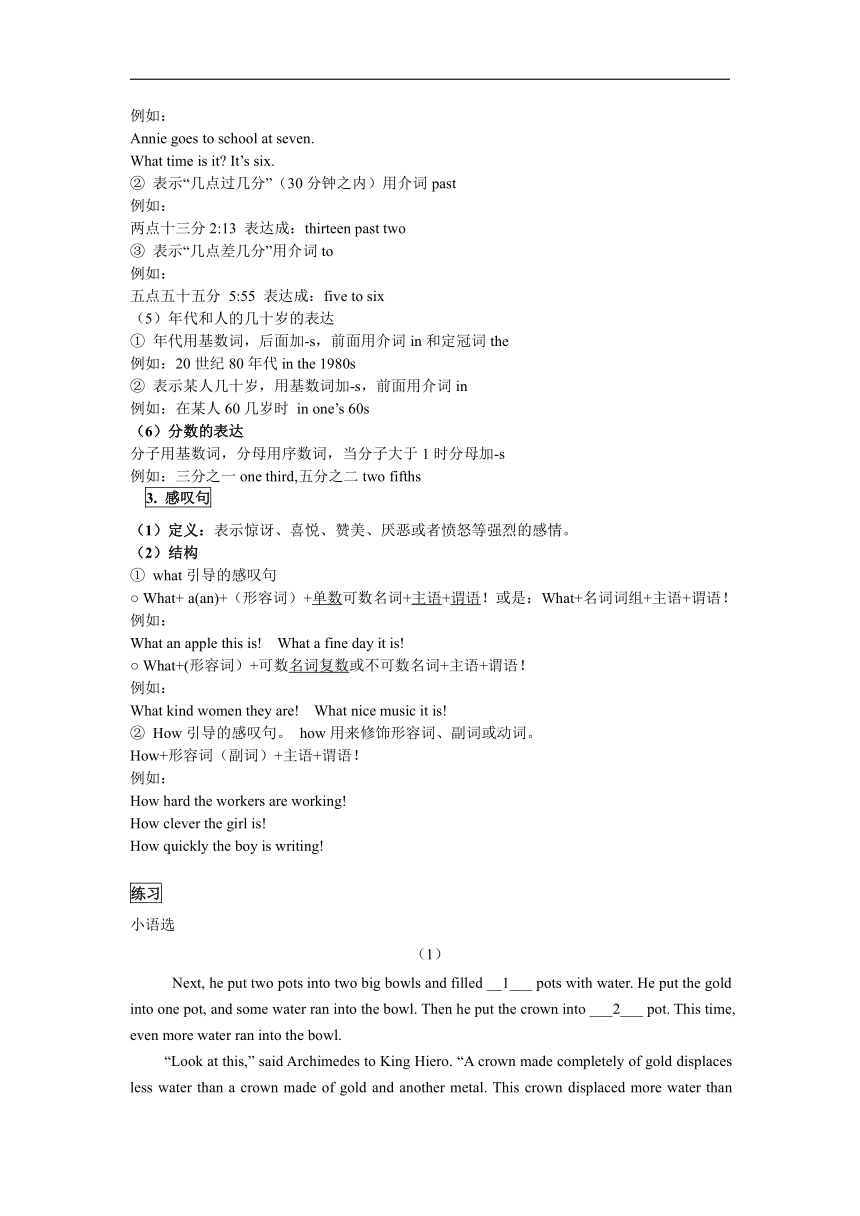
(5)年代和人的几十岁的表达
① 年代用基数词,后面加-s,前面用介词in和定冠词the
例如:20世纪80年代in the 1980s
② 表示某人几十岁,用基数词加-s,前面用介词in
例如:在某人60几岁时 in one’s 60s
(6)分数的表达
分子用基数词,分母用序数词,当分子大于1时分母加-s
例如:三分之一one third,五分之二two fifths
3. 感叹句
(1)定义:表示惊讶、喜悦、赞美、厌恶或者愤怒等强烈的感情。
(2)结构
① what引导的感叹句
○ What+ a(an)+(形容词)+单数可数名词+主语+谓语!或是:What+名词词组+主语+谓语!
例如:
What an apple this is! What a fine day it is!
○ What+(形容词)+可数名词复数或不可数名词+主语+谓语!
例如:
What kind women they are! What nice music it is!
② How引导的感叹句。 how用来修饰形容词、副词或动词。
How+形容词(副词)+主语+谓语!
例如:
How hard the workers are working!
How clever the girl is!
How quickly the boy is writing!
练习
小语选
(1)
Next, he put two pots into two big bowls and filled __1___ pots with water. He put the gold into one pot, and some water ran into the bowl. Then he put the crown into ___2___ pot. This time, even more water ran into the bowl.
“Look at this,” said Archimedes to King Hiero. “A crown made completely of gold displaces less water than a crown made of gold and another metal. This crown displaced more water than gold of the same weight, so I’m certain that it’s not completely made of gold.
“The crown maker tricked me, didn’t he ___3____ he is!” shouted King Hiero. He then sent the crown maker to prison.
A. both B. either C. all D. every
A. the others B. other C. the other D. another
A. What a bad man B. What bad man C. How a bad man D. How bad man
(2)
At the university, Hans was guided to the front of the hall. Einstein took a seat, listened to Hans give his lecture without difficulty, and joined in ___1____ at the end.
However, before Hans left, a man shouted, “I’d like to ask you a question.”He then asked a question so difficult that Hans ____2____ what he was talking about.
Einstein turned pale. “Oh, no!” he thought. “Now we’re in trouble.” But Hans just laughed and said, “That’s ___3___ that even my driver can answer it. Hans, Please……
1.A. an applause B. the applause C. the applauses D. applause
2.A. had an idea B. had some idea C. had no idea D. had idea
3.A. so an easy question B. such easy an question C. such an easy question D. so easy an question
(3)
In 2010, something very strange happened in a small Australian town. ___1___ fish began falling from the sky! People called their friends to tell them about the strange event, but nobody believed it.
There have been ___2___ of “raining animals all over the world.
1.A. Hundreds of B. A few hundreds C. A few hundred of D. Hundreds of
2.A. an similar event B. similar events C. similar event D. similar event
语法选择
(1)
In 2010, something very strange happened in a small Australian town. ___1___ fish began falling from the sky! People called their friends to tell them about ___2___ strange event, but nobody believed it.
There have been similar events of "raining animals" all over the world. It ___3___ in Singapore, Canada, the Philippines, and other places. Usually the falling animals are fish, but sometimes other animals have fallen from the sky. In 2009, the animals ___4___ fell from the sky in Japan were frogs. In Hungary in 2010 frogs ___5___ to fall from the sky, too. Throughout history there have also been reports of falling jellyfish, spiders and worms.
You probably won't be surprised to know that this kind of event ___6___ cause a lot of panic(恐慌). When this happens, people often believe that the world is going to end, or that something ___7___ is happening. However, although this seems crazy and impossible, we now know ___8___ fish and other animals sometimes fall from the sky.
The answer ___9___ this question is the weather. Sometimes, tornado(龙卷风)sucks up water from ponds, rivers and oceans. When this happens, the tornado often sucks up fish and other animals ___10___. The tornado carries these unlucky animals for a short distance, and then drops them in ___11___ place. When fish fall from the sky, they are often still alive ___12___ tornado doesn't carry the fish very far.
Scientists have never been able ___13___ this theory, so we can't be sure that it's completely correct. However, almost everyone ___14___ that weather causes the raining animals.
___15___ some photographs if you are outside and it starts to rain animals. Otherwise, how can anyone else believe you
( ) 1. A. Hundreds of B. A few hundreds C. A few hundred of D. Hundreds of
( ) 2. A. a B. an C. / D. the
( ) 3. A. happen B. happens C. happened D. was happened
( ) 4. A. who B. that C. what D. /
( ) 5. A. saw B. seen C. were seen D. were seeing
( ) 6. A. can B. must C. need D. should
( ) 7. A. terror B. terribly C. more terrible D. terrible
( ) 8. A. when B. where C. why D. how
( ) 9. A. to B. with C. of D. how
( ) 10. A. also B. as well C. either D. as well as
( ) 11. A. other B. another C. the other D. others
( ) 12. A. because B. so C. but D. although
( ) 13. A. test B. testing C. to test D. tested
( ) 14. A. agree B. agrees C. agreed D. to agree
( ) 15. A. Take B. Taking C. To take D. Have taken
(2)
In China, almost everyone knows Ma Yun. Ma Yun became one of ___1___ men in China. His company Alibaba went on the stock(股票)market last year with a value of £140 billion ---- the largest public offering in history. ___2___ amazing thing it is! Here are some stories about him on the way to ___3___.
Ma made his ___4___ trip to the US in 1995 and used the Internet ___5___ the first time. After ___6___ for "beer", he saw that no results ___7___ up about China. Then he searched for "China" and still saw no results. He decided to set up a Chinese website ---- the seed for Alibaba was sown(播种).
Ma said he ___8___ many times in his life. He failed the College Entrance Examination in China three times and ___9___ companies offered him jobs, including one at KFC. And the famous Harvard University refused him 10 times.
Learning English was difficult when Ma was a teenager ___10___ limited resources. However, he found that he could learn English well by giving tourists free guides around ___11___ hometown Hangzhou. And he kept it for nine years. Ma said that tourists opened up a new world for him because everything they said and did was so different from ___12___ he had been taught at school and by his parents.
Ma's hero is Forest Gump ___13___ never gives up. When he made a speech about his success at Davos(达沃斯论坛)in 2015, Ma said, "Life ___14___ a box of chocolate because you never know what you are going to get". ___15___ as Ma does, never give up and you will be successful one day.
( ) 1. A. rich B. the richest C. most rich D. most richest
( ) 2. A. How a B. How an C. What a D. What an
( ) 3. A. success B. succeed C. successful D. successfully
( ) 4. A. one B. first C. the first D. once
( ) 5. A. at B. in C. on D. for
( ) 6. A. search B. searched C. searching D. to search
( ) 7. A. come B. comes C. came D. coming
( ) 8. A. refuse B. refused C. was refused D. was refusing
( ) 9. A. a few B. few C. little D. a little
( ) 10. A. because B. because of C. as D. so
( ) 11. A. he B. him C. his D. himself
( ) 12. A. what B. that C. which D. when
( ) 13. A. what B. which C. / D. who
( ) 14. A. like B. likes C. is liked D. is like
( ) 15. A. Do B. Doing C. Does D. Did
(3)
There ___1___ many things we need to know that we do not learn at school. ___2___, if we want to use our money wisely, we need to shop ___3___. We need to know how ___4___ the prices of the things in different shops. We need to be able to compare the quality of different brands(品牌). We need to know how to make ___5___ choice when we shop.
___6___ how to make such choices is a "life skill", and we need these skills if we like to live useful and ___7___ lives.
Some of these choices are small. For example: Will I take an apple ___8___ a pear for lunch Will I go to school by bus or on foot Will I wear the red T-shirt or the blue one to the movies ___9___ choices are more important. For example: Will I eat ___10___ food or will I eat junk food because it is ___11___ Will I work hard in all my classes or will I only work hard in the classes I enjoy We make choices like this every day.
We have realized ___12___ the choices we make can affect(影响)the rest of ___13___ lives. Just as importantly, our choices can also affect other people. The next time you decide to waste time in class, play a joke ___14___ someone or talk loudly in the library, think about this: ___15___ does your choice affect
( ) 1. A. is B. are C. was D. were
( ) 2. A. For example B. As example C. Such as D. Like
( ) 3. A. care B. cares C. careful D. carefully
( ) 4. A. compare B. to compare C. compared D. comparing
( ) 5. A. / B. a C. an D. the
( ) 6. A. Know B. To know C. Knowing D. Knew
( ) 7. A. happy B. unhappy C. happily D. happiness
( ) 8. A. and B. but C. or D. as well as
( ) 9. A. Another B. The other C. Others D. Other
( ) 10. A. health B. unhealthy C. healthy D. an health
( ) 11. A. taste B. tasty C. tastier D. more tasty
( ) 12. A. that B. when C. how D. where
( ) 13. A. we B. our C. us D. ours
( ) 14. A. on B. with C. by D. at
( ) 15. A. What other B. What else C. Who other D. Who else
完成句子
1. 好新的电脑呀! _____ _______ computer it is!
2. 看!多么漂亮的花呀! Look ! ______ _______ flowers!
3. 好厌烦的电影啊! ______ the film is!
4. 多么聪明的男孩啊! ______ ______ ______boy he is!
5. 你的衣服好漂亮呀! _______ _______ your clothes are!
6. 好刺激的NBA球赛呀! _______ the NBA games are !
7. 多么有趣的一本书啊! _______ _______ _______ book it is !
8. 你妹妹好甜呀! _____ _______ your sister is !
9. 他们工作得好努力呀! _____ ______they work !
10.---Kate只有5岁的时候就会游泳了。---多么聪明的女孩啊!
---Kate could swim when she was only 5 years old. --- _____ _______ the girl is!

展开更多......

收起↑

资源预览