外研版(2019)选择性必修第一册 Unit 1 Laugh out Loud! 单元教学设计(表格式)

资源下载
  1. 二一教育资源

外研版(2019)选择性必修第一册 Unit 1 Laugh out Loud! 单元教学设计(表格式)

资源简介

Book 4 Unit 1 Laugh out Loud!教学设计
Unit theme The theme context of this unit is "man and self", and the theme context involved is a positive attitude towards life. This unit has a variety of articles, including questionnaire, narrative, dialogue, essays, blog and so on. Starting from a video of comedy history, this unit, in turn, presents the self questionnaire, the story of the clown doctor, the British humorous story, Mark Twain and Lin Yutang life humor story, Charlie Chaplin characters introduce learning content, from multiple angles expounds the topics related to the positive attitude towards life, aims to help students to better manage their emotions, always keep happy mood, with a positive attitude to face life, set up the correct attitude towards life.
Unit target Students were able to follow around the thematic context content of this unit, Based on the questionnaire, narrative, dialogue, argumentative essays, blog and other multimodal discourse provided by the unit, Using a variety of language skills, Read the introduction to the humorous characters and their experiences, Understand and talk about topics related to humor, Use appropriate words and expressions to tell humorous stories, Introducing the comedians, Understand the humorous qualities of outstanding Chinese and foreign characters, Deepen the understanding of the meaning of the unit theme; Also be able to be able to use what the unit has learned, By comparison, by analysis, With their own reality, Create and perform talk shows and humdramas, Develop a positive and optimistic attitude towards life, Explore the mysteries of happiness, Establish a positive outlook on life, Realize the expansion and migration of knowledge and thinking ability; Ability to use various learning strategies, In the process of independent learning, cooperative learning and inquiry learning, Combine the reflective and evaluative problems to continuously monitor, evaluate, reflect on and adjust the learning content and process provided by the unit, Stimulate the interest in English learning, Improve your ability to analyze and solve problems, Improve your understanding and expression skills, Finally, to promote the comprehensive improvement of their own language ability, cultural consciousness, thinking quality and learning ability.
Starting out板块教学设计 (建议时长10–15分钟,教师可根据教学实际酌情调整。)
lesson type Viewing + Speaking
Theme context People and self —— positive attitude towards life
[电] content analysis There are two activities in this section. Activity 1 presents a video about the history of comedy, which introduces the origin, development, representative figures and types of comedy, and clarifies that although comedy is influenced by The Times and different cultures, the joy brought by comedy to people remains unchanged. Activity 2 is a questionnaire, asking students to choose their own treatment methods in different situations, to help students to form a preliminary understanding of their own individual characteristics.
instructional objectives At the end of this section, students can: Understand the general idea of the theme of the video, quickly extract the key information from the video, such as the origin, development, representative characters, types, etc., and introduce the theme; Based on their own daily life and divergent thinking, they can understand the jokes of different comedies under different cultural backgrounds, activate students' existing background knowledge and language knowledge, and stimulate their interest in topics; By making questionnaires, I can understand myself, express my personal views on the topic according to the dimensions of "with myself" and "with others", and summarize what individual characteristics are reflected in different processing methods in different situations.
key teaching points;focal point Guide students to initially understand the origin, development, representatives, types of comedy, and contact the actual life and their own experience, understand the different comedy jokes under different cultural backgrounds, so as to pave the way and warm up for the learning activities of the whole unit.
difficult point in teaching Guide the students to know themselves and express their personal views on the topic.
instructional strategies Audio-visual teaching method, communicative teaching method
Teaching contents Procedures Purposes
Teacher’s activity Students’ activity
Activity 1 Teacher plays the video and asks students to pay attention to the key information. Teacher plays the video again and asks students to answer the first question. Teacher asks students to check the answer with the class. Teacher asks students to answer the second question. Students watch the video and pay attention to the key information. Students answer the first question and check the answer. Students answer the second question. To arouse students’ interest and have students think about the differences of people’s cognition of comedy in different cultures and different times.
Activity 2 Teacher asks students to read the questionnaire. Teacher asks students to complete the questionnaire and discuss the results. Teacher asks students to check their results on page 84 to see whether they are the same with their analyses. Students read the questionnaire. Students complete the questionnaire and discuss the results. Students check their results on page 84 to see whether they are the same with their analyses. To make students reflect on themselves and establish a correct attitude towards life.
Understanding ideas板块教学设计 (建议时长30–35分钟,教师可根据教学实际酌情调整。)
课型 Reading
主题语境 People and self —— positive attitude towards life
内容分析 The type of the text in this section is narrative, which tells the story of a clown doctor through magic, singing, telling stories and telling jokes to relieve the pain of patients. While reading the text, students can increase their knowledge, enrich their life experience, and realize the importance of having a positive life attitude of "helping others". In the introduction activity before reading, please look at the pictures and find out where you can see the clown, aiming to activate the students' existing knowledge of the clown and pave the way for the appearance of the clown doctor in the text. In the reading activity, please find out the special place of the clown doctor's work, and echo with the pre-reading activity. After reading, the activities help students through the matching of paragraphs and questions, explore the significance of the theme, cultivate students' logical thinking and critical thinking, and guide students to construct a multi-cultural perspective.
教学目标 At the end of this section, students can: Understand the job responsibilities and work methods of the clown doctor; Master the language knowledge in the text through the context, look up the dictionary and the teacher's explanation, and further understand the meaning of the text; Through understanding the content of the text, deepen the understanding of the meaning of the theme, and form a positive, optimistic and smiling attitude towards life.
教学重点 Guide the students to read the text, understand the author's writing intention, and the clown doctor's job responsibilities and work methods; Guide students to master the language knowledge in the text through the context, dictionary and teacher explanation, and deeply understand the meaning of the text.
教学难点 Guide students to think deeply about the work of the clown doctor, and form a positive and optimistic attitude towards life.
教学策略 P-W-P模式
Teaching contents Procedures Purposes
Teacher’s activity Students’ activity
Activity 1 Teacher asks students to look at the pictures and predict where a clown can be seen. Teacher invites some students to share what they know about clowns. Teacher asks students to predict the content of the text according to the pictures and the title. Students look at the pictures and predict where a clown can be seen. Some students share what they know about clowns with the class. Students predict the content of the text according to the pictures and the title. To have students get to know the background information about clowns. To prepare students for reading.
Activity 2 Teacher asks students to read the passage quickly and find out what is special about the clown’s job. Teacher asks students to answer the questions. Students read the passage quickly and find out what is special about the clown’s job. Students answer the questions. To lead students to the reading of the passage.
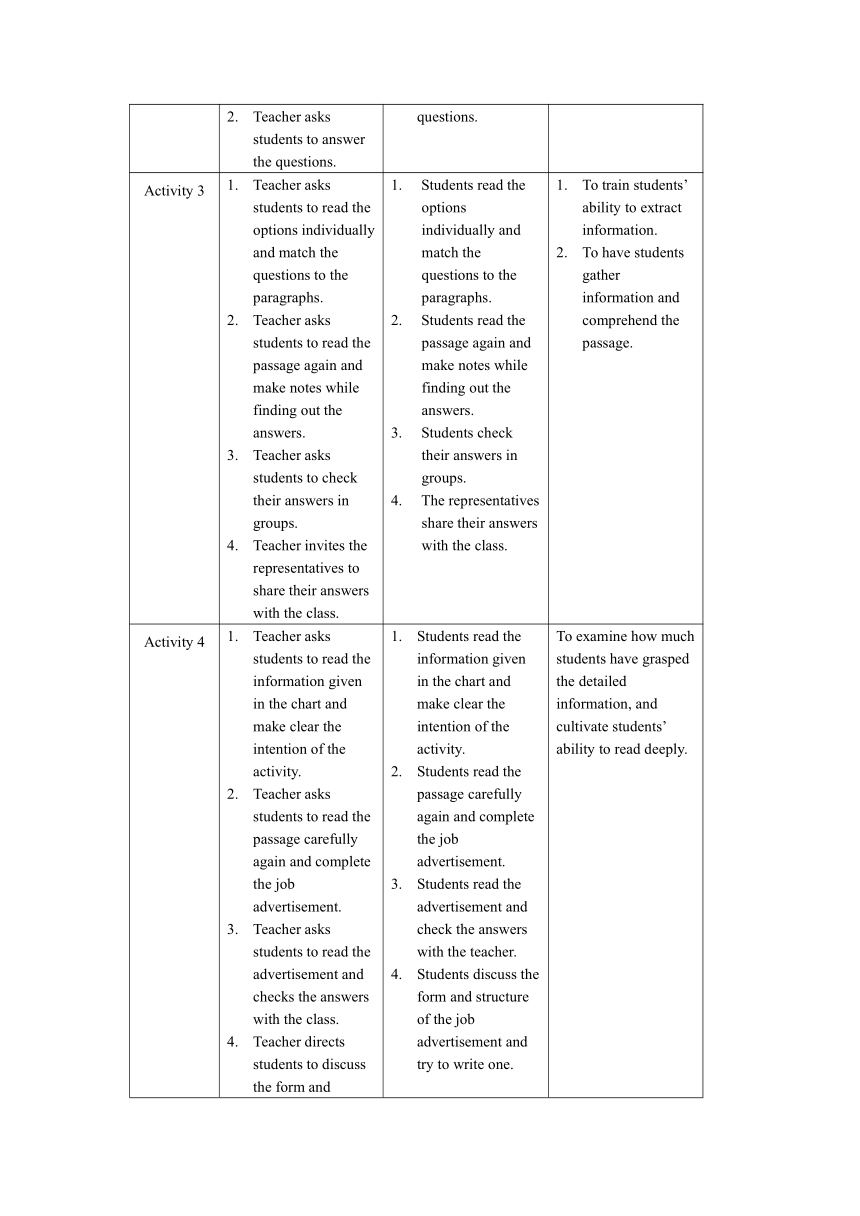
Activity 3 Teacher asks students to read the options individually and match the questions to the paragraphs. Teacher asks students to read the passage again and make notes while finding out the answers. Teacher asks students to check their answers in groups. Teacher invites the representatives to share their answers with the class. Students read the options individually and match the questions to the paragraphs. Students read the passage again and make notes while finding out the answers. Students check their answers in groups. The representatives share their answers with the class. To train students’ ability to extract information. To have students gather information and comprehend the passage.
Activity 4 Teacher asks students to read the information given in the chart and make clear the intention of the activity. Teacher asks students to read the passage carefully again and complete the job advertisement. Teacher asks students to read the advertisement and checks the answers with the class. Teacher directs students to discuss the form and structure of job advertisement and try to write one. Students read the information given in the chart and make clear the intention of the activity. Students read the passage carefully again and complete the job advertisement. Students read the advertisement and check the answers with the teacher. Students discuss the form and structure of the job advertisement and try to write one. To examine how much students have grasped the detailed information, and cultivate students’ ability to read deeply.
Activity 5 Teacher divides the class into groups and asks students to discuss the differences between clown doctors and medical doctors on the basis of the passage. Teacher asks students to gather more information and complete the diagram. Teacher invites some students to share their group opinion and explain the reasons. Students work in groups to discuss the differences between clown doctors and medical doctors. Students gather more information and complete the diagram. Some students share their group opinions and explain the reasons. To help students to make a deep comprehension of the theme of the passage and solve problems in real situation.
Think & Share Teacher asks students to think about and answer the questions. Students think about and answer the questions. To develop students’ abilities to dig the theme and think about caring and helping others.
Using language板块教学设计 (建议时长80–90分钟,教师可根据教学实际酌情调整。)
lesson type Reading + Listening + Speaking
Theme context People and self —— positive attitude towards life
[电] content analysis The main content of the grammar part of this section is the unqualified attributive clauses. Two small paragraphs respectively introduce the mystery of happiness and a humorous story to help students master the usage of clauses in specific context; the vocabulary part presents "laugh" and helps students learn to describe different "laugh"; and the speaking part is a radio program that tells three humorous stories. This section helps students to deeply focus on the meaning and function of language, deepen the understanding of unit topics through the comprehensive training of skills in real context, and improve the all-round comprehensive language application ability.
instructional objectives At the end of this section, students can: Understand the similarities and differences of restrictive attributive clauses and non-restrictive attributive clauses, and learn to use non-restrictive attributive clauses correctly in discourse writing; Learn and use English idioms to express all kinds of "laughter", find more similar English idioms, understand the meaning of these English idioms; Guide students to think about how to maintain a healthy and optimistic attitude in difficult situations, so that they can always have a positive attitude; Guide students to pay attention to the pragmatic function, learn to tell humorous stories and make comments in English, and be able to use the relevant expressions they have learned in real life.
key teaching points;focal point Guide students to further understand the similarities and differences between restrictive attributive clauses and non-restrictive attributive clauses, and master the usage of non-restrictive attributive clauses; Guide students to learn to use more English idioms to simply express a variety of "laughter".
difficult point in teaching Guide students to correctly use non-qualified attributive clauses in discourse writing, learn to tell humorous stories and make comments in English; Guide students to think about how to maintain a healthy and optimistic attitude in difficulties, so that they can always have a positive attitude.
instructional strategies Task-based teaching method, discovery teaching method, communicative teaching method, listening and speaking teaching method
Teaching contents Procedures Purposes
Teacher’s activity Students’ activity
Activity 1 Teacher asks students to read the sentences in the first box and pay attention to the words in bold. Then asks students to answer Questions 1-2. Teacher asks students to read and compare the example sentences again to answer Question 3. Teacher asks students to conclude the usage of non-defining attributive clauses and pay more attention to the similarities and differences of defining attributive clauses and non-defining attributive clauses. Teacher asks students to look for more sentences with the similar structures in the reading passage, and helps students to summarise the uses of non-defining attributive clauses. Students read the sentences in the first box and answer Questions 1-2. Students read and compare the example sentences again to answer Question 3. Students conclude the uses of non-defining attributive clauses and the similarities and differences of defining attributive clauses and non-defining attributive clauses. Students look for more sentences with the similar structures in the reading passage, and summarise the uses of non-defining attributive clauses. To encourage students to discover the grammar usage by themselves. To further enhance students’ understanding of the functions and usage of non-defining attributive clauses.
Activity 2 Teacher asks students to read the two simple sentences given in each advice and decide which sentence should be the main clause and which one should be the subordinate clause. Teacher asks students to find out the relationship between the modified nouns or sentences and the conjunctions of clauses. Teacher asks students to rewrite the tips with non-defining attributive clauses. Teacher asks some students to read the clauses they made and others check answers with the class. Teacher asks students to conclude how to make sentences using non-defining attributive clauses. Students read the two simple sentences given in each advice and decide which sentence should be the main clause and which one should be the subordinate clause. Students find out the relationship between the modified nouns or sentences and the conjunctions of clauses. Students rewrite the tips with non-defining attributive clauses. Some students read the clauses they made and others check the answers. Students conclude how to make sentences using non-defining attributive clauses. To get students to practise using non-defining attributive clause.
Activity 3 Teacher asks students to read the discourse and get its main idea by themselves. Teacher asks students to complete the joke with the sentence parts in the box using who/ which and commas where appropriate. Teacher asks some students to share their answers with the class. Students read the discourse and get its main idea by themselves. Students complete the joke with the sentence parts in the box using who/ which and commas where appropriate. Some students share their answers with the class. To help students consolidate the application of non-defining attributive clauses in authentic context.
Activity 4 Teacher asks students to work in groups and think of a joke they find funny and write it down using non-defining attributive clauses where appropriate. Teacher asks some students to share their jokes in front of the class. Teacher makes comments. Students think of a joke they find funny and write it down using non-defining attributive clauses where appropriate. Some students share their jokes in front of the class. To enlarge students’ vocabulary and have them form an optimistic outlook on life.
Activity 5 Teacher plays the audio and asks students to complete the conversations. Teacher asks students to read the conversations and write down the answers. Teacher checks the answers with the students. Students look at the six pictures, and guess the meanings of the idioms. Students listen to the audio and complete the conversations. Students check the answers with the teacher. To train students to grasp key information of the listening materials, and make key notes while listening.
Activity 6 Teacher asks students to match the idioms to the explanations given individually. Teacher adds more words or phrases that can express “laugh” and asks students to guess the meanings of them. Teacher asks students to explain the expressions in English by cooperating in groups. Teacher asks the groups to show their answers with the class. Students match the idioms to the explanations given individually. Students guess the meanings of the words and phrases the teacher adds. Students explain the expressions in English by cooperating in groups. Some students share their answers with the class. To help students consolidate their vocabulary through explaining expressions in English. Train students to learn cooperative learning.
Activity 7 Teacher asks students to work in pairs and discuss what situations the expressions can be used. Teacher asks students to choose one situation and make a dialogue with the phrases about “laugh” they’ve learnt. Teacher invites some pairs to show their dialogues. Teacher asks students to make comments and select the best pair. Students work in pairs and discuss what situations the expressions can be used. Students choose one situation and make a dialogue with the phrases about “laugh” they’ve learnt Some students show their dialogues. Students make comments and select the best pair. To have students use what they learnt in new situations . To train students’ abilities to use language.
Activities 8-9 Teacher asks students to look at the four pictures, describe them and predict what the audio talks about. Teacher plays the audio and asks students to listen and choose the pictures mentioned. Teacher checks the answers with the students. Teacher plays the audio again and asks students to complete the notes. Teacher asks some students to read the whole notes and others check the answers. Teacher asks students work in pairs, discuss which of the practical jokes is the funniest and give reasons. Students look at the four pictures, describe them and predict what the audio talks about. Students listen to the audio and choose the pictures mentioned. Students check the answers with the teacher. Students listen to the audio again and complete the notes. Some students read the whole notes and others check the answers. Students work in pairs, discuss which of the practical jokes is the funniest and give reasons. To help students grasp the main idea and understand the details of the listening materials. To strengthen students’ ability to use theme-related language to express views after listening.
Activities 10-11 Teacher asks students to read and understand the expressions from the radio programme. Teacher asks students to complete the boxes with the expressions according to their pragmatic function. Teacher asks students to check the answers with class. Teacher divides students into pairs and asks them to tell story and make comments in pairs. Teacher invites several pairs to act out their conversations in front of the class and asks other students to make comments. Students read and understand the expressions from the radio programme. Students complete the boxes with the expressions according to their pragmatic function. Students check the answers with the class. Students tell story and make comments in pairs. Some students act out their conversations in front of the class and other students make comments. To have students pay attention to the pragmatic function. To encourage students to make free and open communication under relevant topics using the vocabulary and expressions they have learnt. To have students make evaluation and reflection.
Developing ideas板块教学设计 (建议时长80–90分钟,教师可根据教学实际酌情调整。)
lesson type Reading + Writing
Theme context People and self —— positive attitude towards life
[电] content analysis This section presents the text reflecting the theme of the unit from another Angle, and the discourse type is the essay. The title of the text is The Importance of Humor, which is an important part of human behavior, which is not only a way of life, but also a tool used to clarify the world. The text expounds the humorous story of Mark Twain and Mr.Lin Yutang, discusses the importance of humor, and briefly introduces and evaluates Charlie Chaplin and his works.
instructional objectives At the end of this section, students can: By extracting the general idea of the text, combing the structure of the text, to better understand the importance of humor; Through analyzing, summarizing and integrating Mark Twain and Lin Yutang's humor in his works and life, they can understand their life wisdom, learn their open-minded outlook on life, and establish a positive and healthy world outlook, outlook on life and values; 3. By observing the discourse, I can find the basic content, stylistic characteristics and writing techniques of the character introduction, and I can use the knowledge to introduce a familiar and favorite comedian.
key teaching points;focal point 1. Guide the students to have a comprehensive understanding of the two masters and deeply understand the discourse through reading; 2. Train students to discover the basic content, stylistic characteristics and writing techniques of character introduction, and to use the knowledge to introduce a familiar and favorite comedian.
difficult point in teaching 1. Guide the students to write about the character introduction; 2. Learn Mark Twain and Lin Yutang's humorous way in their works and life, understand their life wisdom, open-minded outlook on life, and establish a positive and healthy world outlook, outlook on life and values;
instructional strategies P-W-P模式
Teaching contents Procedures Purposes
Teacher’s activity Students’ activity
Activity 1 Teacher asks two students to read the short introductions to Mark Twain and Lin Yutang respectively and helps students clear the obstacles in reading. Teacher asks students to read the short introductions and get the main ideas of them. Teacher asks some students to share what else they know about Mark Twain and Lin Yutang with the class. Students read the short introductions to Mark Twain and Lin Yutang respectively and clear the obstacles in reading. Students read the short introductions and get the main ideas of them. Students share what else they know about Mark Twain and Lin Yutang with the class. To activate students’ theme-related background knowledge and prepare for the following reading activities.
Activity 2 Teacher asks students to read the activity instruction and make sure they understand the reading task. Teacher asks students to read the passage to find out Mark Twain and Lin’s attitude towards humour, and refer to dictionary when necessary. Teacher invites some students to present their answers and other students to make supplements. Students read the activity instruction and make sure they understand the reading task. Students read the text to find out Mark Twain and Lin’s attitude towards humour, and refer to dictionary when necessary. Students present their answers and other students make supplements. To train students to read a passage with tasks and find out the key information.
Activity 3 Teacher asks students to read the passage individually, organise the information from the passage and complete the diagram. Teacher asks students to check their answers and learn from each other in groups. Teacher invites some students to retell the passage and other students to make supplements. 1. Students read the passage individually, organise the information from the passage and complete the diagram. 2. Students check their answers and learn from each other in groups. 3. Some students retell the passage and other students make supplements. To test students’ abilities to sort out the structure and specific information of a passage
Think & Share Teacher asks students to work in pairs to discuss the four questions. Teacher asks students to answer the questions and other students to make supplements or free discussion. Students work in groups to discuss the four questions. Some students answer the questions and other students make supplements or free discussion. To help students further explore the topic. To improve students’ critical thinking ability. To help students apply what they’ve learnt in a real-life context.
Activity 4 Teacher asks students to read the equation from the passage, think of it and try answering the questions individually. Teacher asks students to work in groups to fully express their own opinions and give reasons. Teacher asks some groups to share their opinions of the equation and others make comments. Teacher asks students to pay close attention to self-evaluation and think about their performances in this activity. Teacher makes advice to improve students’ performances. Students read the equation from the passage, think of it and try answering the questions individually. Students work in groups to fully express their own opinions and give reasons. Some groups share their opinions of the equation and others make comments. Students think about their performances in this activity. To inspire students to think the author’s attitude and the value of the passage and cultivate students’ ability to think creatively.
Activity 5 Teacher asks students to share the information about Charlie Chaplin that they have known. Teacher asks students to read the blog post quickly and match the headings to the paragraphs. Teacher checks the answers with the students. Students share the information about Charlie Chaplin that they have known. Read the blog post quickly and match the headings to the paragraphs. Students check the answers with the teacher. To train students’ reading skills.
Activity 6 Teacher asks students to read the passage again and find out the specific information in this activity. Teacher asks students to work in groups to discuss the specific information and how the author presents it. Teacher asks students to check the answers with the class. Students read the passage again and find out the specific information in this activity. Students work in groups to discuss the specific information and how the author presents it. Some students answer the questions and other students check the answers. To teach students how to analyse a passage, and prepare for the following writing activity.
Activities 7-8 Teacher asks students to read the passage in activity 5 and analyse the structure of it. Teacher asks students to choose a comedian and complete the notes. Teacher asks students to write a short introduction of the comedian according to the notes they made. Teacher asks students to work in pairs and make improvements to each other’s introductions. Teacher asks students to share their introductions with the class. Teacher and other students make comments. Teacher asks students to polish their writing and post them on their social media. Students read the passage in activity 5 and analyse the structure of it. Students choose a comedian and complete the notes. Students write a short introduction of the comedian according to the notes they made. Some students work in pairs and make improvements to each other’s introductions. Some students share their introductions with the class. Others make comments. Students polish their writing and post them on their social media. To provide opportunities for students to present their writing and do evaluation.
Presenting ideas & Reflection板块教学设计 (建议时长40–45分钟,教师可根据教学实际酌情调整。)
课型 Speaking
主题语境 People and self —— positive attitude towards life
内容分析 Presenting ideas The section requires students to discuss the content and form of stand-up comedy in groups, and then create their own stand-up comedy and perform it. The purpose of this section is to promote students to review and master the content they have learned by understanding and creating stand-up comedy, so that students can comprehensively use the content they have learned in real situations, and at the same time, help students to internalize the unit theme, develop the quality of thinking, and complete the transfer and innovation of the learned content. Reflection The section guides students to self-evaluate and summarize from many aspects, such as text, language, culture, learning strategies and methods, and the ability to analyze and solve problems, and write a self-reflection log.
instructional objectives At the end of this section, students can: Understand the stand-up comedy, so that students can understand and appreciate this art form; Through the completion of this comprehensive activity, deepen the understanding and understanding of the meaning of the unit theme, understand and learn a humorous way of doing things; Through group cooperation, cultivate the sense of teamwork, and can cooperate with the group members to complete the performance tasks.
key teaching points;focal point Guide the students to understand the stand-up comedy, understand and appreciate this art form and learn the humorous way of doing things; Guide students to evaluate their learning performance according to the evaluation content in the students' book.
difficult point in teaching Guide students to deal with problems in life in a humorous way and establish a positive and optimistic attitude towards life; Guide students to determine their own aspects to improve and improve on the basis of self-evaluation analysis.
instructional strategies Task-based teaching method, communicative teaching method
Teaching contents Procedures Purposes
Teacher’s activity Students’ activity
Presenting ideas
Activity 1 Teacher asks students to preview the stand-up comedy acts through the Internet. Teacher asks students to discuss the four questions in groups. Teacher asks some students to answer the questions and introduce the characteristics of the stand-up comedy acts. Teacher asks the whole class to summarise the features of the stand-up comedy acts and makes supplements. Students preview the stand-up comedy acts through the Internet. Students discuss the four questions in groups. Some students answer the questions and introduce the features of the stand-up comedy acts. The whole class summarise the features of the stand-up comedy acts. To encourage students to know the features of the stand-up comedy acts and prepare for the following activities.
Activities 2-3 Teacher asks students to think of their comedy act considering the four clues given in activity 2. Teacher asks students to write the scripts for their acts according to the structure given in activity 3. Teacher asks students to write their comedy acts, using the expressions and sentence structures related to the theme as many as possible. Students think of their comedy act considering the four clues given in activity 2. Students write the scripts for their acts according to the structure given in activity 3. Students write their comedy acts, using the expressions and sentence structures related to the theme as many as possible. To help students make deep learning and transform abilities into competences.
Activities 4-5 Teacher asks each group to choose a best script and a group member to be a stand-up comedian, and improve the acts in groups. Teacher asks students to think of actions and props to include and prepare to perform. Teacher asks each group to perform in front of the whole class, and other groups to make comments and vote for the best act. Each group chooses a best script and a group member to be a stand-up comedian, and improves the acts in groups. Students think of actions and props to include and prepare to perform. Each group performs in front of the whole class, and other groups make comments and vote for the best act. To train students to perform their own acts.
Reflection
Reflection Teacher asks students to recall what they’ve learnt in this unit. Teacher asks students to write a reflection based on the six tips.. Students summarise what they’ve learnt and write a reflection based on the six tips. To help students evaluate their performance, review the unit, and think about ways to improve.
Project板块教学设计 (此部分教师可根据教学实际酌情处理。)
lesson type Speaking
Theme context People and self —— positive attitude towards life
[电] content analysis The project practice in this unit requires students to write a comedy sketch and perform it. Through the process of co-creating and performing comedy sketches, it helps students to deeply understand the significance of a positive attitude towards life, constantly find the pleasant side of life, and improve the overall happiness level. Under the guidance of teachers, students make comprehensive use of the knowledge learned in the unit, carry out independent cooperation, effectively complete the open task, further explore the theme context of positive attitude towards life, and develop the comprehensive language use ability.
instructional objectives At the end of this section, students can: Through the search and understanding of comedy sketches, master the basic characteristics of this art form, understand the content it conveys, and cultivate the ability to analyze and integrate information; Through group cooperation, select their own comedy sketch themes, create their own comedy sketch stories, and feel the differences between Chinese and English language and culture; Through cooperative performance, we can deepen the understanding of the theme meaning of the unit, establish positive values, and cultivate a humorous attitude towards life.
key teaching points;focal point Guide students to understand the basic characteristics of comedy sketch, and the content it conveys; Guide students to learn comedy stories, establish positive values, cultivate life humorous attitude.
difficult point in teaching Guide students to comprehensively use the knowledge learned in this unit to create their own comedy sketch stories; Guide the students to further explore the theme of humorous, optimistic and positive attitude in life.
instructional strategies Task-based teaching method
Teaching contents Procedures Purposes
Teacher’s activity Students’ activity
Investigate (In the previous class) Teacher asks students to go online to find more about comedy sketches, and get a general understanding of it. Teacher asks some groups to introduce the features of comedy act and other students to make supplements. (In the previous class) Students go online to explore information about comedy act, and get a general understanding of it. Some groups introduce the features of comedy act and other students make supplements. To get students prepared for the project, and develop their individual learning and exploring abilities.
Plan Teacher asks students to work together to brainstorm the subject and the setting of their comedy. Teacher asks students to assign roles to each member of the group. Teacher asks each group to decide how they might present the sketch on stage, thinking about the characters, the setting and the key actions. Students work together to brainstorm the subject and setting of their comedy. Students assign roles to each member of the group. Each group decides how they might present the sketch on stage, thinking about the characters, the setting and the key actions. To help students prepare for the comedy acts.
Create Teacher asks each group to write their script and polish it. Teacher asks students to work together to practise saying the lines, and decide when and where the actor(s) should appear on stage. Teacher asks each group to rehearse with everyone together more than once. Each group writes their script and polishes it. Students work together to practise saying the lines, and decide when and where the actor(s) should appear on stage. Each group rehearses with everyone together more than once. To teach students to cooperate with each other.
Present Teacher encourages each group to present their comedy sketch for the class. Teacher asks students to vote for the best sketch and the best performance. Each group performs their comedy sketch for the class. Students vote for the best sketch and the best performance. To help students learn from each other.

展开更多......

收起↑

资源预览