人教版英语九年级全册Unit 4 I used to be afraid of the dark.单词默写知识点详讲义学案(无答案)

资源下载
  1. 二一教育资源

人教版英语九年级全册Unit 4 I used to be afraid of the dark.单词默写知识点详讲义学案(无答案)

资源简介

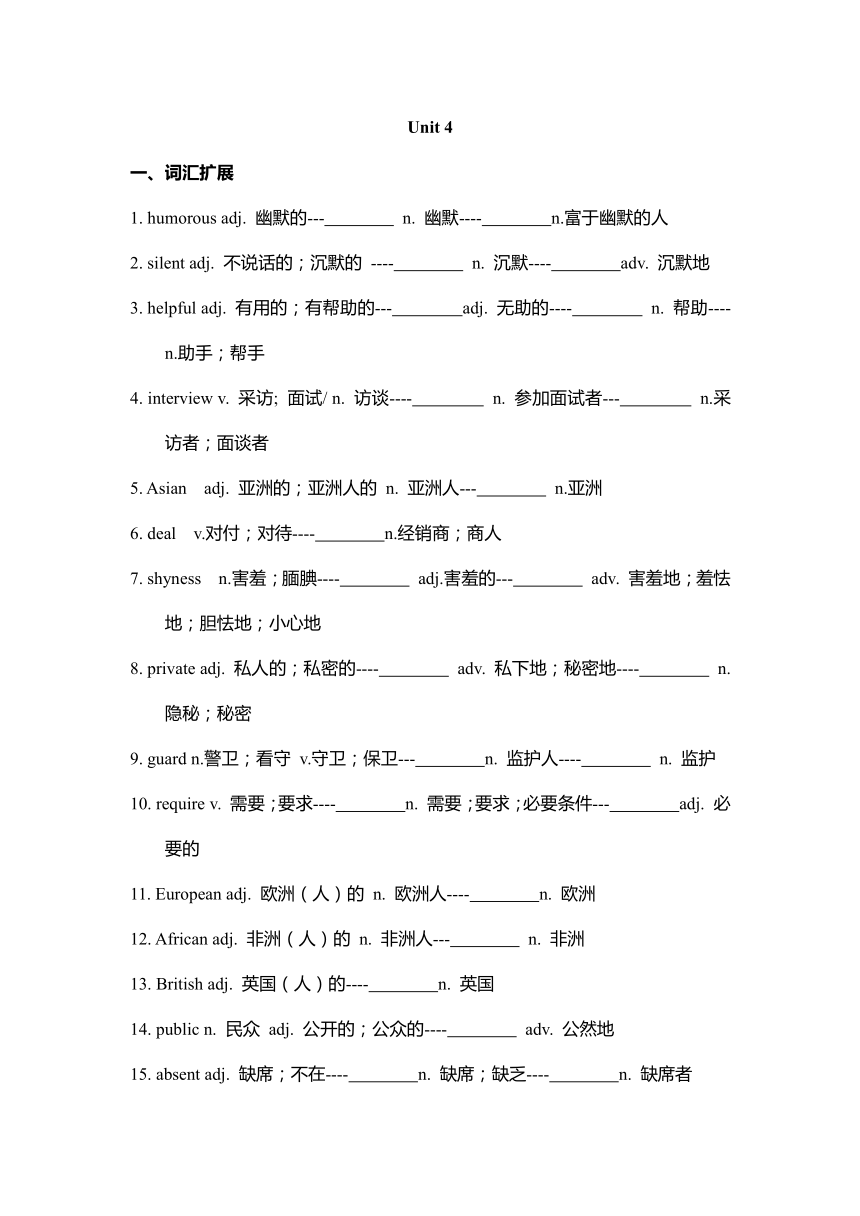
Unit 4
一、词汇扩展
1. humorous adj. 幽默的--- n. 幽默---- n.富于幽默的人
2. silent adj. 不说话的;沉默的 ---- n. 沉默---- adv. 沉默地
3. helpful adj. 有用的;有帮助的--- adj. 无助的---- n. 帮助---- n.助手;帮手
4. interview v. 采访; 面试/ n. 访谈---- n. 参加面试者--- n.采访者;面谈者
5. Asian adj. 亚洲的;亚洲人的 n. 亚洲人--- n.亚洲
6. deal v.对付;对待---- n.经销商;商人
7. shyness n.害羞;腼腆---- adj.害羞的--- adv. 害羞地;羞怯地;胆怯地;小心地
8. private adj. 私人的;私密的---- adv. 私下地;秘密地---- n. 隐秘;秘密
9. guard n.警卫;看守 v.守卫;保卫--- n. 监护人---- n. 监护
10. require v. 需要;要求---- n. 需要;要求;必要条件--- adj. 必要的
11. European adj. 欧洲(人)的 n. 欧洲人---- n. 欧洲
12. African adj. 非洲(人)的 n. 非洲人--- n. 非洲
13. British adj. 英国(人)的---- n. 英国
14. public n. 民众 adj. 公开的;公众的---- adv. 公然地
15. absent adj. 缺席;不在---- n. 缺席;缺乏---- n. 缺席者
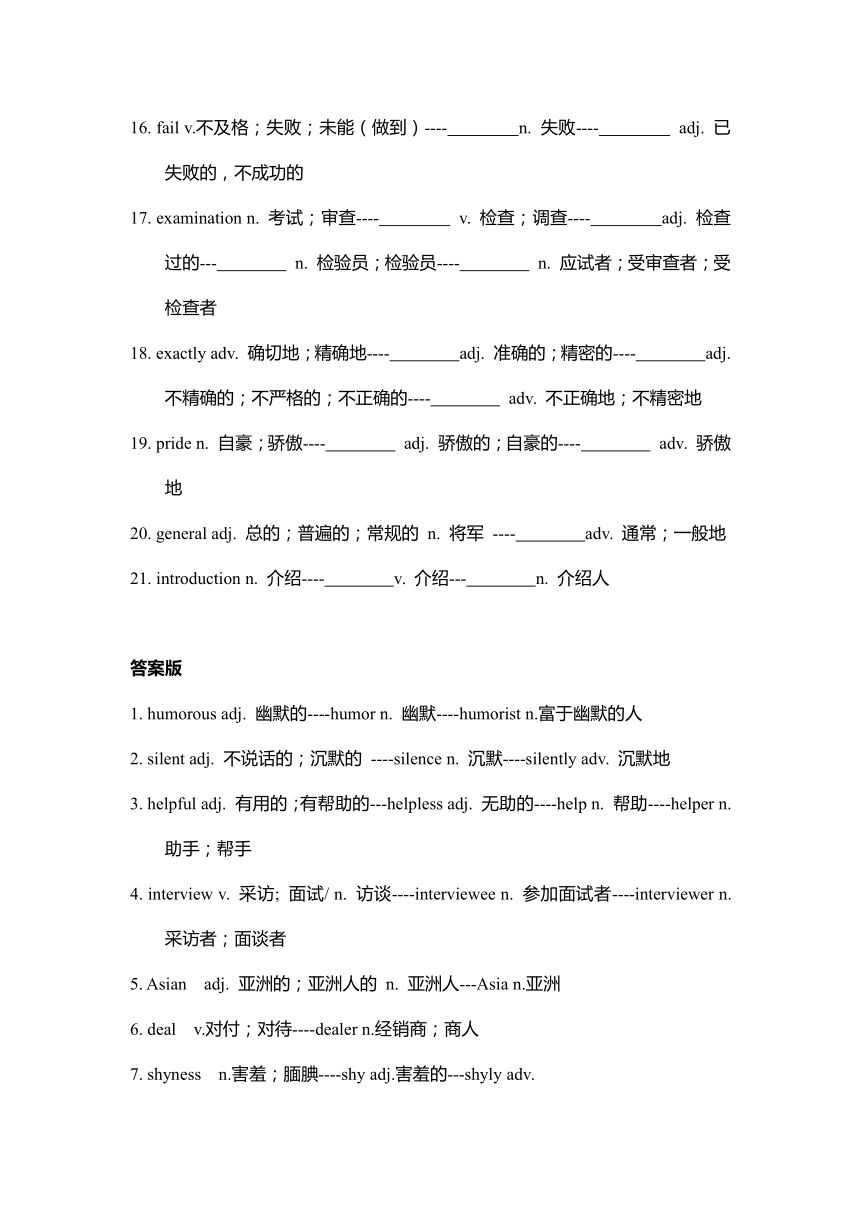
16. fail v.不及格;失败;未能(做到)---- n. 失败---- adj. 已失败的,不成功的
17. examination n. 考试;审查---- v. 检查;调查---- adj. 检查过的--- n. 检验员;检验员---- n. 应试者;受审查者;受检查者
18. exactly adv. 确切地;精确地---- adj. 准确的;精密的---- adj. 不精确的;不严格的;不正确的---- adv. 不正确地;不精密地
19. pride n. 自豪;骄傲---- adj. 骄傲的;自豪的---- adv. 骄傲地
20. general adj. 总的;普遍的;常规的 n. 将军 ---- adv. 通常;一般地
21. introduction n. 介绍---- v. 介绍--- n. 介绍人
答案版
1. humorous adj. 幽默的----humor n. 幽默----humorist n.富于幽默的人
2. silent adj. 不说话的;沉默的 ----silence n. 沉默----silently adv. 沉默地
3. helpful adj. 有用的;有帮助的---helpless adj. 无助的----help n. 帮助----helper n.助手;帮手
4. interview v. 采访; 面试/ n. 访谈----interviewee n. 参加面试者----interviewer n.采访者;面谈者
5. Asian adj. 亚洲的;亚洲人的 n. 亚洲人---Asia n.亚洲
6. deal v.对付;对待----dealer n.经销商;商人
7. shyness n.害羞;腼腆----shy adj.害羞的---shyly adv.
害羞地;羞怯地;胆怯地;小心地
8. private adj. 私人的;私密的----privately adv. 私下地;秘密地----privacy n. 隐秘;秘密
9. guard n.警卫;看守 v.守卫;保卫----guardian n. 监护人----guardianship n. 监护
10. require v. 需要;要求----requirement n. 需要;要求;必要条件----required adj. 必要的
11. European adj. 欧洲(人)的 n. 欧洲人----Europe n. 欧洲
12. African adj. 非洲(人)的 n. 非洲人----Africa n. 非洲
13. British adj. 英国(人)的----Britain n. 英国
14. public n. 民众 adj. 公开的;公众的----publicly adv. 公然地
15. absent adj. 缺席;不在----absence n. 缺席;缺乏----absentee n. 缺席者
16. fail v.不及格;失败;未能(做到)----failure n. 失败----failed adj. 已失败的,不成功的
17. examination n. 考试;审查----examine v. 检查;调查----examined adj. 检查过的----examiner n. 检验员;检验员----examinee n. 应试者;受审查者;受检查者
18. exactly adv. 确切地;精确地----exact adj. 准确的;精密的----inexact adj. 不精确的;不严格的;不正确的----inexactly adv. 不正确地;不精密地
19. pride n. 自豪;骄傲----proud adj. 骄傲的;自豪的----proudly adv. 骄傲地
20. general adj. 总的;普遍的;常规的 n. 将军 ----generally adv. 通常;一般地
21. introduction n. 介绍----introduce v. 介绍----introducer n. 介绍人
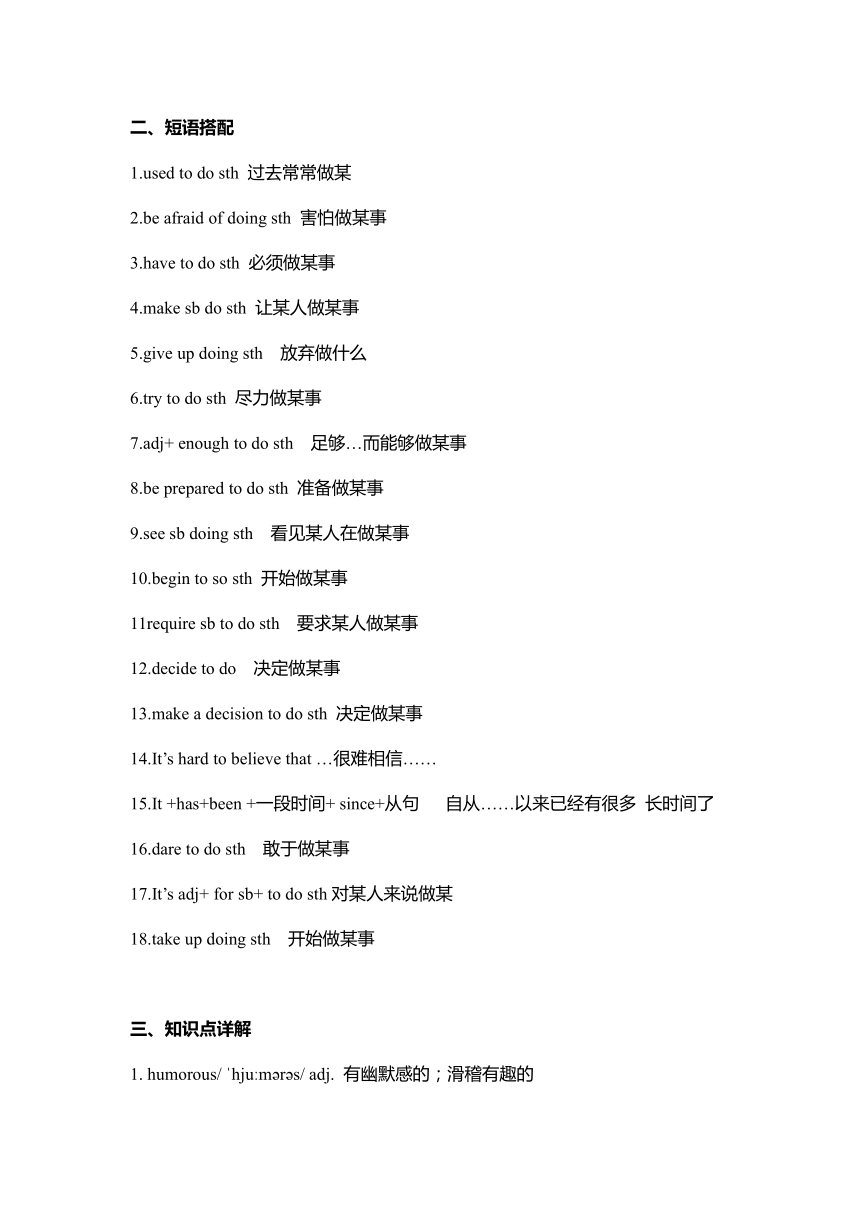
短语搭配
1.used to do sth 过去常常做某
2.be afraid of doing sth 害怕做某事
3.have to do sth 必须做某事
4.make sb do sth 让某人做某事
5.give up doing sth 放弃做什么
6.try to do sth 尽力做某事
7.adj+ enough to do sth 足够…而能够做某事
8.be prepared to do sth 准备做某事
9.see sb doing sth 看见某人在做某事
10.begin to so sth 开始做某事
11require sb to do sth 要求某人做某事
12.decide to do 决定做某事
13.make a decision to do sth 决定做某事
14.It’s hard to believe that …很难相信……
15.It +has+been +一段时间+ since+从句 自从……以来已经有很多 长时间了
16.dare to do sth 敢于做某事
17.It’s adj+ for sb+ to do sth对某人来说做某
18.take up doing sth 开始做某事
三、知识点详解
1. humorous/ hju m r s/ adj. 有幽默感的;滑稽有趣的
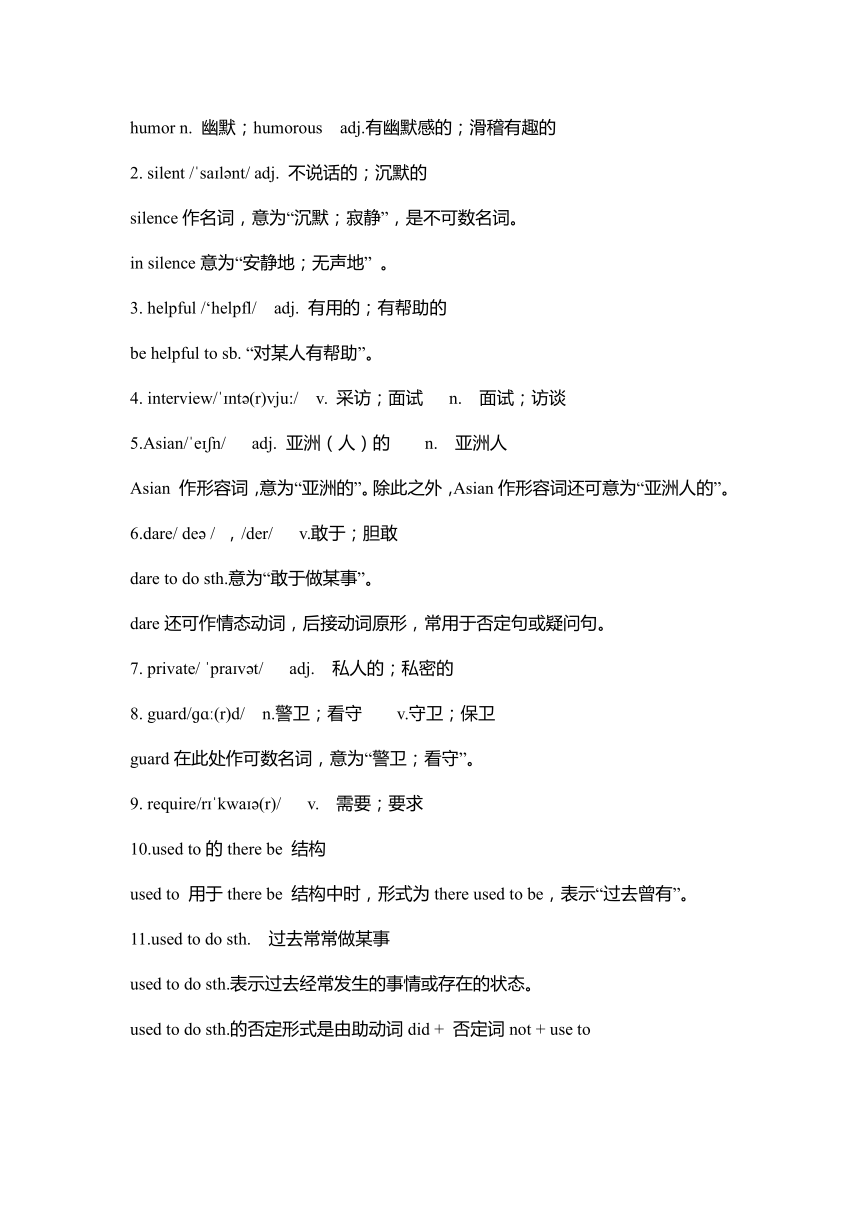
humor n. 幽默;humorous adj.有幽默感的;滑稽有趣的
2. silent / sa l nt/ adj. 不说话的;沉默的
silence作名词,意为“沉默;寂静”,是不可数名词。
in silence意为“安静地;无声地” 。
3. helpful /‘helpfl/ adj. 有用的;有帮助的
be helpful to sb. “对某人有帮助”。
4. interview/ nt (r)vju:/ v. 采访;面试 n. 面试;访谈
5.Asian/ e n/ adj. 亚洲(人)的 n. 亚洲人
Asian 作形容词,意为“亚洲的”。除此之外,Asian作形容词还可意为“亚洲人的”。
6.dare/ de / ,/der/ v.敢于;胆敢
dare to do sth.意为“敢于做某事”。
dare还可作情态动词,后接动词原形,常用于否定句或疑问句。
7. private/ pra v t/ adj. 私人的;私密的
8. guard/ɡɑ (r)d/ n.警卫;看守 v.守卫;保卫
guard在此处作可数名词,意为“警卫;看守”。
9. require/r kwa (r)/ v. 需要;要求
10.used to的there be 结构
used to 用于there be 结构中时,形式为there used to be,表示“过去曾有”。
11.used to do sth. 过去常常做某事
used to do sth.表示过去经常发生的事情或存在的状态。
used to do sth.的否定形式是由助动词did + 否定词not + use to
do构成;其疑问形式是由助动词did + 主语 + use to do构成。
12.take up后常跟名词或动词-ing形式作宾语。
take up doing sth. “开始做某事”
13. deal with 应对;处理
deal with的同义词组是do with,但deal with与how搭配,do with与what搭配。
单元课时训练
一、单项选择
1.They ________ dance, but now they do.
A.didn’t used to B.used not C.didn’t use to D.weren’t used to
2.Our school has changed a lot. It looks ________ than before.
A.more many beautiful B.more much beautiful
C.many more beautiful D.much more beautiful
3.My parents ________ my brother, because he did quite well ________ the exam.
A.took pride for; at B.took pride in; in C.were proud for; in D.were proud of; of
4.She ________ free time to help us in our work.
A.gave in B.gave off C.gave out D.gave up
5.The film is ________ and all of us are ________ in it.
A.interest; interesting B.interesting; interest
C.interested; interesting D.interesting; interested
6.Please be__________, Mario! I want to listen to the weather report.
A.silent B.serious C.honest D.brave
7.It's well-known that learning English well__________ time and effort.
A.requires B.wastes C.pays D.spends
8.Boys and girls, work hard. I'm sure your parents will__________ you in the future.
A.be famous as B.be proud of C.keep in touch
9.—What's the __________of yesterday's basketball game
—Class Five 108 points to Class Seven 96.
A.speed B.plan C.score D.record
10.The terrible accident has made a great influence_____________ the child.
A.on B.to C.with D.At
二、 阅读理解
My grandfather is eighty years old. He always complains about how fast things have changed, and he often says that life used to be better.
Families aren’t what they used to be. A lot of families have broken up. If the husband and wife have problems with their marriage, they no longer stay together. And mothers used to stay at home and take care of their children, but now everyone is busy working. No one has time to look after children at home.
And the cars! No one walks anymore; more and more people drive. We used to walk five miles to school on schooldays, even in winter. But now students don’t. And in school, children don’t have to think anymore. In maths class, for example, we used to add, subtract, multiply and divide (加减乘除) by using our heads. But now kids don’t use their heads anymore; instead, they use calculators (计算器).
Most families have computers and there are lights at home now. In the past we
didn’t have computers. We didn’t even have lights. My mother used to spend all day cooking in the kitchen. But now we don’t often eat home-cooked food.
And people talk less to each other than before. They are too busy to talk, too busy to eat, too busy to think...
Life used to be simple, but it isn’t simple anymore.
1.What does my grandfather think of the life now
A.He thinks the life now is very good.
B.He thinks the life now is worse than it used to be.
C.He thinks the life now is better than it used to be.
D.He thinks the life now is the same as it used to be.
2.What does the underlined word “marriage” mean in Chinese
A.生活 B.工作 C.婚姻 D.家庭
3.What has happened these years according to the passage
A.Children don’t have to think anymore in school.
B.Students use calculators in maths class.
C.Students used to walk to school, but now they don’t.
D.All of the above.
4.What changes have happened to families
① There are lights at home.
② People often eat home-cooked food.
③ Lots of families have computers.
④ More couples (夫妇) live apart because of unhappy problems.
A.①②④ B.②③④ C.①②③ D.①③④
5.Which is TRUE according to the passage
A.Life now is much simpler.
B.People have more time to talk with each other now.
C.The grandfather only complains and pays no attention to the better life now.
D.Lots of mothers stay at home and look after their children now.
三、适当形式填空
1.We’re looking forward to __________(visit)Taiwan soon.
2.Yao Ming is one of my favourite basketball ___________(play).
3.My mother bought me a new _________ (education) CD-ROM last week.
4.I am interested in__________ (tell) a story.
5.He dares ______________ (watch) the show.
6.He studies very hard and gets good ____ (grade).
7.My mother is always ____ (worry) about my health.
8.After the teacher talked with him, he studied even ____ (hard) than before.
9.Don’t let your ____ (unhappy) influence your life.
10.It’s hard to believe that he used to have ____ (difficulty) in school.
四、完成句子
1.我们决定去罗马度假。
We _________ _________ _________ _________ go to Rome for the holiday.
2.他爸爸为他做的事情感到非常自豪。
His father is very _________ _________ what he has done.
3.要自信,别怕在公众面前讲话。
Be confident. Don’t be afraid of speaking _________ _________.
4.我想知道怎么处理那些变质的鱼。
I wonder how _________ _________ _________ those bad fish.
5.有时,我妈妈亲自给我做蛋糕。
_________ time _________ time, my mother makes cakes for me _________ _________.
6.现今,很多孩子在电子屏幕前花费了太多时间。
Nowadays many children spend           time in front of digital screens.
7.上周日,我和我姐姐在购物广场闲逛。
Last Sunday, my elder sister and I           in the shopping mall.
8.你不应该再服用这种药了。它对你的健康有害。
You    take the medicine           .It's bad for your health.
9.经理亲自为顾客解决了这个问题。
The manager solved the problem for the customer        .
10.青少年应该学习如何照顾自己。
Teenagers should learn how to            themselves.

展开更多......

收起↑

资源预览