2024年初中英语一轮复习知识点之一般疑问句

资源下载
  1. 二一教育资源

2024年初中英语一轮复习知识点之一般疑问句

资源简介

2024年初中英语一轮复习知识点之一般疑问句
·
一般疑问句:
是疑问句的一种。它是以be动词,have或助动词、情态动词开头,用yes(是)或no(否)来回答的句子。
其结构是:系动词be/助动词/情态动词+主语+其他成分
1、一般疑问句是疑问句的一种。它是一般只用yes(是)或no(否)来回答的句子。朗读一般疑问句时用升调,而一般疑问句的简略答语则用降调。
2、特殊疑问句是以特殊疑问词开头,对句中某一成分提问的句子。常用的疑问词有:what、who、whose、which、when、where、how、why等。
3、疑问句是按照句子的语气分出来的一个类,它与陈述句、感叹句、祈使句的最大区别就是它的疑问语气;是问一些事情的,表达的内容并不是陈述,所以是不确定的;主要有四大句型,一般疑问句、选择疑问句、特殊疑问句和反意疑问句;而反意疑问句是高考英语的语法项目之一
一般疑问句的肯定形式为:
助动词+主语(+实义动词)。肯定答语用“yes+可定结构”。
一般疑问句的否定形式为:
助动词构成的缩写否定词+主语(+实义动词)。否定答语用“no+否定结构”。
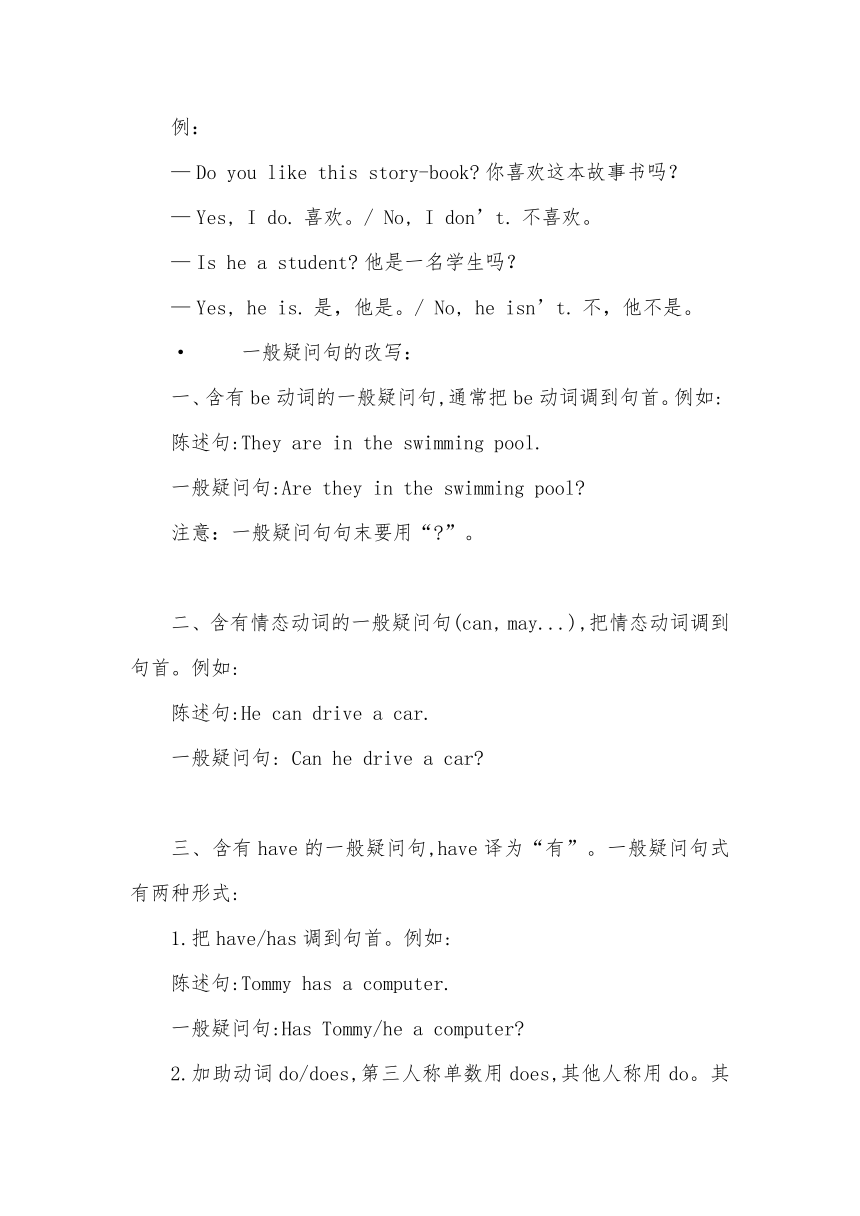
例:
— Do you like this story-book 你喜欢这本故事书吗?
— Yes, I do. 喜欢。/ No, I don’t. 不喜欢。
— Is he a student 他是一名学生吗?
— Yes, he is. 是,他是。/ No, he isn’t. 不,他不是。
· 一般疑问句的改写:
一、含有be动词的一般疑问句,通常把be动词调到句首。例如:
陈述句:They are in the swimming pool.
一般疑问句:Are they in the swimming pool
注意:一般疑问句句末要用“ ”。
二、含有情态动词的一般疑问句(can, may...),把情态动词调到句首。例如:
陈述句:He can drive a car.
一般疑问句: Can he drive a car
三、含有have的一般疑问句,have译为“有”。一般疑问句式有两种形式:
1.把have/has调到句首。例如:
陈述句:Tommy has a computer.
一般疑问句:Has Tommy/he a computer
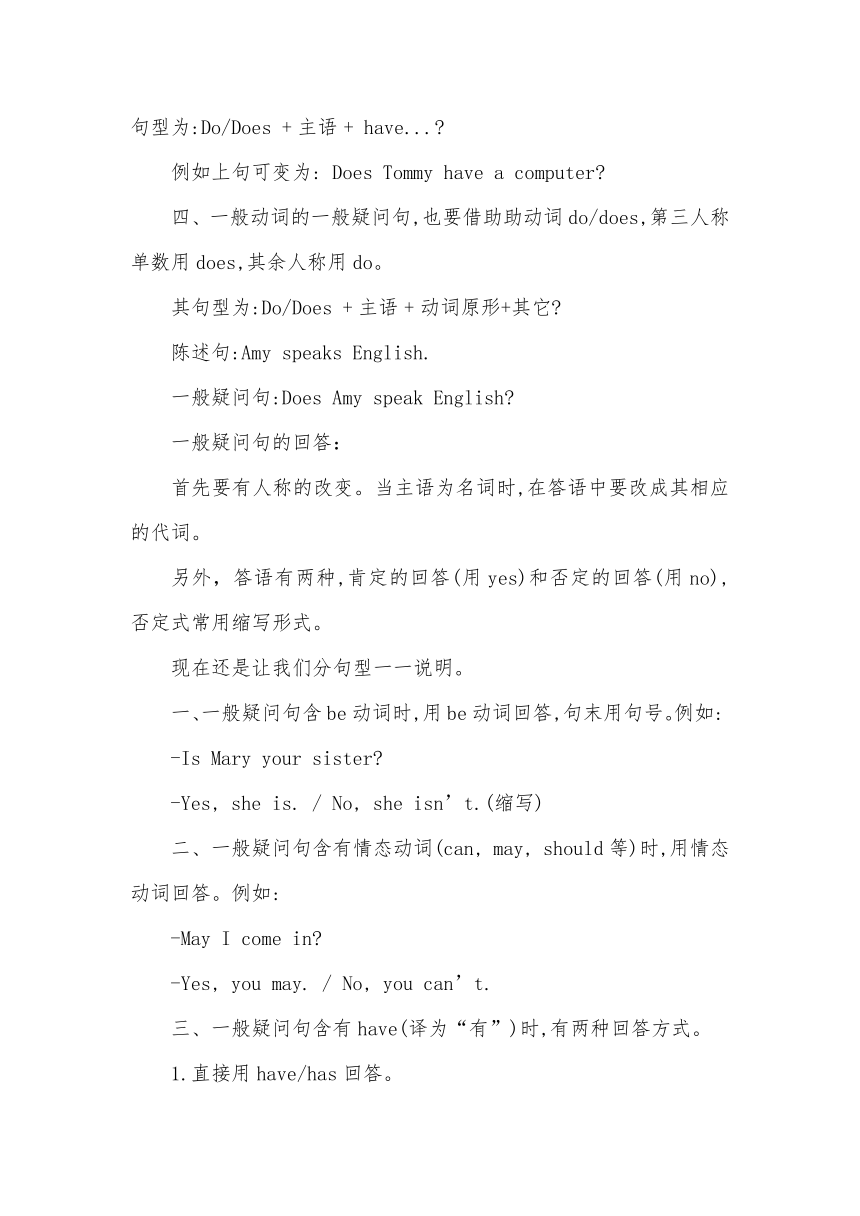
2.加助动词do/does,第三人称单数用does,其他人称用do。其句型为:Do/Does + 主语 + have...
例如上句可变为: Does Tommy have a computer
四、一般动词的一般疑问句,也要借助助动词do/does,第三人称单数用does,其余人称用do。
其句型为:Do/Does + 主语 + 动词原形+其它
陈述句:Amy speaks English.
一般疑问句:Does Amy speak English
一般疑问句的回答:
首先要有人称的改变。当主语为名词时,在答语中要改成其相应的代词。
另外,答语有两种,肯定的回答(用yes)和否定的回答(用no),否定式常用缩写形式。
现在还是让我们分句型一一说明。
一、一般疑问句含be动词时,用be动词回答,句末用句号。例如:
-Is Mary your sister
-Yes, she is. / No, she isn’t.(缩写)
二、一般疑问句含有情态动词(can, may, should等)时,用情态动词回答。例如:
-May I come in
-Yes, you may. / No, you can’t.
三、一般疑问句含有have(译为“有”)时,有两种回答方式。
1.直接用have/has回答。
例如:
-Have they any pictures
-Yes, they have. / No, they haven’t.
2.用助动词do/does回答。
例如:
-Does Millie smoke
-Yes, she does. / No, she doesn’t.
四、一般动词的一般疑问句回答时也用助动词。
例如:
-Do the workers live in London
-Yes, they do. / No, they don’t.

一般疑问句的特性:
1.将陈述句变为一般疑问句时,如句中有be 动词(am/ is/ are)时,可直接将它们提至主语前。
如主语为第一人称,应将其改为第二人称。如:
I'm in Class 2Grade 1. →Are you in Class 2Grade 1﹖
We're watching TV. →Are you watching TV﹖
2.陈述句中有情态动词(can、may、must …)时,也可直接将它们提至主语前,即可成为一般疑问句。如:
He can swim now. →Can he swim now﹖
The children may come with us. → May the children come with us﹖
3.陈述句中只有一个实义动词作谓语且其时态为一般现在时,变为一般疑问句时要在句首加do或does主语后的实义动词用原形。如:
I like these animals. →Do you like these animals﹖
She wants to go to the movies. → Does she want to go to the movies﹖
4.一般疑问句一般读升调(↑)
5.一般疑问句有时不用yes或 no 回答。如:
Are they in town now﹖
I think so.
May I sit here﹖
Certainly.
Does he like soccer﹖
Sorry I don't know.
6. 一般疑问句的第一单词总是虚词,读的时候要读轻声。
陈述句变为一般疑问句技巧:
根据一般疑问句不同的家族,可以用不同的方法将陈述句变为相应的一般疑问句。
1、第一家族:含be动词或情态动词的句子
秘诀:一调二改三问号
一调:即把句中的be或情态动词调到主语前;
二改:改换主语称谓,即将句中的主语I\my \mines\we\our\ours等。第一人称分别改为相应的第二人称you\your\ yours等;
三问号:句末的句号改为问号。如:
Eg. I am an English teacher. → Are you an English teacher
Eg. We can speak English fluently. → Can you speak English fluently
2、第二家族:含行为动词(或称为实义动词)的句子
秘诀:一加二改三问号
一加:即在句首加助动词Do或Does;
二改:1、把谓语动词改为原形;2、改换主语称谓(同第一家组);
三问号:句末的句号改为问号。
Eg. We read English every morning. → Do you read English every morning
Eg. Tom’s father listens to English on the radio every evening. →Does Tom’s father listen to English on the radio every evening
特别注意:对于第二家族一定要注意动词的还原,因为时态与数的变化已经体现在助动词上了。
3、加强记忆口诀:
肯变一,并不难,can 或be提在前;
谓语若为行为动,do 或does句首用。

展开更多......

收起↑

资源预览