2024年初中英语语法复习之表语从句

资源下载
  1. 二一教育资源

2024年初中英语语法复习之表语从句

资源简介

2024年初中英语语法复习之表语从句
( javascript:; )
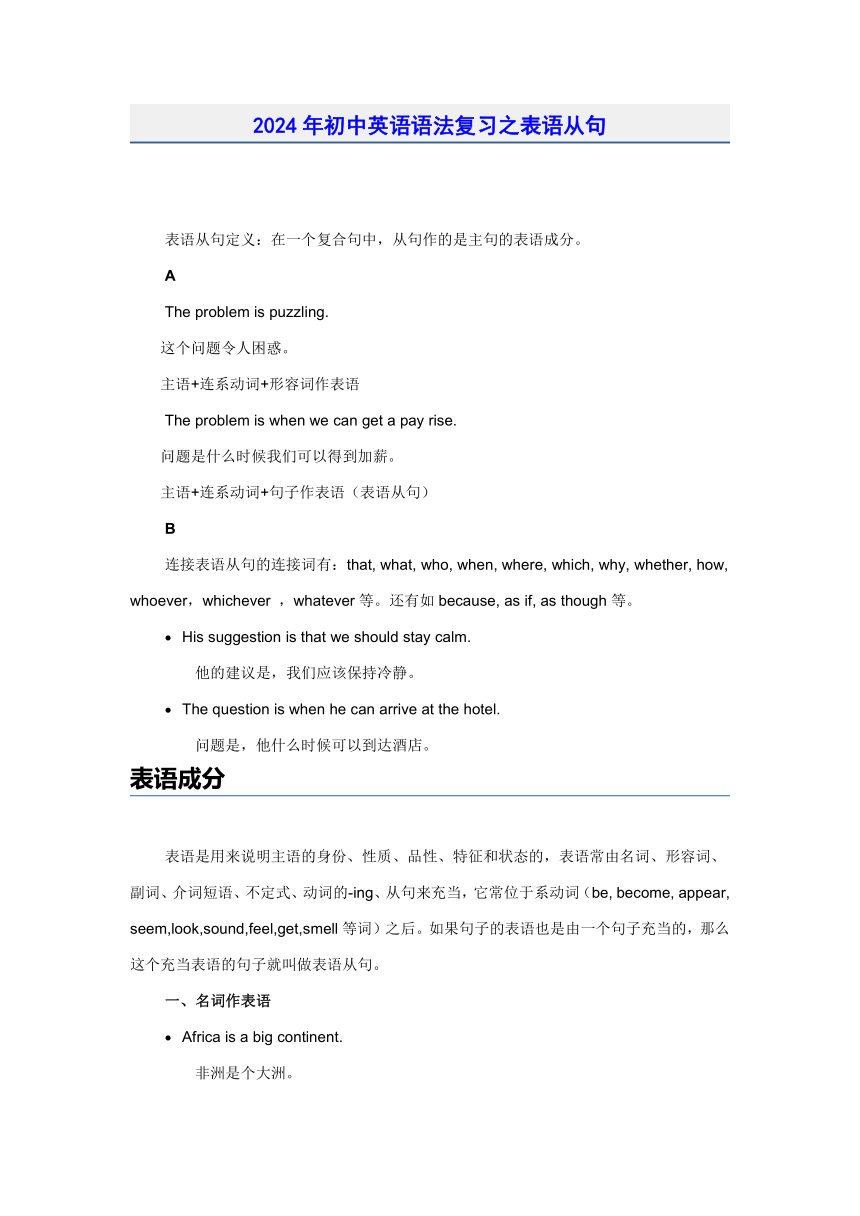
表语 ( https: / / baike. / item / %E8%A1%A8%E8%AF%AD" \t "_blank )从句定义:在一个复合句 ( https: / / baike. / item / %E5%A4%8D%E5%90%88%E5%8F%A5" \t "_blank )中,从句作的是主句的表语成分。
A
The problem is puzzling.
  这个问题令人困惑。
  主语 ( https: / / baike. / item / %E4%B8%BB%E8%AF%AD" \t "_blank )+连系动词 ( https: / / baike. / item / %E8%BF%9E%E7%B3%BB%E5%8A%A8%E8%AF%8D" \t "_blank )+形容词作表语
The problem is when we can get a pay rise.
  问题是什么时候我们可以得到加薪。
  主语+连系动词+句子 ( https: / / baike. / item / %E5%8F%A5%E5%AD%90" \t "_blank )作表语 ( https: / / baike. / item / %E8%A1%A8%E8%AF%AD" \t "_blank )(表语从句)
B
连接表语从句的连接词 ( https: / / baike. / item / %E8%BF%9E%E6%8E%A5%E8%AF%8D" \t "_blank )有:that, what, who, when, where, which, why, whether, how, whoever,whichever ,whatever等。还有如because, as if, as though等。
His suggestion is that we should stay calm.
  他的建议是,我们应该保持冷静。
The question is when he can arrive at the hotel.
  问题是,他什么时候可以到达酒店。
表语成分
( javascript:; )
表语是用来说明主语 ( https: / / baike. / item / %E4%B8%BB%E8%AF%AD" \t "_blank )的身份、性质、品性、特征和状态的,表语常由名词、形容词、副词 ( https: / / baike. / item / %E5%89%AF%E8%AF%8D" \t "_blank )、介词短语 ( https: / / baike. / item / %E4%BB%8B%E8%AF%8D%E7%9F%AD%E8%AF%AD" \t "_blank )、不定式、动词的-ing、从句 ( https: / / baike. / item / %E4%BB%8E%E5%8F%A5" \t "_blank )来充当,它常位于系动词 ( https: / / baike. / item / %E7%B3%BB%E5%8A%A8%E8%AF%8D" \t "_blank )(be, become, appear, seem,look,sound,feel,get,smell等词)之后。如果句子的表语也是由一个句子充当的,那么这个充当表语的句子就叫做表语从句。
一、名词作表语
Africa is a big continent.
  非洲是个大洲。
That remains a puzzle to me.
  这对我还是个难题。
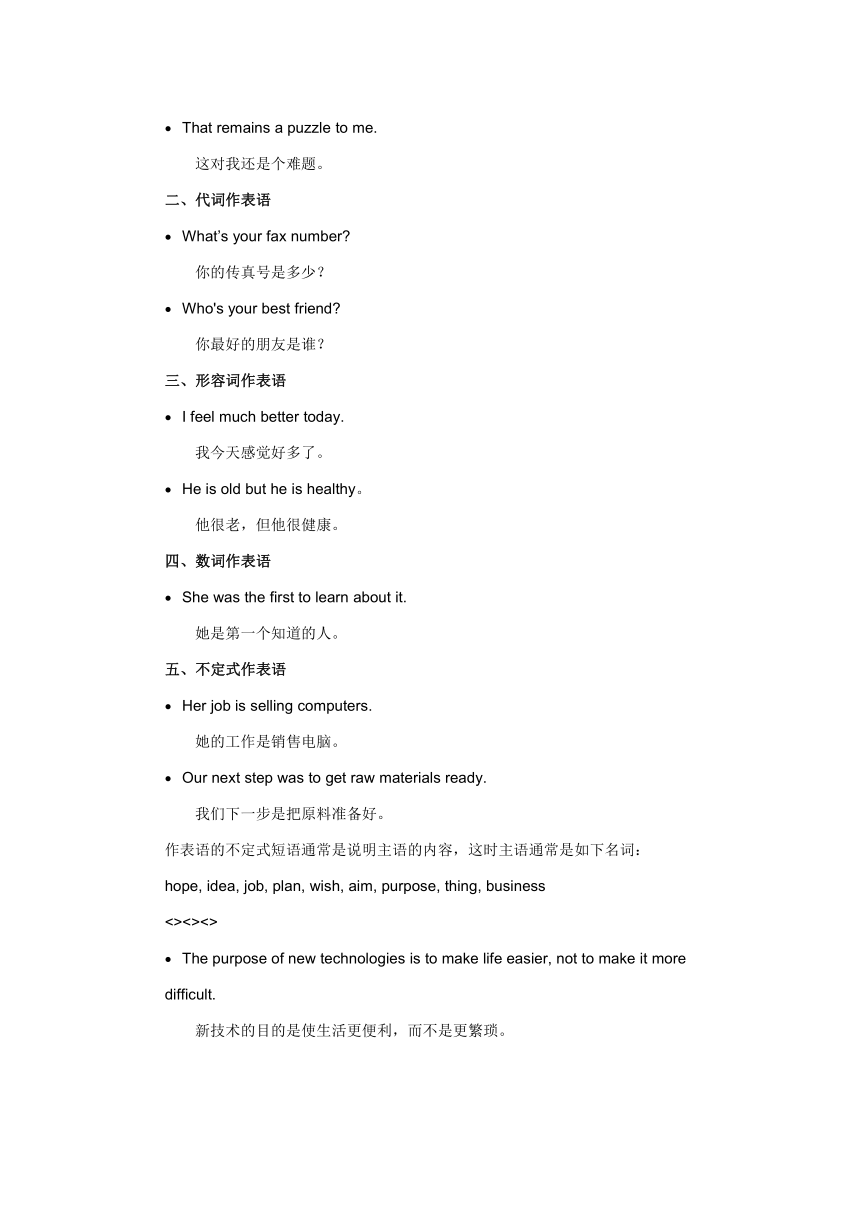
二、代词作表语
What’s your fax number
  你的传真号是多少?
Who's your best friend
  你最好的朋友是谁?
三、形容词作表语
I feel much better today.
  我今天感觉好多了。
He is old but he is healthy。
  他很老,但他很健康。
四、数词作表语
She was the first to learn about it.
  她是第一个知道的人。
五、不定式作表语
Her job is selling computers.
  她的工作是销售电脑。
Our next step was to get raw materials ready.
  我们下一步是把原料准备好。
作表语的不定式短语 ( https: / / baike. / item / %E4%B8%8D%E5%AE%9A%E5%BC%8F%E7%9F%AD%E8%AF%AD" \t "_blank )通常是说明主语 ( https: / / baike. / item / %E4%B8%BB%E8%AF%AD" \t "_blank )的内容,这时主语通常是如下名词:
hope, idea, job, plan, wish, aim, purpose, thing, business
<><><>
The purpose of new technologies is to make life easier, not to make it more difficult.
  新技术的目的是使生活更便利,而不是更繁琐。
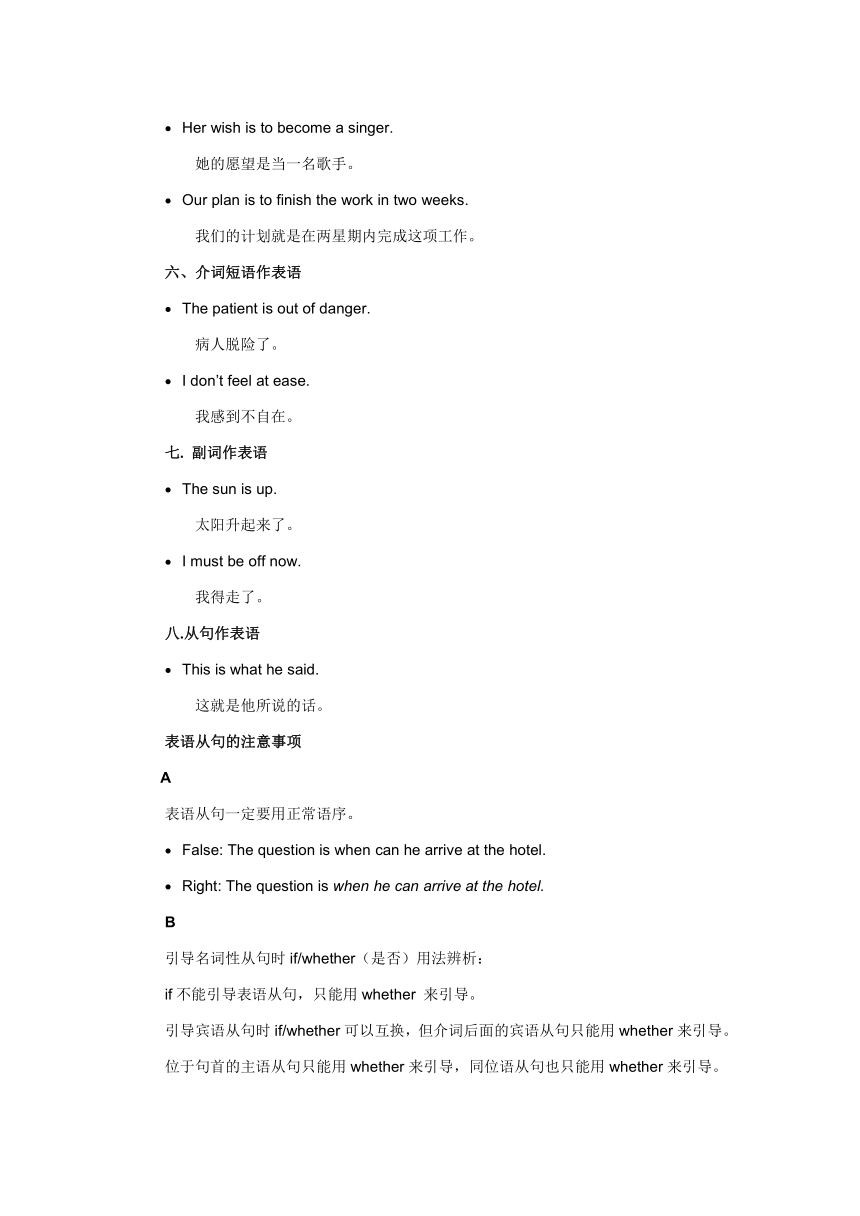
Her wish is to become a singer.
  她的愿望是当一名歌手。
Our plan is to finish the work in two weeks.
  我们的计划就是在两星期内完成这项工作。
六、介词短语作表语
The patient is out of danger.
  病人脱险了。
I don’t feel at ease.
  我感到不自在。
七. 副词作表语
The sun is up.
  太阳升起来了。
I must be off now.
  我得走了。
八.从句 ( https: / / baike. / item / %E4%BB%8E%E5%8F%A5" \t "_blank )作表语
This is what he said.
  这就是他所说的话。
表语从句的注意事项
  A
表语从句一定要用正常语序 ( https: / / baike. / item / %E8%AF%AD%E5%BA%8F" \t "_blank )。
False: The question is when can he arrive at the hotel.
Right: The question is when he can arrive at the hotel.
B
引导名词性从句 ( https: / / baike. / item / %E5%90%8D%E8%AF%8D%E6%80%A7%E4%BB%8E%E5%8F%A5" \t "_blank )时if/whether(是否)用法辨析:
if不能引导表语从句,只能用whether 来引导。
引导宾语从句 ( https: / / baike. / item / %E5%AE%BE%E8%AF%AD%E4%BB%8E%E5%8F%A5" \t "_blank )时if/whether可以互换,但介词 ( https: / / baike. / item / %E4%BB%8B%E8%AF%8D" \t "_blank )后面的宾语从句只能用whether来引导。
位于句首的主语从句 ( https: / / baike. / item / %E4%B8%BB%E8%AF%AD%E4%BB%8E%E5%8F%A5" \t "_blank )只能用whether来引导,同位语从句 ( https: / / baike. / item / %E5%90%8C%E4%BD%8D%E8%AF%AD%E4%BB%8E%E5%8F%A5" \t "_blank )也只能用whether来引导。
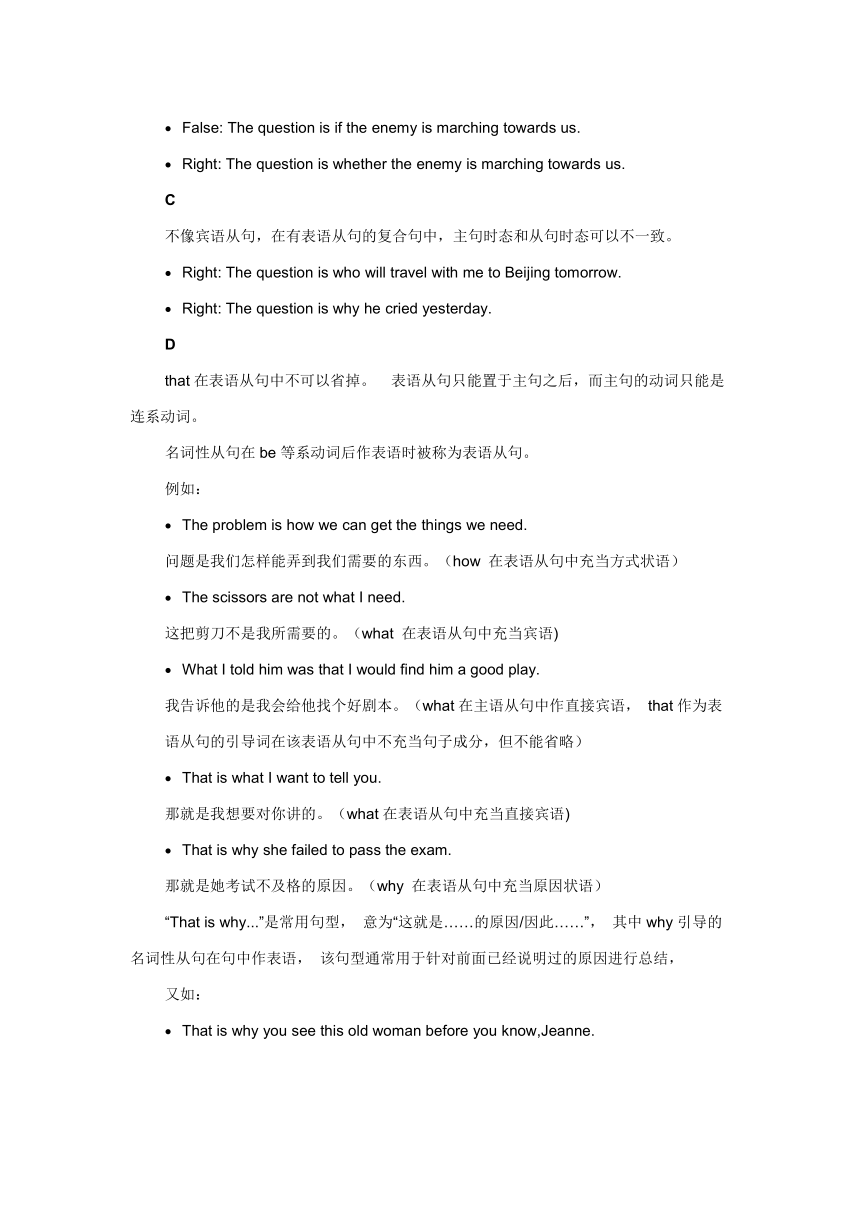
False: The question is if the enemy is marching towards us.
Right: The question is whether the enemy is marching towards us.
C
不像宾语从句,在有表语从句的复合句 ( https: / / baike. / item / %E5%A4%8D%E5%90%88%E5%8F%A5" \t "_blank )中,主句时态 ( https: / / baike. / item / %E6%97%B6%E6%80%81" \t "_blank )和从句时态可以不一致。
Right: The question is who will travel with me to Beijing tomorrow.
Right: The question is why he cried yesterday.
D
that在表语从句中不可以省掉。 表语从句只能置于主句之后,而主句的动词 ( https: / / baike. / item / %E5%8A%A8%E8%AF%8D" \t "_blank )只能是连系动词 ( https: / / baike. / item / %E8%BF%9E%E7%B3%BB%E5%8A%A8%E8%AF%8D" \t "_blank )。
名词性从句 ( https: / / baike. / item / %E5%90%8D%E8%AF%8D%E6%80%A7%E4%BB%8E%E5%8F%A5" \t "_blank )在be等系动词 ( https: / / baike. / item / %E7%B3%BB%E5%8A%A8%E8%AF%8D" \t "_blank )后作表语 ( https: / / baike. / item / %E8%A1%A8%E8%AF%AD" \t "_blank )时被称为表语从句。
例如:
The problem is how we can get the things we need.
问题是我们怎样能弄到我们需要的东西。(how 在表语从句中充当方式状语 ( https: / / baike. / item / %E7%8A%B6%E8%AF%AD" \t "_blank ))
The scissors are not what I need.
这把剪刀不是我所需要的。(what 在表语从句中充当宾语 ( https: / / baike. / item / %E5%AE%BE%E8%AF%AD" \t "_blank ))
What I told him was that I would find him a good play.
我告诉他的是我会给他找个好剧本。(what在主语从句 ( https: / / baike. / item / %E4%B8%BB%E8%AF%AD%E4%BB%8E%E5%8F%A5" \t "_blank )中作直接宾语 ( https: / / baike. / item / %E7%9B%B4%E6%8E%A5%E5%AE%BE%E8%AF%AD" \t "_blank ), that作为表语从句的引导词 ( https: / / baike. / item / %E5%BC%95%E5%AF%BC%E8%AF%8D" \t "_blank )在该表语从句中不充当句子成分 ( https: / / baike. / item / %E5%8F%A5%E5%AD%90%E6%88%90%E5%88%86" \t "_blank ),但不能省略)
That is what I want to tell you.
那就是我想要对你讲的。(what在表语从句中充当直接宾语)
That is why she failed to pass the exam.
那就是她考试不及格的原因。(why 在表语从句中充当原因状语 ( https: / / baike. / item / %E7%8A%B6%E8%AF%AD" \t "_blank ))
“That is why...”是常用句型, 意为“这就是……的原因/因此……”, 其中why引导的名词性从句 ( https: / / baike. / item / %E5%90%8D%E8%AF%8D%E6%80%A7%E4%BB%8E%E5%8F%A5" \t "_blank )在句中作表语 ( https: / / baike. / item / %E8%A1%A8%E8%AF%AD" \t "_blank ), 该句型通常用于针对前面已经说明过的原因进行总结,
又如:
That is why you see this old woman before you know,Jeanne.
珍妮 ( https: / / baike. / item / %E7%8F%8D%E5%A6%AE" \t "_blank ), 这就是现在这个老太婆出现在你面前的原因。(前文提到Jeanne对老妇人 ( https: / / baike. / item / %E8%80%81%E5%A6%87%E4%BA%BA" \t "_blank )显得苍老憔悴深感诧异,说话人 ( https: / / baike. / item / %E8%AF%B4%E8%AF%9D%E4%BA%BA" \t "_blank )对她讲述了其中的原因之后,用这一句来进行概括)。
That is why I came.
这就是我来的原因。
下面是两个与“That is why...”形式相似的结构, 它们与“That is why...”结构之间的关系要能够辨析清楚:
(1)“That is why...”与“That is the reason why...”同义, 只不过从语法结构上讲, “That is the reason why...”中why引导的是—个定语从句 ( https: / / baike. / item / %E5%AE%9A%E8%AF%AD%E4%BB%8E%E5%8F%A5" \t "_blank ), 将其中的the reason去掉则与“That is why...”结构一样, 例如:
That is (the reason) why I cannot agree.
这就是我不能同意的理由。
(2)“That is because...”句型中从属连词 ( https: / / baike. / item / %E4%BB%8E%E5%B1%9E%E8%BF%9E%E8%AF%8D" \t "_blank )because引导的名词性从句 ( https: / / baike. / item / %E5%90%8D%E8%AF%8D%E6%80%A7%E4%BB%8E%E5%8F%A5" \t "_blank )在此作表语 ( https: / / baike. / item / %E8%A1%A8%E8%AF%AD" \t "_blank ), 这也是个常用句型, 意为“这就是为什么……/因为……”。“That is because...”与“That is why...”之间的不同在于“That is because...”指原因或理由, “That is why...”则指由于各种原因所造成的后果, 例如:
He did not see the film last night. That is because he had to help his little sister with her homework.
昨天晚上他没有去看电影, 那是因为他得帮助他的妹妹做作业。(第一句话说明结果, 第二句话说明原因)
He had seen the film before. That is why he did not see it last night.
他以前曾看过那部电影, 因此他昨天晚上没有去看。(第一句话说明原因, 第二句话说明结果)
考题分析
( javascript:; )
考题1
  The traditional view is ____ we sleep because our brain is “programmed” to make us do so.
  A. when B. why C. whether D. that
  [答案] D
  [解析] 下划线处之后是包含一个原因状语从句 ( https: / / baike. / item / %E5%8E%9F%E5%9B%A0%E7%8A%B6%E8%AF%AD%E4%BB%8E%E5%8F%A5" \t "_blank )的表语从句, 如果看不出它是充当整个句子 ( https: / / baike. / item / %E5%8F%A5%E5%AD%90" \t "_blank )结构的表语从句将难以把握整个句子的意思。因此, 应选择可引导名词性从句 ( https: / / baike. / item / %E5%90%8D%E8%AF%8D%E6%80%A7%E4%BB%8E%E5%8F%A5" \t "_blank )且不充当任何成分的that。
考题2
  You are saying that everyone should be equal,and this is ____ I disagree.
  A. why B. where C. what D. how
  [答案] B
  [解析] 下划线处的引导词 ( https: / / baike. / item / %E5%BC%95%E5%AF%BC%E8%AF%8D" \t "_blank )引导系动词 ( https: / / baike. / item / %E7%B3%BB%E5%8A%A8%E8%AF%8D" \t "_blank )is后的表语从句并在该表语从句中充当地点状语 ( https: / / baike. / item / %E5%9C%B0%E7%82%B9%E7%8A%B6%E8%AF%AD" \t "_blank )(“disagree”属于不及物动词 ( https: / / baike. / item / %E4%B8%8D%E5%8F%8A%E7%89%A9%E5%8A%A8%E8%AF%8D" \t "_blank ), “I disagree”本身是完整的主谓结构 ( https: / / baike. / item / %E4%B8%BB%E8%B0%93%E7%BB%93%E6%9E%84" \t "_blank )), 下划线应填入引导词where, 表语从句“where I disagree”的意思是“我不同意之处、 我不同意的地方”。
考题3
  — I drove to Zhuhai for the air show last week.
  — Is that ____ you had a few days off
  A. why B. when C. what D. where
  [答案] A
  [解析] 下划线处的引导词 ( https: / / baike. / item / %E5%BC%95%E5%AF%BC%E8%AF%8D" \t "_blank )引导与系动词 ( https: / / baike. / item / %E7%B3%BB%E5%8A%A8%E8%AF%8D" \t "_blank )is连用的表语从句并在该表语从句中充当原因状语 ( https: / / baike. / item / %E7%8A%B6%E8%AF%AD" \t "_blank ), 下划线应填入表示“因此……”(指因某种原因所造成的结果)的引导词why。
考题4
  ____ she couldn’t understand was ____ fewer and fewer students showed interest in her lessons.
  A. What; why B. That; what C. What; because D. Why; that
  [答案] A
  [解析] 第一个下划线处的引导词 ( https: / / baike. / item / %E5%BC%95%E5%AF%BC%E8%AF%8D" \t "_blank )引导主语从句 ( https: / / baike. / item / %E4%B8%BB%E8%AF%AD%E4%BB%8E%E5%8F%A5" \t "_blank )并在该主语从句中充当宾语 ( https: / / baike. / item / %E5%AE%BE%E8%AF%AD" \t "_blank ), 特指她所不理解的事情, 应填入关系代词 ( https: / / baike. / item / %E5%85%B3%E7%B3%BB%E4%BB%A3%E8%AF%8D" \t "_blank )型的引导词what; 第二个下划线处表示“因此……”(指因某种原因所造成的后果, 由why引导对应的名词性从句 ( https: / / baike. / item / %E5%90%8D%E8%AF%8D%E6%80%A7%E4%BB%8E%E5%8F%A5" \t "_blank ))而不是“为什么……”(指原因、 理由, 由because引导对应的名词性从句), 应填入引导词why。
考题5
  ____ made the school proud was ____ more than 90% of the students had been admitted to key universities.
  A. What; because B. What; that
  C. That; what D. That; because
  [答案] B
  [解析] 第一个下划线处的引导词引导主语从句并在该主语从句中充当主语, 特指令校方骄傲的事情, 应选用关系代词 ( https: / / baike. / item / %E5%85%B3%E7%B3%BB%E4%BB%A3%E8%AF%8D" \t "_blank )型的引导词what; 第二个下划线处引导表语从句表示原因、 理由, 应由that引导对应的名词性从句。
考题6
  — Are you still thinking about yesterday’s game
  — Oh,that’s ____.
  A. what makes me feel excited B. whatever I feel excited about
  C. how I feel about it D. when I feel excited
  [答案] A
  [解析] A选项的意思是“令我感觉激动的事物”; B选项的意思是“我觉得激动的任何事物”; C选项的意思是“我对它感觉的方式”; D选项的意思是“令我感觉激动的时候”。四个选项中A最适合跟代表“game”的主语 ( https: / / baike. / item / %E4%B8%BB%E8%AF%AD" \t "_blank )that对应, 充当表语从句。
例句
( javascript:; )
This is what I want.
  这就是我想要的
The reason why he was late is that his bike broke down.
  他迟到是因为自行车坏了
Next sunday is when we shall meet.
  下周日是我们见面的时间
This is why I am late.
  这就是我迟到的原因
My problem is which computer to choose
  我的问题是不知道选哪个电脑好
The argument is whether it rains tomorrow
  明天是否下雨是争论的内容
What the police want to know is when you entered red the room
  警察想知道的是你什么时候进的房间。
The trouble is that we are short of funds
  困难是我们缺乏资金。
This is what we should do
  这是我们应当做的。
That‘s why I want you to work there
  那就是我要你在那儿工作的原因。
His first question was whether Mr. Smith had arrived yet
  他的第一个问题是史密斯先生到了没有。
注意:从句中的疑问句 ( https: / / baike. / item / %E7%96%91%E9%97%AE%E5%8F%A5" \t "_blank )用正常语序 ( https: / / baike. / item / %E8%AF%AD%E5%BA%8F" \t "_blank ),即陈述语序。
as if,as though,because也可用来引导表语从句。
She seems as if she had done a great thing
  她看起来好像做了一件大事。
It is because you eat too much
  是因为你吃得太多了。

展开更多......

收起↑

资源预览