2024届中考英语专项复习之主谓一致的易错点归纳 讲义

资源下载
  1. 二一教育资源

2024届中考英语专项复习之主谓一致的易错点归纳 讲义

资源简介

2024届中考英语专项复习之主谓一致的易错点归纳
■不定式短语、动词-ing形式或名词性从句都可以作主语,但是谓语动词需要根据主语的形式来确定。
不定式短语作主语:不定式短语可以作为主语出现在句子中,此时谓语动词需要用单数形式。例如:
I want to eat pizza.(我想吃比萨饼。)
She likes to play basketball.(她喜欢打篮球。)
动词-ing形式作主语:动词-ing形式也可以作为主语出现在句子中,此时谓语动词需要用单数形式。例如:
He is running in the park.(他正在公园里跑步。)
She is reading a book.(她正在读一本书。)
名词性从句作主语:名词性从句也可以作为主语出现在句子中,此时谓语动词也需要用单数形式。例如:
What he said made me happy.(他说的话让我很高兴。)
Where she lives is important.(她住在哪里很重要。)
在这些情况下,谓语动词需要根据主语的形式来确定,以保证句子的表达准确无误。
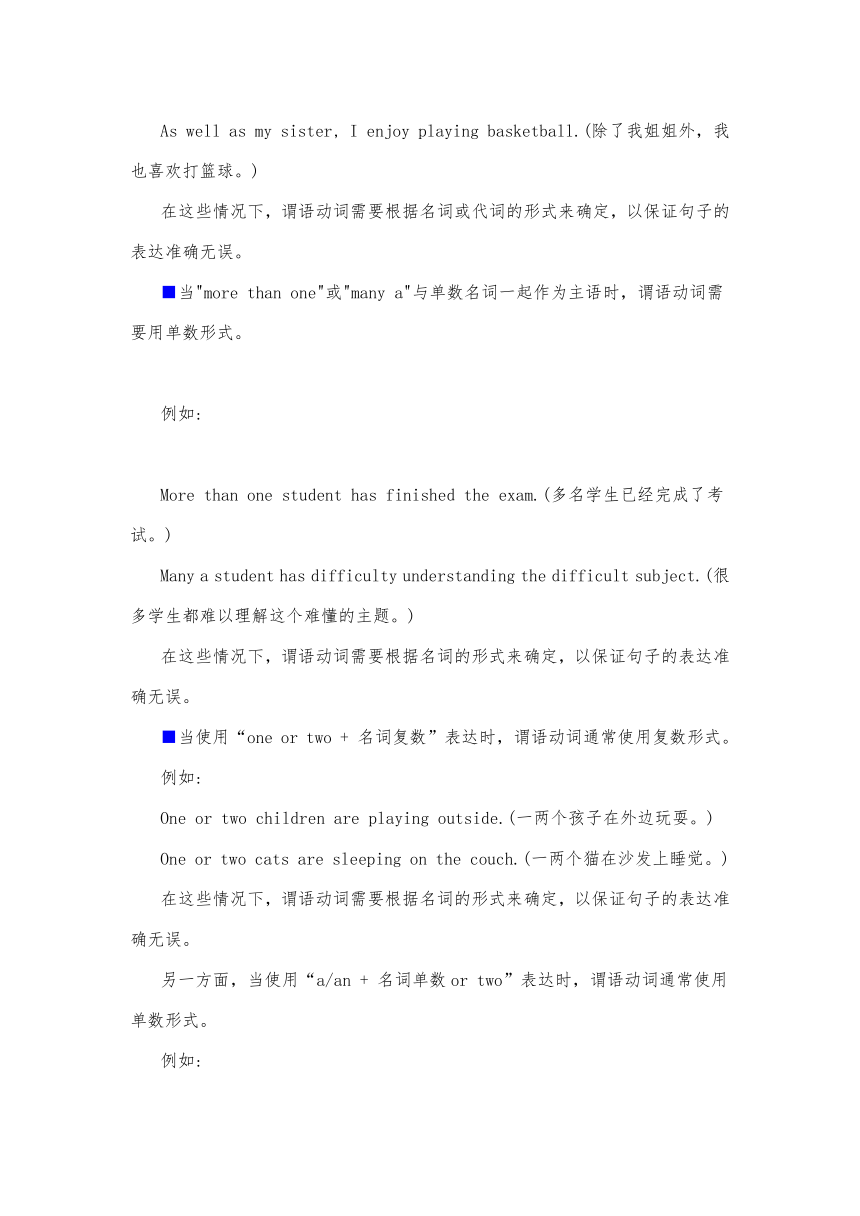
■名词或代词与由with, together with, along with, as well as, besides, but,except, including, in addition to, like, no less than, rather than等引起的短语一起作为主语时,谓语动词需要与前面的名词或代词的数一致。
例如:
With my friend, I went to the park.(我和我的朋友一起去了公园。)
Together with my colleagues, I worked on the project.(我和我的同事们一起完成了这个项目。)
As well as my sister, I enjoy playing basketball.(除了我姐姐外,我也喜欢打篮球。)
在这些情况下,谓语动词需要根据名词或代词的形式来确定,以保证句子的表达准确无误。
■当"more than one"或"many a"与单数名词一起作为主语时,谓语动词需要用单数形式。
例如:
More than one student has finished the exam.(多名学生已经完成了考试。)
Many a student has difficulty understanding the difficult subject.(很多学生都难以理解这个难懂的主题。)
在这些情况下,谓语动词需要根据名词的形式来确定,以保证句子的表达准确无误。
■当使用“one or two + 名词复数”表达时,谓语动词通常使用复数形式。
例如:
One or two children are playing outside.(一两个孩子在外边玩耍。)
One or two cats are sleeping on the couch.(一两个猫在沙发上睡觉。)
在这些情况下,谓语动词需要根据名词的形式来确定,以保证句子的表达准确无误。
另一方面,当使用“a/an + 名词单数or two”表达时,谓语动词通常使用单数形式。
例如:
A cat or two is sleeping on the couch.(沙发上有一两个猫在睡觉。)
在这些情况下,谓语动词需要根据名词的形式来确定,以保证句子的表达准确无误。
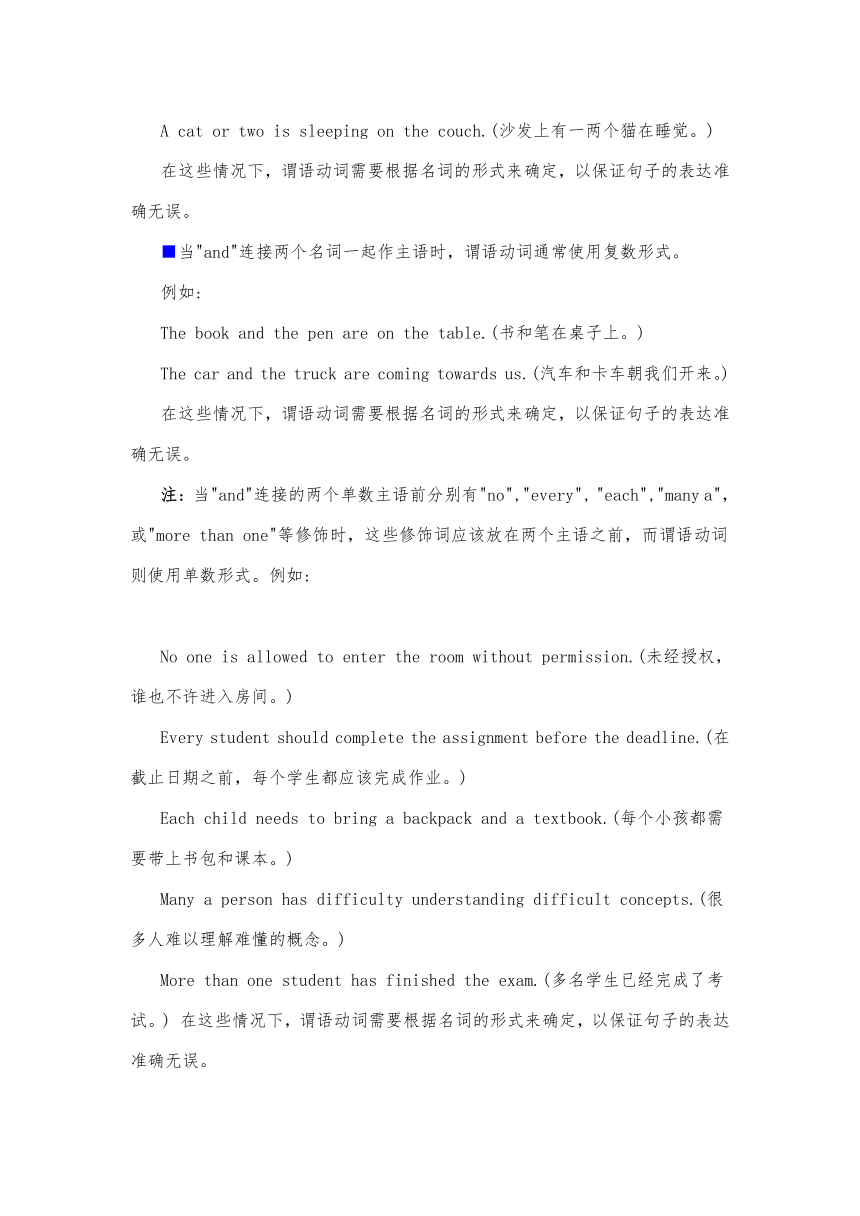
■当"and"连接两个名词一起作主语时,谓语动词通常使用复数形式。
例如:
The book and the pen are on the table.(书和笔在桌子上。)
The car and the truck are coming towards us.(汽车和卡车朝我们开来。)
在这些情况下,谓语动词需要根据名词的形式来确定,以保证句子的表达准确无误。
注:当"and"连接的两个单数主语前分别有"no","every", "each","many a",或"more than one"等修饰时,这些修饰词应该放在两个主语之前,而谓语动词则使用单数形式。例如:
No one is allowed to enter the room without permission.(未经授权,谁也不许进入房间。)
Every student should complete the assignment before the deadline.(在截止日期之前,每个学生都应该完成作业。)
Each child needs to bring a backpack and a textbook.(每个小孩都需要带上书包和课本。)
Many a person has difficulty understanding difficult concepts.(很多人难以理解难懂的概念。)
More than one student has finished the exam.(多名学生已经完成了考试。) 在这些情况下,谓语动词需要根据名词的形式来确定,以保证句子的表达准确无误。
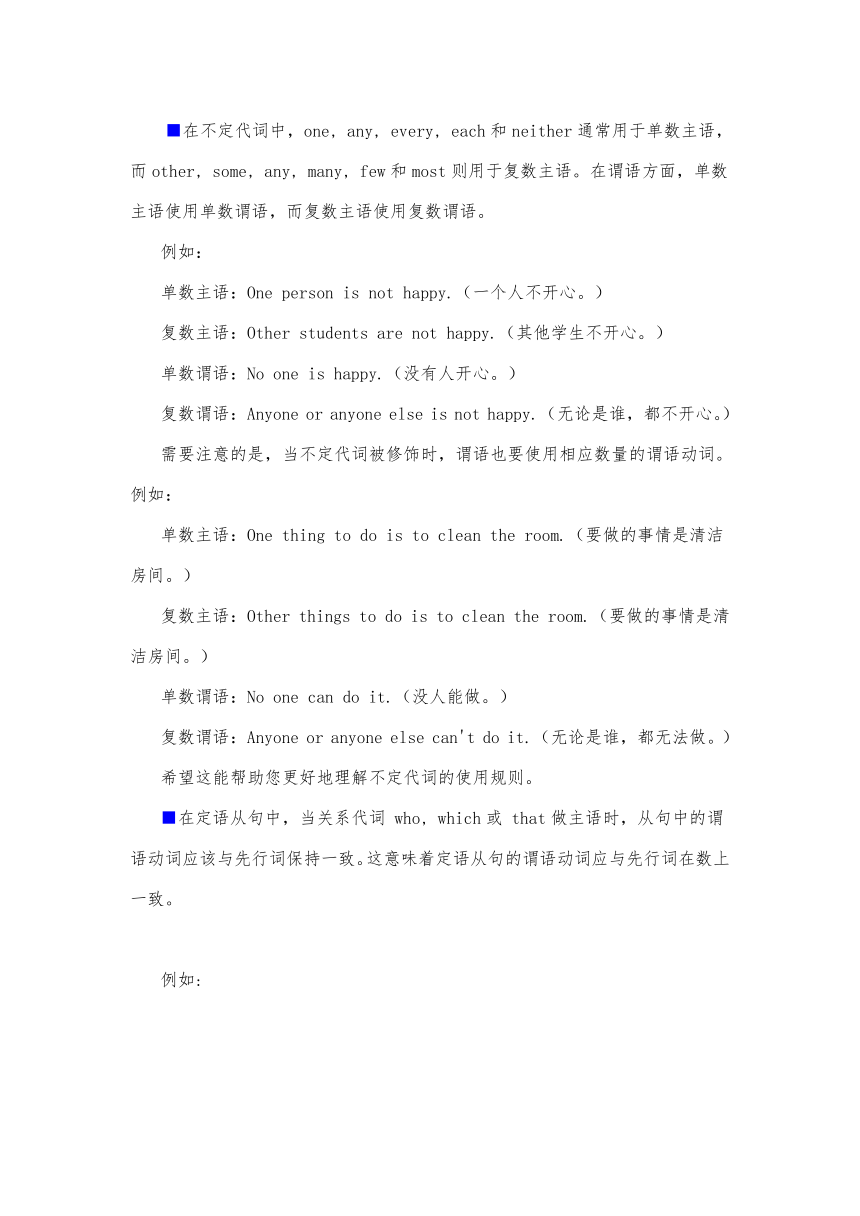
■在不定代词中,one, any, every, each和neither通常用于单数主语,而other, some, any, many, few和most则用于复数主语。在谓语方面,单数主语使用单数谓语,而复数主语使用复数谓语。
例如:
单数主语:One person is not happy.(一个人不开心。)
复数主语:Other students are not happy.(其他学生不开心。)
单数谓语:No one is happy.(没有人开心。)
复数谓语:Anyone or anyone else is not happy.(无论是谁,都不开心。)
需要注意的是,当不定代词被修饰时,谓语也要使用相应数量的谓语动词。例如:
单数主语:One thing to do is to clean the room.(要做的事情是清洁房间。)
复数主语:Other things to do is to clean the room.(要做的事情是清洁房间。)
单数谓语:No one can do it.(没人能做。)
复数谓语:Anyone or anyone else can't do it.(无论是谁,都无法做。)
希望这能帮助您更好地理解不定代词的使用规则。
■在定语从句中,当关系代词 who, which或 that做主语时,从句中的谓语动词应该与先行词保持一致。这意味着定语从句的谓语动词应与先行词在数上一致。
例如:
单数先行词: The book that I read last week was interesting.(我上周读的这本书很有趣。)
复数先行词: The books that I read last week were interesting.(我上周读的这本书们很有趣。)
需要注意的是,当关系代词 that在定语从句中作主语时,从句的谓语动词使用一般现在时态。而当关系代词 who在定语从句中作主语时,从句的谓语动词则使用现在时态。例如:
单数先行词: The teacher who taught us last week was good.(上周教我们的那个老师很好。)
复数先行词: The students who taught us last week were good.(上周教我们的那些学生都很好。)
希望这能帮助您更好地理解定语从句中的关系代词的使用规则。
■在英语中,当定语从句修饰一个名词复数时,谓语动词应该用复数形式。
例如:
One of the best places to visit in summer is the beach.(夏天去参观最好的地方之一是海滩。)
The one of the best places to visit in summer is the beach.(夏天去参观最好的地方之一是海滩。)
但是,当定语从句修饰一个名词单数时,谓语动词应该用单数形式。
例如:
One of the best places to visit in summer is the beach.(夏天去参观最好的地方之一是海滩。)
The (only) one of the best places to visit in summer is the beach.(夏天去参观最好的地方中,只有海滩是唯一的。)
需要注意的是, 当定语从句的引导词为 the only 时, 定语从句中的谓语动词使用单数形式。这是因为 the only 在定语从句中作为限定词,它表示唯一的意思, 而单数形式的谓语动词与它保持一致。
希望这能帮助您更好地理解英语定语从句的用法。
■当表示时间、距离、金额等度量的复数名词作主语,把它看作一个整体时,谓语动词一般用单数。当度量的复数名词作主语时,若强调每个单位,谓语动词用单数形式。例如:
The distance between the two cities is many thousands of miles. 两个城市之间的距离有好几千里。
注意,这种强调方式一般用于诗歌、文学等修辞手法中,现实生活中的语言表达不太常见。
■当由两个或多个部分组成的物品名词作主语时,谓语动词通常用复数形式。这是因为这些物品通常需要多个部件才能完成使用。例如:
These shoes are too small. 这批鞋子太小了。
I lost my glasses. 我丢了眼镜。
My Boots are too tight. 我的靴子太紧了。
These socks don't match. 这些袜子颜色不搭。
Can you cut these scissors in half 你能把这把剪刀剪成两半吗?
These compasses don't work properly. 这些指南针指南针不起作用。
My trousers need mending. 我的裤子需要缝补。
These shorts are too short. 这些短裤太短了。
■当“分数(百分数)+ of + 名词”以及“all (most, some, any, half, a lot, part, the rest) + of + 名词”做主语时,谓语动词的数应与of后名词的数一致。
例如:
A third of the population is female. 三分之一的人口是女性。
Most of the students are studying for exams. 大部分学生在备考。
None of us likes sweets. 我们当中没有人喜欢甜食。
Half of the money went to the charity. 一半的钱捐给了慈善机构。
A lot of people are interested in music. 很多人对音乐感兴趣。
Part of the building needs to be renovated. 一部分建筑需要翻新。
The rest of the team is waiting for instructions. 其余的队员在等指示。
需要注意的是,这种结构中的of后面接的是分数、百分号、all、most等表示数量的限定词,而不是of后面的名词。
■当“a (the, this, that) kind /sort / type of + 名词”做主语时,谓语动词通常用单数形式。例如:
A kind of music has a deep impact on people. 某种类型的音乐对人的情感有深刻影响。
A type of person may have a different approach to problem-solving. 某些人解决问题的方式可能不同寻常。
A sort of feeling comes over me when I see the sunset. 当我看到日落的时候,我会产生一种特殊的感觉。
而当“these (those, all, many, some) kinds of + 名词”做主语时,谓语动词则用复数形式。例如:
These kinds of problems need to be solved in the future. 这些类型的问题需要在将来得到解决。
These types of food are popular among people of all ages. 这些食品在全年龄段的人们中都很受欢迎。
These sorts of places can be very quiet and peaceful. 这些地方通常非常安静和宁静。
These kinds of situations require quick decisions. 这些情况下需要快速做出决策。
需要注意的是,这种结构中的kind、sort或type后接的名词通常指一种类别或类型的事物,而不是特指某一件或某些事物。
■是的,当“a number of + 复数名词”作主语时,谓语动词通常用复数形式。例如:
A number of students are studying for exams. 许多学生在备考。
A number of cars have been stolen. 许多汽车被盗了。
而当“the number of + 复数名词”作主语时,谓语动词通常用单数形式。例如:
The number of people who are interested in music is increasing. 对音乐感兴趣的人数量在增加。
The number of animals that have been killed is incredible. 被杀的动物数量令人难以置信。
需要注意的是,这种结构中的of后面接的是number这个表示数量的限定词,而不是of后面的名词。

展开更多......

收起↑

资源预览