牛津译林版(2020) 必修第一册 Unit 1 Back to School Extended reading教案(表格式)

资源下载
  1. 二一教育资源

牛津译林版(2020) 必修第一册 Unit 1 Back to School Extended reading教案(表格式)

资源简介

《英语》(必修·第一册)
Unit 1 Back to school
Extended reading
I. Learning objectives
By the end of the lesson, the students will be able to:
locate and describe some specific information related to the school life in the UK;
compare the similarities and differences between school life in the UK and in China;
verbalize their own ideal school by describing its facilities, courses, faculties and others and explain the reasons.
II. Key competence focus
1. Compare school life in the UK and that in China.
III. Predicted areas of difficulty
1. Understand the author’s attitude towards school life in the UK.
2. Write a narration about dream school by employing what has been learnt.
IV. Teaching procedures
steps procedures reflection
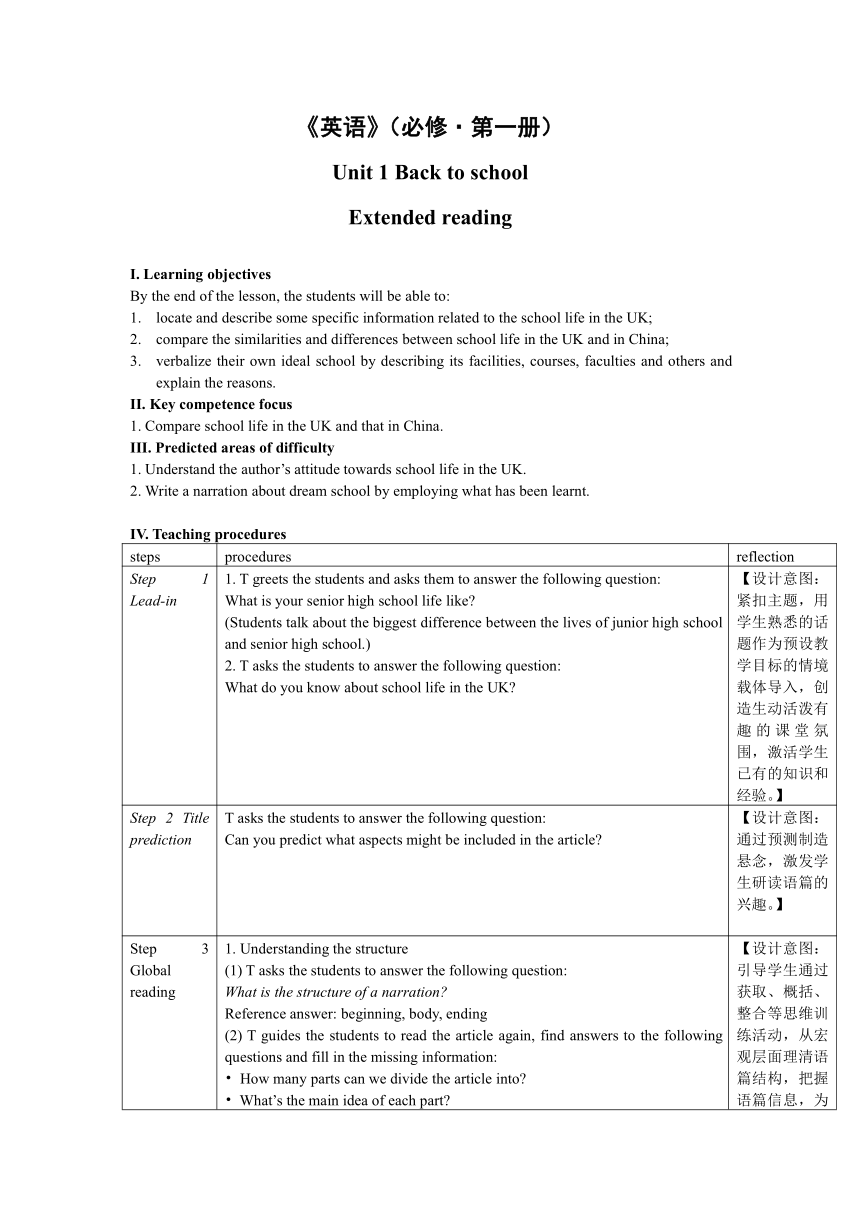
Step 1 Lead-in 1. T greets the students and asks them to answer the following question: What is your senior high school life like (Students talk about the biggest difference between the lives of junior high school and senior high school.) 2. T asks the students to answer the following question: What do you know about school life in the UK 【设计意图:紧扣主题,用学生熟悉的话题作为预设教学目标的情境载体导入,创造生动活泼有趣的课堂氛围,激活学生已有的知识和经验。】
Step 2 Title prediction T asks the students to answer the following question: Can you predict what aspects might be included in the article 【设计意图:通过预测制造悬念,激发学生研读语篇的兴趣。】
Step 3 Global reading 1. Understanding the structure (1) T asks the students to answer the following question: What is the structure of a narration Reference answer: beginning, body, ending (2) T guides the students to read the article again, find answers to the following questions and fill in the missing information: How many parts can we divide the article into What’s the main idea of each part Beginning (Part 1) Para. ______ _________ to the school life in the UK Body (Part 2) Paras. ______ Different _________ of the school life in the UK Ending (Part 3) Para. ______ _________ 【设计意图:引导学生通过获取、概括、整合等思维训练活动,从宏观层面理清语篇结构,把握语篇信息,为进一步挖掘语篇深层信息搭建“脚手架”。培养学生查找处理信息的能力。】
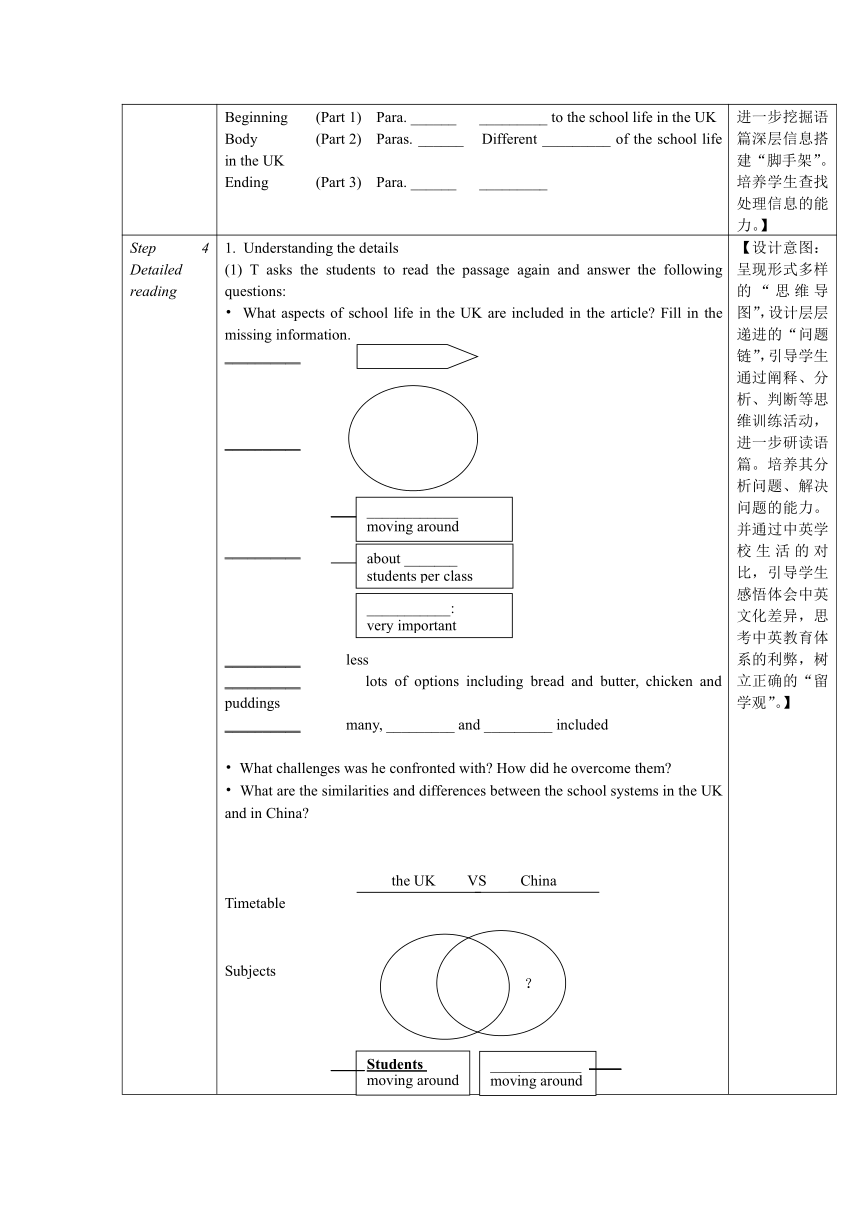
Step 4 Detailed reading Understanding the details (1) T asks the students to read the passage again and answer the following questions: What aspects of school life in the UK are included in the article Fill in the missing information. __________ __________ (
____________ moving around
) (
about _______
students per class
)__________ (
___________:
very important
) __________ less __________ lots of options including bread and butter, chicken and puddings __________ many, _________ and _________ included What challenges was he confronted with How did he overcome them What are the similarities and differences between the school systems in the UK and in China
the UK VS China (
9:00-16:00

)Timetable (

) Subjects (
____________ moving around
) (
Students
moving around
) (
About _______
Ss per class
) (
About
20
Ss per class
) Classes (
Discussion
:
____________
_
) (
Discussion
:
very important
) (
lots of options including bread and butter, chicken and puddings
)Homework Less More School lunch (
Many, including the Rugby Club and the Theatre Club
) Clubs (2) T guides the students to reflect on the following question: Some people think school life in the UK is superior to that in China. What is your opinion 【设计意图:呈现形式多样的“思维导图”,设计层层递进的“问题链”,引导学生通过阐释、分析、判断等思维训练活动,进一步研读语篇。培养其分析问题、解决问题的能力。并通过中英学校生活的对比,引导学生感悟体会中英文化差异,思考中英教育体系的利弊,树立正确的“留学观”。】
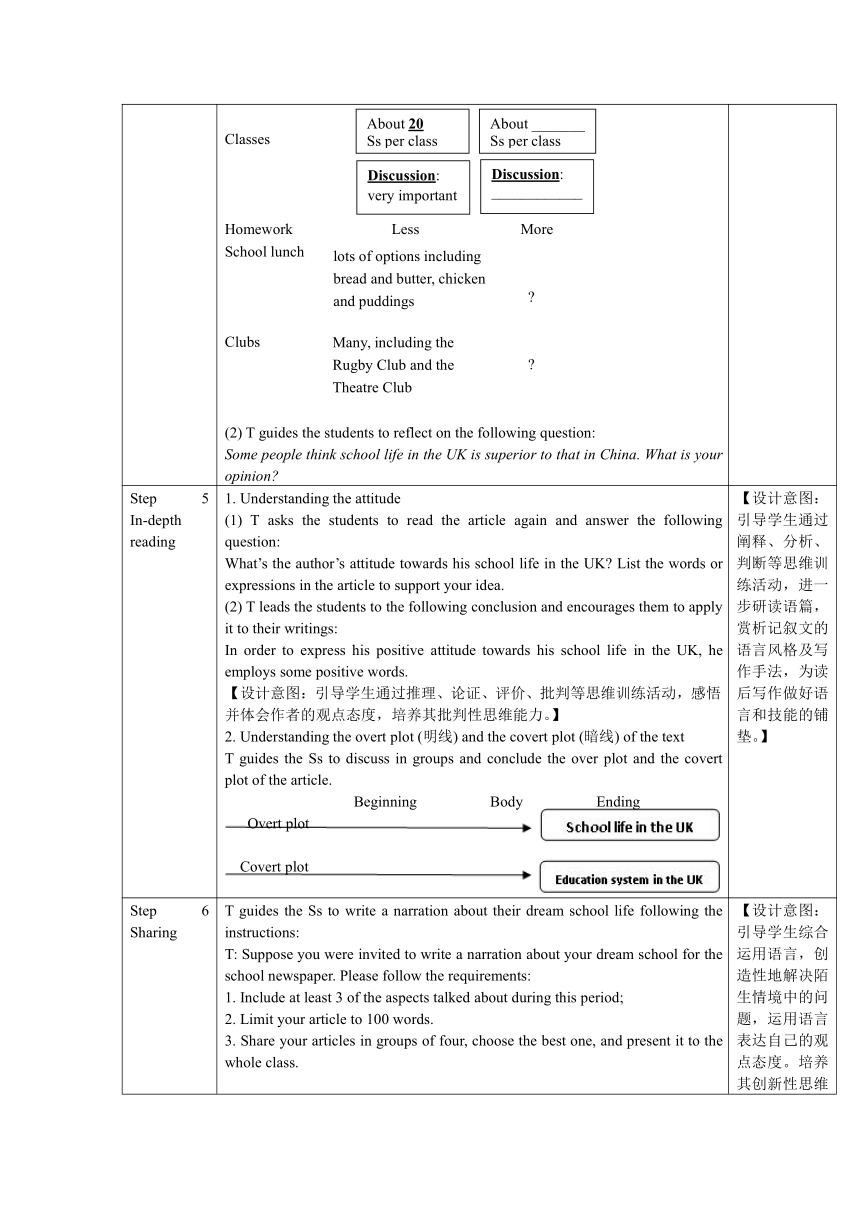
Step 5 In-depth reading 1. Understanding the attitude (1) T asks the students to read the article again and answer the following question: What’s the author’s attitude towards his school life in the UK List the words or expressions in the article to support your idea. (2) T leads the students to the following conclusion and encourages them to apply it to their writings: In order to express his positive attitude towards his school life in the UK, he employs some positive words. 【设计意图:引导学生通过推理、论证、评价、批判等思维训练活动,感悟并体会作者的观点态度,培养其批判性思维能力。】 2. Understanding the overt plot (明线) and the covert plot (暗线) of the text T guides the Ss to discuss in groups and conclude the over plot and the covert plot of the article. Beginning Body Ending Overt plot Covert plot 【设计意图:引导学生通过阐释、分析、判断等思维训练活动,进一步研读语篇,赏析记叙文的语言风格及写作手法,为读后写作做好语言和技能的铺垫。】
Step 6 Sharing T guides the Ss to write a narration about their dream school life following the instructions: T: Suppose you were invited to write a narration about your dream school for the school newspaper. Please follow the requirements: 1. Include at least 3 of the aspects talked about during this period; 2. Limit your article to 100 words. 3. Share your articles in groups of four, choose the best one, and present it to the whole class. 【设计意图:引导学生综合运用语言,创造性地解决陌生情境中的问题,运用语言表达自己的观点态度。培养其创新性思维能力,实现能力向素养的转化,实现“深度学习”。】
3. exchange
原文: I hadthe chance to study at a British secondary school as an exchange student. 我有机会作为交换生在英国的一所中学学习 (教材P11)
◆n. 交换;交流;交易 vt. 交换;交易;兑换
exchange sth for sth 以某物交换某物
exchange sth with sb 和某人交换某物
make an exchange 交换
in exchange for 以… 交换…
①Juliet and David exchanged glances (= they looked at each other) .
朱丽叶和戴维相互看了看对方。
②I shook hands and exchanged a few words with the manager.
我与经理握手,相互交谈了几句。
③Would you like my old TV in exchange for this camera
用我的旧电视机换这架照相机,你愿意吗?
【跟踪典例】
①I’ve never ______________________ those moms.
我从来没和那些妈妈们说过话。
②Would you like my old TV ______________________________
用我的旧电视机换这架照相机,你愿意吗?
【答案】①exchanged words with ②in exchange for this camera
4. alarm alarming adj. 令人担忧的,令人恐惧的 alarmed adj. 担忧的;恐惧的
原文:I liked it so much that I still use it as my alarm. 我是那么喜欢它以至于我仍然通它做闹铃。(教材P11)
◆ n.闹钟;恐慌;警报;警报器 vt. 使恐慌,使害怕
raise/ sound the alarm 拉响警报
in alarm 惊恐地
be alarmed at/ by 对…惊恐/ 担忧
be alarmed to do sth 害怕做某事
①When I saw the smoke, I tried to sound the alarm.
看到烟后,我就设法发出警报。
②What have you done ' Ellie cried in alarm.
“你都干了些什么?”埃利惊恐地喊道。
③The disease has spread at an alarming rate.
这种疾病已经以惊人的速度传播开来。
【跟踪典例】 完成句子
①__________________ in the middle of the night .
半夜里一辆汽车的警报器突然响了起来
②She shrieked____________ when she saw the mouse.
她看见老鼠时惊恐地尖声喊叫起来。
③Our countryside is disappearing _________________.
我们的农村地区正在以惊人的速度消亡。
【答案】
①A car alarm went off ②in alarm ③at an alarming rate
5. contribution contribute vt. 贡献;捐赠;投稿 contributor n. 贡献者;投稿者;捐助者
原文:…But I could not make much of a contribution. … 但是我能做的贡献不多 (教材P11)
◆n.贡献;捐赠;捐款;投稿
contribute to 有助于;导致,促成;
contribute … to … 向… 投稿/ 捐赠
make (great) contributions to 对…做出(巨大的)贡献
①We contributed £5 000 to the earthquake fund.
我们向地震基金捐赠了 5 000 英镑。
②The three sons also contribute to the family business.
3个儿子也为家族企业做贡献。
③ Learning English makes contributions to one's development to some extent.
英语也为个人发展做出一定得贡献。
【跟踪典例】
①We're not saying that everyone needs to ___________________________.
我们并不是要每个人都必须为穷人奉献生命。
②I believe that each of us can ______________ the future of the world.
我相信我们每一个人都能为世界的未来做出贡献。
②I persuaded myself that I could _______________________________.
我相信我能为祖国作出贡献。
【答案】①contribute their lives to the poor ②contribute to ③make contributions to the motherland 6. fortunately fortune n. 财富;命运;运气 fortunate adj. adj. 幸运的;吉利的
misfortune n. 不幸 unfortunate adj. unfortunately adv.
原文:Fortunately, my teachers and classmates were always helpful and gave me lots of encouragement. 幸运的是,我的老师和同学们一直乐于助人,给了我很多鼓励。 (教材P12)
◆adv. 幸运的;辛亏
make a fortunate 发财
try one’s fortunate 碰运气
be fortunate in 在某方面幸运
be fortunate to do sth. 有幸做某事
①I was late, but fortunately the meeting hadn't started.
我迟到了,不过幸好会议还没有开始。
②I was fortunate to be one of the lucky user.
我有幸成为幸运网友之一。
③We became companions in misfortune.
我们成了患难之交。
2. so…that… 引导结果状语从句
原文: I like it so much that I still use it as my alarm!我是那么的喜欢它以至于我仍然拿它当闹钟!(教材P11)
【句式分析】
本句中“so…that…”意为 “如此…以至于…”so是副词,修饰形容词或副词;that引导结果状语从句。具体形式如下:
so + adj./adv + that 从句
so +adj.+ a/an+ 可数名词单数 + that 从句
so + many/ few/ much/ little + 可数名词复数/ 不可数名词 + that 从句
①The stone is so heavy that I can‘t lift it up.
②This is so important a meeting that you should attend it.
③There were so many people in the street watching the fire that firefighters could not get close to the building.
备注: so that 也可以连在一起使用;可引导目的状语从句和结果状语从句;引导目的状语从句相当于 “in order that”
①She burned the letters so that her husband would never read them.
②You've adjusted the microscope so that it reflects!
such… that… 中such 常用来修饰名词,具体形式如下:
such + a/an + adj. + 可数名词单数 + that从句
such + adj. + 不可数名词 + that从句
such + adj. + 可数名词复数 + that从句
①She is such a good teacher that all of us love and respect her.
②It was such bad weather that I had to stay at home.
③They are such interesting books that I want to read them once more.
【跟踪典例】翻译句子
他是如此聪明的一个孩子以至于老师们都很喜欢他
① _________________________________________
② _________________________________________
【答案】 ①He is so clever that teachers like him very much.
②He is such a clever boy that teachers like him very much.

展开更多......

收起↑

资源预览