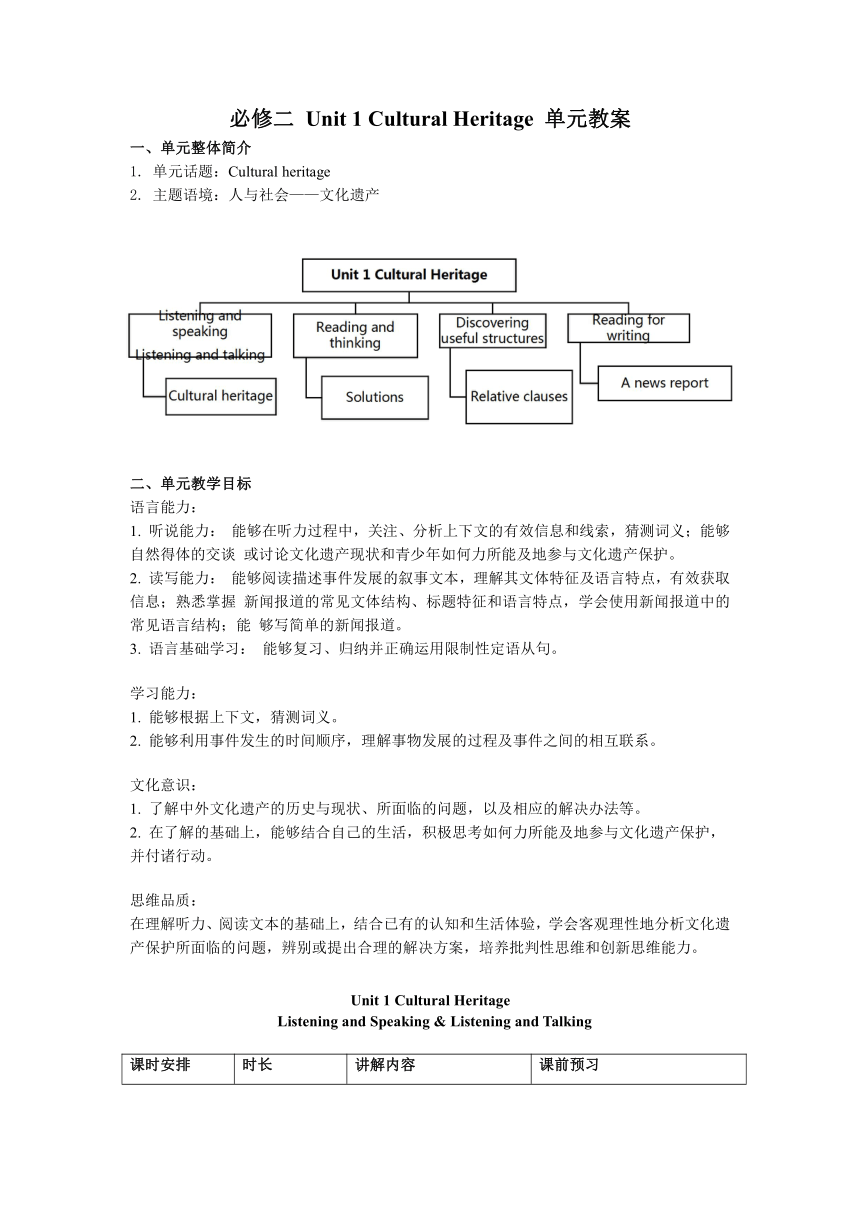
资源简介 必修二 Unit 1 Cultural Heritage 单元教案一、单元整体简介1. 单元话题:Cultural heritage2. 主题语境:人与社会——文化遗产二、单元教学目标语言能力:1. 听说能力: 能够在听力过程中,关注、分析上下文的有效信息和线索,猜测词义;能够自然得体的交谈 或讨论文化遗产现状和青少年如何力所能及地参与文化遗产保护。2. 读写能力: 能够阅读描述事件发展的叙事文本,理解其文体特征及语言特点,有效获取信息;熟悉掌握 新闻报道的常见文体结构、标题特征和语言特点,学会使用新闻报道中的常见语言结构;能 够写简单的新闻报道。3. 语言基础学习: 能够复习、归纳并正确运用限制性定语从句。学习能力:1. 能够根据上下文,猜测词义。2. 能够利用事件发生的时间顺序,理解事物发展的过程及事件之间的相互联系。文化意识:1. 了解中外文化遗产的历史与现状、所面临的问题,以及相应的解决办法等。2. 在了解的基础上,能够结合自己的生活,积极思考如何力所能及地参与文化遗产保护,并付诸行动。思维品质:在理解听力、阅读文本的基础上,结合已有的认知和生活体验,学会客观理性地分析文化遗 产保护所面临的问题,辨别或提出合理的解决方案,培养批判性思维和创新思维能力。Unit 1 Cultural HeritageListening and Speaking & Listening and Talking课时安排 时长 讲解内容 课前预习1课时 45分钟 教材 P2 ,P3,P7 学生自主完成教材中的题目。教材分析Listening and speaking介绍的是保护文化遗产的一个青年组织,成员们在制作一个推介泰山及保护泰山文化遗产的应用软件。Listening and talking介绍莫斯科的著名文化遗产建筑,总结如何开始对话的套路。必修二比起必修一,语言难度的层面有所提高,从听力难度入手,开始注意影响听力难度的不同层面,除此之外,仍然注重语篇,注重从上下文获取信息。教学目标与核心素养1. Guide students to understand the content of listening texts in terms of the whole and key details;2. Cultivate students’ ability to guess the meaning of words in listening; discuss with their peers how to participate in cultural heritage protection activities.3. Instruct students to use functional sentences of the dialogue such as “I beg your pardon, but…” “Forgive me for asking, but…” and so on to start the conversation more politely and appropriately.教学重难点1. Cultivate students’ ability to guess the meaning of words in listening;2. Guide students to understand the content of listening texts in terms of the whole and key details;教学资源教材,课件PPT,课时练教学方法1. Cooperative Teaching Method,2. Task-based language teaching教学过程Part1 Listening and SpeakingStep1 Leading-in1. Discuss the issues related to the Opening page.2. What does the word “heritage” mean Share your ideas about your understanding and you can use examples to illustrate your meaning.设计意图从主题图入手,以学生熟悉的长城作为切入点导入文化遗产的话题。让学生进一步熟悉主题语境。Step 2: Pre-listeningAfter their small talk, the teacher can ask students to predict what the listening text is about by looking at the pictures.设计意图让学生在问题的指引下,学会听前预测,带着目的去积极的听对话,为听力理解奠定基础。Step3 while-Listening1. Listen to the conversation for the first time and sum up the main idea.Youths from seven countries are working together to protect cultural relics on Mount tai.2. Listen again and get the details of the conversation.3. Guessing the meaning of the unknown wordsListen to the conversation again and use the context to guess the meaning of the words below. And tell the reasons why you guess so.Preserve PromotePreserve: to protectReason: the word means the same of a word I know.Promote: to help sth to happen or developReason: The word is explained by the speaker.设计意图1. 学生听第1遍录音核实听前预测,同时记下关键词,根据关键词选择听力对话大意。2. 利用上下文猜测词义是一项很重要的学习策略,教师要注意结合文本语境的着重培养。Step3 Post-listeningSpeaking1. Work in pairs or groups and role play a conversation.Suppose you are a reporter and interviewing the students who devote their time to protecting the heritage.Reporter: It is said that you are one of the volunteers to preserve the pine trees on Mount Huang. What are you guys doing Volunteer: We are making some signs which are designed to educate people to protect the pine trees.Volunteer: Besides, we took a lot of pictures of pine trees and create an app which aims to promote people’s awareness of protecting the precious trees.Reporter: Sounds great and anything else Volunteer: We often wear volunteer clothes and send some brochures in the park to call on more people to protect the trees.Reporter: Does your hard work pay off Volunteer: Definitely. More and more tourists are now stopping carving names on the trees or climbing the trees.设计意图激发学生保护文化遗产的责任感,激活学生的创造性思维为,为单元后续内容作话题上的铺垫。Step4 Pronunciation1.Play the recording of Activity 1, have students identify the words they hear, and guide them to distinguish the subtle differences between several consonant clusters with similar pronunciations.2. Please gather some tongue twisters online and reinforce the pronunciation knowledge of this lesson by practicing reading aloud.设计意图学生通过听和朗读体会辅音连缀的发音,通过听和模仿达到巩固提升的目的。Part 2: Listening and Talking教学过程Step1 Leading-inUse the pictures in the book to discuss the Kremlin and Red Square.What do you know about the Kremlin and Red Square 设计意图让学生看此部分配图,并预测对话中要谈论的内容,为下面听的任务做准备。Step2 Listening1. Listen to the conversation and choose the correct answers to activity 1 on page 7.2. Listen again and complete the fact sheet.3. Practice using the relevant clauses.设计意图训练学生捕捉关键词的能力,同时也训练学生通过关键词获取重要信息的能力。让学生关注听力对话里的启动交谈的礼貌用语,为后面的口语活动做准备。Step3 Talking1. Work in groups. Choose a cultural site that you like and role-play a conversation between some tourists and their tour guide. Take turns to play the different roles.2. Expressions used to start a conversation politely and properly:I beg your pardon, but…Forgive me for asking, but …Excuse me, but what is … Excuse me Could you please tell me about … Do/Did you know ... I see that you are ...设计意图训练学生在新的语境中运用启起交谈的语言结构。帮助学生在口头交际中比较准确的体得进行表达。HomeworkWrite a summary of the conversation about Kremlin and Red Square.Try to use some relative clauses as much as possible.设计意图帮助学生巩固对话内容,训练学生的写作能力。板书设计Unit 1 Cultural HeritageListening and Speaking & Listening and TalkingExpressions used to start a conversation politely and properly:I beg your pardon, but…Forgive me for asking, but …Excuse me, but what is … Excuse me Could you please tell me about … Do/Did you know ... I see that you are ...教学反思本节课优点:教学内容完成,实现了既定的教学目标,学生在思考和输出的环节有参与互动和分享。本节课缺点:学生没有充分调动起来,输出环节时间安排略显仓促。本节课需要完善的地方:需要利用早自习补充音标知识。 展开更多...... 收起↑ 资源预览
 资源预览
资源预览
 资源预览
资源预览