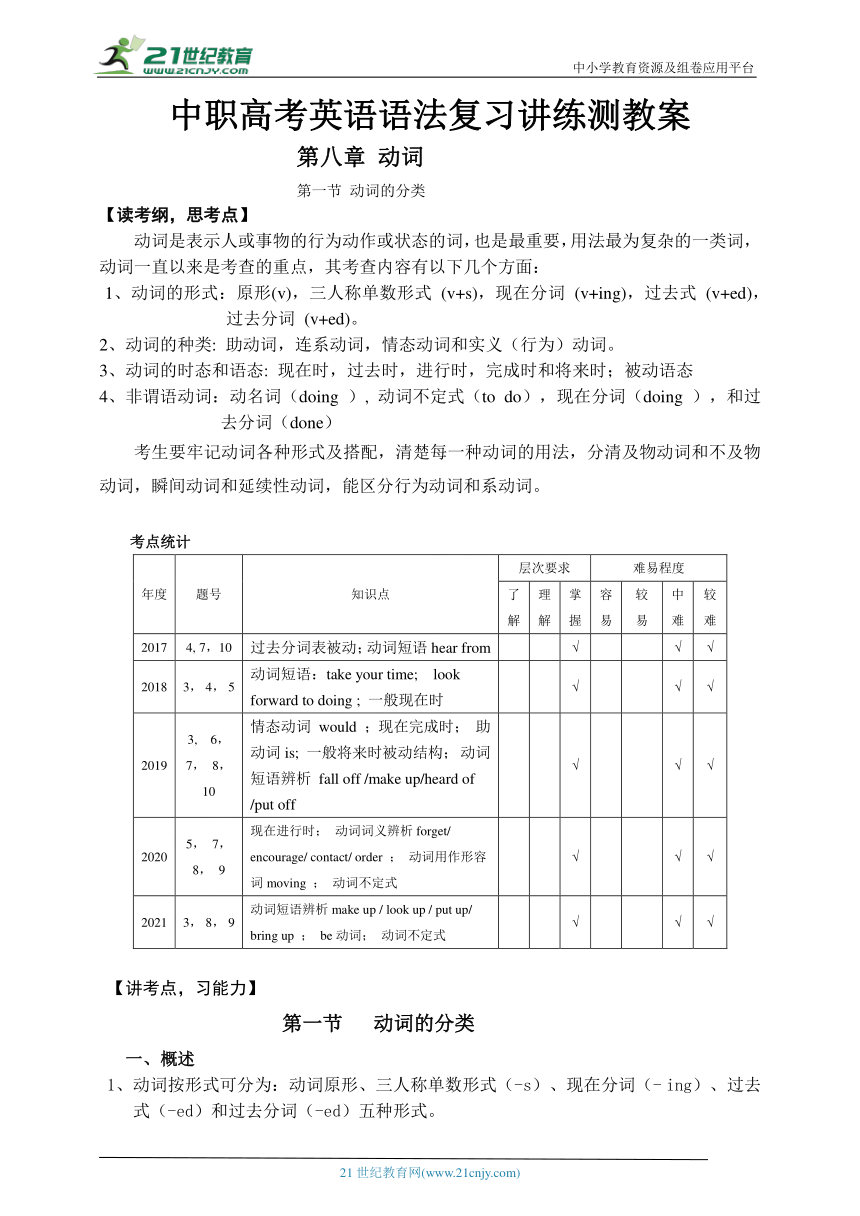
第八章 动词 第一节 动词的分类教案-中职高考英语语法复习讲练测

资源下载
  1. 二一教育资源

第八章 动词 第一节 动词的分类教案-中职高考英语语法复习讲练测

资源简介

中小学教育资源及组卷应用平台
中职高考英语语法复习讲练测教案
动词
第一节 动词的分类
【读考纲,思考点】
动词是表示人或事物的行为动作或状态的词,也是最重要,用法最为复杂的一类词,动词一直以来是考查的重点,其考查内容有以下几个方面:
1、动词的形式:原形(v),三人称单数形式 (v+s),现在分词 (v+ing),过去式 (v+ed),过去分词 (v+ed)。
2、动词的种类: 助动词,连系动词,情态动词和实义(行为)动词。
3、动词的时态和语态: 现在时,过去时,进行时,完成时和将来时;被动语态
4、非谓语动词:动名词(doing ), 动词不定式(to do),现在分词(doing ),和过去分词(done)
考生要牢记动词各种形式及搭配,清楚每一种动词的用法,分清及物动词和不及物动词,瞬间动词和延续性动词,能区分行为动词和系动词。
考点统计
年度 题号 知识点 层次要求 难易程度
了解 理解 掌握 容易 较易 中难 较难
2017 4, 7,10 过去分词表被动;动词短语hear from √ √ √
2018 3, 4, 5 动词短语:take your time; look forward to doing ; 一般现在时 √ √ √
2019 3, 6, 7, 8, 10 情态动词 would ;现在完成时; 助动词is; 一般将来时被动结构; 动词短语辨析 fall off /make up/heard of /put off √ √ √
2020 5, 7, 8, 9 现在进行时; 动词词义辨析forget/ encourage/ contact/ order ; 动词用作形容词moving ; 动词不定式 √ √ √
2021 3, 8, 9 动词短语辨析make up / look up / put up/ bring up ; be动词; 动词不定式 √ √ √
【讲考点,习能力】
第一节 动词的分类
一、概述
1、动词按形式可分为:动词原形、三人称单数形式(-s)、现在分词(- ing)、过去式(-ed)和过去分词(-ed)五种形式。
2、动词按性质、词义和在句子中的作用分为:助动词、连系动词、情态动词和实义动词(行为动词)
3、动词按在句子中的功能分为:谓语动词和非谓语动词。
4、动词按发生的时限还可分为:延续性动词和非延续性动词(短暂性动词)
如下表:
动词 按性质分 实义动词(也称行为动词) 及物动词 watch , study
不及物动词 go , look
系动词 be , look , smell , sound
助动词 do , have
情态动词 might , must , can , may
按时限分 延续性动词 see , stay , live , write
非延续性动词(瞬间动词) buy , open , die
二、动词基本形式
1. 动词原形
动词原形用于一般现在时,一般将来时,情态动词后,祈使句和动词不定式中,如:do, study, work , play , drive , use,guess , relax 等。
2. 第三人称单数形式
在一般现在时中,主语为第三人称单数时,谓语动词后要加s或es,其变化规则如下:
(1)一般情况下在动词后加s,如work—works, write—writes
(2)以o, s, x, sh, ch结尾的动词,后加es,如do—does, guess—guesses,
mix—mixes, finish—finishes, catch—catches, watch -- watches
(3) 以辅音字母加y结尾的动词,改y为i再加es,如study—studies, try—tries
cry—cries , carry — carries
注:不规则变化的单词有:have — has , be — is 等
3. 现在分词(V-ing)
现在分词的构成:
(1)一般情况下在动词后直接加-ing , 如:
study—studying ; work—working; wash—washing
(2)以不发音的字母e结尾的动词,先去掉e再加ing,如
write—writing ; move—moving ; have—having
dance -- dancing ; make -- making ; arrive—arriving
注:see—seeing (直接加ing )
(3) 以重读闭音节结尾的动词,要双写末尾字母,再加ing , 如:
get—getting ; begin—beginning ; prefer—preferring
stop – stopping ; regret – regretting ; forget – forgetting
(4) 以ie结尾的动词,一般将ie改为y,再加ing,如:
lie—lying 躺; die—dying 死; tie—tying 拴,系
注:以l结尾的动词,尾音节重读时,双写l,如control—controlling;尾音节不重读时,可双写也可不双写,如travel—traveling (美) / travelling(英)
4. 过去式和过去分词(V-ed)
过去式和过去分词的构成:
(1)规则变化
① 一般情况直接加ed,如ask—asked, work—worked, help--helped
② 以不发音的e结尾,只加d,如love—loved , dance—danced
③ 以辅音字母加y结尾,把y变为i,再加ed,如try—tried, study—studied
④ 以重读闭音节结尾的动词,先双写末尾的辅音字母,再加ed, 如:
stop—stopped permit—permitted plan --planned
control—controlled (控制) travel—travelled / traveled (旅行)
另外,还有很多动词的过去式和过去分词是不合乎上述规则的,需要熟记。
(2)不规则变化
过去式和过去分词的不规则变化需单独记忆。
常见不规则动词的变化规律归纳如下:
① A—A—A型,即原形、过去式和过去分词三者都相同,如:
cost—cost—cost cut—cut—cut hit—hit—hit hurt—hurt—hurt let—let— let put—put—put
read—read—read set—set—set shut—shut—shut
② A—B—B型,即过去式、过去分词相同, 如:
bring—brought—brought build—built—built catch—caught—caught keep—kept—kept tell—told—told smell—smelt—smelt
mean—meant—meant say—said—said meet—met—met
win—won—won hang—hung—hung leave—left—left
③ A—B—C型,即原形、过去式、过去分词都不相同,如:
begin—began—begun drink—drank—drunk sing— sang—sung
know—knew—known drive—drove—driven write—wrote—written break—broke—broken fall—fell—fallen fly—flew—flown
④ A—A—B型,即过去式和原形相同。
beat—beat—beaten
⑤ A—B—A型,即过去分词和原形相同,如:
come—came—come become—became—become run— ran—run
⑥ 情态动词,只有原形和过去式,没有过去分词,如:
can—could may—might will—would shall—should
注:更多的不规则变化动词见书后附录2
【经典例题】
【例1】He often ______ to the park once a week.
A. go B. goes C. went D. going
解析:B本题考查动词的形。句意:他经常每周去一次公园。根据时间often 和 once a week 可知时态用一般现在时,主语是三人称单数 he , 谓语动词加s , 故选B
【例2】Mike ______ his best to finish the task , but failed.
A. try B. tries C. tried D. trying
解析:C本题考查动词的过去式,try 的过去式是tried,故选C
【例3】The People’s Republic of China ______on 1 October, 1949.
A. found B. was found C. was founded D. were founded
解析:C本题考查一般过去时被动语态,was/were +过去分词,found的意思是“建立,成立”,过去分词是founded ,故选C
另外find(找到,发现)的过去式和过去分词分别是found , found
【例4】Liz is excited . She _____ to Japan with her mom.
A. has gone B. goes C. is going D. is gone
解析:C 本题考查进行时。根据上下文可知,利兹激动是因为将要跟她妈妈去日本,用现在进行时表示即将发生的事情,故选C
【例5】Mr. Wang does what he can _______ us improve our English.
A. help B. helped C. helping D. to help
解析:D本题考查非谓语动词—不定式。句意:张先生尽力帮助我们提高英语。此句中what he can 是动词does的宾语,后面用动词不定式to help表示做事的目的,故选D
有同学可能会误选A,以为can后应接动词原形,要仔细审题,弄清楚句子的结构和含义。
【试一试】1
( ) 1. Honey, don’t _____. Everything will be OK.
A. worried B. be worry C. worry D. worrying
( ) 2. The students are busy _______ the classroom now.
A. cleans B. to clean C. clean D. cleaning
( ) 3. My mother ____ a walk after supper every day .
A. take B. takes C. took D. taken
( ) 4. I have _____ English for about 5 years .
A. study B. studying C. studies D. studied
( )5. The coat _____ me two hundred yuan .
took B. spent C. cost D. paid
三、各类动词的用法
1、助动词
助动词本身无词义或意义不完整,不能单独作谓语,只能与主要动词一起构成谓语,表示不同的时态、语态,表示句子的否定、疑问及答语。
常见的助动词有:
(1)be 及其变形:be , am /is / are ; was / were
I am not a student any more. 我不再是个学生了。
My English teacher is tall and handsome. 我的英语老师高大英俊。
Where were you when the bell rang 铃响的时候你在哪儿?
Are you from China 你是中国人吗
Yes , I am . 是的,我是。
(2)do / does ; did
do / does构成一般现在时; did 构成一般过去时
I don’t like eating junk food .我不喜欢垃圾食品。
My father doesn’t go to work on weekends . 我的爸爸周末不上班。
Did you stay up late last night 昨晚你熬夜了吗?
注意:陈述句中的do , does , did 用于加强语气,不是用作助动词。
Lily does study hard . 莉莉确实学习很努力。
I did know that result. 我确实知道那个结果。
Do come to my birthday party . 一定要来参加我的生日派对。
(3)have / has ; had
have/ has 用于构成现在完成时; had 构成过去完成时
I have seen the movie twice . 我看过这部电影两次。
We haven’t finished learning Unit One . 我们还没学完第一单元。
Have you ever been to HongKong 你曾去过香港吗?
No , never. 没有,从来没去过。
The train had left when he got to the railway station.
当他赶到车站时,火车已经开走了。
(4)will / would ; shall / should
Will / would 用于一般将来时、过去将来时;用于第一人称疑问句征求对方意愿。
We will have sports meet next week .下周我们要开运动会。
Mother said we would buy a new house . 妈妈说我们要买新房子。
Shall we go shopping after school? 放学后我们去逛街好吗?
【经典例题】
【经典例题】
【例1】We _____ go out because it was raining hard .
A. don’t B. won’t C. didn’t D. haven’t
解析:C本题考查一般过去时中行为动词否定,用“didn’t+原形,故选C
【例2】How_____ you read novels online
A. do B. does C. is D. are
解析:A本题考查助动词。行为动词的疑问句用助动词do 或does,第三
人称单数用does, 其余的人称和数用do,此句主语是you , 故选A
【例3】--_____ you heard from you parents recently ?
-- No , I haven’t
A. Do B. Are C. Will D. Have
解析:D本题考查助动词。根据答语“No , I haven’t”可知上句问句中的助
动词为have , 故选D
2. 连系动词
系动词是表示主语“是什么”或“怎么样”的词。它虽有词义,但不完整,所以不能单独作谓语,必须跟表语一起构成合成谓语。例如:
We are in Grade Eight this year. 今年我们上八年级。(are意为“是”)
注:are的词义 “是” 在句子中常常不翻译。
系动词可具体分为以下几类:
(1)表“是”的词,如 be (是,在); seem(好像是,似乎是);例如:
He is a teacher. 他是个教师。
He was a soldier two years ago. 两年前他是个士兵。
The students are in the classroom. 学生们在教室里。
We are Chinese. 我们是中国人。
She seems (to be) happy today . 她今天看起来很高兴。
(2)表感观的词,如look(看起来),feel(觉得,摸起来),smell(闻起来),sound(听起来),taste(尝起来)等。例如:
She looked tired.她看上去很疲劳。
I feel ill. 我觉得不舒服。
Cotton feels soft. 棉花摸起来很软。
The story sounds interesting. 这个故事听起来很有趣。
The flowers smell sweet. 这些花闻起来很香。
The medicine tasted horrible. 这药水太难喝了。
③ 表示“变”、“变成”的词,如become, get, grow, turn,come, go 都译作“变”、“变得”。例如:
She became a college student. 她成了一名大学生。
He feels sick. His face turns white. 他感到不舒服,脸色苍白。
The weather gets warmer and the days get longer when spring comes.
春天来了,天气变得暖和些了,白天也变得长些了。
He grew old. 他老了。
I believe my dream will come true. 我相信我的梦想会实现。
Meat can go bad easily in summer. 肉在夏天很容易变坏。
(4)表“保持, 停留”意思的词,keep , stay , remain ; 例如:
Please keep quiet in the library. 请在图书管里保持安静。
The bridge remains good for over 100 years.这座桥100多年来一直完好无损。
(5)表“结果是”的词,turn out 结果是, prove 证明是; 例如:
The show turned out to be very successful. 这次演出非常成功。
【经典例题】
【例1】You ____ beautiful in red .
sound B. look C. see D. looking
解析:B 本题考查连系动词。句意:你穿红色衣服看上去真漂亮。A. sound
听起来B. look 看上去C. see 看见D. looking 看上去, 此句为一般现在时,动词用原形,排除D项,根据句意B项符合,故选B
【例2】The dress ______ soft and comfortable.
feels B. looks C. smells D. sounds
解析:A 本题考查连系动词。句意:这条裙子摸起来又软又舒服。A.feel
感受到,触摸;B. look 看上去;C. smell闻起来;D. sound 听起来,此句soft and comfortable柔软又舒服,只能是感受到的,故选A
【例3】People here _____ very friendly.
A. be B. is C. am D. are
解析:D 本题考查系动词用法。句意:这儿的人们非常友好。根据句意和主语people 人民,人们(复数), 排除了A B C 项,故选D
【试一试】2
( )1.How ____ the weather in your hometown
A. be B. is C. am D. are
( ) 2. Do come to my party , _______
A. are you B. do you C. will you D. can you
( ) 3. You ____ very upset today . What's the matter .
A. looking B. seems C. be D. seem
( )4.Mr.Li _____ teach us English next term.
A. isn’t B. doesn’t C. hasn’t D. won’t
( )5.The little boy always ______ silent when asked a question.
keep B. kept C. keeps D. to keep
3. 情态动词 ( 具体用法见本章第四节 )
情态动词表示说话人的能力、语气或态度,本身有意义,但不完整,必须和动词原形一起构成谓语。常见的情态动词有:can , may , must , need , should , ought to , dare , could , might等。例如:
I can dance and she can sing . 我会跳舞, 她会唱歌。(can意为“ 能,会”)
You mustn’t smoke here. 你不准在这儿抽烟。( mustn’t意为 “不准,不许” )
May I come in?我可以进来吗?( may意为 “可以” )
4. 实义动词(行为动词)
实义动词是表示行为,动作或状态的词,其词义完整,可以单独作谓语。实义动词根据动作发生的时间和状态又有时态和语态之分(具体用法见本章第二节、第三节)。
(1)及物动词和不及物动词
能带带宾语的是及物动词,不能带宾语的动词是不及物动词。 如:
I have a round face. 我有一张圆圆的脸。(have“有、拥有”,及物动词)
Our family lives in Beijing . 我们一家住在北京(live“住,居住”,不及物动词)
(2)谓语动词和非谓语动词 (具体用法见本章第五节)
(3)瞬间动词和延续性动词
瞬间动词:
表示一个动作发生在一瞬间,非常短暂。亦称终止性动词或短暂性动词。常见的瞬间动词和动词短语有begin, start, finish, go, come, leave, find, get up, arrive, reach, get to, enter, hear, stop, open, close, become, buy, borrow, lend, happen, join, lose, renew, die, take away, put up, set out, put on, get on/off等。
延续性动词:
表示一个动作可以持续一段时间或更长时间。常见的有study, play, do, read, learn, drive, write, clean, sleep, speak, talk, wait, fly, stay, write, sit, stand, lie, keep等。
常用瞬间动词对应的延续性动词如下:
go—be away come—be here
come back—be back leave—be away (be not here)
buy—have borrow—keep
die—be dead begin—be on
finish—be over open—be open
close—be closed lose—be lost
get to know—know turn on—be on
get up—be up sit down—sit/be seated
join—be in …或be a … member become—be
【试一试】3
( ) 1. Peter , hurry up! Your teacher _______for you in the office.
A. wait B. waits C. is waiting D. waited
( ) 2. Don't waste your time on the games. This report needs____.
A. finish B. finishing C. to finish D. finished
( ) 3.-- Don’t forget ______ your homework to school tomorrow .
-- Yes , we will .
A. bring B. brings C. to bring D. bringing
( )4. You should stop when the traffic light ______ red.
A.is turning B. turned C. will turn D. turns
( )5. Her grandmother ______ for 10 years.
A. die B. has died C. was dead D. has been dead
短语动词
英语中还有许多短语动词,它们在意义上是一个整体,其用法有的相当于及物动词,有的相当于不及物动词,有的兼具二者的特征。动词短语和固定搭配在平常需要积累,对于容易混淆的短语要放在一起记忆。在答题时,要注意结合上下文理解句子意思
常见的短语动词如:
动词+介词
agree with同意...的意见 arrive at / in到达 ask for请求,要求
begin with以...开始 belong to属于 come from来自
fall behind落后 get to到达 get on上车
hear from收到...来信 laugh at嘲笑 look after照顾;照料
look for寻找 talk about谈论 wait for等待
动词+名词+介词
have a look at看一看 make use of利用 make friends with与...交朋友
pay attention to注意 take part in参加 take care of照看
动词+副词
come across偶然遇见 come out出现;结果是 eat up吃光
fall down跌落 find out找出;查明 give up放弃
go on继续 get back回来;回复 go home回家
grow up成长;长大 hurry up快点 hold on坚持;等一等
put up挂起;举起 run away逃跑 try on试穿
turn off关闭 take out拿出 think over仔细考虑
动词+副词+介词
catch up with赶上 do well in在...做得好 go on with继续
get on with与...相处 keep up with赶上;跟上
look forward to盼望;期待
动词+形容词+介词
be angry with生某人的气 be afraid of 害怕
be crazy about着迷于… be famous for因...而著名
be good at在...方面好 be good / bad for有益 / 害于
be interested in对...感兴趣 be proud of因...而骄傲
be ready for为...做准备 be tired of厌烦
【经典例题】
【例1】We usually go to bed at 9 pm and ______ at 6 am.
A. get up B. get away C. get in D. get off
解析:A本题考查动词短语辨析。A. get up 起床,B. get away离开,出发 C. get in 进入;收获D. get off下车,句意:我们通常晚上9点睡觉,早上6点起床, A项符合句意,故选A。
【例2】Please _____ your book and turn to Page 51.
A. take up B. take out C. take off D. take down
解析:B本题考查动词短语辨析. A. take up从事,参与 B.take out拿出 C. take off 脱下;起飞,D.take down 拿下,取下,句意:拿出你们的书,翻到P51页,B项符合句意, 故选B。
【例3】You shouldn't ____ your hope. Everything will be better.
A. give up B. fix up C. cheer up D. put up
解析:A本题考查动词短语辨析。A. give up放弃,B. fix up安排、修理, C. cheer up(使)高兴起来,D. put up举起、张贴, 此句意是:不要放弃希望,一切都会好的,A项符合句意,故选A
【试一试】4
( ) 1. You must ______ smoking. It’s bad for your health.
A. give away B. give up C. give out D. give off
( ) 2.We spent almost an hour just ______ the bus.
A. waiting for B. paying for C. leaving for D. taking for
( ) 3. I am writing to _____ the position of sales manager in your company.
A. ask for B. pay for C. apply for D. look for
( ) 4. I think I have ______ weight. I need to take more exercise.
A. put off B. put in C. put up D. put on
( )5. The students work hard and they often ________ to study until midnight.
A. turn up B. dress up C. wake up D. stay up
21世纪教育网 www.21cnjy.com 精品试卷·第 2 页 (共 2 页)
21世纪教育网(www.21cnjy.com)

展开更多......

收起↑

资源预览