【核心素养目标】Unit 2 What time do you go to school Section B(3a-Self Check)表格式教案

资源下载
  1. 二一教育资源

【核心素养目标】Unit 2 What time do you go to school Section B(3a-Self Check)表格式教案

资源简介

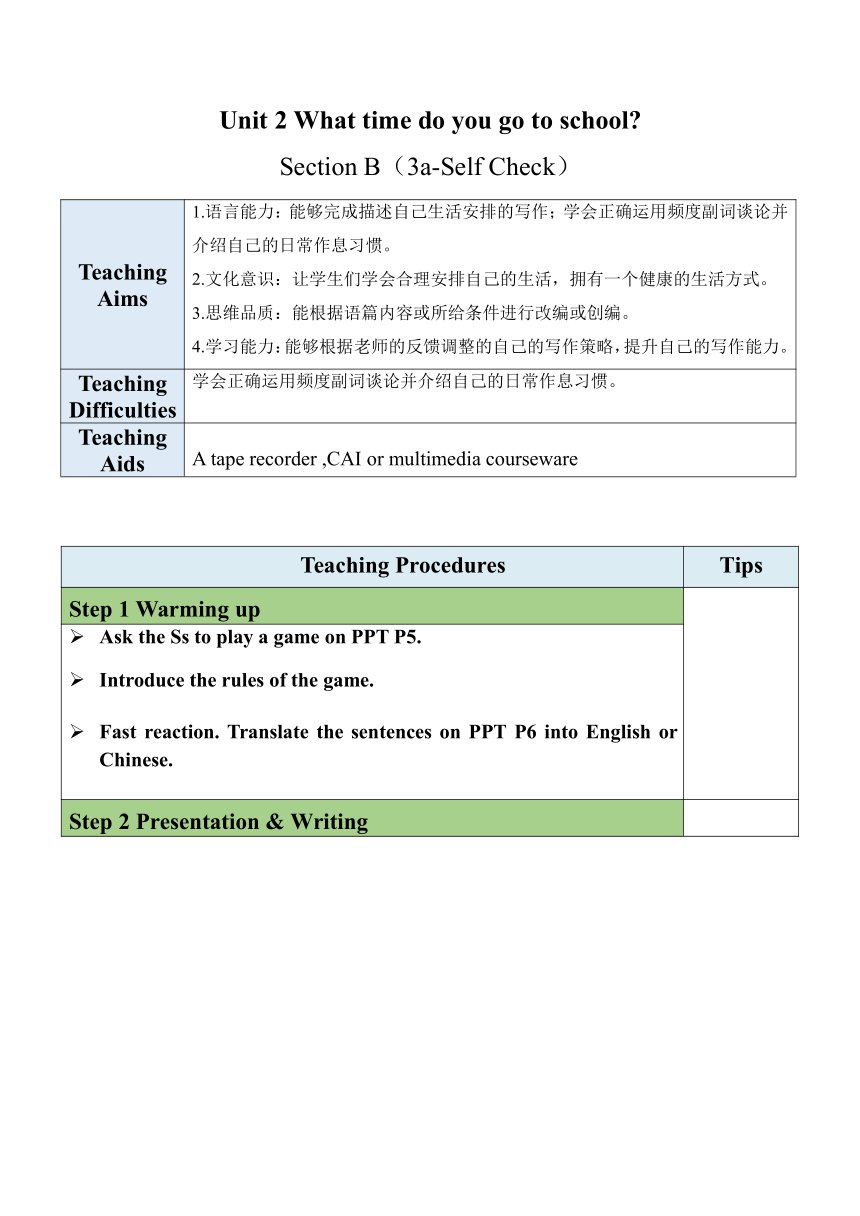
Unit 2 What time do you go to school
Section B(3a-Self Check)
Teaching Aims 1.语言能力:能够完成描述自己生活安排的写作;学会正确运用频度副词谈论并介绍自己的日常作息习惯。 2.文化意识:让学生们学会合理安排自己的生活,拥有一个健康的生活方式。 3.思维品质:能根据语篇内容或所给条件进行改编或创编。 4.学习能力:能够根据老师的反馈调整的自己的写作策略,提升自己的写作能力。
Teaching Difficulties 学会正确运用频度副词谈论并介绍自己的日常作息习惯。
Teaching Aids A tape recorder ,CAI or multimedia courseware
Teaching Procedures Tips
Step 1 Warming up
Ask the Ss to play a game on PPT P5. Introduce the rules of the game. Fast reaction. Translate the sentences on PPT P6 into English or Chinese.
Step 2 Presentation & Writing
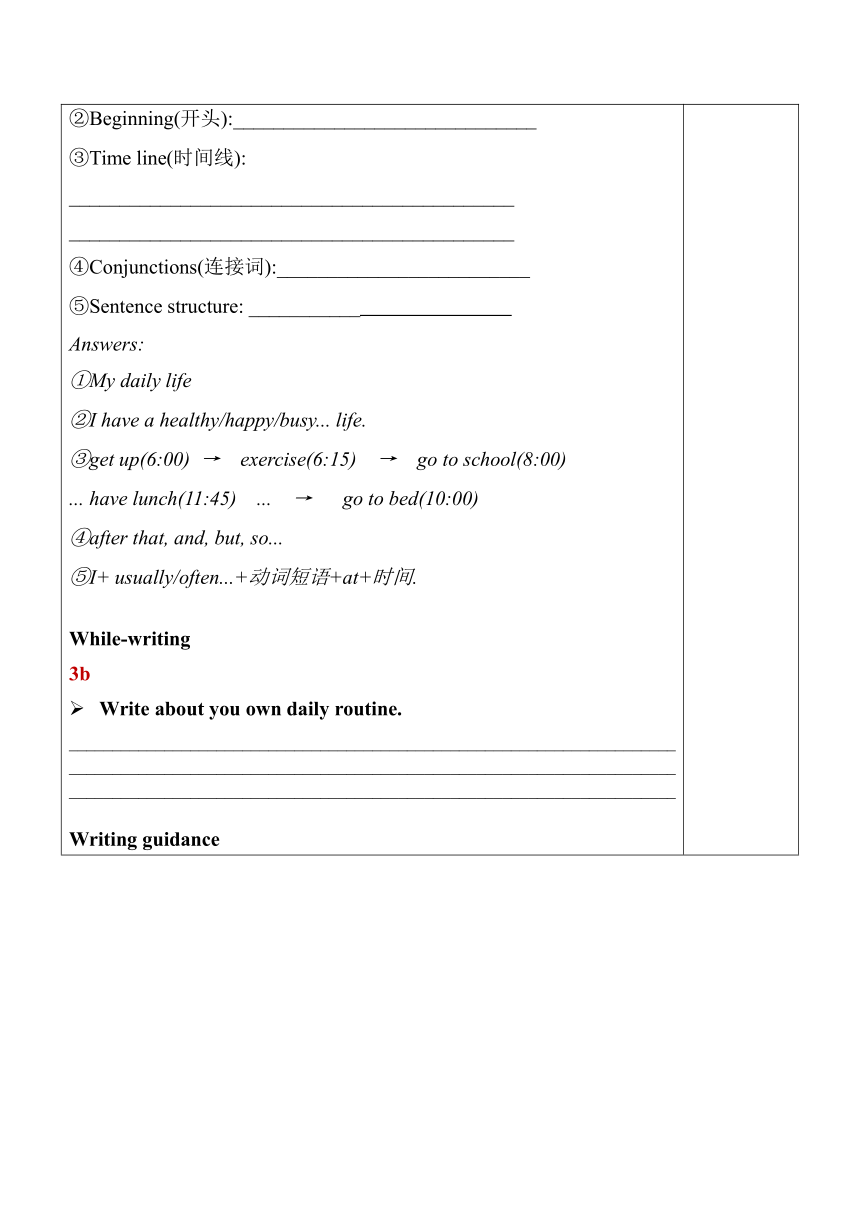
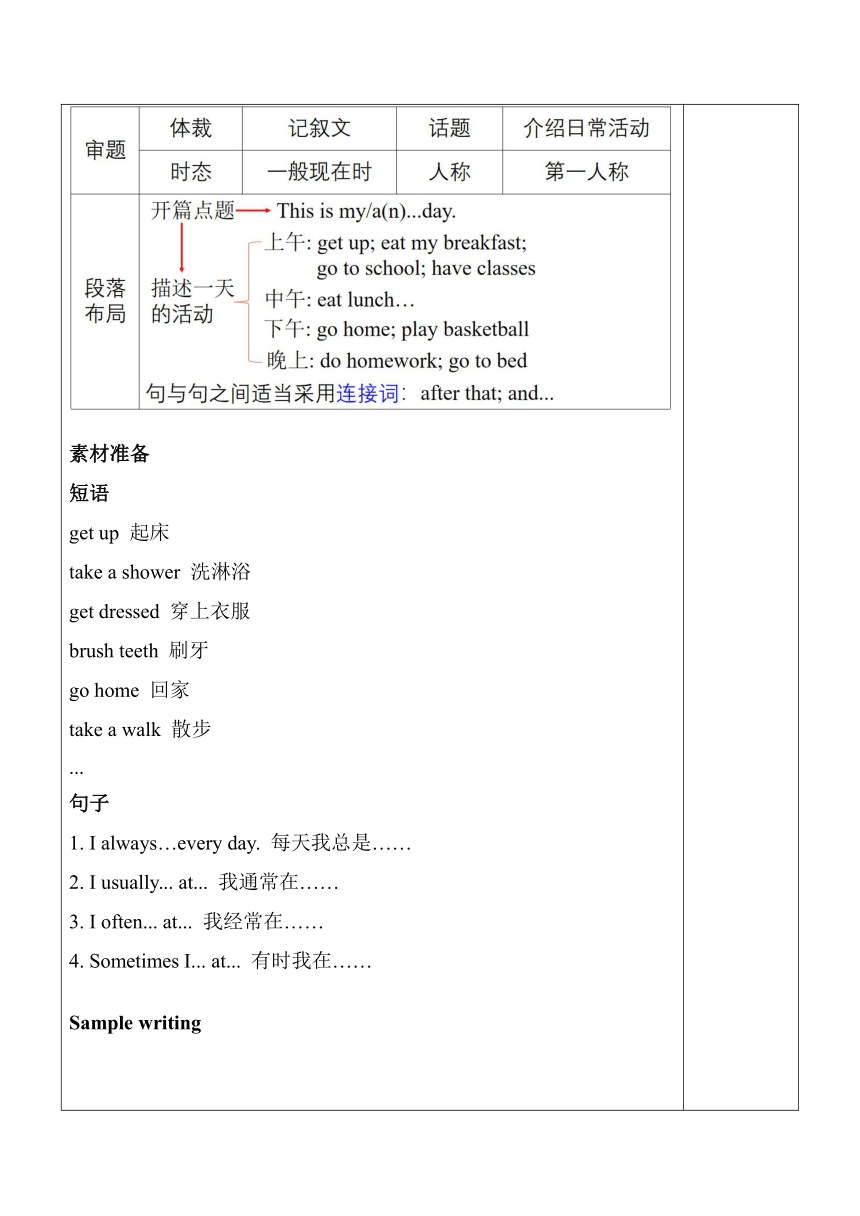
Pre-writing Exercising is good for us. Do you think so Do you usually exercise When do you usually exercise Ask the Ss to read these sentences and understand their meanings. 3a Number these sentences in order to make a story about a daily routine. 3 I usually exercise from six fifteen to seven. 2 I always get up at six. 5 After that, I always brush my teeth and go to school at eight. 4 Then I quickly have a shower and eat breakfast. 6 I have lunch at a quarter to twelve. 7 I get home from school at half past four and do my homework. 1 _ I have a very healthy life. 8 I have dinner at seven thirty. 9 I go to bed at ten. Read the passage. My daily life I have a very healthy life. I always get up at six. I usually exercise from six fifteen to seven. Then I quickly have a shower and eat breakfast. After that, I always brush my teeth and go to school at eight. I have lunch at a quarter to twelve. I get home from school at half past four and do my homework. I have dinner at seven thirty. I go to bed at ten. Read the passage again. Then fill in the chart. ①Title(标题):______________________ ②Beginning(开头):______________________________ ③Time line(时间线): ____________________________________________ ____________________________________________ ④Conjunctions(连接词):_________________________ ⑤Sentence structure: ___________ Answers: ①My daily life ②I have a healthy/happy/busy... life. ③get up(6:00) → exercise(6:15) → go to school(8:00) ... have lunch(11:45) ... → go to bed(10:00) ④after that, and, but, so... ⑤I+ usually/often...+动词短语+at+时间. While-writing 3b Write about you own daily routine. __________________________________________________________________________________________________________________________________________________________________________________________________________________ Writing guidance 素材准备 短语 get up 起床 take a shower 洗淋浴 get dressed 穿上衣服 brush teeth 刷牙 go home 回家 take a walk 散步 ... 句子 1. I always…every day. 每天我总是…… 2. I usually... at... 我通常在…… 3. I often... at... 我经常在…… 4. Sometimes I... at... 有时我在…… Sample writing
Step 3 Self Check
1 Ask the Ss to match the verbs in column A with the words in column B. Then use the phrases to complete the sentences. taste your teeth clean my room have a walk get good take dressed brush a good job 1. Ice-cream usually tastes good so students like to eat it after school. 2. My grandparents are very healthy. They always take a walk after dinner. 3.You need to brush your teeth after eating to have good teeth. 4. He has a good job. He works at a radio station. 5. Here are your clothes. Go and get dressed quickly! 6. I don’t have time to clean my room from Monday to Friday. So I clean it on weekends. 2 Complete the conversations with questions and answers. Use the words in brackets to help you. 1. A: _______________________________________________ (your mother/usually/get up) B: _______________________________________________. (5:45) A: _______________________________________________ (why/get up/so early) B: ________________________________________________. (always/make breakfast for me) 2. A: _______________________________________________ (you/usually/get to school) B: _______________________________________________. (7:30) A: _______________________________________________ (your class teacher/usually/get to school) B: I don’t know. But he/she is never late for the first class in the morning. Answer: 1.What time does your mother usually get up She usually gets up at 5:45 in the morning Why does she get up so early Because she always makes breakfast for me 2.What time do you usually get to school I usually get to school at 7:30 in the morning What time does your class teacher usually get to school Read the two conversations. A:What time does your mother usually get up B:She usually gets up at 5:45 in the morning. A:Why does she get up so early B:Because she always makes breakfast for me. A:What time do you usually get to school B:I usually get to school at 7:30 in the morning. A:What time does your class teacher usually get to school B:I don’t know. But he/she is never late for the first class in the morning.
Step 4 Language points learning
1. I have a very healthy life. 我过着非常健康的生活。 healthy adj. 健康的 【用法详解】 healthy的反义词为unhealthy(不健康的)。 keep healthy意为“保持健康”。 We should eat more healthy food to keep healthy. 我们应该多吃健康食品来保持健康。 【拓展延伸】health作不可数名词,意为“健康”。 be in good/poor health意为“健康状况良好/不好”。 My grandpa is in poor health. 我爷爷健康状况不好。 life n. 生活;生命 【用法详解】 (1)life在此处作名词,意为“生活”,have/live a(n)...life意为“过着……的生活”。 Now, we Chinese have/live a happy life. 现在,我们中国人过着幸福的生活。 (2)life作名词时,还可意为“生命;一生”,in one’s life 意为“在某人的一生中”。 My parents are the most important people in my life. 父母是我一生中最重要的人。 2. Here are your clothes. 这是你的衣服。 倒装句 【用法详解】本句是倒装句,即谓语在主语之前,正常语序为“Your clothes are here.”。当here, there等位于句首且主语为名词时,句子要用倒装语序,谓语动词应与后面的主语在数上保持一致。 Here rings the bell. 铃响了。 【拓展延伸】以here或there开头的句子,如果主语是人称代词,则句子不倒装。 Here you are. 给你。 Here he comes. 他来了。 The language points are for reference only.
Step 5 Summary & Homework The homework can vary with the specific conditions.
Summary Ask the Ss to do exercises on PPT P24-P26. Homework Remember the words, expressions and sentences in this unit. Preview Unit 3 Section A (1a-1c).
Teaching Reflection This is the period for writing practice. In this period, we help the students to review the unit and tell them how to write their daily routines. Before writing, the students talk about their daily routines so that they have enough expressions to use. Then they learn what are in the first, second and third part of the article. That is to get the students to write what they have learned in listening, speaking and reading.

展开更多......

收起↑

资源预览