【核心素养目标】Unit 2 What time do you go to school? Section B(1a-1e)表格式教案

资源下载
  1. 二一教育资源

【核心素养目标】Unit 2 What time do you go to school? Section B(1a-1e)表格式教案

资源简介

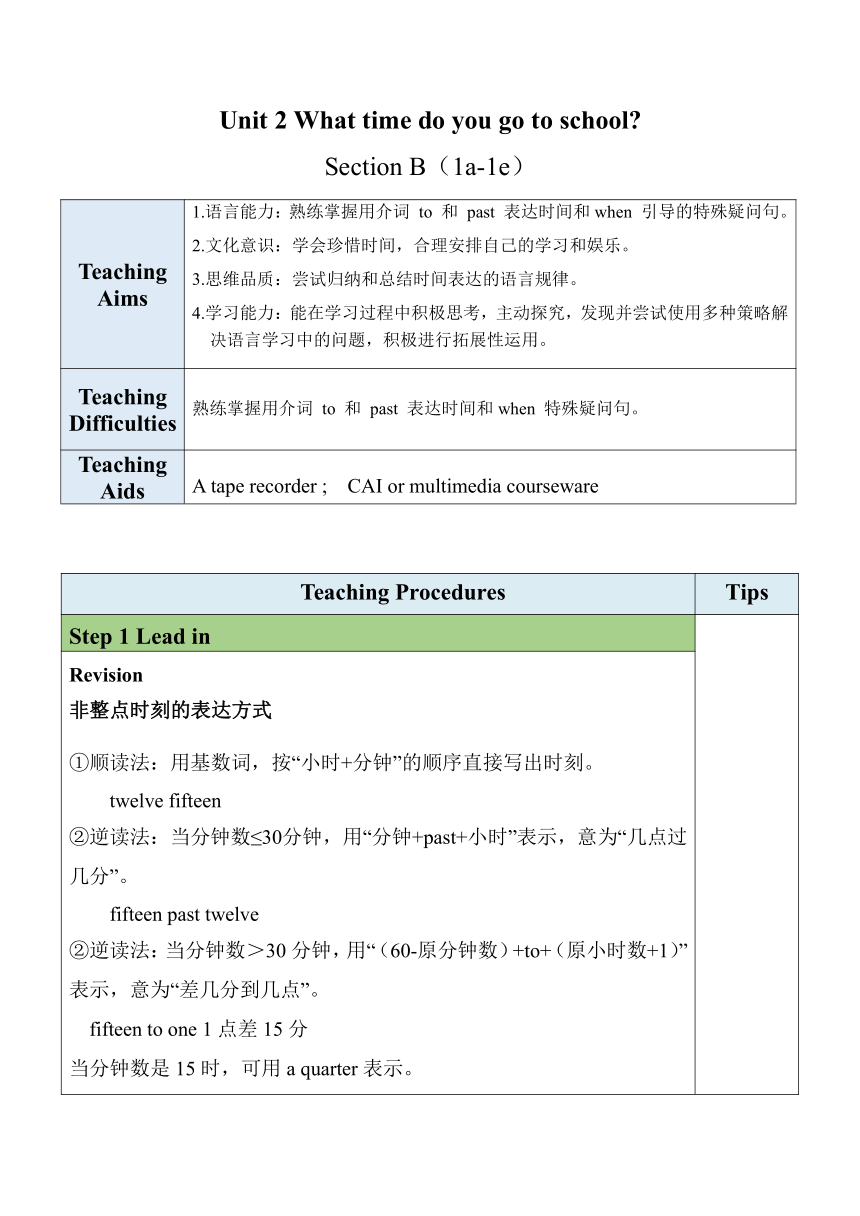
Unit 2 What time do you go to school
Section B(1a-1e)
Teaching Aims 1.语言能力:熟练掌握用介词 to 和 past 表达时间和when 引导的特殊疑问句。 2.文化意识:学会珍惜时间,合理安排自己的学习和娱乐。 3.思维品质:尝试归纳和总结时间表达的语言规律。 4.学习能力:能在学习过程中积极思考,主动探究,发现并尝试使用多种策略解决语言学习中的问题,积极进行拓展性运用。
Teaching Difficulties 熟练掌握用介词 to 和 past 表达时间和when 特殊疑问句。
Teaching Aids A tape recorder ; CAI or multimedia courseware
Teaching Procedures Tips
Step 1 Lead in
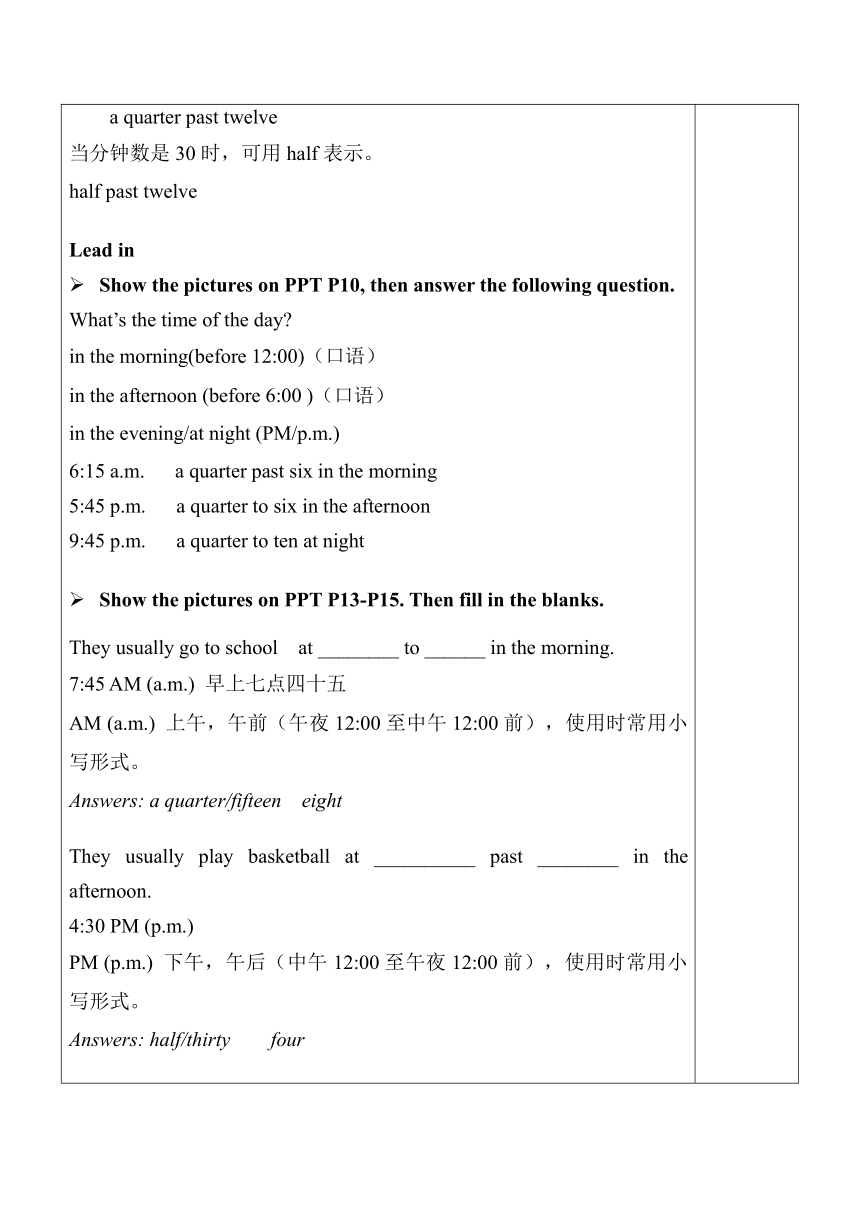
Revision 非整点时刻的表达方式 ①顺读法:用基数词,按“小时+分钟”的顺序直接写出时刻。 twelve fifteen ②逆读法:当分钟数≤30分钟,用“分钟+past+小时”表示,意为“几点过几分”。 fifteen past twelve ②逆读法:当分钟数>30分钟,用“(60-原分钟数)+to+(原小时数+1)”表示,意为“差几分到几点”。 fifteen to one 1点差15分 当分钟数是15时,可用a quarter表示。 a quarter past twelve 当分钟数是30时,可用half表示。 half past twelve Lead in Show the pictures on PPT P10, then answer the following question. What’s the time of the day in the morning(before 12:00)(口语) in the afternoon (before 6:00 )(口语) in the evening/at night (PM/p.m.) 6:15 a.m. a quarter past six in the morning 5:45 p.m. a quarter to six in the afternoon 9:45 p.m. a quarter to ten at night Show the pictures on PPT P13-P15. Then fill in the blanks. They usually go to school at ________ to ______ in the morning. 7:45 AM (a.m.) 早上七点四十五 AM (a.m.) 上午,午前(午夜12:00至中午12:00前),使用时常用小写形式。 Answers: a quarter/fifteen eight They usually play basketball at __________ past ________ in the afternoon. 4:30 PM (p.m.) PM (p.m.) 下午,午后(中午12:00至午夜12:00前),使用时常用小写形式。 Answers: half/thirty four Mr. Chen always watches TV at __________ past ________ at night. 10:15 PM (p.m.) PM (p.m.) 下午,午后(中午12:00至午夜12:00前),使用时常用小写形式。 Answers: a quarter/fifteen ten
Step 2 Presentation & Practice
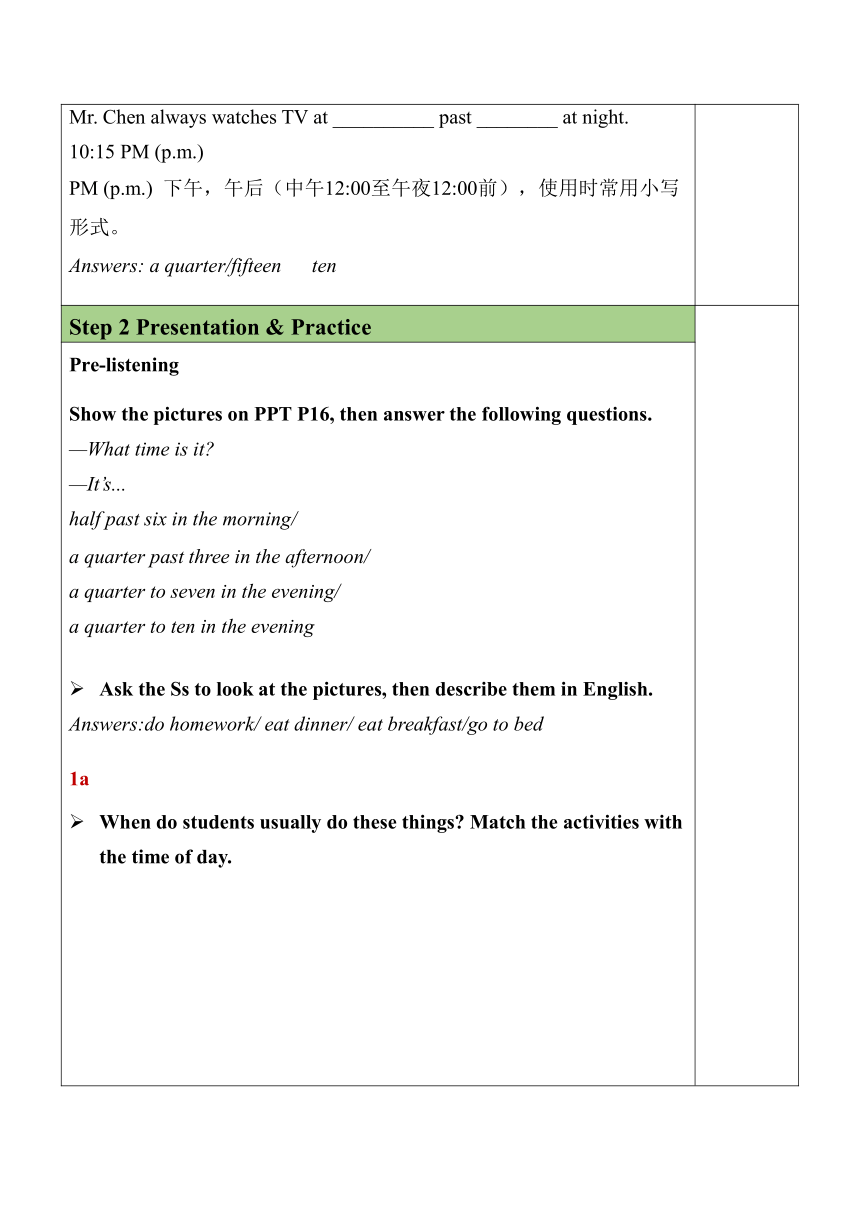
Pre-listening Show the pictures on PPT P16, then answer the following questions. —What time is it —It’s... half past six in the morning/ a quarter past three in the afternoon/ a quarter to seven in the evening/ a quarter to ten in the evening Ask the Ss to look at the pictures, then describe them in English. Answers:do homework/ eat dinner/ eat breakfast/go to bed 1a When do students usually do these things Match the activities with the time of day. 1b Check your answers with your partner. Samples: When do students usually eat dinner They usually eat dinner at a quarter to seven in the evening. When do students usually go to bed They usually go to bed at a quarter to ten in the evening. When do students eat breakfast They usually eat breakfast at half past six in the morning. When do students do homework They usually do homework at a quarter past three in the afternoon. Read and learn the expressions in the chart. 1. get up 6. do my homework 2. run 7. clean my room 3. eat breakfast 8. eat dinner 4. go to school 9. take a walk 5. go home 10. go to bed Ask the Ss the following question. Can you add more expressions 起居 饮食就餐 学习 家务 运动休闲 get up go to bed take a shower go to school go home eat breakfast eat lunch eat dinner do homework study for the test read a book clean my room make the bed do the dishes wash clothes run take a walk jump exercise go fishing
While-listening 1c Listen and circle the activities you hear. 1. get up _____ 6. do my homework _____ 2. run _____ 7. clean my room _____ 3. eat breakfast _____ 8. eat dinner _____ 4. go to school _____ 9. take a walk _____ 5. go home _____ 10. go to bed _____ 1d Listen again. Write the times next to the activities you circled in 1c. 1. get up 5:30 6. do my homework __________ 2. run _________ 7. clean my room _______ 3. eat breakfast _________ 8. eat dinner _________ 4. go to school _________ 9. take a walk _______ 5. go home _________ 10. go to bed _________ Answers: 2. 6:00 a. m. 7:00 a. m 7:45 a. m. 4:15 p. m. 5:30 p. m. 8.7:15 p. m. 9:00 p. m. Ask the Ss to listen again and answer the questions. 1.Who is talking about his day 2.Does Tom get up early When does he get up 3.When does he exercise, in the morning or in the evening 4.What sports does he do every day Answers:1.Tom. 2.Yes, he does.He gets up at half past five. 3.He exercises in the morning. 4.He runs in the morning. Post-listening 1e Show some pictures on PPT P28 about Tom. Then ask and answer questions about him. Sample: —When does Tom usually get up —He usually gets up at half past five. —When does Tom usually … — He usually … at … Let’s give a report of Tom’s day. The interviewer wants to know about Tom’s day. Tom usually _________ at about half past five. Then he runs at _______________________. He always eats his breakfast at seven o’clock. Then he goes to school at _________________. At a quarter past four _______________, he goes home. He often __________________ at about five thirty and __________ at seven. After that he ___________ at nine o’clock. Answers:gets up six o’clock in the morning a quarter to eight in the afternoon does his homework eats dinner goes to bed remember Time is money.一寸光阴一寸金。 Time is life.时间就是生命。 Time and tide wait for no man!时不我待!
Step 4 Language points learning
1. half past six in the morning 早上六点半 past prep. 晚于;过(时间) adj. 过去的 【用法详解】 (1)past在此作介词,意为“晚于;过(时间)”,用来表示时间,用于分钟数不超过30的情况。 Lily gets up at ten past six. 莉莉六点十分起床。 (2) past也可作形容词,意为“过去的”,仅用于名词前。 in past years 在过去的岁月里 2. a quarter past three in the afternoon 下午三点十五 a quarter to seven in the evening 晚上六点四十五 quarter n. 一刻钟;四分之一 He arrived after a quarter. 他一刻钟以后到达了。 About three quarters of the earth is covered with water. 地球(表面)约四分之三被水覆盖。 3. run v. 跑;奔 【用法详解】run作动词, 意为“跑;奔”,其现在分词形式为running。runner作名词,意为“跑步者”。 e.g. The boy is good at running. He runs with other runners in the park every morning. 这个男孩擅长跑步,每天早上他都与其他跑步者在公园跑步。 【拓展延伸】 run 作动词,还可意为“掉色;经营”。 e.g. The color will run in hot water. 这个颜色在热水里会掉色。 run a hotel 经营一家酒店 4. clean my room 打扫我的房间 clean v. 打扫;弄干净 adj. 干净的 【用法详解】 (1)clean在此作及物动词,意为“打扫;弄干净”,其后可以直接跟宾语。 Sam, you must clean your bedroom. 萨姆,你必须打扫你的卧室。 (2)clean还可作形容词,意为“干净的”,其反义词为dirty(脏的)。 Her room is beautiful and clean. 她的房间既漂亮又干净。 5. take a walk 散步 【用法详解】 take a walk 意为“散步;走一走”,其同义短语为have a walk和go for a walk。walk在此处作名词,意为“行走;步行”。 My grandfather often takes a walk after dinner. 晚饭后,我爷爷经常去散步。 【拓展延伸】walk还可作动词,意为“行走;步行”。是不及物动词。 The baby is learning to walk. 这个宝宝正在学走路。 She walks to school every day. 她每天步行上学。 The language points are for reference only.
Step 5 Summary & Homework The homework can vary with the specific conditions.
Summary Ask the Ss to do the exercises on PPT P36-P38. Homework Preview the passage in Section B 2b. Do the exercises in students’ book.
Teaching Reflection The teacher should get the students to practice the target language in listening and speaking.They will improve their capacity of language organization and oral output while listening and speaking practice.

展开更多......

收起↑

资源预览