【核心素养目标】Unit 2 I'll help to clean up the city parks Section A(2a-2d)表格式教案

资源下载
  1. 二一教育资源

【核心素养目标】Unit 2 I'll help to clean up the city parks Section A(2a-2d)表格式教案

资源简介

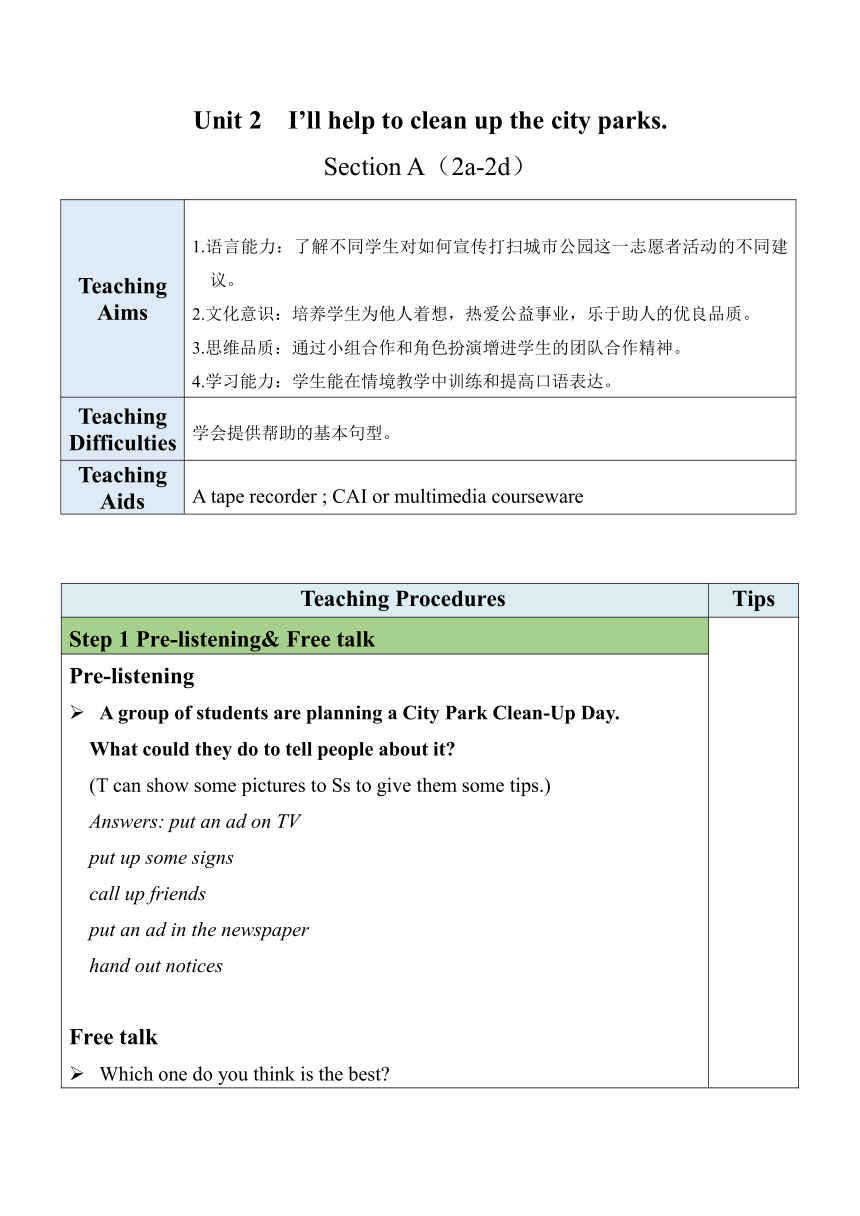
Unit 2 I’ll help to clean up the city parks.
Section A(2a-2d)
Teaching Aims 1.语言能力:了解不同学生对如何宣传打扫城市公园这一志愿者活动的不同建议。 2.文化意识:培养学生为他人着想,热爱公益事业,乐于助人的优良品质。 3.思维品质:通过小组合作和角色扮演增进学生的团队合作精神。 4.学习能力:学生能在情境教学中训练和提高口语表达。
Teaching Difficulties 学会提供帮助的基本句型。
Teaching Aids A tape recorder ; CAI or multimedia courseware
Teaching Procedures Tips
Step 1 Pre-listening& Free talk
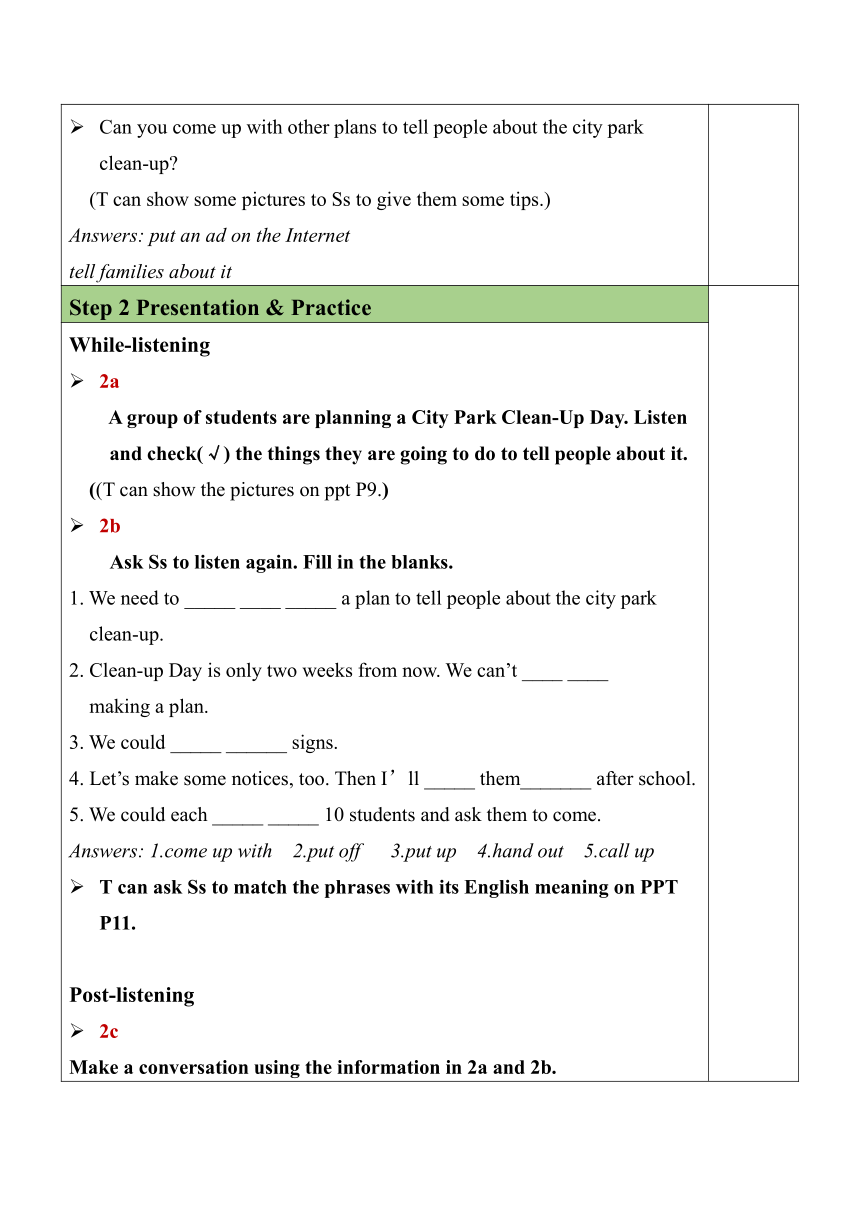
Pre-listening A group of students are planning a City Park Clean-Up Day. What could they do to tell people about it (T can show some pictures to Ss to give them some tips.) Answers: put an ad on TV put up some signs call up friends put an ad in the newspaper hand out notices Free talk Which one do you think is the best Can you come up with other plans to tell people about the city park clean-up (T can show some pictures to Ss to give them some tips.) Answers: put an ad on the Internet tell families about it
Step 2 Presentation & Practice
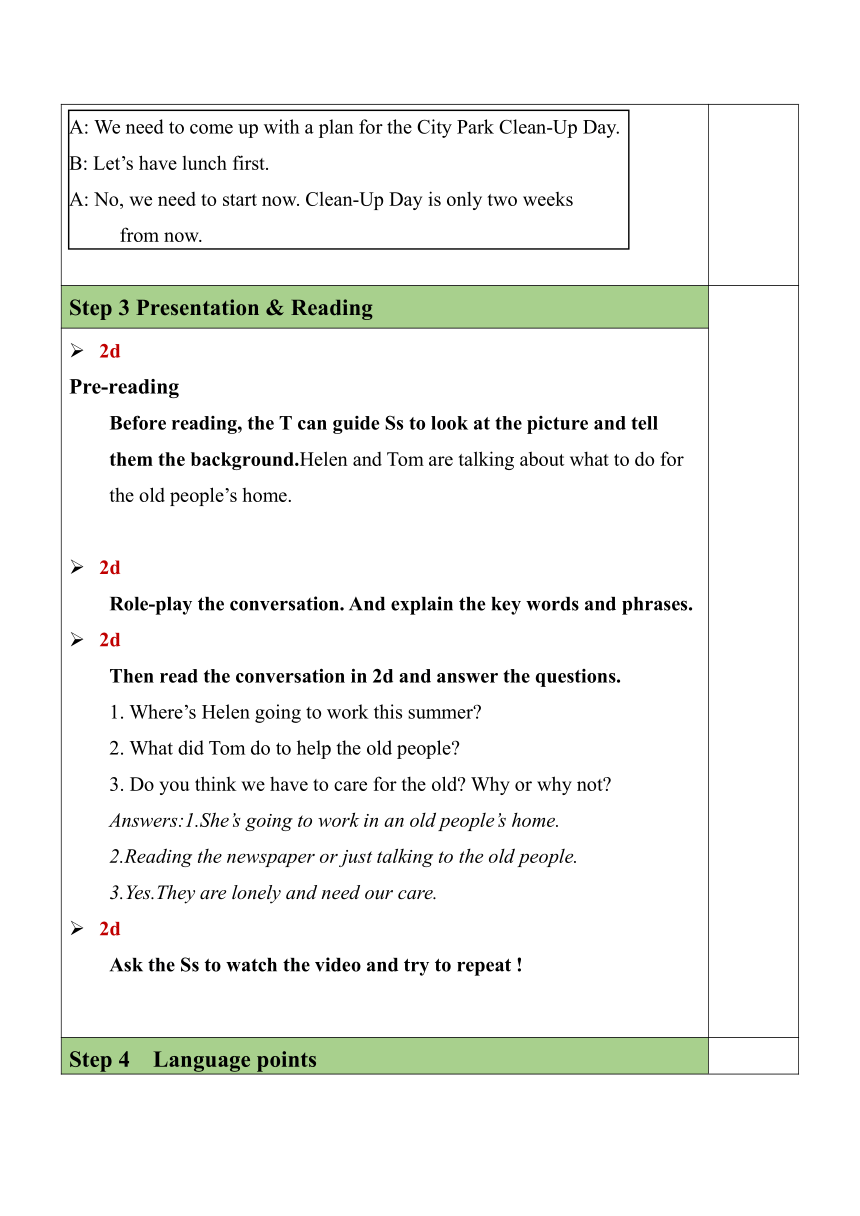
While-listening 2a A group of students are planning a City Park Clean-Up Day. Listen and check(√) the things they are going to do to tell people about it. ((T can show the pictures on ppt P9.) 2b Ask Ss to listen again. Fill in the blanks. 1. We need to _____ ____ _____ a plan to tell people about the city park clean-up. 2. Clean-up Day is only two weeks from now. We can’t ____ ____ making a plan. 3. We could _____ ______ signs. 4. Let’s make some notices, too. Then I’ll _____ them_______ after school. 5. We could each _____ _____ 10 students and ask them to come. Answers: 1.come up with 2.put off 3.put up 4.hand out 5.call up T can ask Ss to match the phrases with its English meaning on PPT P11. Post-listening 2c Make a conversation using the information in 2a and 2b. A: We need to come up with a plan for the City Park Clean-Up Day. B: Let’s have lunch first. A: No, we need to start now. Clean-Up Day is only two weeks from now.
Step 3 Presentation & Reading
2d Pre-reading Before reading, the T can guide Ss to look at the picture and tell them the background.Helen and Tom are talking about what to do for the old people’s home. 2d Role-play the conversation. And explain the key words and phrases. 2d Then read the conversation in 2d and answer the questions. 1. Where’s Helen going to work this summer 2. What did Tom do to help the old people 3. Do you think we have to care for the old Why or why not Answers:1.She’s going to work in an old people’s home. 2.Reading the newspaper or just talking to the old people. 3.Yes.They are lonely and need our care. 2d Ask the Ss to watch the video and try to repeat !
Step 4 Language points
1. We need to come up with a plan for the City Park Clean-up Day. 我们需要为“城市公园清洁日”想出一个计划。 1)①need 是一个常见的动词,表示“需要”之意。它既可以作实义动词,也可以作情态动词。其具体用法如下: need用作实义动词,有“必要”、“必需”之意,有人称、数和时态的变化,可以接名词、代词、动名词或带to 的动词不定式作宾语。 e.g. The man needs an English dictionary when he works. Do you need to see him yourself ②need用作情态动词,意为“必须”、“必要”,没有人称、数等变化,后接不带to的动词不定式。通常用于疑问句和否定句中,构成疑问句和否定句时,不需要使用助动词。 e.g. Need you go to the park with your classmate He needn’t spend much money for this new watch. 【注意】 由need引出的疑问句,答语表肯定时用must或have to;表示否定时用needn’t或don’t have to。 A: Need I come to work tomorrow B: Yes, you must/have to. A: Need I finish the work at once B: No, you needn’t/don’t have to. 2)come up with 意为“想出;提出” 后面常接idea、plan、answer、solution、advice 等名词。 同义短语:think up e.g. She came up with a way to work out the math e up with 还可意为“追上;赶上”,相当于catch up with。 e.g. I will come up with you soon. 2. We can’t put off making a plan. 我们不能推迟制定计划。 put off 推迟 通常指会议、活动等未能按预定的时间举行,后面可接名词、代词或动词-ing形式作宾语。 Would you mind if we put it off until tomorrow 【拓展延伸】 与put相关的短语还有: put down 放下;写下 put ... into 投入 (时间、心思等) put up 张贴; 搭建; 举起 put out 熄灭 put away 把······放回原处 put on 穿上;上演;体重增加 3. We could each call up 10 students and ask them to come. call up 打电话给(某人);征召 (1) call up在此处意为“打电话给(某人)”,是“动词+副词” 型短语。 Forgive me for calling you up so early please. (2) call up还可意为“征召”。 He was called up at the beginning of the war. 【拓展延伸】 含call的其他常见短语 4. They tole me stories about the past and how things used to be. used to 曾经……;过去…… used to 表示过去一度存在或经常发生,但现在已经不存在的动作或状态。其后接动词原形,且不与表示过去的时间状语连用。used to的否定形式是didn’t use to或used not to(usedn’t to)。 He used to be a teacher. He didn’t use to wear glasses. = He usedn’t to wear glasses. 【拓展延伸】 ①be/get used to doing sth. 意为“习惯做某事”,to在此处为介词。 Mario is used to volunteering at an animal hospital now. ②be used to do sth. 意为“被用来做某事”,to为不定式符号。 ③be used for doing sth. 意为“被用来做某事” The milk is used to make kinds of food. Knives are used for cutting fruits. 5. ①Yeah, a lot of old people are lonely. ②I want to travel alone. lonely adj. 孤独的;寂寞的 alone adv. 独自;单独 The old man lives alone, but he doesn’t feel lonely. At a dark night, a man came to a lonely village. The boy was very shy, and he was alone all the time. 6. We should listen to them and care for them. care for 照顾;非常喜欢 (1) care for在此处意为“照顾”,相当于look after 或 take care of。 The mother cared for the sick child day and night. (2) care for还可意为“非常喜欢”,常与not连用。 He doesn’t care for classical music. 【归纳总结】 与care相关的短语: care for 照顾;非常喜欢 care about 关心;在意 take care 当心;小心 take care of 照顾
Step 5 Summary & Homework
Summary Ask Ss to do the exercises from PPT P31-33. Homework: Preview the passage on Page 11. Preview the new words and phrases. Do the exercises in students’ book.
Teaching Reflection The teacher needs to encourage the students to practice the target language in listening and speaking. With the help of language practice, the students can learn the new pattern in a more natural way.

展开更多......

收起↑

资源预览