【核心素养目标】人教版七年级下册Unit 3 How do you get to school Section B(1a-1e)教案(表格式)

资源下载
  1. 二一教育资源

【核心素养目标】人教版七年级下册Unit 3 How do you get to school Section B(1a-1e)教案(表格式)

资源简介

Unit 3 How do you get to school
Section B(1a-1e)
Teaching Aims 1.语言能力:了解各种各样的交通工具;能谈论出行方式。 2.文化意识:了解因地域文化差别所造成的出行方式的差异。 3.思维品质:在听力中能获取关键信息。 4.学习能力:能够与同伴开展合作学习。
Teaching Difficulties 能谈论出行方式。
Teaching Aids A tape recorder ; CAI or multimedia courseware
Teaching Procedures Tips
Step 1 Lead in
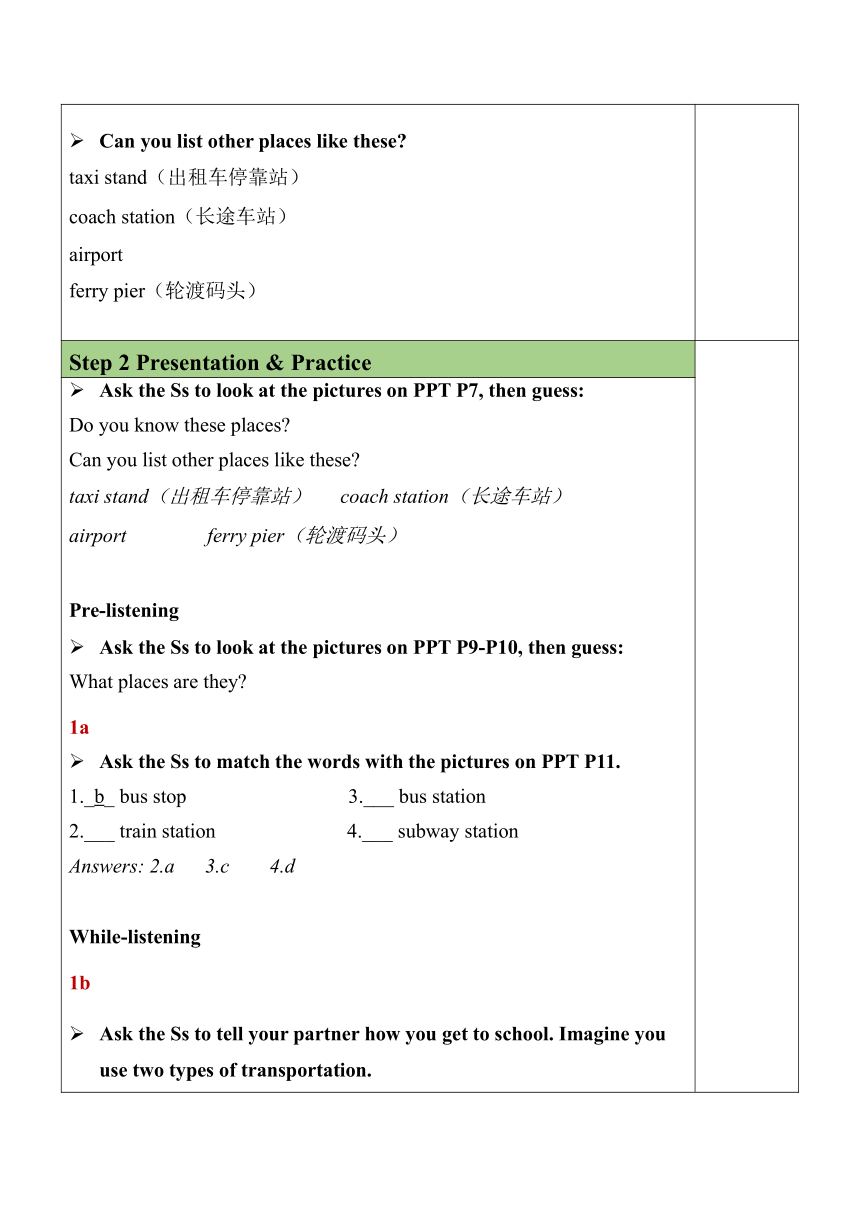
Revision Ask the Ss to look at the pictures on PPT P5, then answer the following questions: How do you get to school How long does it take How does he/she go to work How far is it from his/her home to work Lead in Show some pictures to the Ss, then answer the following question. Do you know these places train station/ subway station/ bus station/ bus stop. Can you list other places like these taxi stand(出租车停靠站) coach station(长途车站) airport ferry pier(轮渡码头)
Step 2 Presentation & Practice
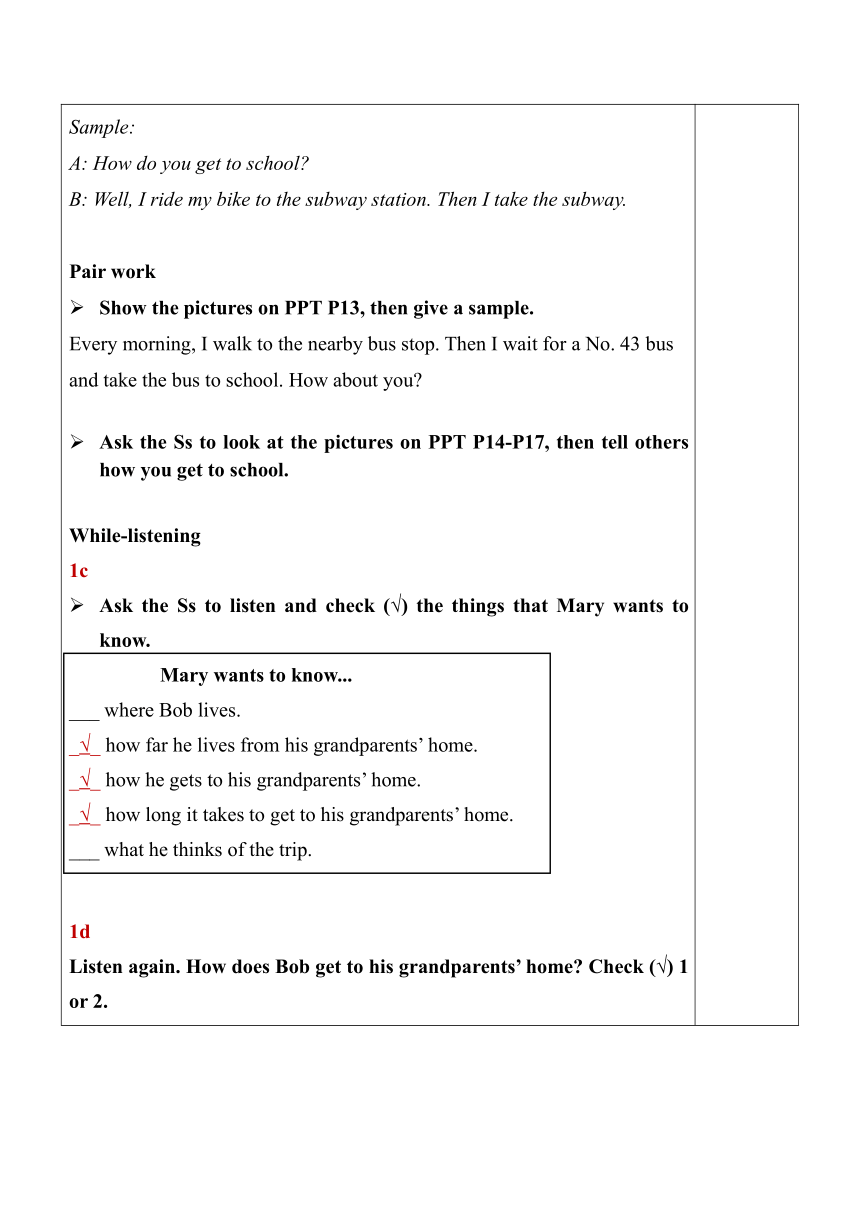
Ask the Ss to look at the pictures on PPT P7, then guess: Do you know these places Can you list other places like these taxi stand(出租车停靠站) coach station(长途车站) airport ferry pier(轮渡码头) Pre-listening Ask the Ss to look at the pictures on PPT P9-P10, then guess: What places are they 1a Ask the Ss to match the words with the pictures on PPT P11. 1._b_ bus stop 3.___ bus station 2.___ train station 4.___ subway station Answers: 2.a 3.c 4.d While-listening 1b Ask the Ss to tell your partner how you get to school. Imagine you use two types of transportation. Sample: A: How do you get to school B: Well, I ride my bike to the subway station. Then I take the subway. Pair work Show the pictures on PPT P13, then give a sample. Every morning, I walk to the nearby bus stop. Then I wait for a No. 43 bus and take the bus to school. How about you Ask the Ss to look at the pictures on PPT P14-P17, then tell others how you get to school. While-listening 1c Ask the Ss to listen and check (√) the things that Mary wants to know. Mary wants to know... ___ where Bob lives. _√_ how far he lives from his grandparents’ home. _√_ how he gets to his grandparents’ home. _√_ how long it takes to get to his grandparents’ home. ___ what he thinks of the trip. 1d Listen again. How does Bob get to his grandparents’ home Check (√) 1 or 2. Listen again and choose the best answer. 1. What is Bob’s grandparents’ home like A. It’s big. B. It’s small. C. It’s old. 2. How often does Bob go to see his grandparents A. Every month. B. Every week. C. One or two times a year. 3. How far is it from Bob’s home to his grandparents’ A. About 500 kilometers. B. About six hours’ walk. C. About 500 meters. Answers:1.A 2.C 3.A Listen and read. Mary: I love your home, Bob. It’s so big! Bob: Thanks, Mary. My grandparents’ home is very big, too. Mary: Where do they live Bob: Very far from my home. Mary: Oh, how far Bob: It’s about 500 kilometers from here. Mary: Wow! That’s far. Bob: Yes, it is. So I go there and see my grandparents only one or two times a year. Mary: How do you get there Bob: I usually take the train. Mary: How long does it take Bob: It takes about six hours. And then I take a bus from the train station to their home. Mary: Wow. That’s a long trip. Post-listening 1e Talk about how Bob gets to his grandparents’ home. —How does Bob get to his grandparents’ home —He … These words may help you first, next, then, finally... To get to his grandparents' home, first, he takes the train. The train ride takes about six hours. Then, he takes a bus from the train station to their home.
Step 4 Language points learning
1. bus stop 公共汽车站 stop n.车站;停止 v. 停止 【用法详解】stop 在此作为名词,意为“车站”。此外,作名词时它还可意为“停止”。 Is there a bus stop near here 这附近有公共汽车站吗? It is time to put a stop to the war.是结束战争的时候了。 【易混辨析】stop与station stop 一般指公共汽车的停靠点或途中乘客上下车的站点。station 一般指火车、客车等的发车点或终点站。
【拓展延伸】 stop还可作动词,意为“停止”,常用结构: stop to do sth. 停下来去做某事 stop doing sth. 停止做某事 Don’t jump off the bus before it stops. 在公共汽车停车前别往下跳。 — I’m very tired. I want to stop to have a rest. 我很累。我想停下来休息一下。 — OK. Let’s stop walking. 好的,咱们停止走路吧。 2. ...what he thinks of the trip ......他认为这段旅程怎么样 think of 认为;想起 【用法详解】think of 在此处意为“认为”,此外,think of 还有“想起”之意。 What do you think of the environment in your hometown 你觉得你家乡的环境怎么样 I always look at the album when I think of David. 每当我想起戴维时,我总是会看那本相册。 【拓展延伸】 “What do you think of... ” 意为“你认为……怎么样?” ,用于征询别人的看法或意见,相当于“How do you like... ”。 What do you think of the book (=How do you like the book ) 你觉得这本书怎么样? The language points are for reference only.
Step 5 Summary & Homework The homework can vary with the specific conditions.
Summary Ask the Ss to do the exercises on PPT P30-P33. Homework Preview the passage in Section B 2b. Do the exercises in students’ book.
Teaching Reflection In this period, the students should tell their partners how they get to school. The teacher should get the students to practice the target language in listening and speaking. They will improve their capacity of language organization and oral output.

展开更多......

收起↑

资源预览