【核心素养目标】人教版七年级下册Unit 3 How do you get to school Section B(2a-2d)教案(表格式)

资源下载
  1. 二一教育资源

【核心素养目标】人教版七年级下册Unit 3 How do you get to school Section B(2a-2d)教案(表格式)

资源简介

Unit 3 How do you get to school
Section B(2a-2c)
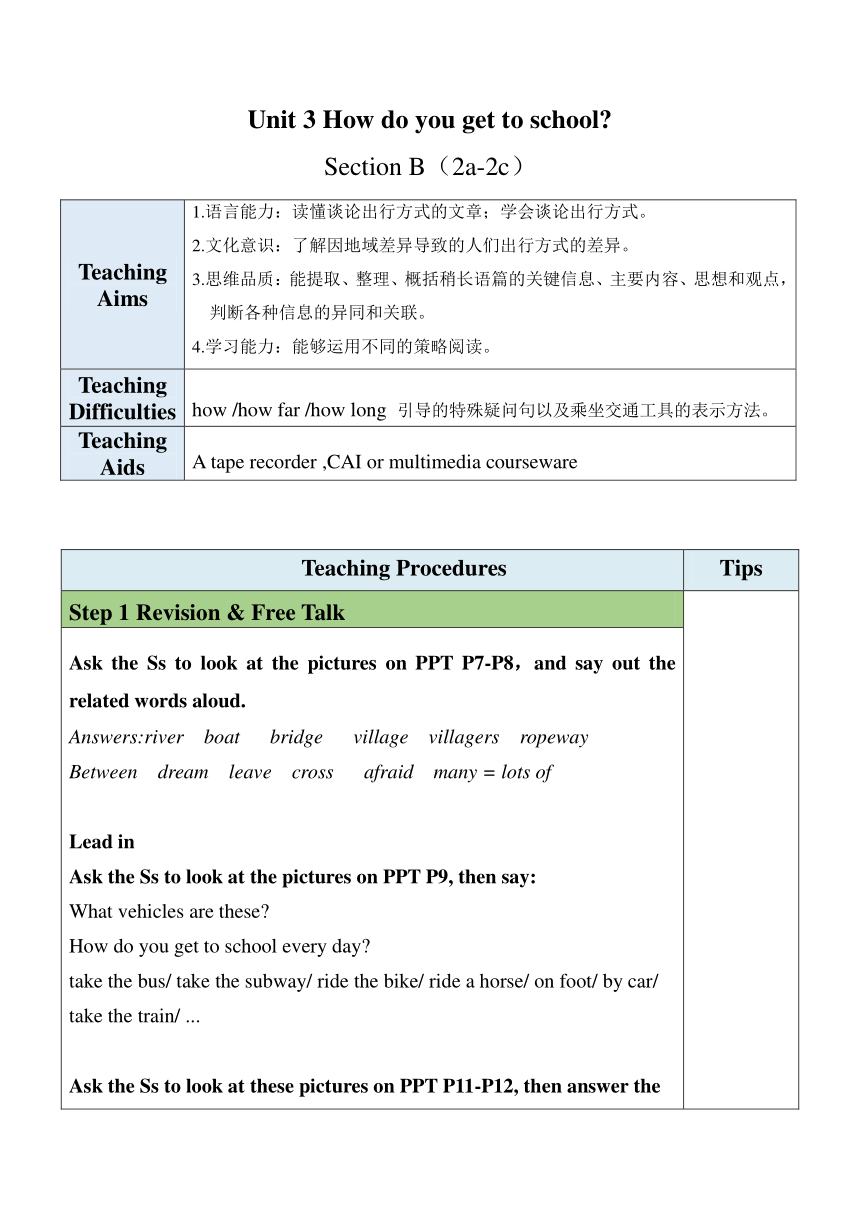
Teaching Aims 1.语言能力:读懂谈论出行方式的文章;学会谈论出行方式。 2.文化意识:了解因地域差异导致的人们出行方式的差异。 3.思维品质:能提取、整理、概括稍长语篇的关键信息、主要内容、思想和观点,判断各种信息的异同和关联。 4.学习能力:能够运用不同的策略阅读。
Teaching Difficulties how /how far /how long 引导的特殊疑问句以及乘坐交通工具的表示方法。
Teaching Aids A tape recorder ,CAI or multimedia courseware
Teaching Procedures Tips
Step 1 Revision & Free Talk
Ask the Ss to look at the pictures on PPT P7-P8,and say out the related words aloud. Answers:river boat bridge village villagers ropeway Between dream leave cross afraid many = lots of Lead in Ask the Ss to look at the pictures on PPT P9, then say: What vehicles are these How do you get to school every day take the bus/ take the subway/ ride the bike/ ride a horse/ on foot/ by car/ take the train/ ... Ask the Ss to look at these pictures on PPT P11-P12, then answer the following questions: Do you think it's easy or difficult for the children to go to school What do you want to say to these students in small villages
Step 2 Presentation & Reading
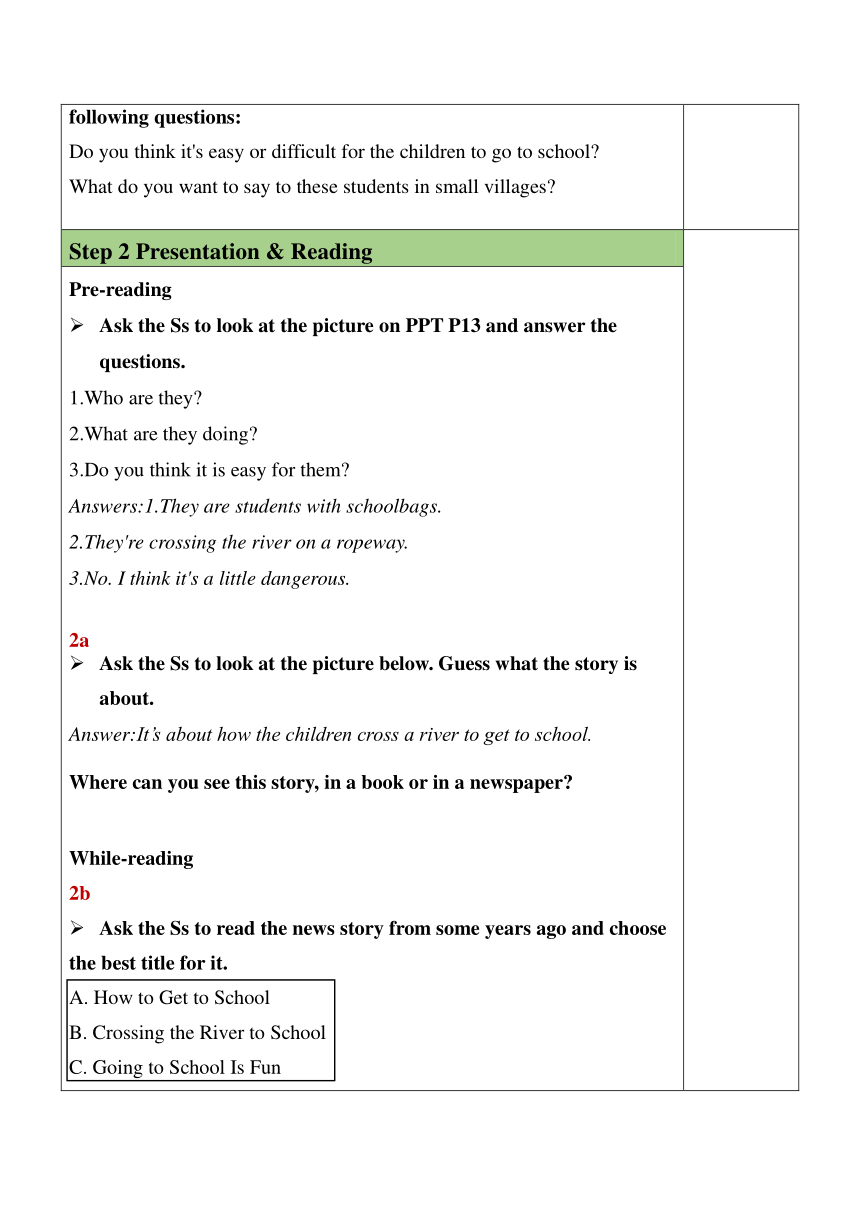
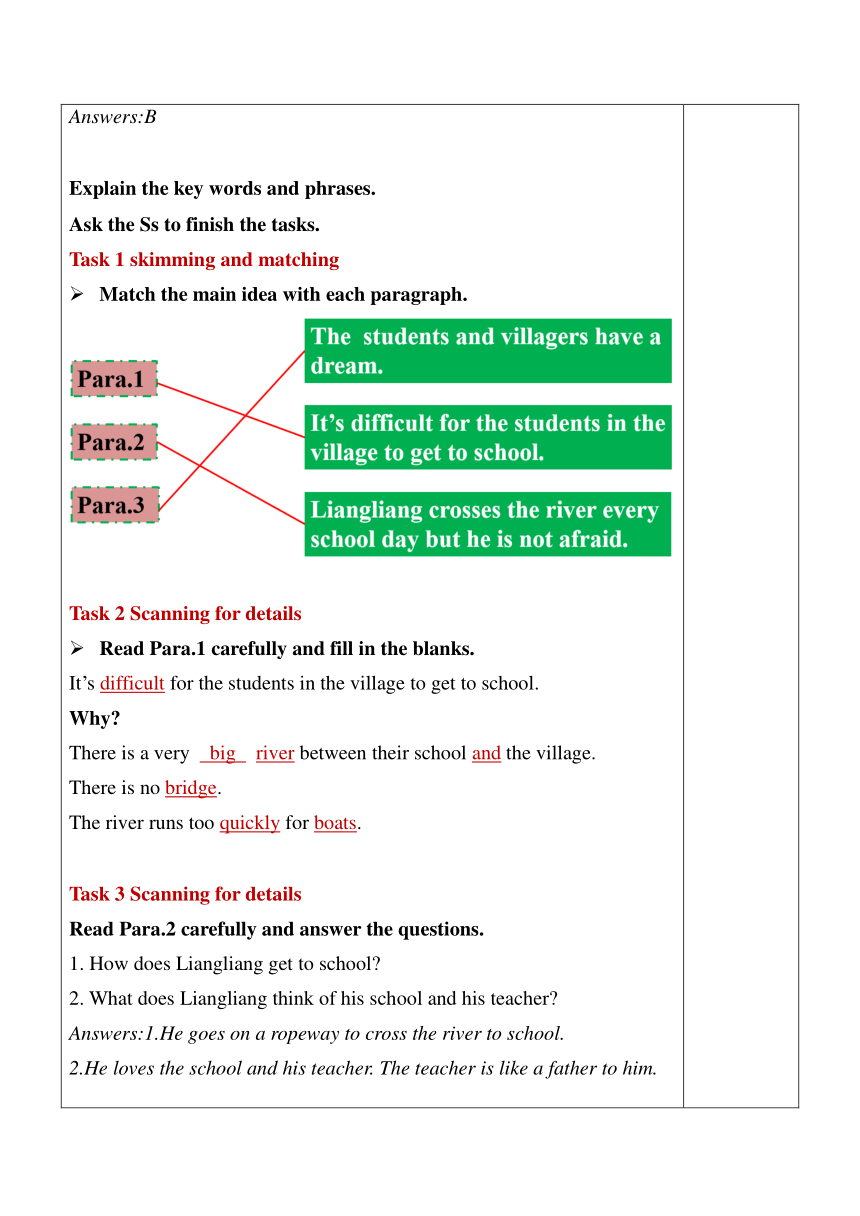
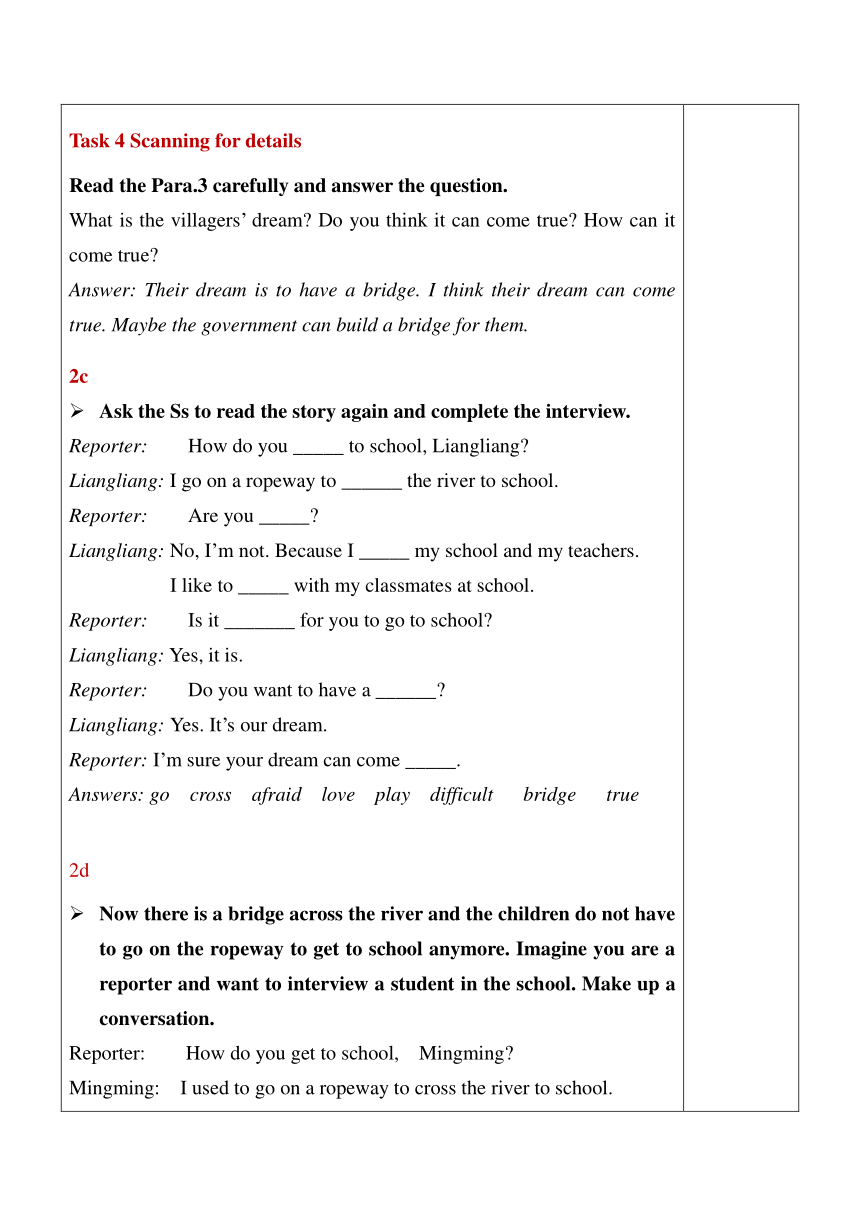
Pre-reading Ask the Ss to look at the picture on PPT P13 and answer the questions. 1.Who are they 2.What are they doing 3.Do you think it is easy for them Answers:1.They are students with schoolbags. 2.They're crossing the river on a ropeway. 3.No. I think it's a little dangerous. 2a Ask the Ss to look at the picture below. Guess what the story is about. Answer:It’s about how the children cross a river to get to school. Where can you see this story, in a book or in a newspaper While-reading 2b Ask the Ss to read the news story from some years ago and choose the best title for it. A. How to Get to School B. Crossing the River to School C. Going to School Is Fun Answers:B Explain the key words and phrases. Ask the Ss to finish the tasks. Task 1 skimming and matching Match the main idea with each paragraph. Task 2 Scanning for details Read Para.1 carefully and fill in the blanks. It’s difficult for the students in the village to get to school. Why There is a very big river between their school and the village. There is no bridge. The river runs too quickly for boats. Task 3 Scanning for details Read Para.2 carefully and answer the questions. 1. How does Liangliang get to school 2. What does Liangliang think of his school and his teacher Answers:1.He goes on a ropeway to cross the river to school. 2.He loves the school and his teacher. The teacher is like a father to him. Task 4 Scanning for details Read the Para.3 carefully and answer the question. What is the villagers’ dream Do you think it can come true How can it come true Answer: Their dream is to have a bridge. I think their dream can come true. Maybe the government can build a bridge for them. 2c Ask the Ss to read the story again and complete the interview. Reporter: How do you _____ to school, Liangliang Liangliang: I go on a ropeway to ______ the river to school. Reporter: Are you _____ Liangliang: No, I’m not. Because I _____ my school and my teachers. I like to _____ with my classmates at school. Reporter: Is it _______ for you to go to school Liangliang: Yes, it is. Reporter: Do you want to have a ______ Liangliang: Yes. It’s our dream. Reporter: I’m sure your dream can come _____. Answers: go cross afraid love play difficult bridge true 2d Now there is a bridge across the river and the children do not have to go on the ropeway to get to school anymore. Imagine you are a reporter and want to interview a student in the school. Make up a conversation. Reporter: How do you get to school, Mingming Mingming: I used to go on a ropeway to cross the river to school. But now ... Free talk Ask the Ss to talk about themselves. 1.How do you get to school Is it easy 2.What do you think of your school, the teachers and classmates 3.What is your dream These expressions may help you. It’s … for … to get to school. I get to school … … is/are like … to me. It’s my dream to … remember 1. Study hard. 2. Appreciate(感激) your life, your friends, your parents and your teachers. 3. Try your best to make your dream come true. 4. Don’t be afraid. Be brave(勇敢).
Step 3 Language points learning
1. Crossing the River to School 过河上学 cross v. 横过;越过 【易混辨析】cross, across与crossing We can’t play mobile phones when we cross (= go across) the street. 过马路时我们不能玩手机。 Turn right at the second crossing. 在第二个十字路口向右转。 2. For many students, it is easy to get to school. 对许多学生来说,到学校是容易的。 It is + adj. + to do sth. 做某事是······的。 【用法详解】it is easy to get to school是“It is + adj. + to do sth.”结构,其中 it 是形式主语,真正的主语是后面的动词不定式短语 to do sth.。 It is important to learn English well. 学好英语很重要。 It is interesting to play basketball. 打篮球很有趣。 【易混辨析】 It is + adj. + for sb. to do sth.与 It is + adj. + of sb. to do sth. It is easy for me to sing the song. 唱这首歌对我来说很简单。 It is kind of you to help me wash the dishes. 你帮我洗盘子真是太好了。 3. There is a very big river between their school and the village. 在他们学校和村庄之间有一条很大的河。 between … and … 在······和······之间 【用法详解】between … and …为固定短语,连接两个并列的成分。其中between作介词,用于两者之间,也可用于三者或三者以上的两两之间。 There is a school between the hospital and the supermarket. 在医院和超市之间有一所学校。 There is a ball between his feet. 他的两脚之间有一个球。 She takes the medicine between meals. 她在两餐之间服药。 4. There is no bridge and the river runs too quickly for boats. (河上)没有桥,而且河水流得太急,不宜于小船(摆渡)。 no det.没有 【用法详解】no 在此处作限定词,修饰可数名词单数 bridge。no 修饰可数名词单数时,相当于 not a/an;修饰可数名词复数或不可数名词时,相当于 not any。 I have no dictionary at hand. = I don’t have a dictionary at hand.我手边没有词典。 I have no footballs. = I don’t have any footballs. 我没有足球。 There is no water in the glass. = There is not any water in the glass. 玻璃杯里没有水。 run v. 流动 run在此处表示液体的“流动”,在不同的语境中有着不同的含义。 The river runs into the sea. 这条河流进大海。 Water is running all over the bathroom floor. 浴室里水流满地。 boat n. 小船 We can get to the other side of the lake by boat. 我们可以乘小船到达湖对岸。 【拓展延伸】与boat相关的短语: by boat/take the boat 乘小船 go boating 去划船 be in the same boat 处于同样的困境 5. One 11-year-old boy, Liangliang, crosses the river every school day. 亮亮,一个11岁的男孩,每个上学日过河上学。 11-year-old 11岁的 【用法详解】11-year-old是复合形容词,作前置定语修饰名词boy,需注意 year 应用单数形式,11的发音以元音音素开头,其前若有不定冠词,应用 an。 Jane is an 11-year-old girl. 简是一个11岁的女孩。 【易混辨析】...-year-old 与... year(s) old ...-year-old 为复合形容词,其结构为“基数词 + 名词 (单数形式) + 形容词作定语修饰后面的名词,中间用连字符“-”连接。 ... year(s) old 在句中作表语,year 的单复数形式取决于其前的基数词,中间不用连字符。
This is an 8-year-old boy. 这是一个8岁的男孩。 This boy is 8 years old. 这个男孩8岁。 6. But he is not afraid because he loves school. 但他并不害怕, 因为他喜欢上学。 afraid adj. 害怕;畏惧 【用法详解】 afraid 作形容词,常作表语,其用法如下: be afraid of sth. 害怕某物 be afraid to do sth. 害怕/不敢做某事 be afraid of doing sth. 害怕做某事 be afraid + that从句 恐怕······ Cathy is afraid of the dog. 凯西怕狗。 The girl is afraid to go out at night. 这个女孩晚上害怕出门。 The man is afraid of missing the train. 这个人怕错过这趟火车。 I’m afraid I can’t do well in the running race. 恐怕我不能在跑步比赛中取得好成绩。 7. He’s like a father to me. 他对我来说就像父亲一样。 like prep. 像;怎么样 【用法详解】 like 在句中作介词,常构成短语be like (像······) 或look like (看起来像······) ,后接名词或代词作宾语。 Kate is like her mother. 凯特像她的妈妈。 Your new eraser looks like an apple. 你的新橡皮看起来像一个苹果。 【拓展延伸】 (1) “What’s sb. like ”意为“某人怎么样?”侧重于询问某人内在的性格、品质等。 —What’s your Chinese teacher like 你的语文老师怎么样? —He’s very kind. 他很善良。 (2) “What does sb. look like ” 意为“某人长得怎么样?” ,侧重于询问某人的外表。 —What does she look like 她长得怎么样 —She is tall and beautiful, just like her mother. 她长得又高又漂亮,就像她妈妈一样。 The language points are for reference only.
Step 5 Summary & Homework The homework can vary with the specific conditions.
Summary Ask the Ss to do the exercises on PPT P42-P43. Homework Read and recite the new words and phrases . Do the exercises in students’ book.
Teaching Reflection This is a period in which students do more practice in reading. The teacher should practice the students’ ability of reading quickly and efficiently. While reading, help the students learn how to catch the main idea and the most important ideas as quickly as they can by mind-mapping.

展开更多......

收起↑

资源预览