【核心素养目标】Unit 4 Don't eat in class Section B(1a-1d)教案 (表格式)

资源下载
  1. 二一教育资源

【核心素养目标】Unit 4 Don't eat in class Section B(1a-1d)教案 (表格式)

资源简介

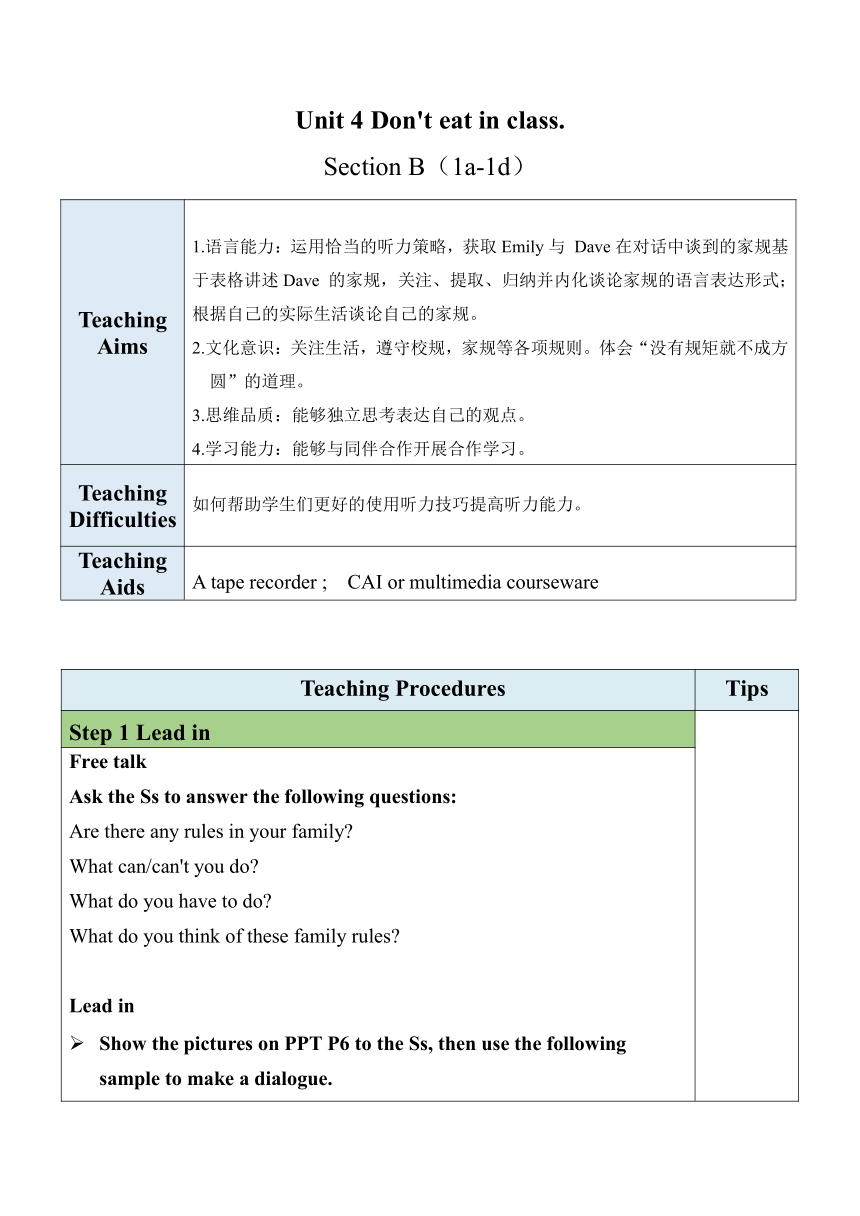
Unit 4 Don't eat in class.
Section B(1a-1d)
Teaching Aims 1.语言能力:运用恰当的听力策略,获取Emily与 Dave在对话中谈到的家规基于表格讲述Dave 的家规,关注、提取、归纳并内化谈论家规的语言表达形式;根据自己的实际生活谈论自己的家规。 2.文化意识:关注生活,遵守校规,家规等各项规则。体会“没有规矩就不成方圆”的道理。 3.思维品质:能够独立思考表达自己的观点。 4.学习能力:能够与同伴合作开展合作学习。
Teaching Difficulties 如何帮助学生们更好的使用听力技巧提高听力能力。
Teaching Aids A tape recorder ; CAI or multimedia courseware
Teaching Procedures Tips
Step 1 Lead in
Free talk Ask the Ss to answer the following questions: Are there any rules in your family What can/can't you do What do you have to do What do you think of these family rules Lead in Show the pictures on PPT P6 to the Ss, then use the following sample to make a dialogue. A: Can you … B: Yes, I (we) can./No, I (we) can’t. Show the pictures on PPT P7-P8 to the Ss, then use the following sample to make a dialogue. A: Do you have to … B: Yes, I (we) do./No, I (we) don’t.
Step 2 Presentation & Practice
Pre-listening 1a Ask the Ss to read the rules in the chart in 1b. Then match the pictures [a-h] with the rules. RulesCan’t (×) Have to/Must(√)When ago out×on school nightshsee friendscdo his homeworkepractice the guitarbdo the dishesgwatch TVdhelp his mom make breakfastfclean his room
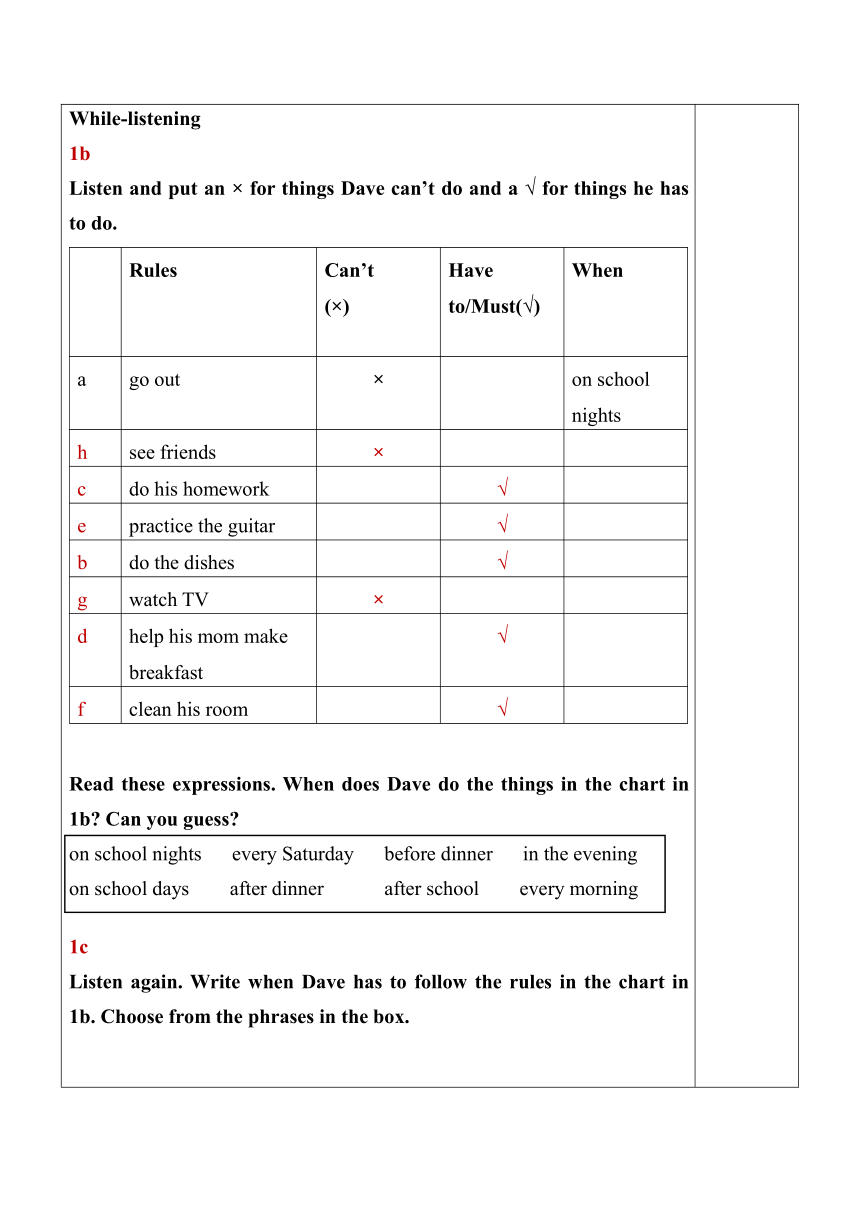
While-listening 1b Listen and put an × for things Dave can’t do and a √ for things he has to do. RulesCan’t (×) Have to/Must(√)When ago out×on school nightshsee friends×cdo his homework√epractice the guitar√bdo the dishes√gwatch TV×dhelp his mom make breakfast√fclean his room√
Read these expressions. When does Dave do the things in the chart in 1b Can you guess on school nights every Saturday before dinner in the evening on school days after dinner after school every morning 1c Listen again. Write when Dave has to follow the rules in the chart in 1b. Choose from the phrases in the box. RulesCan’t (×)Have to/ Must(√)When go out×on school nightssee friends×on school daysdo his homework√after schoolpractice the guitar√before dinnerdo the dishes√after dinnerwatch TV×in the eveninghelp his mom make breakfast√every morningclean his room√every Saturday
Listen again and fill in the blanks with can't, must, have to. Emily: Hi, Dave. Do you want to watch the basketball game in the park this evening Dave: I’d love to, but I __can’t__ go out on school nights. Emily : Oh, that’s too bad. Dave : Yeah, I have so many rules… Emily : Really Dave: Yeah, I __can’t__see my friends on school days and I have to do my homework after school. I _must practice the guitar before dinner and then I have to do the dishes after dinner. And I _can’t_ watch TV in the evening. Emily : Well, I have to help my mom make dinner sometimes. Dave : Me, too. I have to help my mom make breakfast every morning. And I _must___clean my room every Saturday. Listen and read. Emily: Hi, Dave. Do you want to watch the basketball game in the park this evening Dave: I’d love to, but I can’t go out on school nights. Emily: Oh, that’s too bad. Dave: Yeah, I have so many rules... Emily: Really Dave: Yeah, I can’t see my friends on school days and I have to do my homework after school. Emily: What other rules do you have Dave: Mmm... I must practice the guitar before dinner and then I have to do the dishes after dinner. And I can’t watch TV in the evening. Emily: Oh. Well, I have to help my mom make dinner sometimes. Dave: Me, too. I have to help my mom make breakfast every morning. And I must clean my room every Saturday. Emily: Wow, you do have a lot of rules! Post-listening 1d Talk about the rules in Dave’s house. —Can Dave go out on school nights —No, he can’t. These expressions may help you on school nights on school days after school before dinner after dinner in the evening every morning every Saturday Make conversations in groups according to the truth of yourself. These expressions may help you go out, play computer games, do my homework, stay at home, on weekends, go to bed before 9:30, get back home before 10 o’clock, do my homework first, watch TV, for half an hour A: Do you have any family rules BCD: Yes, we do. A: Can you __go out___ on school nights B: Yes, I can, but I must get back home before 10 o’clock. C: Me too. I can only go out on weekends. D: No, I can’t. I have to stay at home. Ask the Ss to work in groups of four. List the rules at home as many as you can in 1 minute. For example, I must go to bed before 10 o’clock at night. I can’t go out at night. I have to clean my room by myself. ...
Step 4 Language points learning
1. practice the guitar 练习吉他 practice v.& n.练习 【用法详解】 (1) practice 在此处作动词,其后可以接名词、代词或动词-ing形式作宾语。 You need to practice English every day. 你需要每天练习英语。 These foreigners are practicing speaking Chinese. 这些外国人正在练习说汉语。 (2) practice还可作名词,意为“练习”。 Practice makes perfect. 熟能生巧。 Learning English needs practice. 学习英语需要练习。 2. do the dishes 清洗餐具 dish n.碟;盘 【用法详解】dish作可数名词,常用the dishes表示“(待清洗的)餐具”。dish还有“菜肴;一道菜”之意。 The glass dish is beautiful. 那个玻璃盘很漂亮。 This is an excellent hot main dish. 这是一道绝好的热主菜。 do the dishes 清洗餐具 【用法详解】do the dishes相当于wash the dishes。 We must do the dishes before we go out. 我们外出前必须清洗餐具。 3. before dinner 晚饭前 before prep.& conj.在……以前;adv. 以前 【用法详解】before 在此处为介词,意为“在……以前”,表示时间,反义词为 after(在……以后)。 You must go to bed before 10 o’clock. 你必须在10点前上床睡觉。 【拓展延伸】 (1) before作介词,还可表示“在……的前面”,表示位置,其反义词为behind。 There is a desk before me and a chair behind me. 我的前面有一张课桌,后面有一把椅子。 (2) before还可作连词,意为“在……以前”,后接句子。 Do it before you forget. 尽早动手,免得忘了。 The language points are for reference only.
Step 5 Summary & Homework The homework can vary with the specific conditions.
Summary Ask the Ss to do the exercises on PPT P26-P29. Homework Preview the passage in Section B 2b. Do the exercises in students’ book.
Teaching Reflection In this period, the students should try to express the rules in their house.The teacher should get the students to practice the target language in listening and speaking. They will improve their capacity of language organization and oral output while listening and speaking practice.

展开更多......

收起↑

资源预览