【核心素养目标】Unit 4 Don't eat in class Section A(2a-2d)教案(表格式)

资源下载
  1. 二一教育资源

【核心素养目标】Unit 4 Don't eat in class Section A(2a-2d)教案(表格式)

资源简介

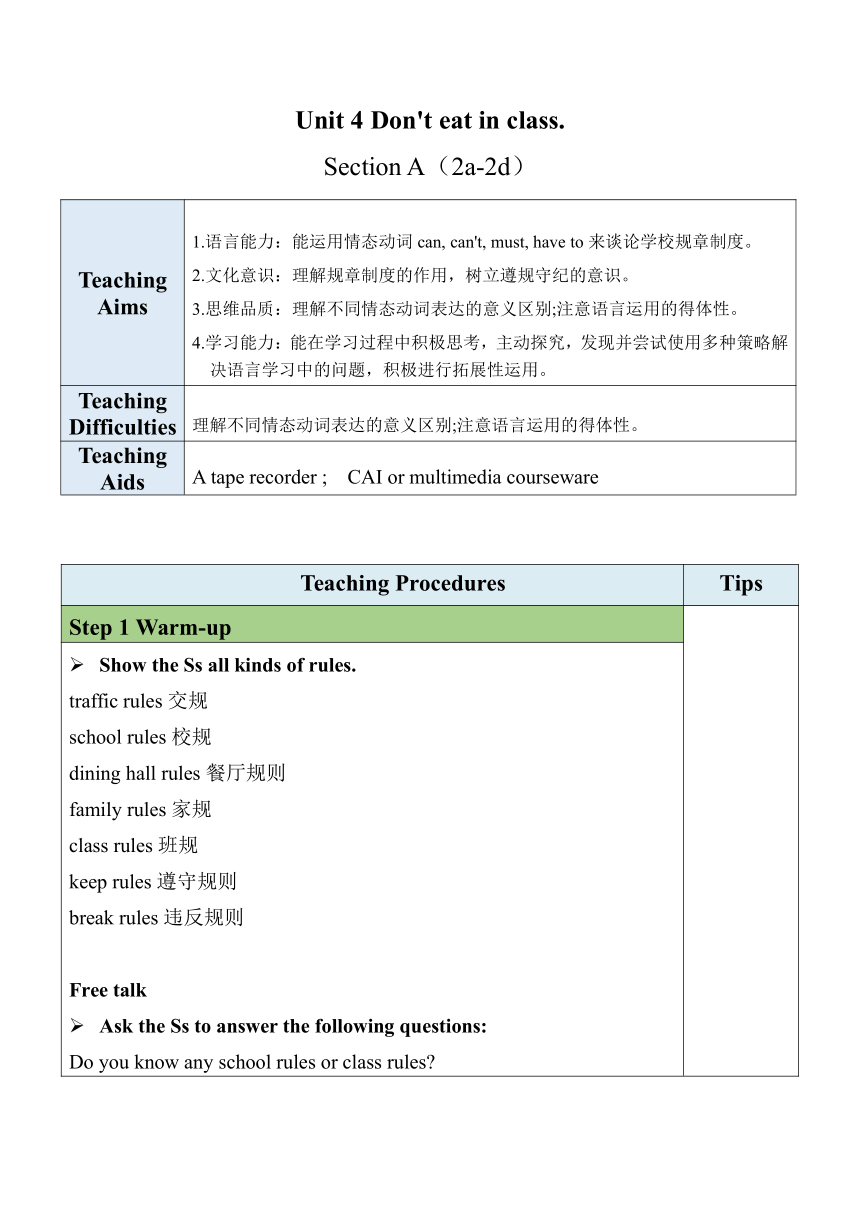
Unit 4 Don't eat in class.
Section A(2a-2d)
Teaching Aims 1.语言能力:能运用情态动词can, can't, must, have to来谈论学校规章制度。 2.文化意识:理解规章制度的作用,树立遵规守纪的意识。 3.思维品质:理解不同情态动词表达的意义区别;注意语言运用的得体性。 4.学习能力:能在学习过程中积极思考,主动探究,发现并尝试使用多种策略解决语言学习中的问题,积极进行拓展性运用。
Teaching Difficulties 理解不同情态动词表达的意义区别;注意语言运用的得体性。
Teaching Aids A tape recorder ; CAI or multimedia courseware
Teaching Procedures Tips
Step 1 Warm-up
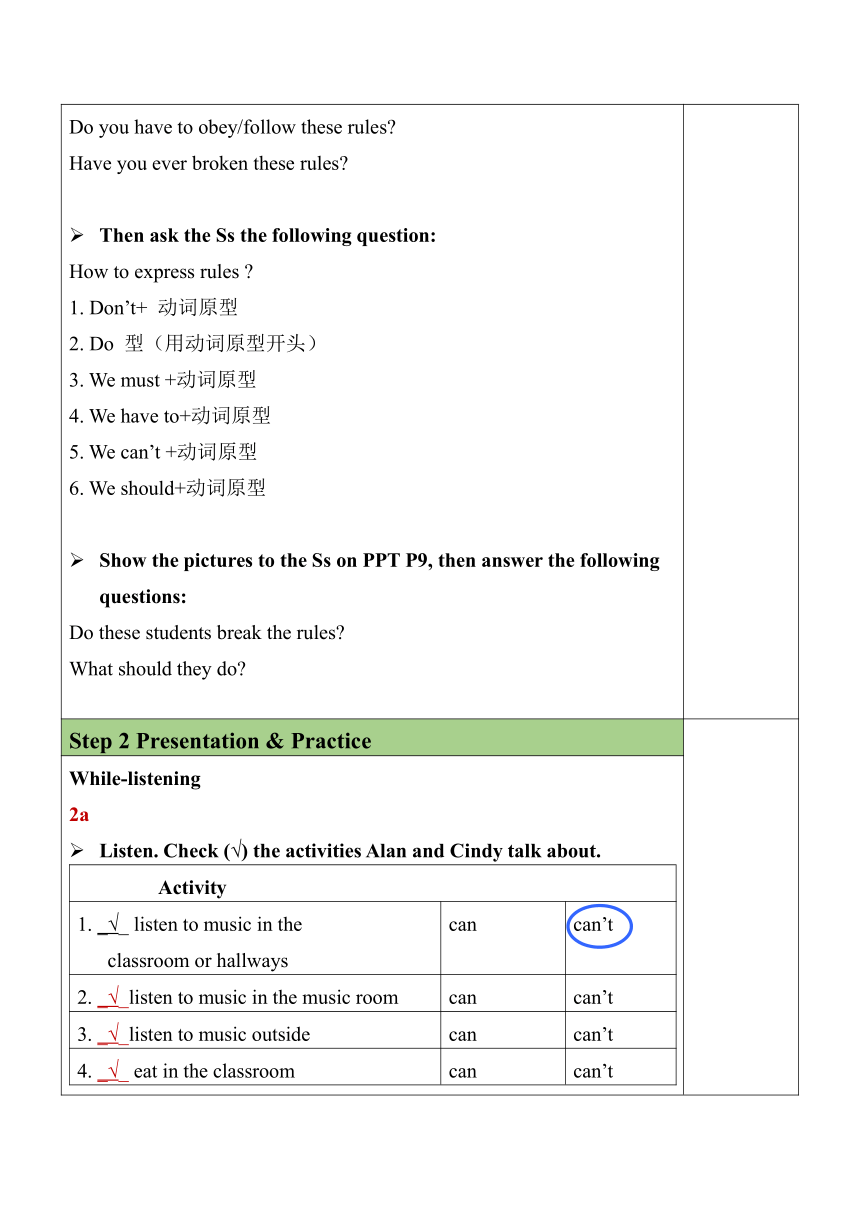
Show the Ss all kinds of rules. traffic rules交规 school rules校规 dining hall rules餐厅规则 family rules家规 class rules班规 keep rules遵守规则 break rules违反规则 Free talk Ask the Ss to answer the following questions: Do you know any school rules or class rules Do you have to obey/follow these rules Have you ever broken these rules Then ask the Ss the following question: How to express rules 1. Don’t+ 动词原型 2. Do 型(用动词原型开头) 3. We must +动词原型 4. We have to+动词原型 5. We can’t +动词原型 6. We should+动词原型 Show the pictures to the Ss on PPT P9, then answer the following questions: Do these students break the rules What should they do
Step 2 Presentation & Practice
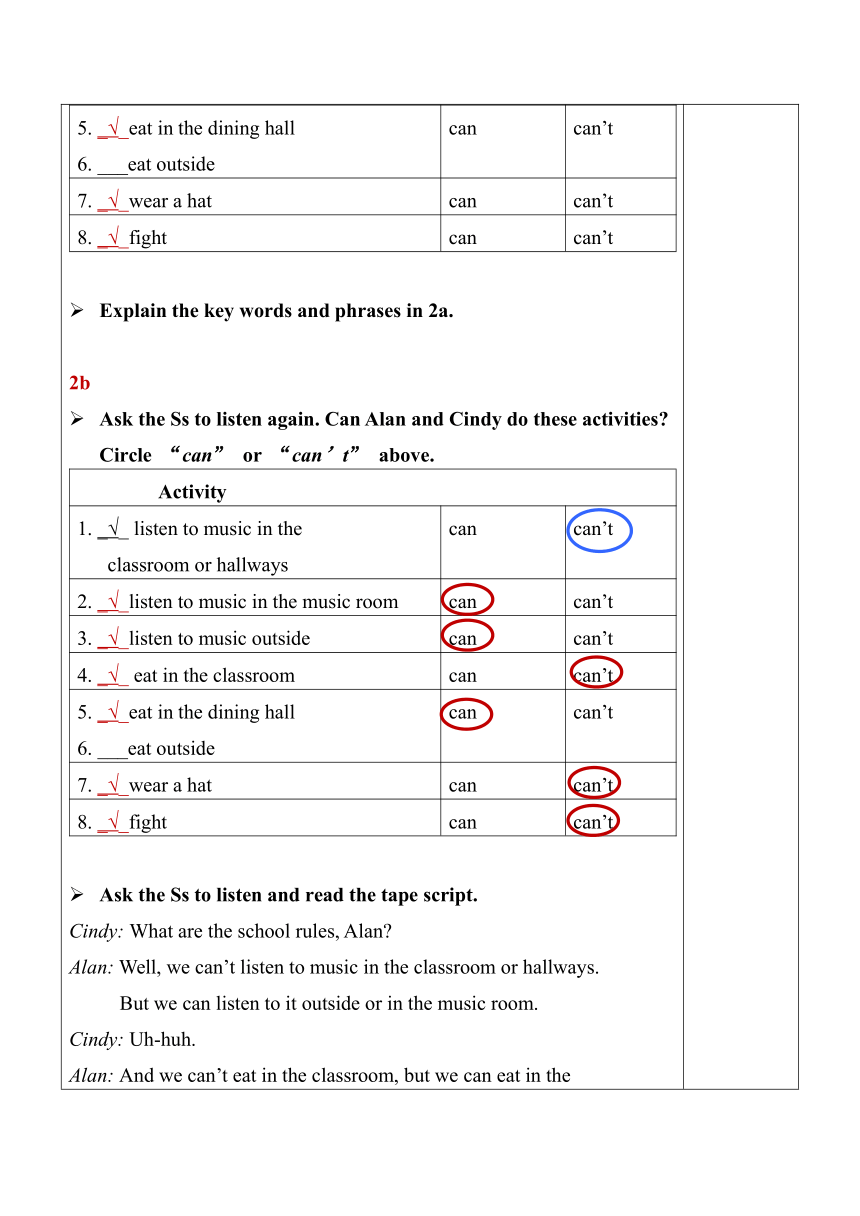
While-listening 2a Listen. Check (√) the activities Alan and Cindy talk about. Activity1. _√_ listen to music in the classroom or hallwayscan can’t 2. _√_listen to music in the music roomcancan’t3. _√_listen to music outsidecancan’t4. _√_ eat in the classroomcancan’t5. _√_eat in the dining hall 6. ___eat outside cancan’t7. _√_wear a hatcancan’t8. _√_fightcancan’t
Explain the key words and phrases in 2a. 2b Ask the Ss to listen again. Can Alan and Cindy do these activities Circle “can” or “can’t” above. Activity1. _√_ listen to music in the classroom or hallwayscan can’t 2. _√_listen to music in the music roomcancan’t3. _√_listen to music outsidecancan’t4. _√_ eat in the classroomcancan’t5. _√_eat in the dining hall 6. ___eat outside cancan’t7. _√_wear a hatcancan’t8. _√_fightcancan’t
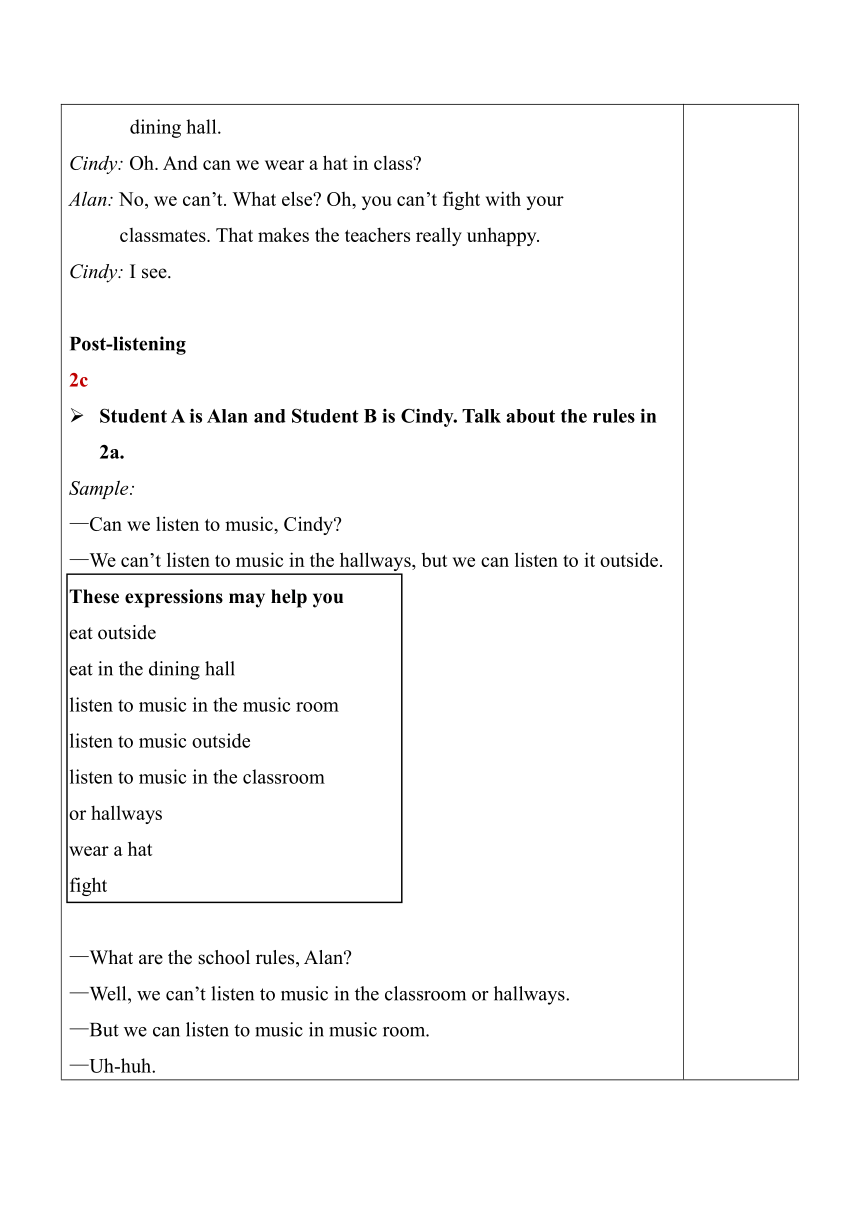
Ask the Ss to listen and read the tape script. Cindy: What are the school rules, Alan Alan: Well, we can’t listen to music in the classroom or hallways. But we can listen to it outside or in the music room. Cindy: Uh-huh. Alan: And we can’t eat in the classroom, but we can eat in the dining hall. Cindy: Oh. And can we wear a hat in class Alan: No, we can’t. What else Oh, you can’t fight with your classmates. That makes the teachers really unhappy. Cindy: I see. Post-listening 2c Student A is Alan and Student B is Cindy. Talk about the rules in 2a. Sample: —Can we listen to music, Cindy —We can’t listen to music in the hallways, but we can listen to it outside. These expressions may help you eat outside eat in the dining hall listen to music in the music room listen to music outside listen to music in the classroom or hallways wear a hat fight —What are the school rules, Alan —Well, we can’t listen to music in the classroom or hallways. —But we can listen to music in music room. —Uh-huh. —We can’t eat in the classroom, but we can eat in the dining hall. —Oh, can we wear a hat in class —No, you can’t. What else Oh, you can’t fight with your classmates. —That makes the teachers really unhappy. —I see. Group work Ask the Ss to talk about our Class Rules. —Can we... —Yes, we can./ No, we can’t. Possible answers: write or draw on the desks write or draw on the wall use mobile phones sit on the desks play ping-pong chew gum play with chalk run around in the classroom speak or laugh loudly in the classroom read comic books or picture books in class or in the classroom
Step 3 Presentation & Reading
2d Listen to the conversation,then explain the key words and phrases. Read the conversation in 2d and answer the questions below. 1. What are John and Alice talking about 2. How many rules does Alice mention Answers:1.School rules. 2.Four rules. What rules does the school have Dos Wear the school uniform. Be quiet in the library.Don’ts Don’t be late for school. Don’t bring music players to school.
Ask the Ss to complete the sentences according to 2d. 1.The students _____ be on time. 2. —_____ the students bring music players to school —No, they _____. 3.The students always _________ wear the school uniform. 4.The students also __________ be quiet in the library. Answers:1.must 2.Can can’t 3.have to 4.have to
Step 4 Language points learning
1. This is very important. 这是非常重要的。 important adj. 重要的 反义词:unimportant; 名词:importance. 【用法详解】 important为形容词,可作表语或定语。常用句型: It is important (for sb.) to do sth. “(对某人来说)做某事是重要的”。 Doing exercise is important. 做运动很重要。 It is an important meeting. 这是一次重要的会议。 2. Can we bring music players to school 我们可以把音乐播放器带到学校吗? bring v. 带来;取来 【用法详解】bring为及物动词,反义词为take(带走)。常用结构有: bring sb./sth. to +地点名词 把某人/某物带到某地(后跟地点副词时省略to) bring sb. sth.=bring sth.for sb. 给某人带来某物 Bring your ID card to school. 把你的身份证带到学校来。 He brings me a big cake. = He brings a big cake for me. 他给我带来了一个大蛋糕。 【易混辨析】bring, take, carry与get bring带来;取来从别处带到说话人这边,多与here连用。take带走;拿走从说话人这边带到别处,多与there连用。carry搬运无方向性,多指搬重物。get去拿来从这边去别处,拿东西再回到这边。
Bring your raincoat here. 把你的雨衣拿到这里。 You’d better take her to hospital. 你最好带她去医院。 Can you help me carry the box 你能帮我搬这个箱子吗? Please get me my glasses. 请把我的眼镜拿来。 3.Can we... 我们能……吗? 【用法详解】该句式用于询问是否许可或征求对方同意。 —Can we eat in the classroom 我们可以在教室里吃东西吗?
—No, we can’t. 不,我们不能。 4. And we always have to wear the school uniform. 并且我们得一直穿着校服。 wear v. 穿;戴 【用法详解】wear作动词,强调状态。其宾语除衣服、鞋、帽子、手套外,还可以是首饰、眼镜、耳机、胡子、假发、奖章等。 You should wear a hat for the party. 这次晚会,你应该戴一顶帽子。 Don’t wear earphones while you are out. 当你在外面时不要戴耳机。 She always wears a pair of glasses. 她总是戴着一副眼镜。 【拓展延伸】put on也可表示“穿;戴”,但它强调动作,指把衣服鞋、袜、帽子、手套等穿上或戴上。 It’s snowing outside. You’d better put on your scarf. 外面在下雪。你最好戴上你的围巾。 【易混辨析】have to与 must 1) have to意为“不得不”,强调“客观需要”。 They have to wear school uniforms every day.他们每天不得不穿校服。 2) must 意为“必须”,强调主观上的愿望。 It’s late. I must go home now.天晚了。现在我必须要回家。 The language points are for reference only.
Step 5 Summary & Homework The homework can vary with the specific conditions.
Summary Ask the Ss to do exercises on PPT P31-P32. Homework Preview the new words and phrases. Do the exercises in students’ book.
Teaching Reflection We can ask the Ss to discuss the school rules. We teach the students to use modal verbs in this unit. They can learn by listening and speaking about the rules they are familiar with. They have a lot to say and this can help them learn fast. In this period, we can use reflecting and transforming strategy to lead the students to talk about rules and practice oral ability.

展开更多......

收起↑

资源预览