【核心素养目标】Unit 4 Don't eat in class Section B(2a-2c)表格式教案

资源下载
  1. 二一教育资源

【核心素养目标】Unit 4 Don't eat in class Section B(2a-2c)表格式教案

资源简介

Unit 4 Don't eat in class.
Section B(2a-2c)
Teaching Aims 1.语言能力:了解文章中Molly需要遵守的一些规则;学习使用目标语言谈论对某些规章制度(校规、家规等)的看法。 2.文化意识:能读懂一些英语的规则制度,能用英语表达和制定一些简单的规 则,理解没有规矩不成方圆; 无论是在学校时还是在家庭中以及以后走上社会都应当遵守规则,按规则办事。 3.思维品质:能依据不同信息进行独立思考,评价语篇的内容和作者的观点,说明理由。 4.学习能力:能够积极尝试运用不同的英语学习策略提高学习效率。
Teaching Difficulties 总结用祈使句、情态动词Don't/ Do, can't/ can, must及have to来表达各种规章制度。
Teaching Aids A tape recorder ,CAI or multimedia courseware
Teaching Procedures Tips
Step 1 Revision & Free Talk
Lead in Ask the Ss to talk about family rules. Show some pictures on PPT P9 to the Ss, then use the following sentence pattern: I must / have to/ can / can’t... do the dishes/ watch TV/ make the bed/ hang out with friends/ play online games/ play the piano Free talk Do you like these rules What do you think of them If you are unhappy about these rules, what can you do
Step 2 Presentation & Reading
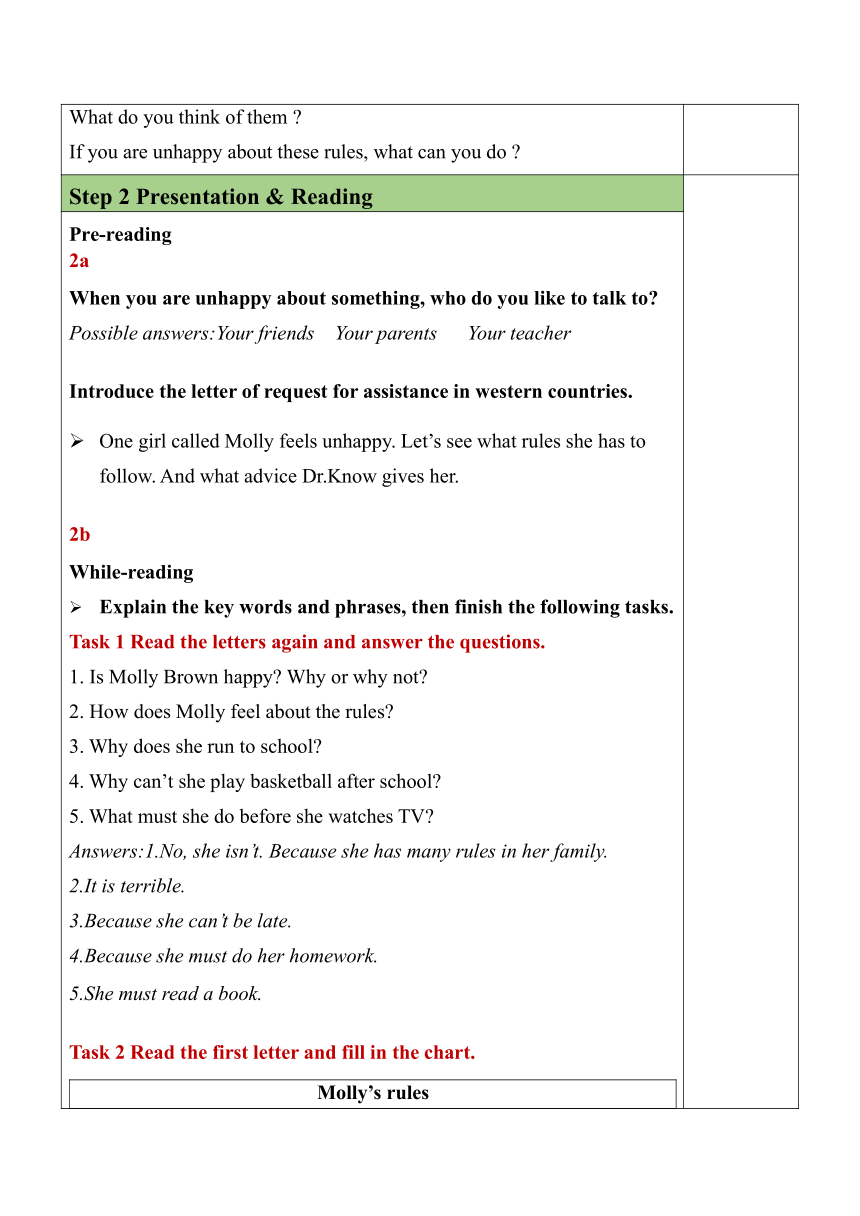
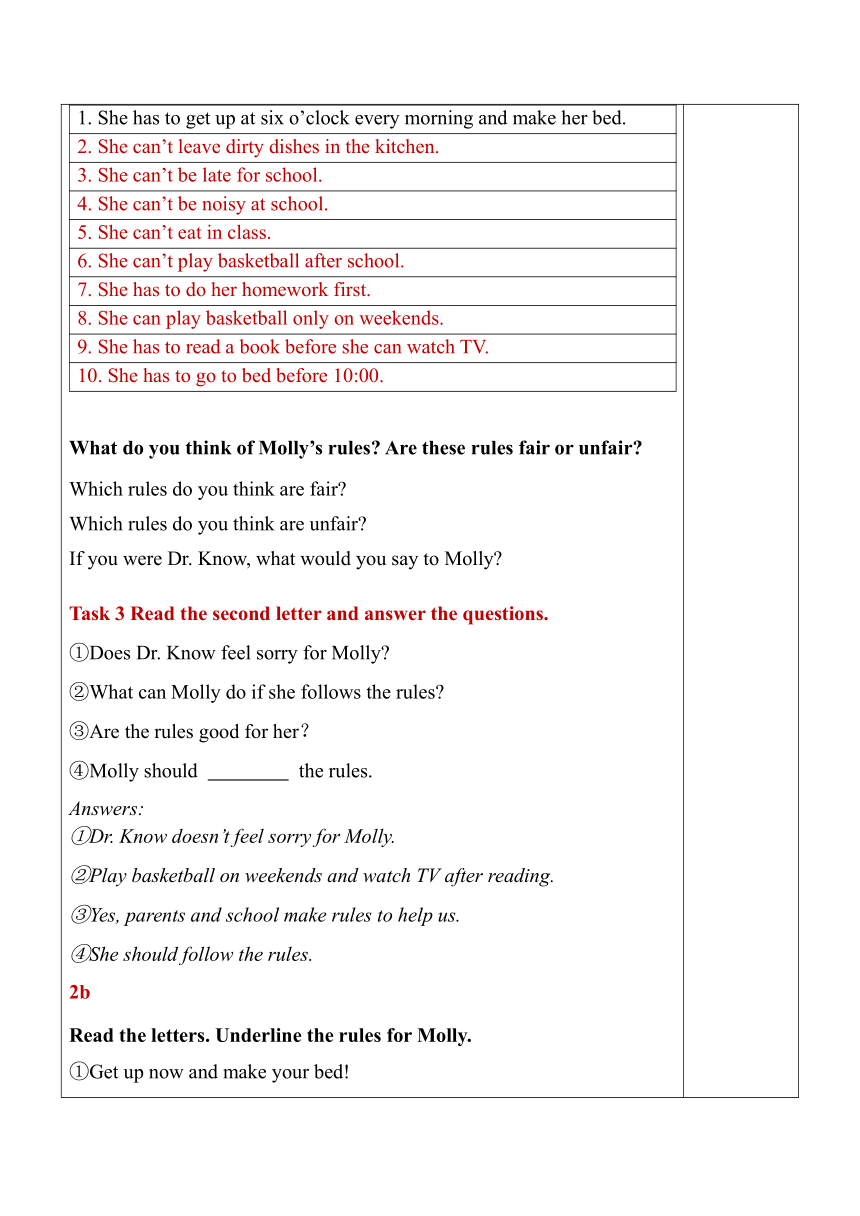
Pre-reading 2a When you are unhappy about something, who do you like to talk to Possible answers:Your friends Your parents Your teacher Introduce the letter of request for assistance in western countries. One girl called Molly feels unhappy. Let’s see what rules she has to follow. And what advice Dr.Know gives her. 2b While-reading Explain the key words and phrases, then finish the following tasks. Task 1 Read the letters again and answer the questions. 1. Is Molly Brown happy Why or why not 2. How does Molly feel about the rules 3. Why does she run to school 4. Why can’t she play basketball after school 5. What must she do before she watches TV Answers:1.No, she isn’t. Because she has many rules in her family. 2.It is terrible. 3.Because she can’t be late. 4.Because she must do her homework. 5.She must read a book. Task 2 Read the first letter and fill in the chart. Molly’s rules1. She has to get up at six o’clock every morning and make her bed.2. She can’t leave dirty dishes in the kitchen.3. She can’t be late for school.4. She can’t be noisy at school.5. She can’t eat in class.6. She can’t play basketball after school.7. She has to do her homework first.8. She can play basketball only on weekends.9. She has to read a book before she can watch TV.10. She has to go to bed before 10:00.
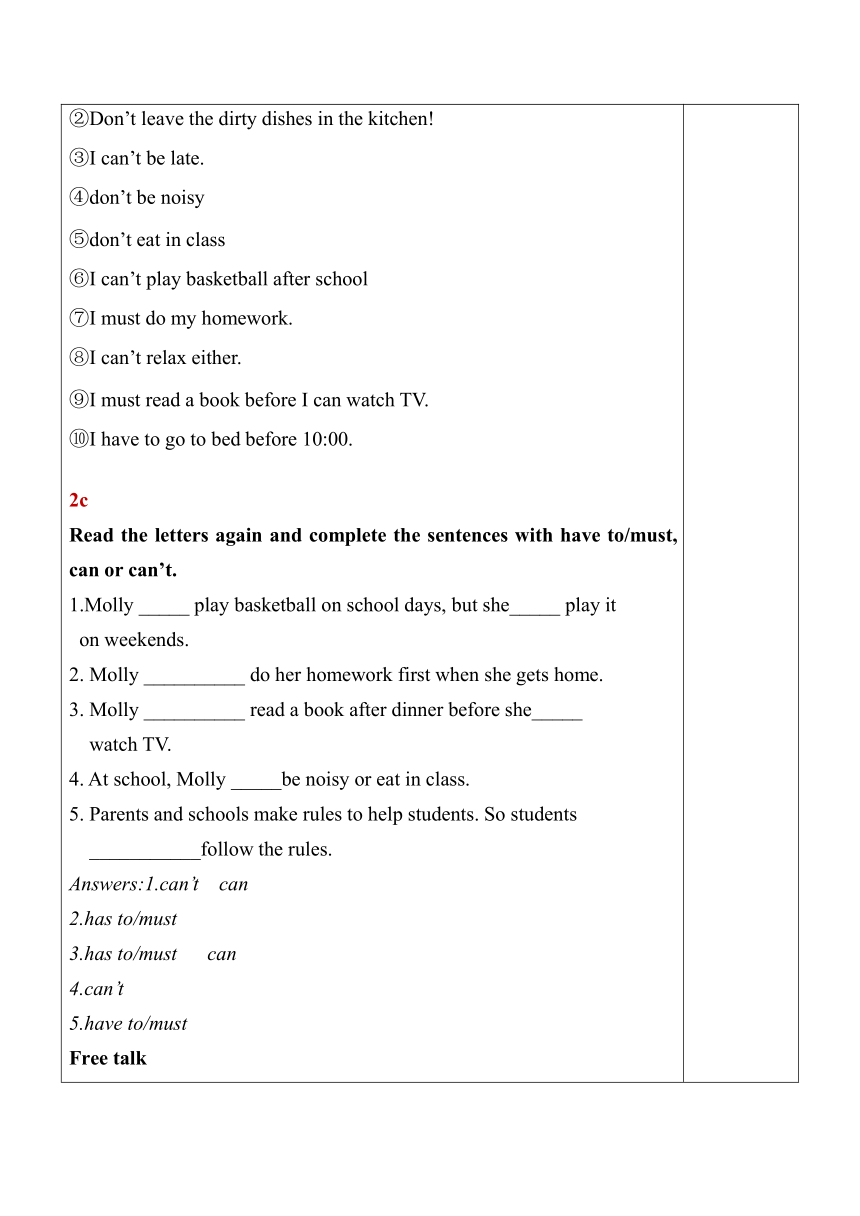
What do you think of Molly’s rules Are these rules fair or unfair Which rules do you think are fair Which rules do you think are unfair If you were Dr. Know, what would you say to Molly Task 3 Read the second letter and answer the questions. ①Does Dr. Know feel sorry for Molly ②What can Molly do if she follows the rules ③Are the rules good for her? ④Molly should the rules. Answers: ①Dr. Know doesn’t feel sorry for Molly. ②Play basketball on weekends and watch TV after reading. ③Yes, parents and school make rules to help us. ④She should follow the rules. 2b Read the letters. Underline the rules for Molly. ①Get up now and make your bed! ②Don’t leave the dirty dishes in the kitchen! ③I can’t be late. ④don’t be noisy ⑤don’t eat in class ⑥I can’t play basketball after school ⑦I must do my homework. ⑧I can’t relax either. ⑨I must read a book before I can watch TV. ⑩I have to go to bed before 10:00. 2c Read the letters again and complete the sentences with have to/must, can or can’t. 1.Molly _____ play basketball on school days, but she_____ play it on weekends. 2. Molly __________ do her homework first when she gets home. 3. Molly __________ read a book after dinner before she_____ watch TV. 4. At school, Molly _____be noisy or eat in class. 5. Parents and schools make rules to help students. So students ___________follow the rules. Answers:1.can’t can 2.has to/must 3.has to/must can 4.can’t 5.have to/must Free talk Ask the Ss to talk about themselves freely. 1.Do you have many rules in your life 2.What do you think of these rules 3.What would you do if you were Molly These expressions may help you. I can't....before..... I have to/must .... I can ... after..... I think they are unnecessary/unfair/useful...
Step 3 Language points learning
1. At school, we have more rules — don’t be noisy, don’t eat in class, … 在学校,我们有更多的规定——不能喧哗,不要在课上吃东西, noisy adj. 吵闹的 【用法详解】noisy作形容词,其反义词为quiet(安静的)。 Turn down the TV. It’s too noisy. 把电视声音调小一些,太吵了。 【拓展延伸】noisy的名词形式为noise,意为“喧闹声;噪声”,作可数名词或不可数名词均可。 more adj.& pron. 更多(的) 【用法详解】 (1) more在此处作形容词,是many的比较级,修饰可数名词复数(rules)。more还可作much的比较级,修饰不可数名词。 I have more books than her. 我的书比她的多。 You should drink more water. 你应该多喝水。 (2) more还可作代词,意为“更多”。 The cake is delicious. I want some more. 这蛋糕很好吃,我想再来一些。 2. After dinner, I can’t relax either. 晚饭后我也不能放松。 relax v. 放松;休息 【用法详解】relax作及物动词和不及物动词均可。relax oneself 意为“放松自己”。 Don’t be nervous. Just relax. 不要紧张,放松点。 She relaxes herself by listening to music. 她通过听音乐的方式来使自己放松。 形容词形式:relaxing adj.令人放松的 relaxed adj.感到轻松的 either adv. 也 副词either表示“也”,用于否定句句末,用法与表示肯定或陈述的副词too相似,可用逗号与语句的主题隔开。 e.g. You like English. I like it, too.你喜欢英语,我也喜欢。 My father can’t speak English. My mother can’t (speak it), either. 我爸不会讲英语,我妈也不会。 3. I must read a book before I can watch TV. 在看电视之前我必须先读一本书。 read v. 读;阅读 【用法详解】read在句中作及物动词,其过去式还是read,但读作/red/。 My father often reads newspapers in the morning. 我爸爸经常在早上读报。 【拓展延伸】read也可作不及物动词,意为“阅读;朗读”。 You read and I write. 你读我写。 【易混辨析】read, look, see与watch read 强调看书、报纸、杂志等有文字的东西。 look 强调“看”的动作,不强调“看见”这个结果,是不及物动词,后接宾语时要与介词at连用。see 强调“看”的结果,表示“看见;看到”。see也用于一些短语中,如:see a doctor“看医生”,see a movie“看电影”。watch 强调“观看”正在运动或变化的事物,有时含有“欣赏”之意。
He is reading a book.他正在看书。 You should look at the blackboard.你应该看黑板。 You can see many flowers in the garden.在花园里你能看到许多花。 My grandparents watch TV every night. 我的爷爷奶奶每天晚上看电视。 巧学妙记 “看”法不同 强调动作用look, 若跟宾语加at; 强调结果要用see,读书看报用read; 电视、戏剧和比赛,凡是表演用watch。 4. I know how you feel. 我知道你的感受。 feel v. 感受;觉得 feel中的ee发元音/i /, 此类单词还有meet(遇见), keep(保持)等。 【用法详解】feel作系动词,在此意为“感受;觉得”,其后可接形容词、副词或介词短语。 I feel sorry for him. 我为他感到可惜。 I am feeling in a good mood. 我现在心情好。 【拓展延伸】feel作系动词,意为“摸起来”,后可接形容词作表语。 The silk feels very soft. 这丝绸摸起来很柔软。 I don’t feel well. I may have a fever. 我感到不舒服,我可能发烧了。 5. Parents and schools are sometimes strict, but remember, they make rules to help us. 父母和学校有时是严格的,但是记住,他们制订规则是为了帮助我们。 strict adj. 严格的;严厉的 【用法详解】strict是形容词,在句中作定语或表语。常见搭配: be strict with sb. 对某人要求严格 be strict in sth. 对某事要求严格 remember v. 记住;记起 【易混辨析】remember to do sth. 与 remember doing sth. remember to do sth. 意为“记着做某事”,此事目前未做。 Remember to turn off the lights when you leave the classroom. 离开教室时记得关灯。 remember doing sth. 意为“记得已经做过某事”,此事目前已做。 I remember seeing the movie in the cinema. 我记得我在电影院看过这部电影了。
The language points are for reference only.
Step 5 Summary & Homework The homework can vary with the specific conditions.
Summary Ask the Ss to do the exercises on PPT P36-P41. Homework Read and recite the new words and phrases . Do the exercises in students’ book.
Teaching Reflection In this period, the most important thing is to train the students' ability of reading. While reading, students should underline the rules for Molly. First we give the general introduction, and then give the specific details and examples. On the one hand, we must learn the new words and new language items; on the other hand, we must practice talking about the topic with the target language. And we ask and answer a lot of questions and practice the useful expressions in many ways.

展开更多......

收起↑

资源预览