【核心素养目标】Unit 5 Why do you like pandas Section A(2a-2d)表格式教案

资源下载
  1. 二一教育资源

【核心素养目标】Unit 5 Why do you like pandas Section A(2a-2d)表格式教案

资源简介

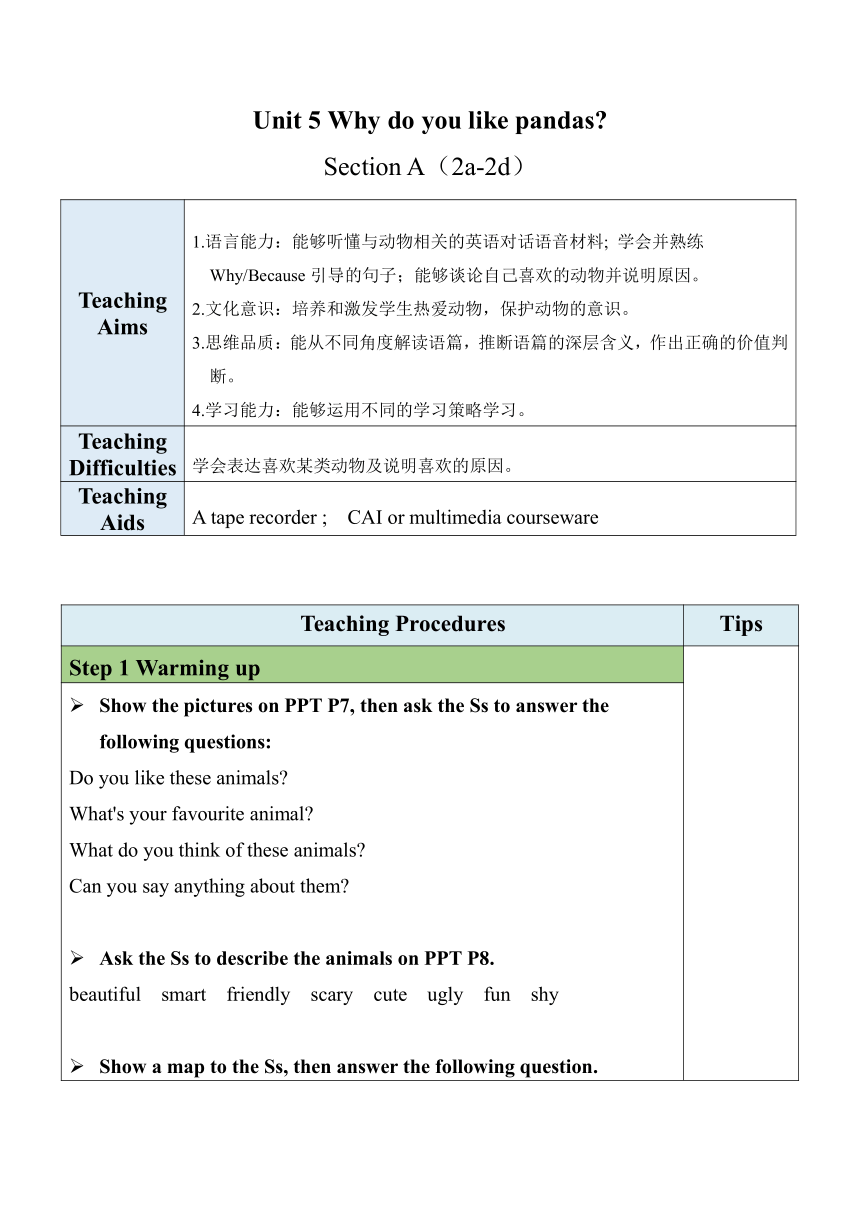
Unit 5 Why do you like pandas
Section A(2a-2d)
Teaching Aims 1.语言能力:能够听懂与动物相关的英语对话语音材料; 学会并熟练Why/Because引导的句子;能够谈论自己喜欢的动物并说明原因。 2.文化意识:培养和激发学生热爱动物,保护动物的意识。 3.思维品质:能从不同角度解读语篇,推断语篇的深层含义,作出正确的价值判断。 4.学习能力:能够运用不同的学习策略学习。
Teaching Difficulties 学会表达喜欢某类动物及说明喜欢的原因。
Teaching Aids A tape recorder ; CAI or multimedia courseware
Teaching Procedures Tips
Step 1 Warming up
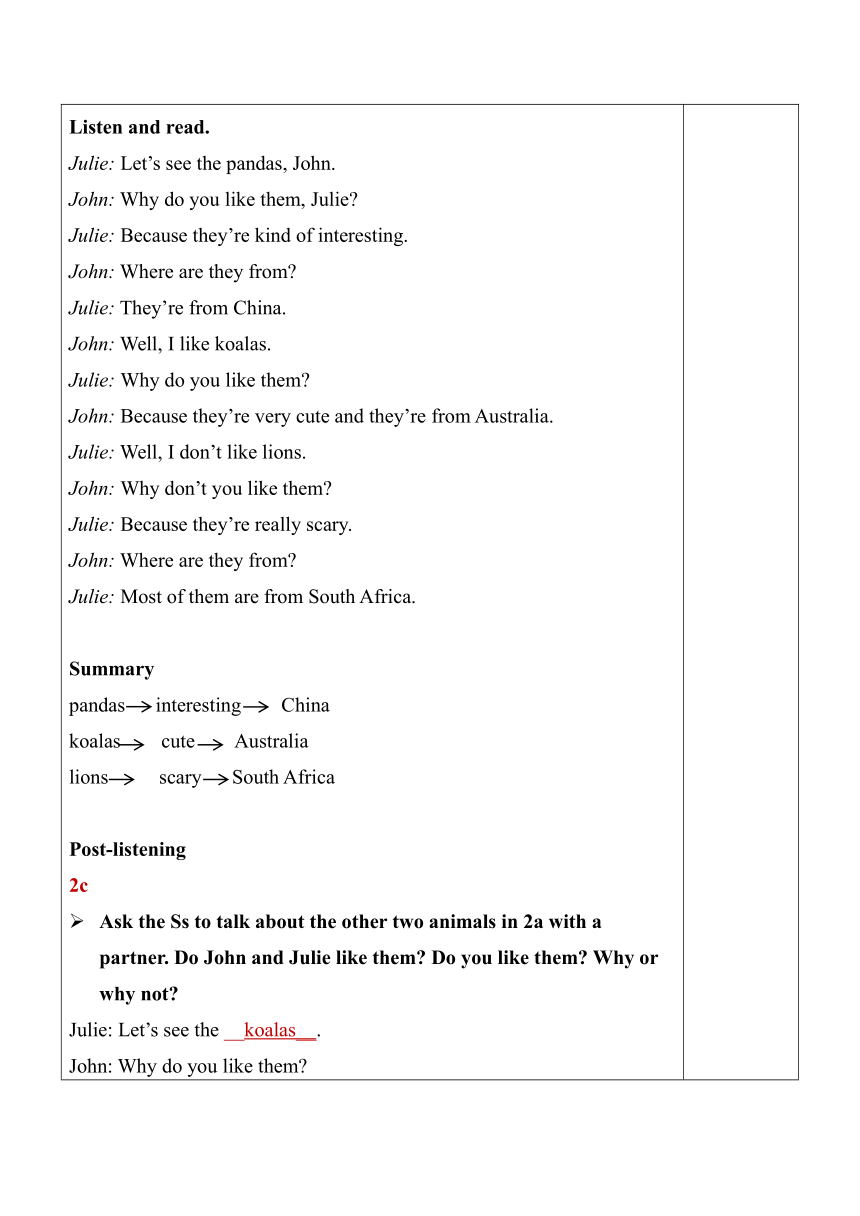
Show the pictures on PPT P7, then ask the Ss to answer the following questions: Do you like these animals What's your favourite animal What do you think of these animals Can you say anything about them Ask the Ss to describe the animals on PPT P8. beautiful smart friendly scary cute ugly fun shy Show a map to the Ss, then answer the following question. Where are these animals from List some animals in different areas. Free Talk My favorite animals are cats because they’re very interesting. Dogs are not my favorite, but I like them a little. They’re kind of interesting. I don’t like tigers. I think tigers are really scary. very和really语气更强,kind of程度轻,相当于a little; 而really语气较重,它还能表示说话者发自内心的感受。
Step 2 Presentation & Practice
While-listening 2a Listen and write the animals you hear. Draw a line from the animals to the description words and the countries they are from. AnimalDescription wordsCountries1.pandasreally scaryAustralia2.koalaskind of interestingSouth Africa3.lions very cuteChina
2b Listen again. Complete the conversation with the words in 2a. Julie: Let’s see the _pandas_. John: Why do you like them Julie: Because they’re _kind of_ interesting. John: Where are they from Julie: They’re from _China_. Listen and read. Julie: Let’s see the pandas, John. John: Why do you like them, Julie Julie: Because they’re kind of interesting. John: Where are they from Julie: They’re from China. John: Well, I like koalas. Julie: Why do you like them John: Because they’re very cute and they’re from Australia. Julie: Well, I don’t like lions. John: Why don’t you like them Julie: Because they’re really scary. John: Where are they from Julie: Most of them are from South Africa. Summary pandas interesting China koalas cute Australia lions scary South Africa Post-listening 2c Ask the Ss to talk about the other two animals in 2a with a partner. Do John and Julie like them Do you like them Why or why not Julie: Let’s see the __koalas__. John: Why do you like them Julie: Because they’re very cute. John: Where are they from Julie: They’re from _Australia_. Group work Can you guess who they are FeaturesGuess who I amI have four legs.panda, lion, tiger, elephantI have a tail.monkey, koala, dog, catI have a long neck.giraffeI eat grass.sheep, cow, horse, goatI only like meat.lion, tigerI can run, but I can’t swim.rabbitI’m a bird, but I can’t fly.penguin
Free Talk Ask the Ss to talk freely. Does your family have any pets What pets Can you describe them
Step 3 Presentation & Reading `
2d Listen the conversation in 2d and fill in the chart. AnimalNameDescriptionCan doPeter’s petdogDingdingvery smart walk on two legs; danceJenny’s mom’s petcat Lazy kind of boringsleep all day
Ask the Ss to read the conversation in 2d and answer the questions below. 1. Does Peter have a pet What’s his name What can he do 2. Does Jenny’s mother have a pet What’s her name What can she do Answers:1.Yes, he does. It’s a dog. Its name is Dingding. He can walk on two legs. He can dance, too. 2.Yes, she does. It’s a cat. Its name is Lazy. She can sleep all day.
Step 4 Language points learning
1.kind of interesting 有点儿有趣 kind of 稍微;有点儿 【用法详解】 kind of常用来修饰形容词或副词,相当于a little或a bit。 I watched a movie. It’s kind of boring. 我看了一场电影,它有点儿无聊。 【拓展延伸】kind 作名词,意为“种类”。常构成短语: a kind of 一种 all kinds of 各种各样的 different kinds of 不同种类的 2. Where are they from 它们来自哪里? be from 来自 【用法详解】be from相当于come from,后接表示地点的名词。 He is from Beijing.=He comes from Beijing. 他来自北京。 Where + be + 主语 + from 【用法详解】该句型意为“……来自哪里?”。回答用 “主语 + be + from + 地点”或直接回答地点。 —Where is Lily from 莉莉来自哪里? —She is from Australia. 她来自澳大利亚。 3. He can walk on two legs. 他会立着走路。 在西方国家,人们多有饲养宠物的习惯,尤以养猫、狗居多。 他们往往将宠物视为家中成员,因此不用代词it指代宠物,而根据宠物性别用she或he。当泛指或不能确定性别时,英语中人们一般用she来指代小猫,用he指代小狗。 walk, stand 等动词后可接“介词+身份部位”,用以描述行为姿态。如:walk on one’s hands 用手倒立行走; stand on one’s hands 倒立。 4. Why don’t you like the cat 你为什么不喜欢那只猫? Why don’t + 主语 +动词原形+其他? 【用法详解】该句式意为“某人为什么不做某事?”,询问原因。 —Why don’t they buy a new house 他们为什么不买一座新房子呢? —Because they don’t have enough money. 因为他们没有足够的钱。 【拓展延伸】 “Why don’t you… ” 可用来提建议,意为“你为什么不……呢?”,与“Why not… ”同义。 此时的答语多为“Good idea!” 或“That’s sounds great.”等。 —Why don’t you get her a scarf 你为什么不给她买条围巾呢? —Good idea! 好主意! 5. She sleeps all day, and her name is Lazy. 她整天睡觉,她的名字是Lazy。 sleep v. & n. 睡觉 【用法详解】 (1) sleep在句中作动词,意为“ 睡觉 ”,指睡眠的持续状态。 Some students can’t sleep well the day before a math exam. 一些学生在数学考试前一天睡不好觉。 (2) sleep也可作名词, 意为“睡觉;睡眠”。 I need to get some sleep. 我需要睡一会儿。 The language points are for reference only.
Step 5 Summary & Homework The homework can vary with the specific conditions.
Summary Ask the Ss to do exercises on PPT P32-P36. Homework Preview the new words and phrases. Do the exercises in students’ book.
Teaching Reflection In this period, there are more new words and expressions. The T should provide more practice in listening and speaking and encourage Ss to be more involved.

展开更多......

收起↑

资源预览