【核心素养目标】Unit 5 Why do you like pandas Section A(GF-3c)表格式教案

资源下载
  1. 二一教育资源

【核心素养目标】Unit 5 Why do you like pandas Section A(GF-3c)表格式教案

资源简介

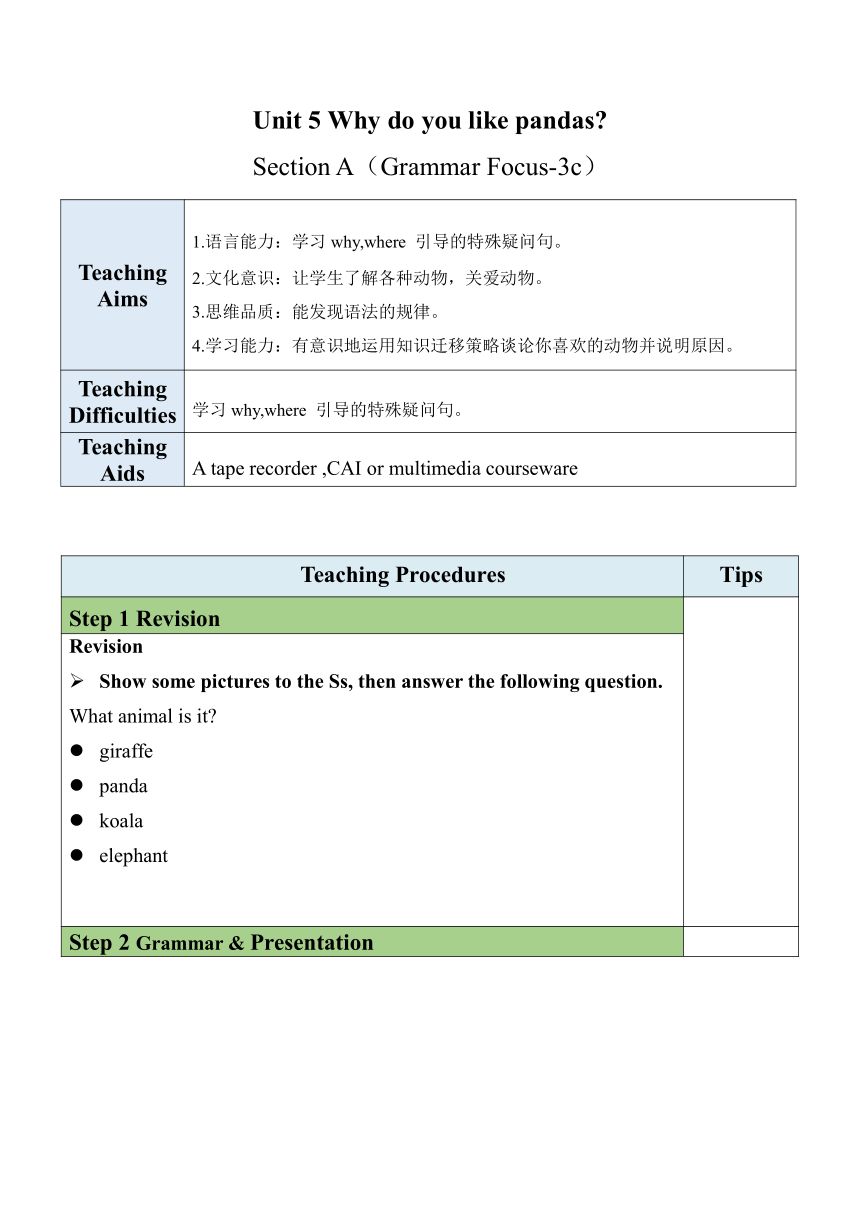
Unit 5 Why do you like pandas
Section A(Grammar Focus-3c)
Teaching Aims 1.语言能力:学习why,where 引导的特殊疑问句。 2.文化意识:让学生了解各种动物,关爱动物。 3.思维品质:能发现语法的规律。 4.学习能力:有意识地运用知识迁移策略谈论你喜欢的动物并说明原因。
Teaching Difficulties 学习why,where 引导的特殊疑问句。
Teaching Aids A tape recorder ,CAI or multimedia courseware
Teaching Procedures Tips
Step 1 Revision
Revision Show some pictures to the Ss, then answer the following question. What animal is it giraffe panda koala elephant
Step 2 Grammar & Presentation
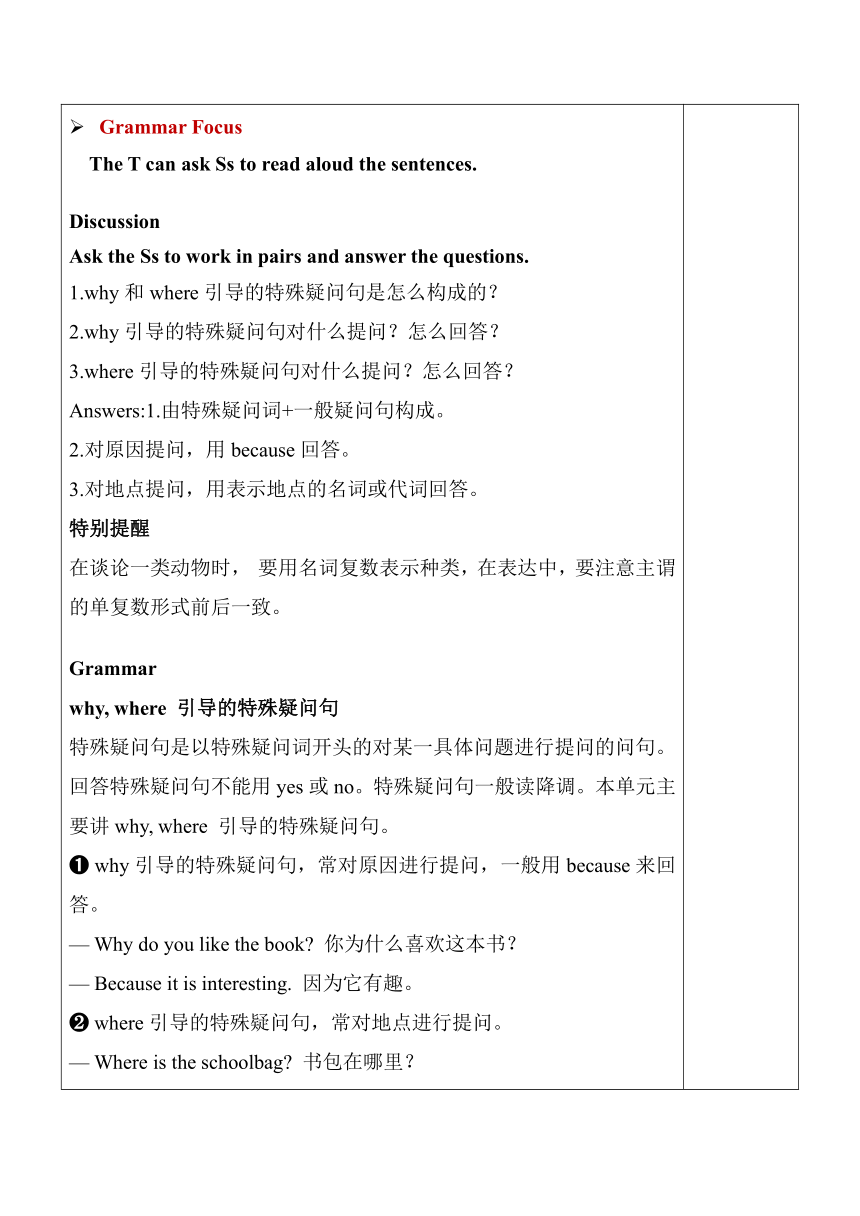
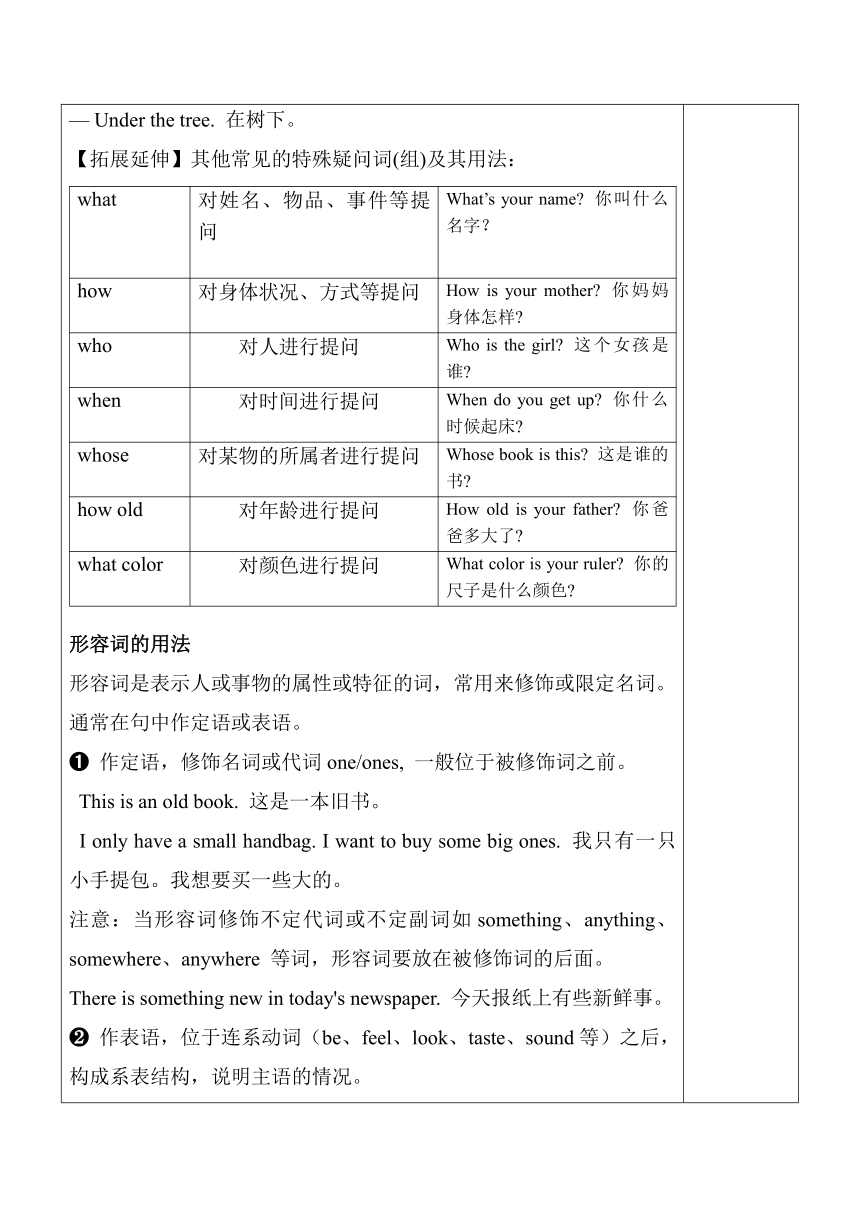
Grammar Focus The T can ask Ss to read aloud the sentences. Discussion Ask the Ss to work in pairs and answer the questions. 1.why和where引导的特殊疑问句是怎么构成的? 2.why引导的特殊疑问句对什么提问?怎么回答? 3.where引导的特殊疑问句对什么提问?怎么回答? Answers:1.由特殊疑问词+一般疑问句构成。 2.对原因提问,用because回答。 3.对地点提问,用表示地点的名词或代词回答。 特别提醒 在谈论一类动物时, 要用名词复数表示种类,在表达中,要注意主谓的单复数形式前后一致。 Grammar why, where 引导的特殊疑问句 特殊疑问句是以特殊疑问词开头的对某一具体问题进行提问的问句。回答特殊疑问句不能用yes或no。特殊疑问句一般读降调。本单元主要讲why, where 引导的特殊疑问句。 why引导的特殊疑问句,常对原因进行提问,一般用because来回答。 — Why do you like the book 你为什么喜欢这本书? — Because it is interesting. 因为它有趣。 where引导的特殊疑问句,常对地点进行提问。 — Where is the schoolbag 书包在哪里? — Under the tree. 在树下。 【拓展延伸】其他常见的特殊疑问词(组)及其用法: what对姓名、物品、事件等提问 What’s your name 你叫什么名字?how对身体状况、方式等提问How is your mother 你妈妈身体怎样 who对人进行提问Who is the girl 这个女孩是谁 when对时间进行提问When do you get up 你什么时候起床 whose对某物的所属者进行提问Whose book is this 这是谁的书 how old对年龄进行提问How old is your father 你爸爸多大了 what color对颜色进行提问What color is your ruler 你的尺子是什么颜色
形容词的用法 形容词是表示人或事物的属性或特征的词,常用来修饰或限定名词。通常在句中作定语或表语。 作定语,修饰名词或代词one/ones, 一般位于被修饰词之前。 This is an old book. 这是一本旧书。 I only have a small handbag. I want to buy some big ones. 我只有一只小手提包。我想要买一些大的。 注意:当形容词修饰不定代词或不定副词如something、anything、somewhere、anywhere 等词,形容词要放在被修饰词的后面。 There is something new in today's newspaper. 今天报纸上有些新鲜事。 作表语,位于连系动词(be、feel、look、taste、sound等)之后,构成系表结构,说明主语的情况。 They are beautiful. 他们很漂亮。 My mother looks young. 我的妈妈看起来很年轻。 程度副词 程度副词表示程度,常用来修饰形容词、副词。 本单元出现的程度副词主要有kind of, very, really, so等。在运用程度副词时,very 和really语气更强; kind of程度轻,相当于a little;而really语气较重,它还能表示说话者发自内心的感受,意思是“真正地”。 Pandas are kind of interesting. 熊猫有些有趣。 Pigs are very lazy. 猪非常懒惰。 Koalas are so cute. 考拉是如此可爱。 I think tigers are really scary. 我认为老虎真的很可怕。
Step 3 Presentation
3a Ask the Ss to fill in the blanks with the words from the box. Then practice the conversation. because they’re do don’t cool like why where A: _______ are lions from B: ________ from South Africa. Do you ____ lions A: No, I don’t. B: Why ______ you like lions A: Because they’re really scary. But I like giraffes. B: Really _____ do you like giraffes A: Well, ________ they’re kind of interesting. Do you like pandas B: Yes, I do. But I like tigers a lot. A: Tigers Why ____ you like tigers B: They’re really ______! Answers:Where They’re like don’t Why because do cool 3b Write names of animals in the blanks to make sentences that are true for you. I like _____ because they’re cute. I like _____ because they’re smart. I like _____ because they’re interesting. I don’t like _____ because they’re lazy. Talk about the animals you like and you don’t like. Ask and answer in pairs. —Do you like... —Yes,... /No,... These sentences may help you Do you like ... Why do you like... Why don’t you like them Where are they from Because they’re... They’re really/kind of/very... A:Why do you like B:Because they are . A:Why don’t you like B:Because they are . 3c Think of an animal. Ask and answer questions with your partner to guess each other’s animal. Sample: A: Is the animal big B: Yes, it is. A: Where’s the animal from B: It’s from China. A: Is it black and white B: Yes, it is. A: It’s a panda! B: Yes, you’re right! Group work Make a survey about your partners’ favorite animal. Then report it to your group. Favorite animal why From where color A B
The language points are for reference only.
Step 4 Summary & Homework The homework can vary with the specific conditions.
Summary Ask the Ss to do exercises on PPT P26-P28. Homework Preview the new words and phrases in Section B(1a-1d). Do the exercises in students’ book.
Teaching Reflection We always get the students to learn grammar by summing up the sentences they have learned. Students can practice grammar by using. After they know how to use these sentence patterns, the students should practice in different activities.

展开更多......

收起↑

资源预览