【核心素养目标】Unit 5 Why do you like pandas Section B(1a-1d)表格式教案

资源下载
  1. 二一教育资源

【核心素养目标】Unit 5 Why do you like pandas Section B(1a-1d)表格式教案

资源简介

Unit 5 Why do you like pandas
Section B(1a-1d)
Teaching Aims 1.语言能力:正确使用形容词描述喜爱的动物及原因。 2.文化意识:培养和激发学生热爱动物,保护动物的意识。 3.思维品质:学会利用听力技巧,准确抓住听力材料的核心问题。 4.学习能力:有意识地运用知识迁移策略表达自己喜欢的动物并说明原因。
Teaching Difficulties 正确使用形容词描述喜爱的动物及原因。
Teaching Aids A tape recorder ; CAI or multimedia courseware
Teaching Procedures Tips
Step 1 Lead in
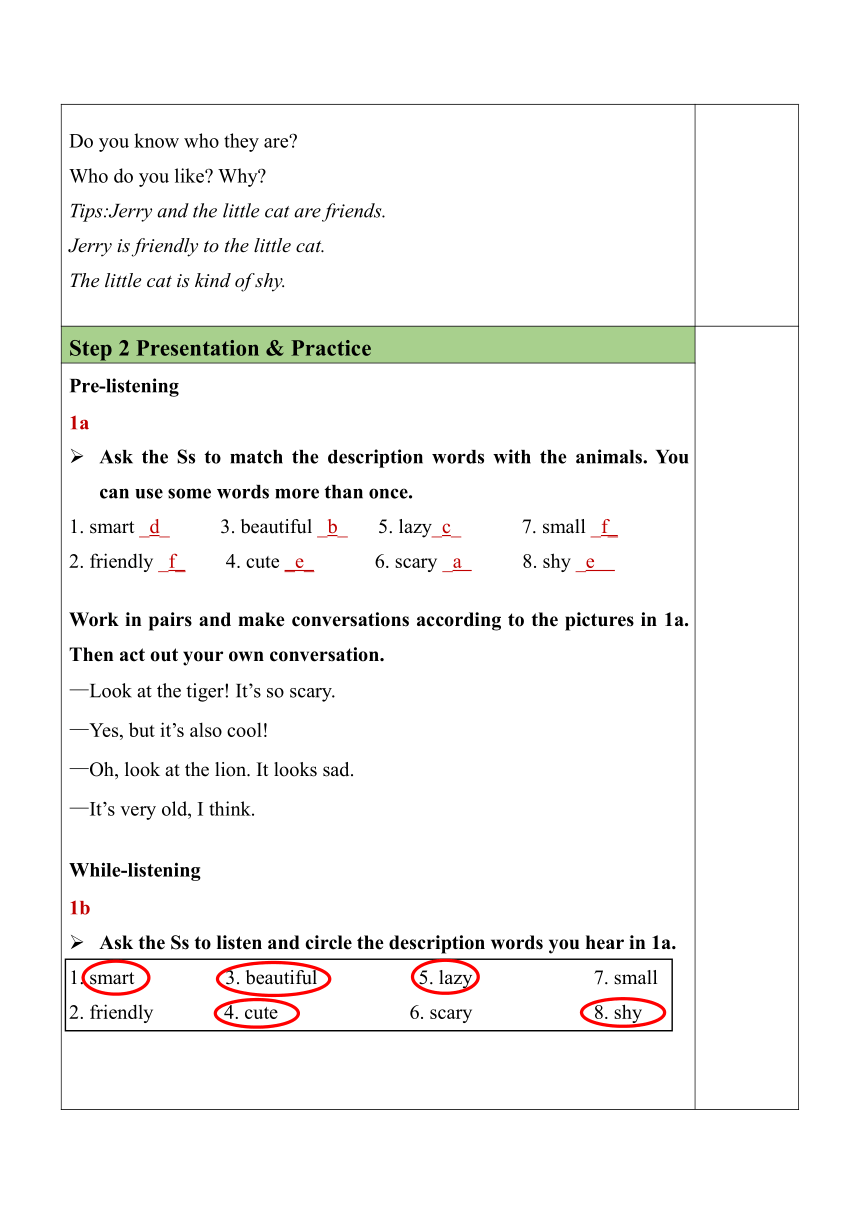
Show some pictures to the Ss, then ask them the following question: How to describe animals Dogs: friendly and lovely Elephants:gentle and shy Tigers:rude and cruel Lions:scary and dangerous Pandas:cute Giraffe:quiet Monkeys:playful Wolves:noisy Ask the Ss to watch the video on PPT P8 and answer the following questions. Do you know who they are Who do you like Why Tips:Jerry and the little cat are friends. Jerry is friendly to the little cat. The little cat is kind of shy.
Step 2 Presentation & Practice
Pre-listening 1a Ask the Ss to match the description words with the animals. You can use some words more than once. 1. smart _d_ 3. beautiful _b_ 5. lazy_c_ 7. small _f_ 2. friendly _f_ 4. cute _e_ 6. scary _a 8. shy _e Work in pairs and make conversations according to the pictures in 1a. Then act out your own conversation. —Look at the tiger! It’s so scary. —Yes, but it’s also cool! —Oh, look at the lion. It looks sad. —It’s very old, I think. While-listening 1b Ask the Ss to listen and circle the description words you hear in 1a. 1. smart 3. beautiful 5. lazy 7. small 2. friendly 4. cute 6. scary 8. shy 1c Listen again. What words do they use to describe the animals Fill in the chart. Animals Mary’s words Tony’s words elephants interesting, really smartlazy pandas beautiful, kind of shykind of cute
Ask the Ss to read the tape script. Tony: Where do you want to go now Mary: Let’s see the elephants. Tony: The elephants Why do you like elephants Mary: Oh, they’re interesting. And they’re really smart. Tony: Yes, but they’re lazy, too. Mary: Oh, Tony! So, where do you want to go Tony: Let’s see the pandas. They’re kind of cute. Mary: Oh, yeah. I love pandas. They’re beautiful. But they’re also kind of shy. Where are they Tony: They’re over there, not far from the koalas. Ask the Ss to describe the animals in the pictures. I like pandas because they’re kind of shy. I like elephants because they are kind of smart. I like giraffes because they’re kind of beautiful. I don’t like koalas because they’re really lazy. I don’t like tigers because they’re very scary. I don’t like lions because they’re really scary. Post-listening 1d Ask the Ss to talk about the animals you know with your partner. A: What animals do you like B: I like elephants. A: Why B: Because they’re cute. What animals do you like A: I like dogs because they’re friendly and smart. Pair work A: What animals do you like B: I like... A: Why B: Because... What animals do you like A: I like... because... What animals do your classmates like Why Finish the chart and give a report. NameAnimalsWhy
For example, XXX likes... because they are... XXX likes... because they are...
Step 3 Language points learning
1.I like dogs because they’re friendly and smart. 我喜欢狗,因为它们既友好又聪明。 friendly adj. 友好的 【用法详解】friendly作形容词,由“friend(n.朋友) + -ly” 构成,其反义词为unfriendly(不友好的)。常用短语:be friendly to sb. “对某人友好”。 The people here are friendly. 这儿的人很友好。 You should be friendly to your classmates. 你应该对同学们友好点儿。 2.Jim and Bob are my good friends. They are very friendly to me. 吉姆和鲍勃是我的好朋友,他们对我很友好。 【拓展延伸】一些单词加-ly变成形容词: love + -ly → lovely 可爱的 live + -ly → lively 充满活力的 The language points are for reference only.
Step 4 Summary & Homework The homework can vary with the specific conditions.
Summary Ask the Ss to do the exercises on PPT P24-P28. Homework Preview the passage in Section B 2b. Do the exercises in students’ book.
Teaching Reflection In this period,the students should try to describe animals using proper adjectives and express their preferences on the animals. The teacher should get the students to practice the target language in listening and speaking. They will improve their capacity of language organization and oral output while listening and speaking practice.We always believe that students must write something after they have learned the new items. So we give them some written work to do after they do the listening practice and make conversations.

展开更多......

收起↑

资源预览