【核心素养目标】Unit 7 It's raining Section A(2a-2d)表格式教案

资源下载
  1. 二一教育资源

【核心素养目标】Unit 7 It's raining Section A(2a-2d)表格式教案

资源简介

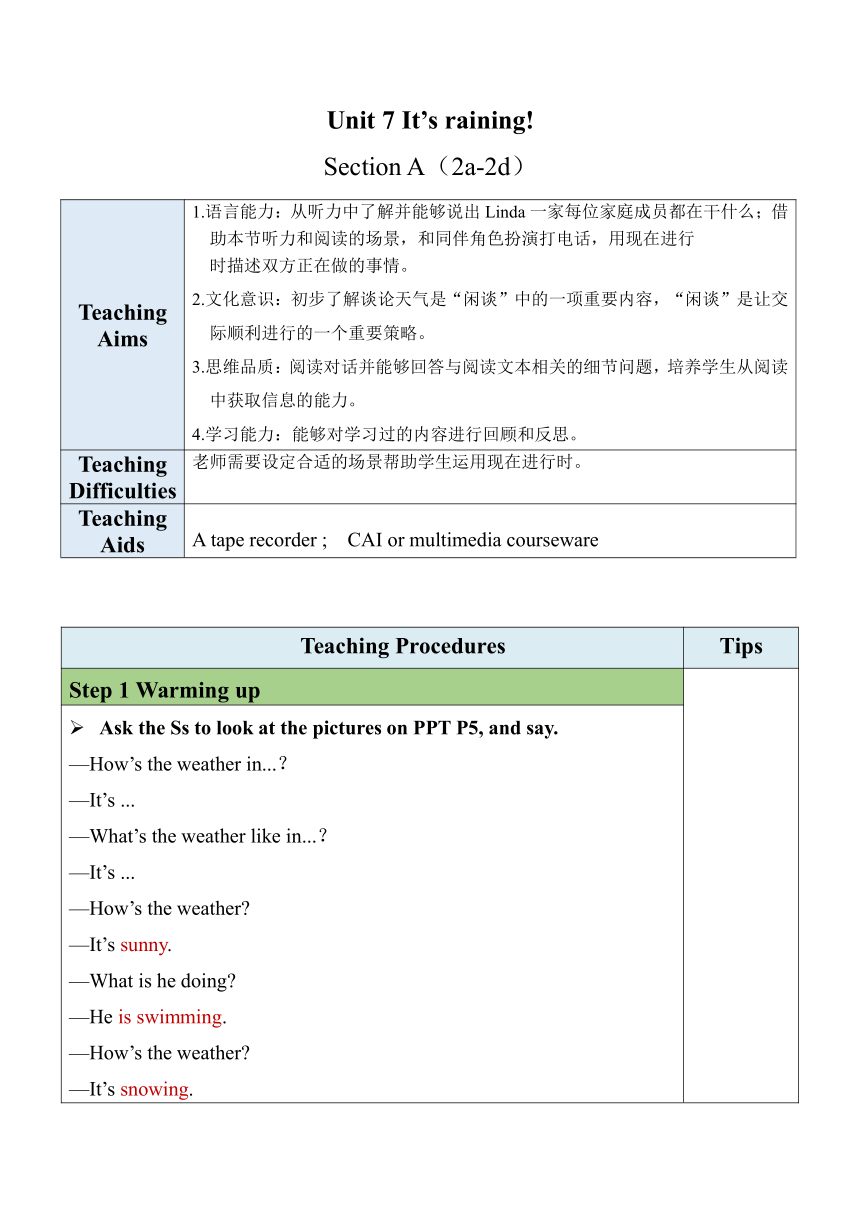
Unit 7 It’s raining!
Section A(2a-2d)
Teaching Aims 1.语言能力:从听力中了解并能够说出Linda一家每位家庭成员都在干什么;借 助本节听力和阅读的场景,和同伴角色扮演打电话,用现在进行 时描述双方正在做的事情。 2.文化意识:初步了解谈论天气是“闲谈”中的一项重要内容,“闲谈”是让交际顺利进行的一个重要策略。 3.思维品质:阅读对话并能够回答与阅读文本相关的细节问题,培养学生从阅读 中获取信息的能力。 4.学习能力:能够对学习过的内容进行回顾和反思。
Teaching Difficulties 老师需要设定合适的场景帮助学生运用现在进行时。
Teaching Aids A tape recorder ; CAI or multimedia courseware
Teaching Procedures Tips
Step 1 Warming up
Ask the Ss to look at the pictures on PPT P5, and say. —How’s the weather in...? —It’s ... —What’s the weather like in...? —It’s ... —How’s the weather —It’s sunny. —What is he doing —He is swimming. —How’s the weather —It’s snowing. —What are they doing —They are building a snowman. —How’s the weather —It’s raining. —What are they doing —They are watching TV at home.
Step 2 Presentation & Practice
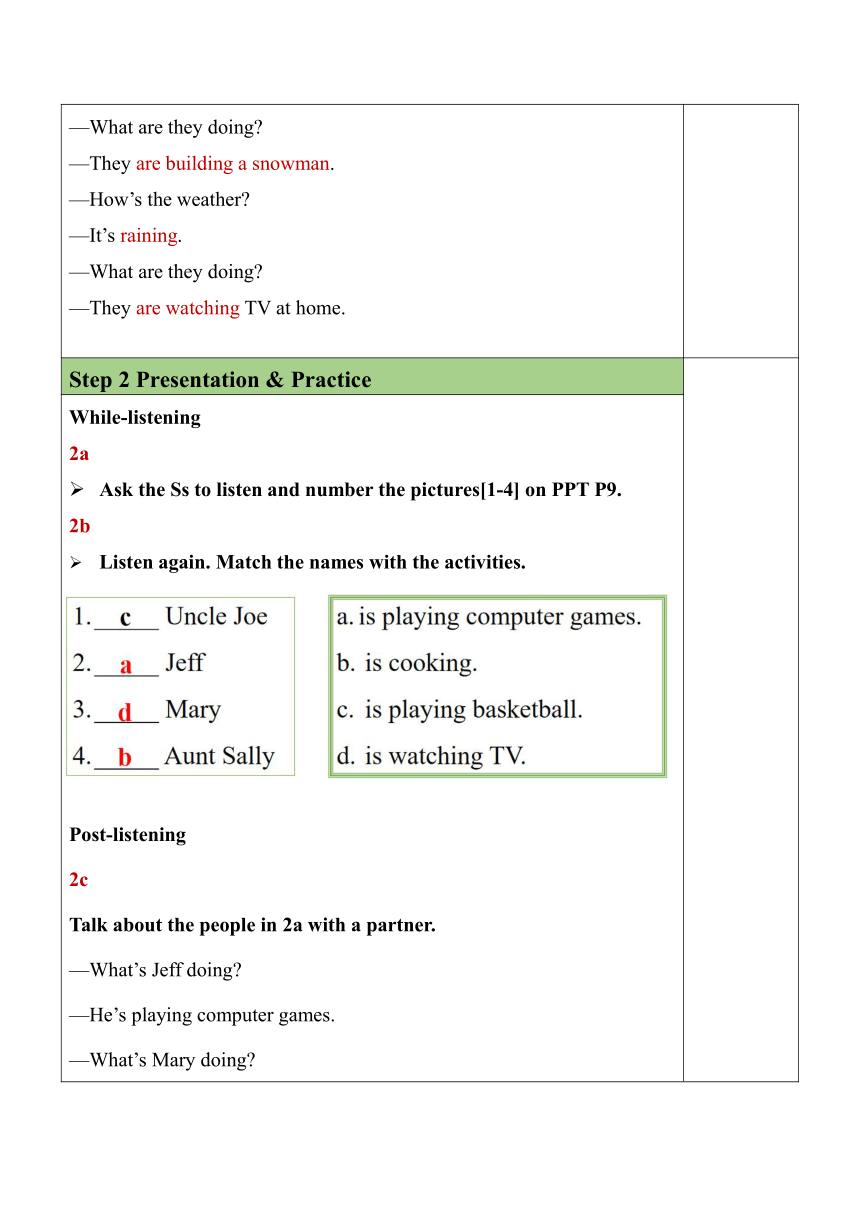
While-listening 2a Ask the Ss to listen and number the pictures[1-4] on PPT P9. 2b Listen again. Match the names with the activities. Post-listening 2c Talk about the people in 2a with a partner. —What’s Jeff doing —He’s playing computer games. —What’s Mary doing —She’s watching TV. Can you tell me what Uncle Joe's family are doing This is Uncle Joe’s family. It’s 6:00 p.m. Uncle Joe’s family are doing different things. Aunt Sally is .... Jim and Linda are ..., and Mary is .... Look! Jeff is .... However, where is Uncle Joe Oh, he is ....
Step 3 Presentation & Reading
2d Ask the Ss to Role-play the conversation. Explain the key words and phrases to the Ss. Read the conversation in 2d and answer the questions below. 1. How is the weather 2. What is Steve doing 3. What is Rick’s brother doing 4. What does Steve want Rick to do Answers:1.The weather’s great. 2.He is playing basketball with some friends at the park. 3.He’s studying at his friend’s home. 4.He wants Rick to tell his brother to call him back.
Step 4 Language points learning
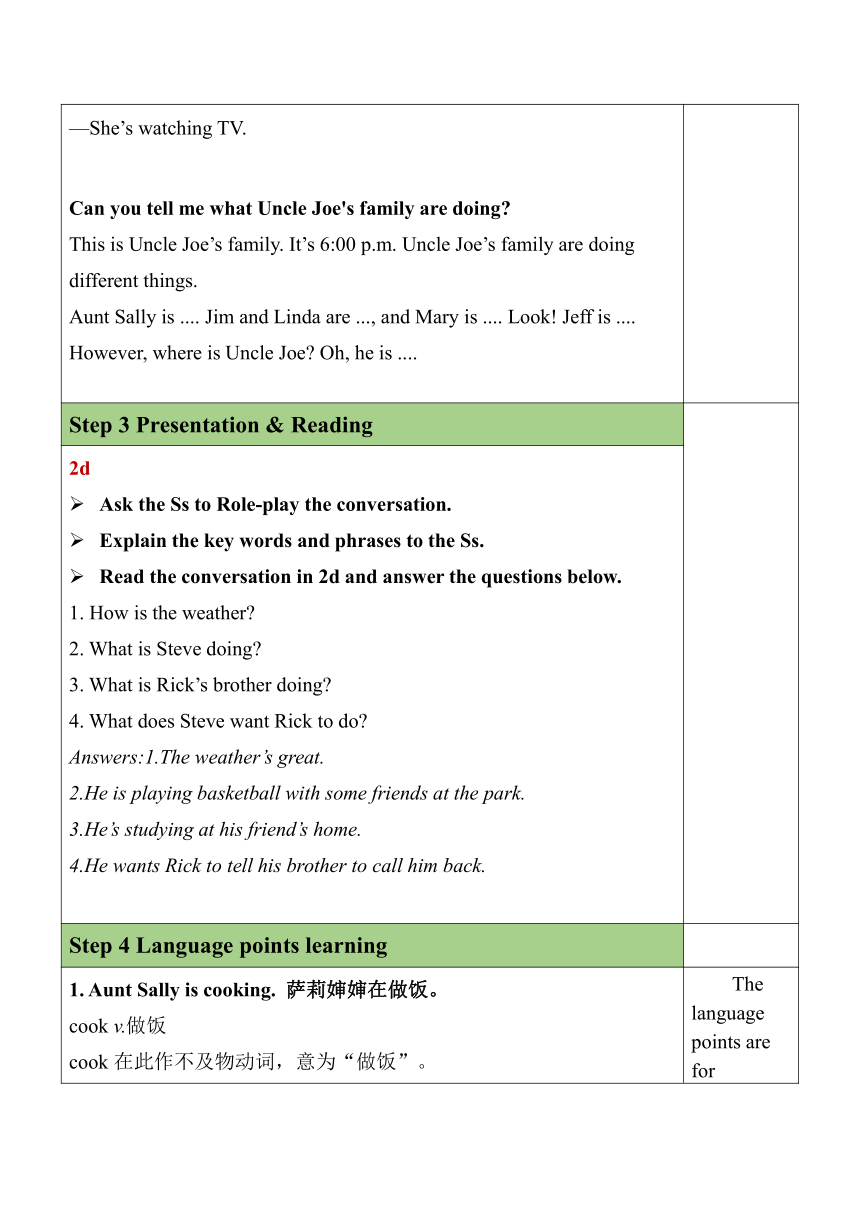
1. Aunt Sally is cooking. 萨莉婶婶在做饭。 cook v.做饭 cook在此作不及物动词,意为“做饭”。 【拓展延伸】 (1)cook还可作及物动词,意为“烹饪”, cook sb. sth. =cook sth.for sb. 意为“为某人做……(饭)”。 (2)cook也可作名词,意为“厨师”。 (3)cooker作可数名词,意为“厨灶;炉具”。 2. — How’s it going 近来可好? —Not bad, thanks. 不错,谢谢。 How’s it going 这是英语中进行问候时的用语, 用于询问对方的近况或事情进展的情况,可译作“最近怎么样?”“一切还好吗?”。其后可接介词短语with sb. / sth., 其答语通常为:“Fine! / Pretty good! / Not bad! / Just so-so. ”等 。 —How’s it going with your English 你的英语学习情况怎么样? —Pretty good. 非常好。 3. Sounds like you’re having a good time.听起来你正玩得很开心。 Sounds like… 本句是省略句,补充完整应为“It sounds like you’re …”,表示“听起来/听上去……”, 后接名词(短语)或从句。这种省略的用法十分口语化。 —What about eating out 出去吃饭怎么样? —Sounds like a good idea. 听起来像是个好主意。 It sounds like he’s all right now. 听上去他现在已经好了。 4. Can I take a message for him 要我给他捎个口信吗? message n. 信息;消息 take a message for sb. 为某人捎个口信 send a message to sb. / send sb. a message 给某人发信息 leave a message 留言 / 留口信 Could you take a message for me 你能为我捎个口信吗? Don’t send long voice messages. 不要发长的语音信息。 5. Sure, no problem. 当然可以,没问题 problem n. 困难;难题 have no problem (in) doing sth. 做某事没问题 have problems (in) doing sth. 做某事有问题 The engineer has no problem in solving the problem. 这个工程师解决这个难题没有问题。 no problem 没问题 no problem常用于以下场合: (1)用来表示乐于助人(本句用法)。 —Could you help me water the flowers 你能帮我浇花吗? —No problem. 没问题。 (2)用来表达事情容易做,意为“没问题;不在话下”。 —Can you fix my bike 你会修我的自行车吗? —No problem. 没问题。 (3)用来回应别人的感谢,意为“不用谢;别客气”。 —Thank you very much. 非常感谢你。 —No problem. 不用谢 (4)用来回应对方的道歉,意为“没关系;没什么”。 —I’m sorry I’m late. 对不起,我迟到了。 —No problem. 没关系。 The language points are for reference only.
Step 5 Summary & Homework The homework can vary with the specific conditions.
Summary Ask the Ss to do exercises on PPT P23-P26. Homework Preview the new words and phrases. Do the exercises in students’ book.
Teaching Reflection In this period, there are more new words and expressions. The T should provide more practice in listening and speaking and encourage Ss to be more involved. The teacher should get them to learn the main structure-What be sb. doing and get the students to practice it in listening and speaking. In the reading part, Ss can experience more practice in using the target language in natural speech.

展开更多......

收起↑

资源预览