【核心素养目标】Unit 10 I'd like some noodles Section A(1a-1c)表格式教案

资源下载
  1. 二一教育资源

【核心素养目标】Unit 10 I'd like some noodles Section A(1a-1c)表格式教案

资源简介

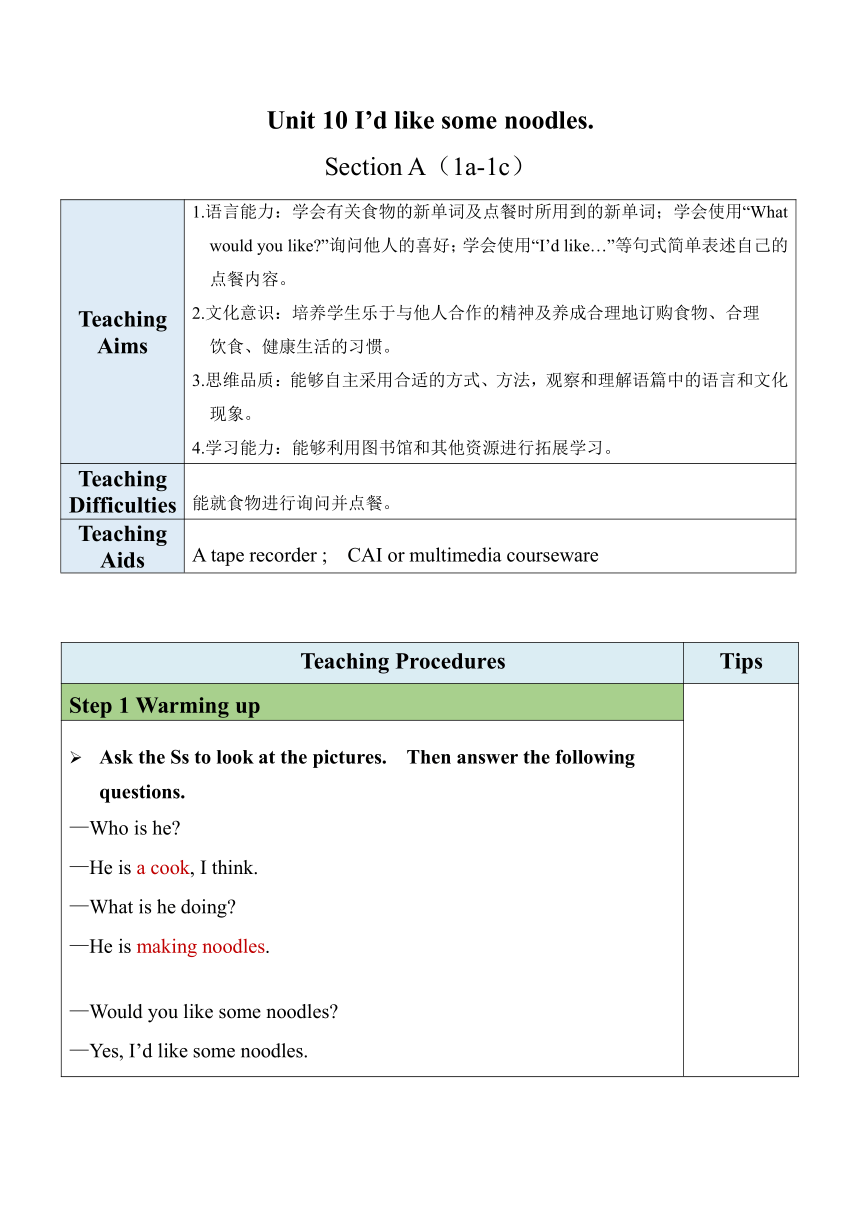
Unit 10 I’d like some noodles.
Section A(1a-1c)
Teaching Aims 1.语言能力:学会有关食物的新单词及点餐时所用到的新单词;学会使用“What would you like ”询问他人的喜好;学会使用“I’d like…”等句式简单表述自己的点餐内容。 2.文化意识:培养学生乐于与他人合作的精神及养成合理地订购食物、合理 饮食、健康生活的习惯。 3.思维品质:能够自主采用合适的方式、方法,观察和理解语篇中的语言和文化现象。 4.学习能力:能够利用图书馆和其他资源进行拓展学习。
Teaching Difficulties 能就食物进行询问并点餐。
Teaching Aids A tape recorder ; CAI or multimedia courseware
Teaching Procedures Tips
Step 1 Warming up
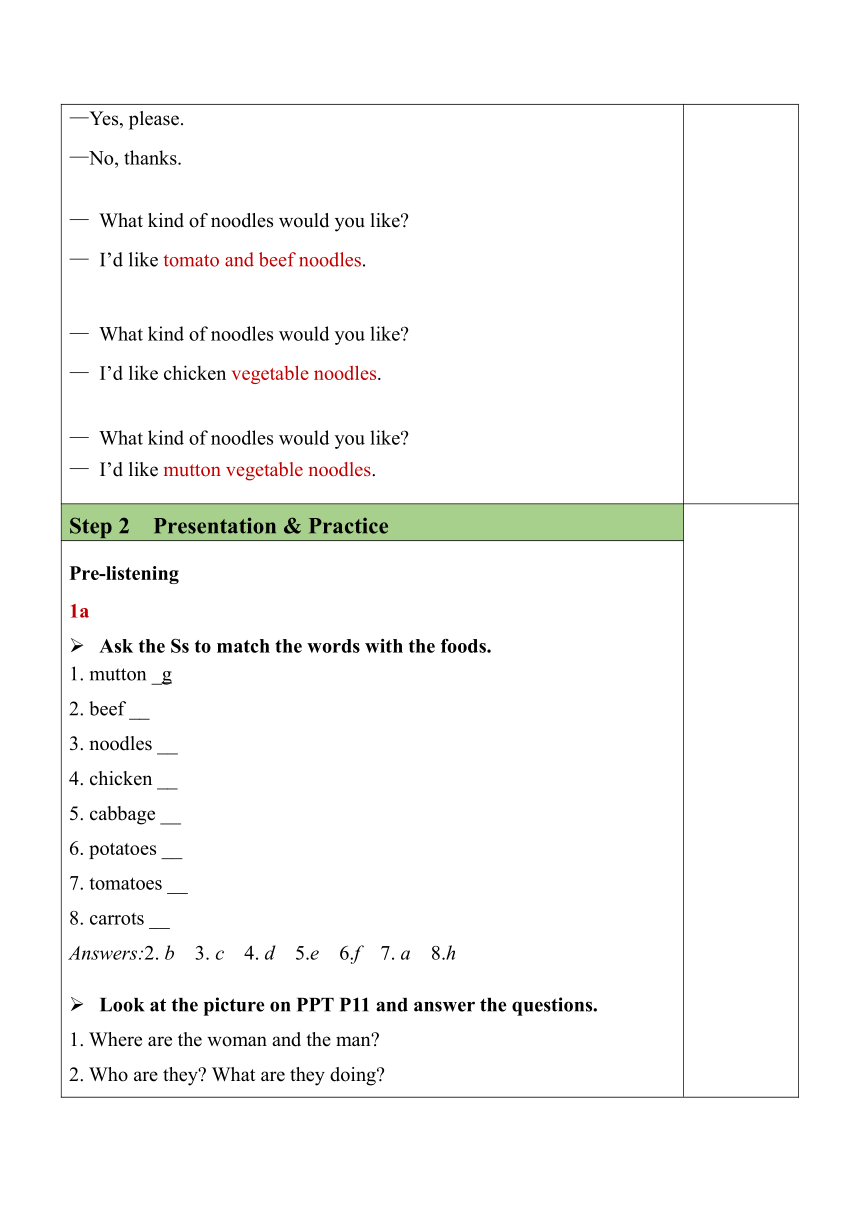
Ask the Ss to look at the pictures. Then answer the following questions. —Who is he —He is a cook, I think. —What is he doing —He is making noodles. —Would you like some noodles —Yes, I’d like some noodles. —Yes, please. —No, thanks. — What kind of noodles would you like — I’d like tomato and beef noodles. — What kind of noodles would you like — I’d like chicken vegetable noodles. — What kind of noodles would you like — I’d like mutton vegetable noodles.
Step 2 Presentation & Practice
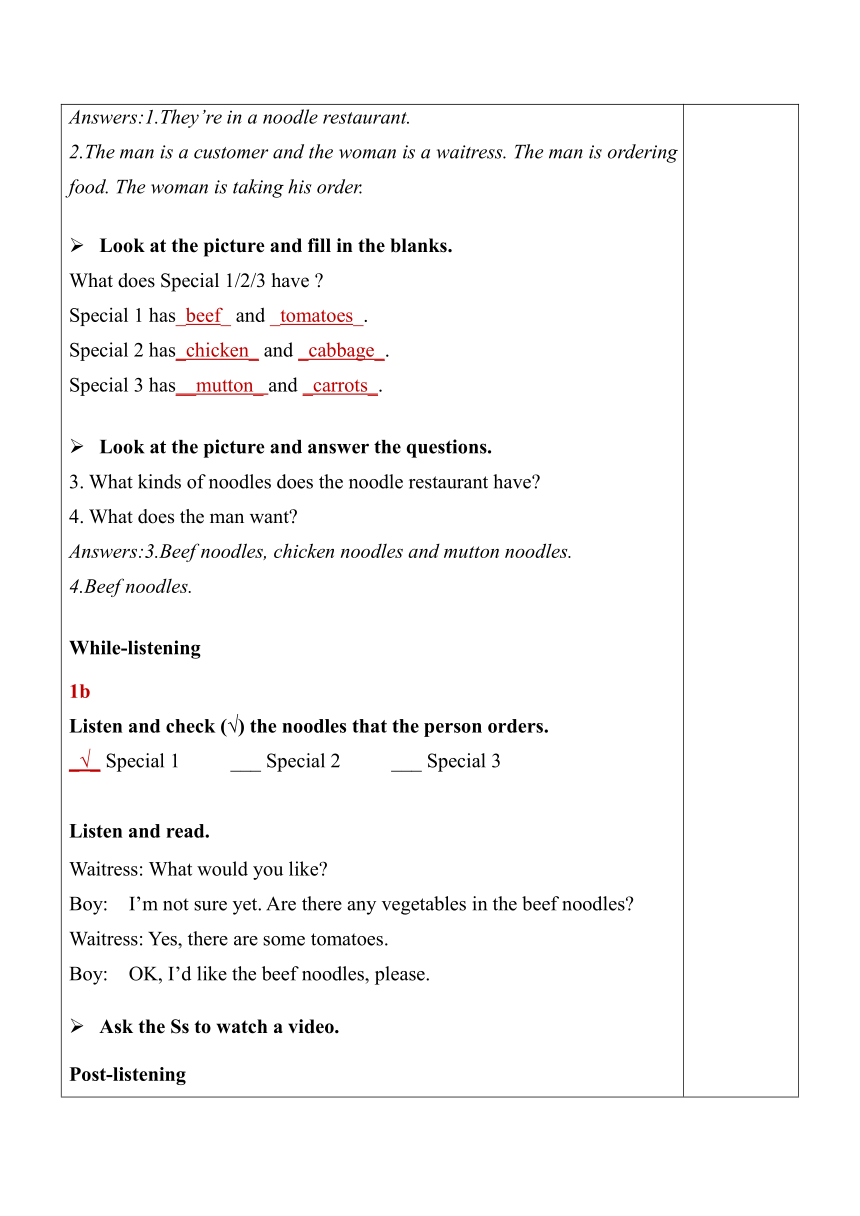
Pre-listening 1a Ask the Ss to match the words with the foods. 1. mutton _g 2. beef __ 3. noodles __ 4. chicken __ 5. cabbage __ 6. potatoes __ 7. tomatoes __ 8. carrots __ Answers:2. b 3. c 4. d 5.e 6.f 7. a 8.h Look at the picture on PPT P11 and answer the questions. 1. Where are the woman and the man 2. Who are they What are they doing Answers:1.They’re in a noodle restaurant. 2.The man is a customer and the woman is a waitress. The man is ordering food. The woman is taking his order. Look at the picture and fill in the blanks. What does Special 1/2/3 have Special 1 has_beef_ and _tomatoes_. Special 2 has_chicken_ and _cabbage_. Special 3 has__mutton_ and _carrots_. Look at the picture and answer the questions. 3. What kinds of noodles does the noodle restaurant have 4. What does the man want Answers:3.Beef noodles, chicken noodles and mutton noodles. 4.Beef noodles. While-listening 1b Listen and check (√) the noodles that the person orders. _√_ Special 1 ___ Special 2 ___ Special 3 Listen and read. Waitress: What would you like Boy: I’m not sure yet. Are there any vegetables in the beef noodles Waitress: Yes, there are some tomatoes. Boy: OK, I’d like the beef noodles, please. Ask the Ss to watch a video. Post-listening 1c Practice the conversation in 1a with your partner. Then make your own conversations. —What would you like —I’m not sure yet. Are there any… noodles —Yes, there are some... —OK, I’d like…, please. Pair Work —What would you like —I’m not sure yet. Are there any vegetables in the chicken noodles —Yes, there is some cabbage . —OK, I’d like the chicken noodles, please.
Step 3 Language points learning
1. What would you like 您需要什么? would like would like和want表示“要;想要”,但两者语气上差别较大。前者礼貌委婉、正式规范,后者直接、非正式且随意。 I’d like a cup of black tea with milk, please. 请给我来杯加奶的红茶。 I want some hot tea, Mom. 妈妈,我想喝些热茶。 What do you want to eat today, children 孩子们,今天你们想吃些什么? What would you like to order, sir 先生,您想点些什么? 2. Special 1 1号特色餐 special n.特色菜;特价品 adj. 特别的;特殊的 【用法详解】 (1) special 在此处作名词,意为“特色菜;特价品”。 Special 2 is my favorite. 2号特色餐是我最喜欢的。 What is your special today 今天你们的特价品是什么 (2) special 还可作形容词,意为“特别的;特殊的”。其副词形式为 specially,意为“专门地;特意;特别”。 It’s a special day for me. 今天对我来说是个特殊的日子。 We come specially to see you. 我们特意来看你。 3. I'd like beef noodles. 我想要牛肉面。 【用法详解】 beef noodles 中beef 作定语修饰名词noodles. 注意:名词作定语修饰名词时,作定语的名词一般只能用单数形式。 e.g. I want to make some word cards. I'd like some egg noodles. 【拓展延伸】 名词作定语时的特殊情况: ①当man, woman 作定语修饰复数名词时,它们本身也要用复数形式。 e.g. a man teacher 一名男老师 two men teachers 两名男老师 ②一些名词用其复数形式作定语。 e.g. a clothes shop 一家服装店 a sports meeting 一场运动会 a glasses shop 一家眼镜店 Remember A healthy diet Pyramid (金字塔)
Step 4 Summary & Homework
Summary Ask the Ss to do the exercises on PPT P24-P25. Homework Preview the conversation in 2d. Do the exercises in students’ book. The homework can vary with the specific conditions.
Teaching Reflection This is the first period of the unit.So it is important to get the students to know what they will learn in this unit and their learning goals. The teacher should encourage students to practice using the target language more.

展开更多......

收起↑

资源预览