【核心素养目标】Unit 10 I'd like some noodles Section A(GF-3c)表格式教案

资源下载
  1. 二一教育资源

【核心素养目标】Unit 10 I'd like some noodles Section A(GF-3c)表格式教案

资源简介

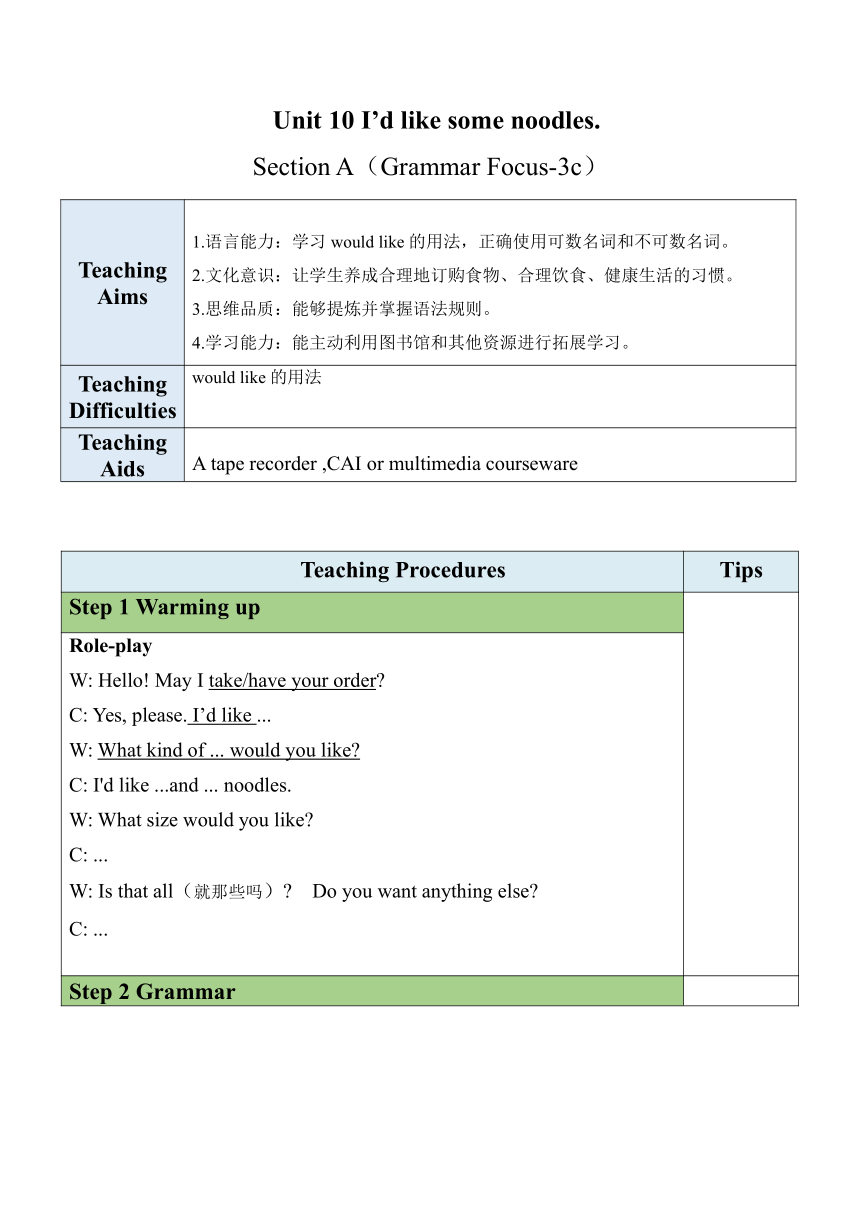
Unit 10 I’d like some noodles.
Section A(Grammar Focus-3c)
Teaching Aims 1.语言能力:学习would like的用法,正确使用可数名词和不可数名词。 2.文化意识:让学生养成合理地订购食物、合理饮食、健康生活的习惯。 3.思维品质:能够提炼并掌握语法规则。 4.学习能力:能主动利用图书馆和其他资源进行拓展学习。
Teaching Difficulties would like的用法
Teaching Aids A tape recorder ,CAI or multimedia courseware
Teaching Procedures Tips
Step 1 Warming up
Role-play W: Hello! May I take/have your order C: Yes, please. I’d like ... W: What kind of ... would you like C: I'd like ...and ... noodles. W: What size would you like C: ... W: Is that all(就那些吗) Do you want anything else C: ...
Step 2 Grammar
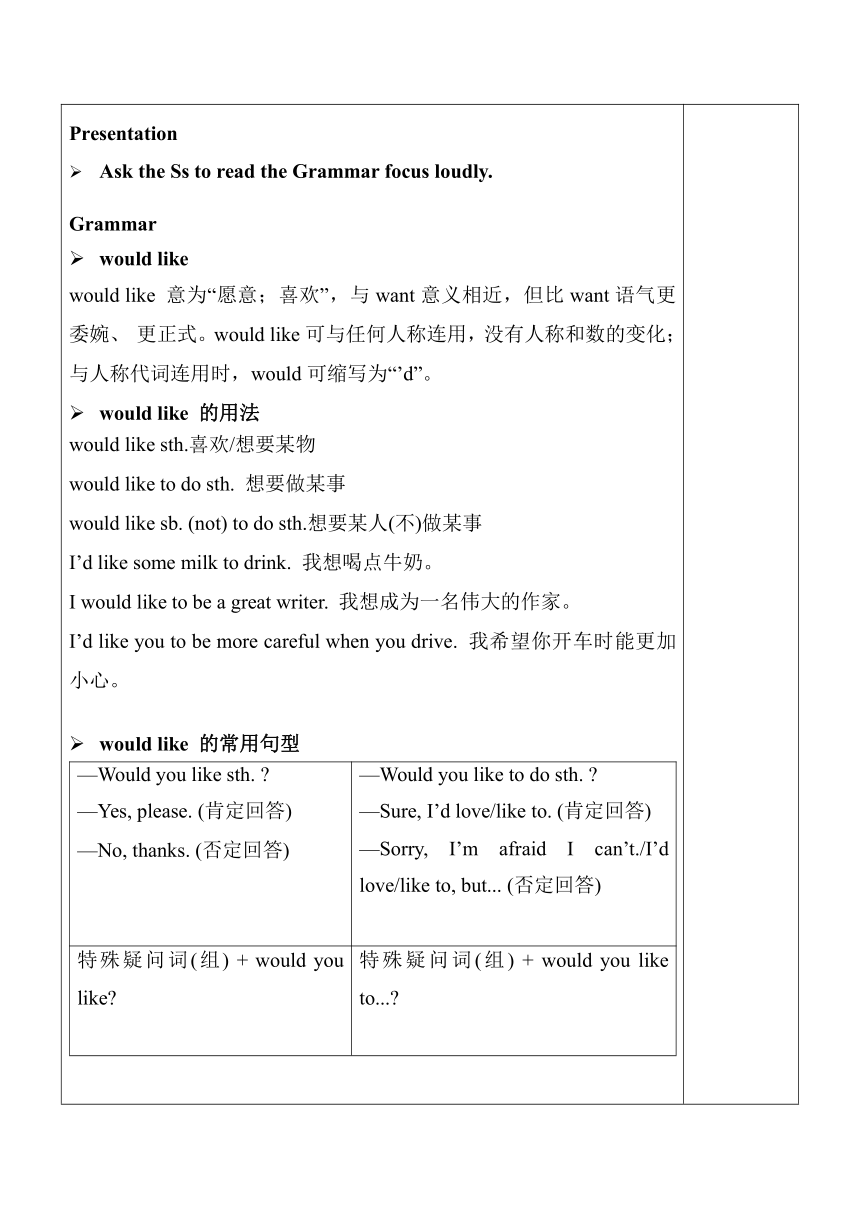
Presentation Ask the Ss to read the Grammar focus loudly. Grammar would like would like 意为“愿意;喜欢”,与want意义相近,但比want语气更委婉、 更正式。would like可与任何人称连用,没有人称和数的变化;与人称代词连用时,would可缩写为“’d”。 would like 的用法 would like sth.喜欢/想要某物 would like to do sth. 想要做某事 would like sb. (not) to do sth.想要某人(不)做某事 I’d like some milk to drink. 我想喝点牛奶。 I would like to be a great writer. 我想成为一名伟大的作家。 I’d like you to be more careful when you drive. 我希望你开车时能更加小心。 would like 的常用句型 —Would you like sth. —Yes, please. (肯定回答) —No, thanks. (否定回答) —Would you like to do sth. —Sure, I’d love/like to. (肯定回答) —Sorry, I’m afraid I can’t./I’d love/like to, but... (否定回答) 特殊疑问词(组) + would you like 特殊疑问词(组) + would you like to...
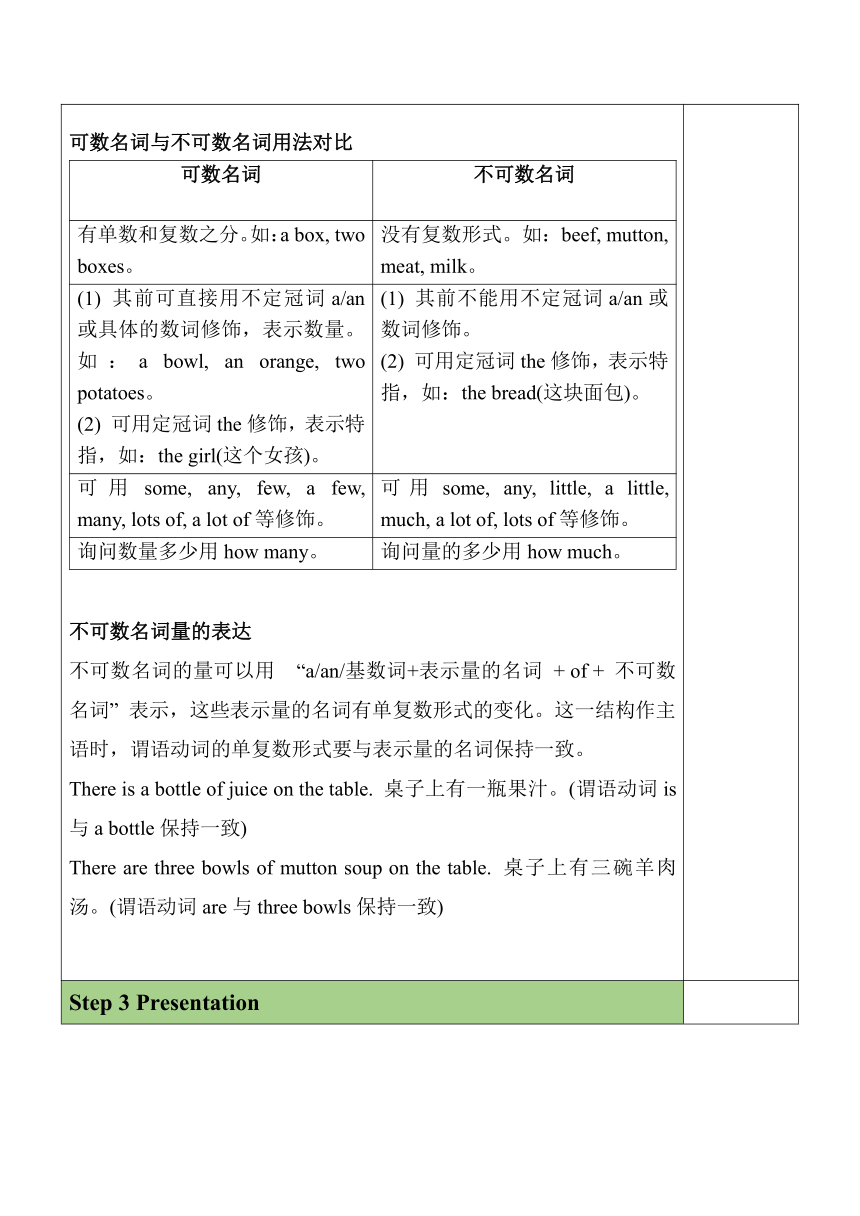
可数名词与不可数名词用法对比 可数名词 不可数名词 有单数和复数之分。如:a box, two boxes。没有复数形式。如:beef, mutton, meat, milk。(1) 其前可直接用不定冠词a/an或具体的数词修饰,表示数量。如:a bowl, an orange, two potatoes。 (2) 可用定冠词the修饰,表示特指,如:the girl(这个女孩)。(1) 其前不能用不定冠词a/an或数词修饰。 (2) 可用定冠词the修饰,表示特指,如:the bread(这块面包)。 可用some, any, few, a few, many, lots of, a lot of等修饰。可用some, any, little, a little, much, a lot of, lots of等修饰。询问数量多少用how many。询问量的多少用how much。
不可数名词量的表达 不可数名词的量可以用 “a/an/基数词+表示量的名词 + of + 不可数名词” 表示,这些表示量的名词有单复数形式的变化。这一结构作主语时,谓语动词的单复数形式要与表示量的名词保持一致。 There is a bottle of juice on the table. 桌子上有一瓶果汁。(谓语动词is与a bottle保持一致) There are three bowls of mutton soup on the table. 桌子上有三碗羊肉汤。(谓语动词are与three bowls保持一致)
Step 3 Presentation
3a Complete the conversation below. 1. May I have your order _d 2. What kind of noodles would you like _c 3. We have beef, chicken, mutton, cabbage, potato, tomato... _a 4. Yes, there are some carrots. _f 5. Sure. What size would you like _b 6. We have large, medium and small bowls. _e a. What kind of noodles do you have b. Oh, a medium bowl, please. c. OK, I’d like the mutton noodles then. d. I’d like some noodles, please. e. What sizes do you have f. Are there any vegetables in the mutton noodles 3b Write questions and answers using the words in brackets. 1._What kind of noodles would you like ___ (kind) I’d like chicken and beef noodles with tomatoes. (chicken/beef/tomatoes) 2.__What size would you like _ (size) __I’d like a medium bowl, please._ (medium) _Is there any cabbage in the beef noodles _ (any/cabbage/beef noodles) _No, there isn’t any.__ (no) Ask the Ss to look at the pictures and match the pictures with the food. a. tomato and egg rice b. beef and carrot noodles c. hamburger d. potato salad c d a b 3c Work in small groups. Who would like the food below Write their names on the cards above the food. A: Anna, what would you like to eat B: I’d like beef and carrot noodles. Make a report about their choice in your group. In our group, Sally and Tom would like some hamburgers. Anna and Jim would like tomato and egg rice. Nobody would like potato salad. ...
Step 4 Summary & Homework The homework can vary with the specific conditions.
Summary Ask the Ss to do exercises on PPT P18-P22. Homework Preview the new words and phrases in Section B(1a-1e). Do the exercises in students’ book.
Teaching Reflection We always learn grammar when we have enough language materials to support. Students can practice grammar by using what they have learned. After they learn the main structure in the grammar focus frame,the students should practice them in different activities.

展开更多......

收起↑

资源预览