【核心素养目标】Unit 11 How was your school trip Section B(2a-2c)表格式教案

资源下载
  1. 二一教育资源

【核心素养目标】Unit 11 How was your school trip Section B(2a-2c)表格式教案

资源简介

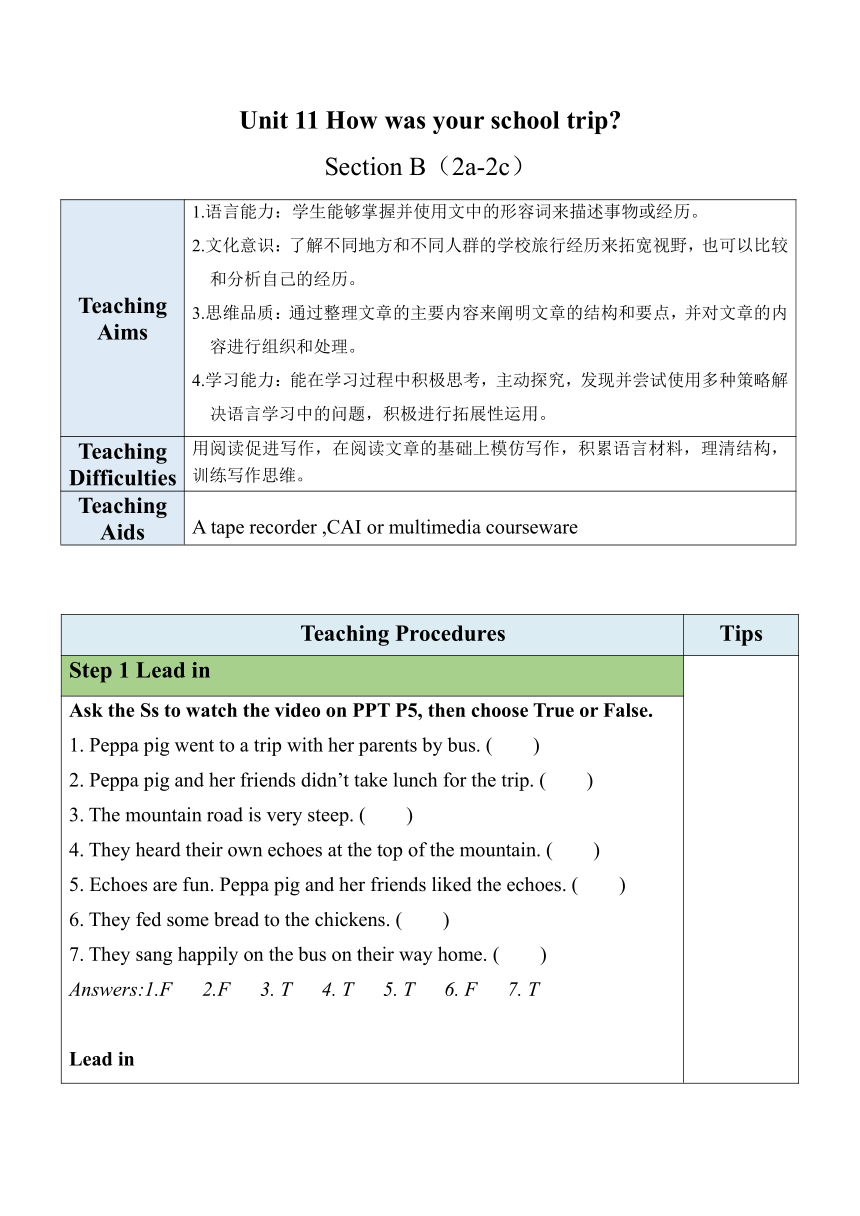
Unit 11 How was your school trip
Section B(2a-2c)
Teaching Aims 1.语言能力:学生能够掌握并使用文中的形容词来描述事物或经历。 2.文化意识:了解不同地方和不同人群的学校旅行经历来拓宽视野,也可以比较和分析自己的经历。 3.思维品质:通过整理文章的主要内容来阐明文章的结构和要点,并对文章的内容进行组织和处理。 4.学习能力:能在学习过程中积极思考,主动探究,发现并尝试使用多种策略解决语言学习中的问题,积极进行拓展性运用。
Teaching Difficulties 用阅读促进写作,在阅读文章的基础上模仿写作,积累语言材料,理清结构,训练写作思维。
Teaching Aids A tape recorder ,CAI or multimedia courseware
Teaching Procedures Tips
Step 1 Lead in
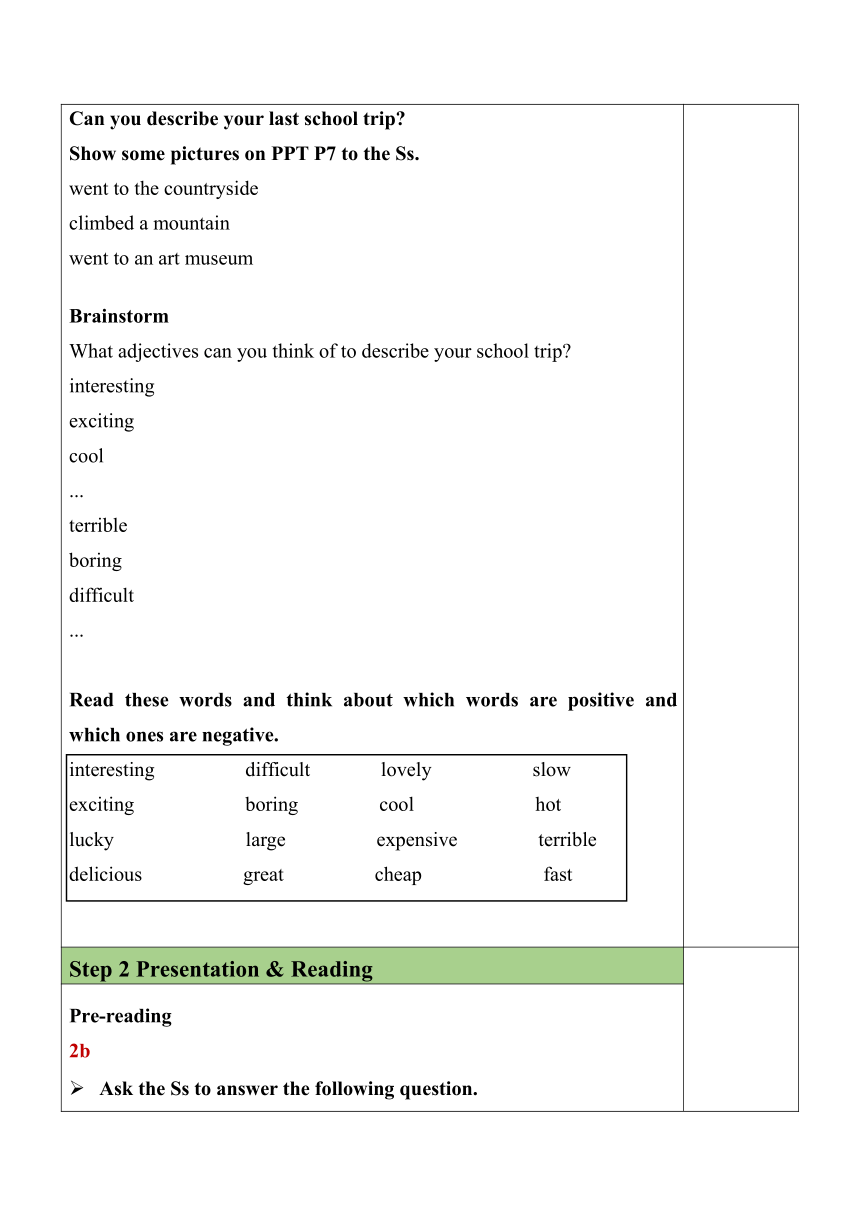
Ask the Ss to watch the video on PPT P5, then choose True or False. 1. Peppa pig went to a trip with her parents by bus. ( ) 2. Peppa pig and her friends didn’t take lunch for the trip. ( ) 3. The mountain road is very steep. ( ) 4. They heard their own echoes at the top of the mountain. ( ) 5. Echoes are fun. Peppa pig and her friends liked the echoes. ( ) 6. They fed some bread to the chickens. ( ) 7. They sang happily on the bus on their way home. ( ) Answers:1.F 2.F 3. T 4. T 5. T 6. F 7. T Lead in Can you describe your last school trip Show some pictures on PPT P7 to the Ss. went to the countryside climbed a mountain went to an art museum Brainstorm What adjectives can you think of to describe your school trip interesting exciting cool ... terrible boring difficult ... Read these words and think about which words are positive and which ones are negative. interesting difficult lovely slow exciting boring cool hot lucky large expensive terrible delicious great cheap fast
Step 2 Presentation & Reading
Pre-reading 2b Ask the Ss to answer the following question. What’s the type of these passages diary 日记的时态多用一般过去时! 2a Do the following words describe good things or bad things Put a √ for good and an × for bad. Leave a blank if they can mean both. _√_ interesting _× _ difficult _√_ lovely ___ slow _√_ exciting _× _boring _√_ cool ___ hot _√_ lucky ___ large ___ expensive _× _terrible _√_ delicious _√_ great ___ cheap ___ fast While-reading 2b Explain the key words and phrases to the Ss. Ask the Ss to finish the tasks. Task 1 Skimming Read the two letters quickly and find out the topic sentences. Task 2 Skimming and mind-mapping Read the two letters quickly and complete the mind-map. School tripWhen On June 15thWherethe science museumHowHeleninteresting and excitingJimterrible
Task 3 Scanning and answering Read Helen's diary entry and answer the questions. 1. What did Helen do or see in these places 2. What did the guide do at the museum Answers:1. On the train saw some farms and villages along the wayAt the museum learned a lot about robots took a lot of great photosIn the gift shop bought some lovely gifts for her parents
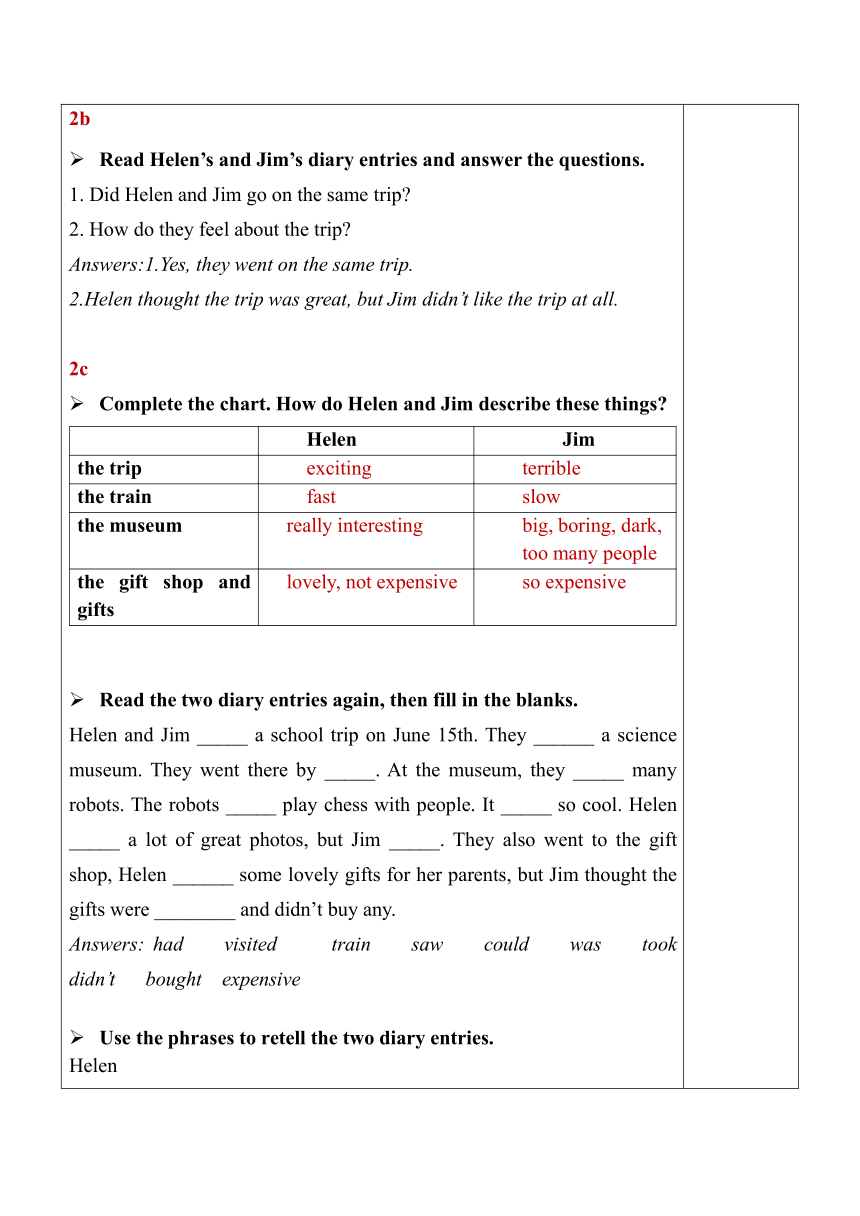
2.He taught them how to make a model robot. Task 4 Scanning and answering Read Jim's diary entry and answer the questions. Why didn’t Jim like the trip Answers:1. Everything was about robots and he is not interested in that. 2. The rooms were dark and it was difficult to take photos. 3. There were too many people and he couldn’t see or hear the guide. 4. The things in the gift shop were so expensive. Jim didn’t like the trip at all. Task 5 Choose the best answer. Read the two diary entries again and choose the best answer. What can we learn from the two diary entries A. We should love school trips. B. Traveling is good for our mind and body. C. You should keep a diary when you are traveling. D. Different people have different ideas about the same thing. Answer: D 2b Read Helen’s and Jim’s diary entries and answer the questions. 1. Did Helen and Jim go on the same trip 2. How do they feel about the trip Answers:1.Yes, they went on the same trip. 2.Helen thought the trip was great, but Jim didn’t like the trip at all. 2c Complete the chart. How do Helen and Jim describe these things HelenJimthe trip excitingterriblethe trainfastslowthe museumreally interestingbig, boring, dark, too many peoplethe gift shop and giftslovely, not expensiveso expensive
Read the two diary entries again, then fill in the blanks. Helen and Jim _____ a school trip on June 15th. They ______ a science museum. They went there by _____. At the museum, they _____ many robots. The robots _____ play chess with people. It _____ so cool. Helen _____ a lot of great photos, but Jim _____. They also went to the gift shop, Helen ______ some lovely gifts for her parents, but Jim thought the gifts were ________ and didn’t buy any. Answers: had visited train saw could was took didn’t bought expensive Use the phrases to retell the two diary entries. Helen an interesting school trip saw some farms and villages learned a lot played chess made a model robot took a lot of photos went to the gift shop bought lovely gifts an exciting day Jim a terrible school trip so hot on the slow train not interested in it big, boring and dark didn’t take any photos couldn’t see or hear didn’t buy any gifts so expensive didn’t like the trip Post-reading 1.Why did Helen and Jim have different opinions about the same trip 2.What's your opinion about their trip
Step 3 Language points learning
1. exciting adj. 使人兴奋的;令人激动的 【易混辨析】exciting与excited exciting “使人兴奋的;令人激动的”,常用于修饰物,表示事物本身让人兴奋、激动。excited“感到兴奋的”,常用于修饰人,表示人的主观感受。
e.g. We are excited at the exciting news. 我们因为那个激动人心的消息而激动万分。 2. Then the guide taught us how to make a model robot. 然后, 导游教我们怎样制作机器人模型。 【句式剖析】本句中how to make a model robot为“特殊疑问词 + 动词不定式”结构,在句中看作一个整体,作taught的直接宾语。 Then the guide taught us (how to make a model robot). teach sb. sth.结构 guide n.导游;向导 The guide explained the history of the Great Wall to us. 导游向我们讲解了长城的历史。 【拓展延伸】 (1)guide作名词,还可表示“指南;指导手册;旅游指南”。 Follow our step-by-step guide. 跟着我们的分步指南去做。 (2)guide还可作动词,意为“给某人领路;指引”。 He will guide you to the top of the mountain. 他将带领你们登上山顶。 e.g. The guide with a guide is guiding us through the forest. 那个拿着旅游指南的导游正领着我们穿越森林。 【拓展延伸】in all表示“总共;合计”,在句中的位置比较灵活。 There were twelve of us in all for dinner. 我们一共十二人吃饭。 That’s 50 dollars in all. 总计50美元。 4. Everything was about robots and I’m not interested in that. 一切 都是关于机器人的,我对那方面不感兴趣。 everything pron. 所有事物;一切 【用法详解】everything是不定代词,作主语时,谓语动词用第三人称单数形式。 Everything goes well. 一切进展顺利。 It’s very important to make a plan before we do everything. 我们在做所有事情之前先制订一个计划是非常重要的。 be interested in 对……感兴趣 【用法详解】该结构中in为介词,其后接名词、代词或动词-ing形式作宾语。 He is interested in basketball. 他对篮球感兴趣。 Lisa is interested in singing and dancing. 莉萨对唱歌和跳舞感兴趣。 【拓展延伸】interest作名词,意为“兴趣;关注” , have (an) interest in sth. 表示“ 对......有兴趣”。 I have an interest in film music. 我对电影音乐感兴趣。 【易混辨析】 interesting与interested interesting意为"有趣的",表示事物的性质特征。This is an interesting story. 这是一个有趣的故事。interested意为"感兴趣的",表示人的 主观感受。He is interested in music. 他对音乐感兴趣。
5. There were also too many people and I couldn’t really see or hear the guide. 而且人太多,我真的看不见导游,也听不清导游说什么。 hear v. 听到;听见 【易混辨析】hear与listen hear及物动词强调听的结果,其后直接接宾语。listen不及物动词强调听的动作,其后跟宾语时要加介词to。
I listened carefully, but heard nothing. 我仔细听了,但什么也没有听到。 Boys and girls, please listen to me. 同学们,请听我说。 6. I didn’t like the trip at all. 我一点儿都不喜欢这次旅行。 not…at all 一点儿也不 【用法详解】not…at all表示强烈的否定意味。 Tom doesn’t like dancing at all. 汤姆一点儿也不喜欢跳舞。 【拓展延伸】not at all的用法: (1) 用来回答别人对你的感谢,意为“不客气,不用谢”。 —Thank you very much for lending me your bike. 非常感谢你借给我自行车。 —Not at all. 不客气。 (2) 用来回答别人的歉意,意为“没关系”。 —I’m sorry, Mom. I broke the glass. 对不起,妈妈。我打破了玻璃杯。 —Not at all. Be careful next time. 没关系。下次小心。 The language points are for reference only.
Step 4 Summary & Homework The homework can vary with the specific conditions.
Summary Ask the Ss to do the exercises on PPT P34-P37. Homework Read and recite the new words and phrases . Do the exercises in students’ book.
Teaching Reflection In this period, the most important thing is reading. It is a good time to train the students' ability of reading quickly and efficiently. Usually we do some work to deal with new words and phrases before reading. While reading, students should learn to catch the main and the most important ideas as quickly as they can.

展开更多......

收起↑

资源预览