【核心素养目标】Unit Unit 12 What did you do last weekend Section A(2a-2d)表格式教案

资源下载
  1. 二一教育资源

【核心素养目标】Unit Unit 12 What did you do last weekend Section A(2a-2d)表格式教案

资源简介

Unit 12 What did you do last weekend
Section A(2a-2d)
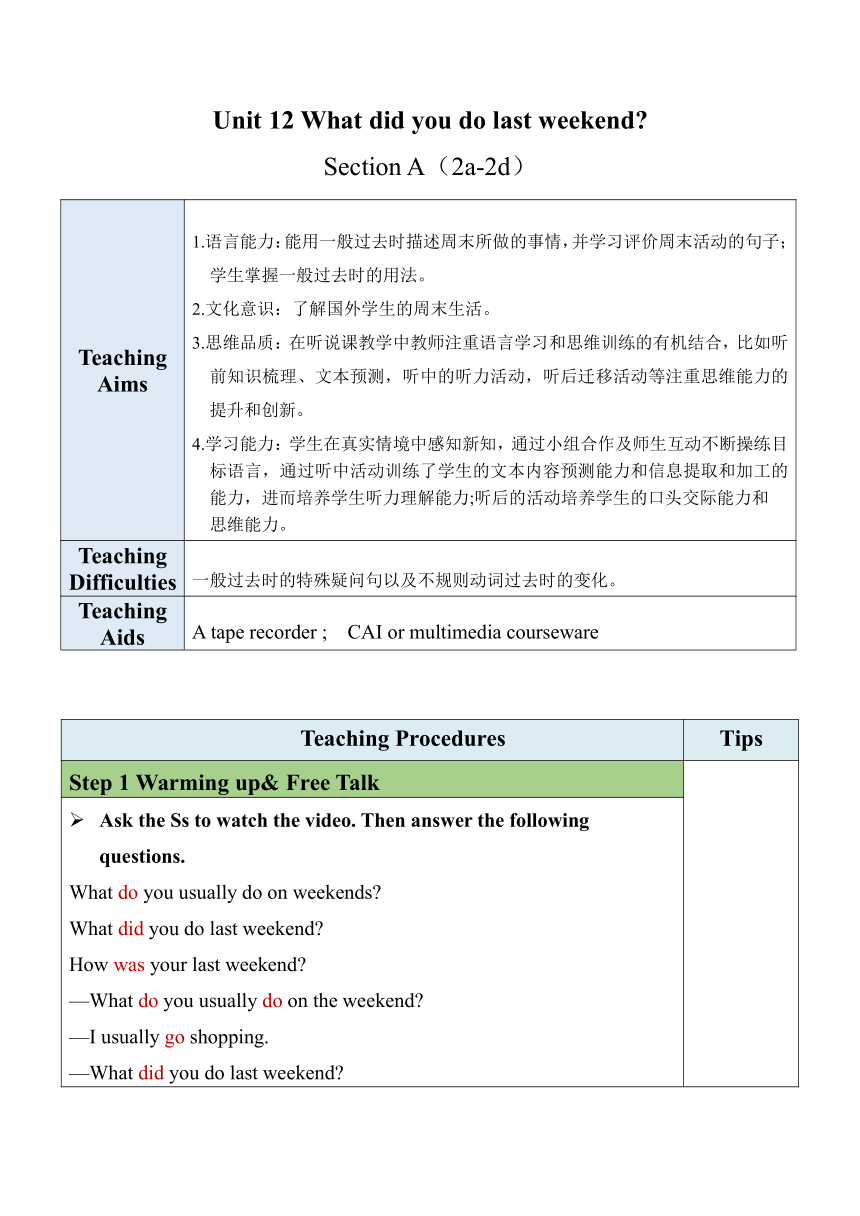
Teaching Aims 1.语言能力:能用一般过去时描述周末所做的事情,并学习评价周末活动的句子;学生掌握一般过去时的用法。 2.文化意识:了解国外学生的周末生活。 3.思维品质:在听说课教学中教师注重语言学习和思维训练的有机结合,比如听前知识梳理、文本预测,听中的听力活动,听后迁移活动等注重思维能力的提升和创新。 4.学习能力:学生在真实情境中感知新知,通过小组合作及师生互动不断操练目标语言,通过听中活动训练了学生的文本内容预测能力和信息提取和加工的能力,进而培养学生听力理解能力;听后的活动培养学生的口头交际能力和 思维能力。
Teaching Difficulties 一般过去时的特殊疑问句以及不规则动词过去时的变化。
Teaching Aids A tape recorder ; CAI or multimedia courseware
Teaching Procedures Tips
Step 1 Warming up& Free Talk
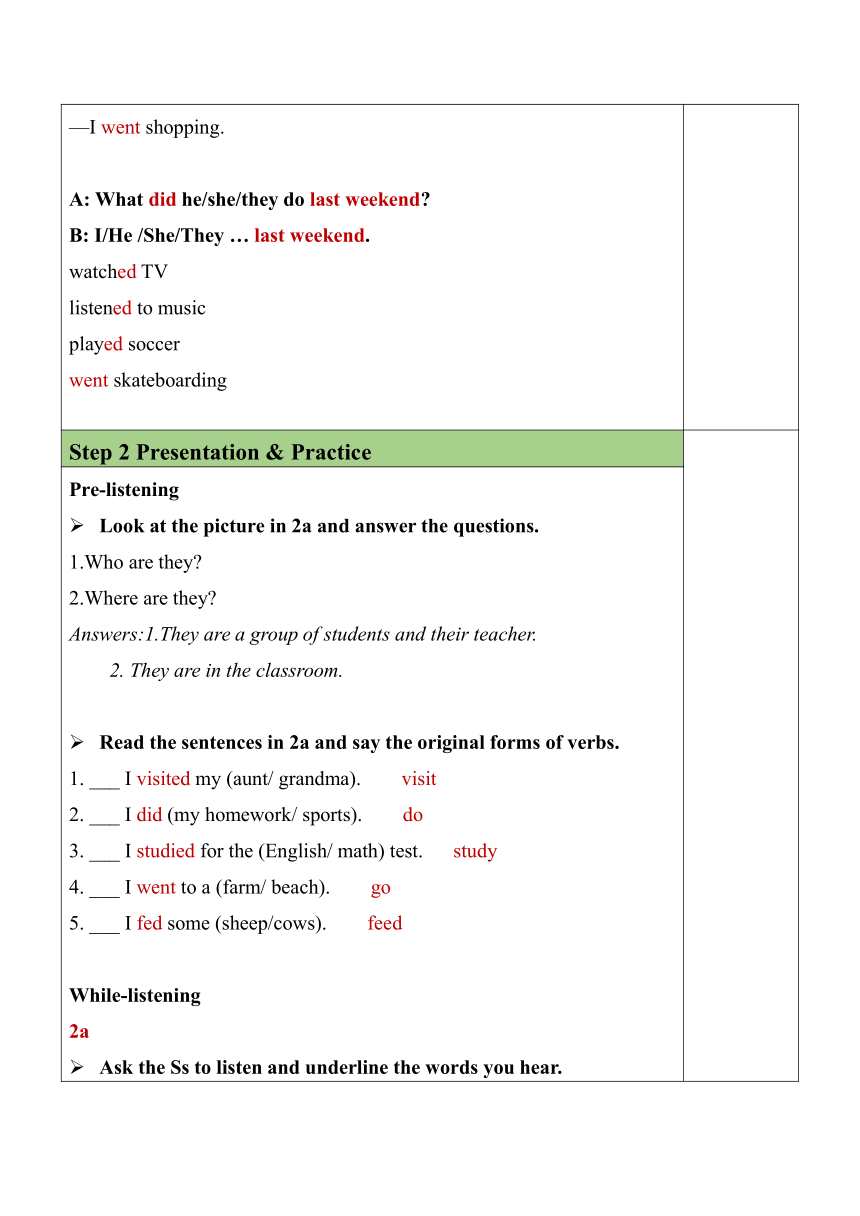
Ask the Ss to watch the video. Then answer the following questions. What do you usually do on weekends What did you do last weekend How was your last weekend —What do you usually do on the weekend —I usually go shopping. —What did you do last weekend —I went shopping. A: What did he/she/they do last weekend B: I/He /She/They … last weekend. watched TV listened to music played soccer went skateboarding
Step 2 Presentation & Practice
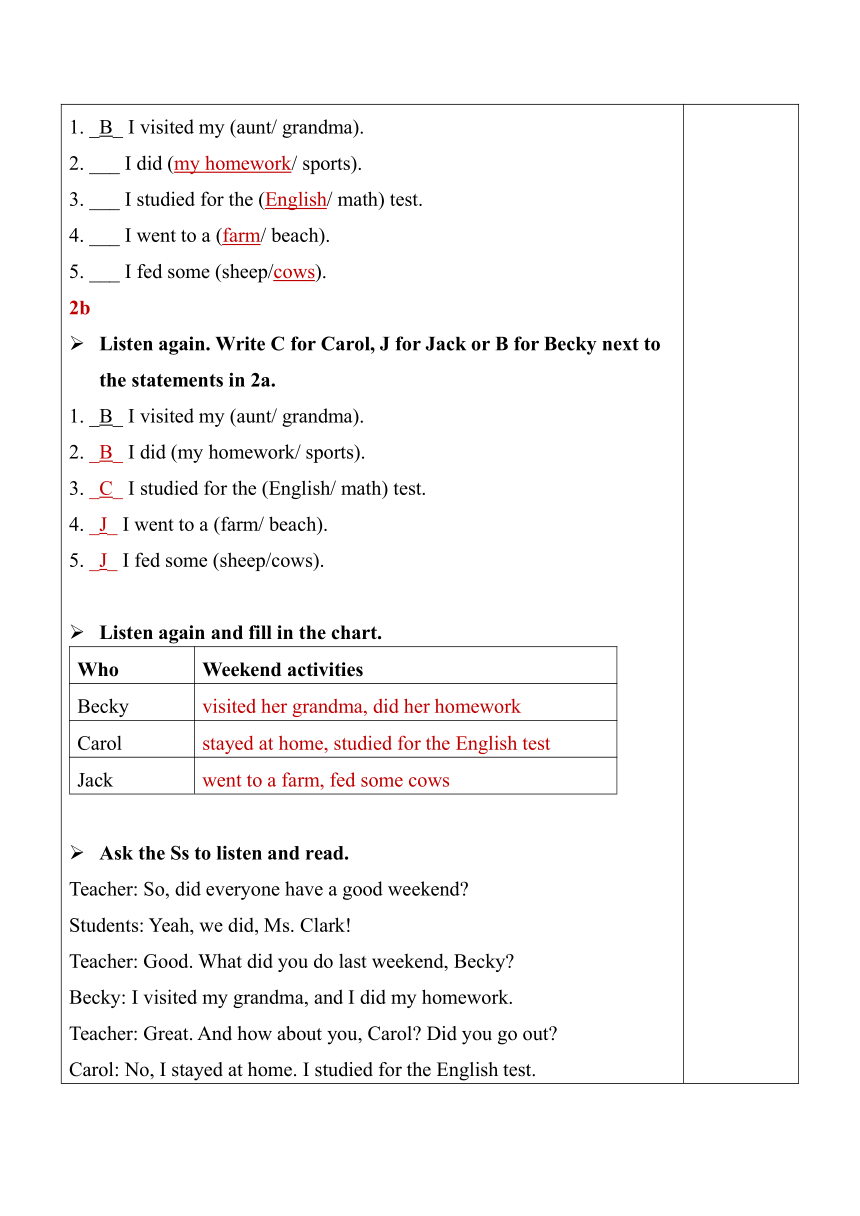
Pre-listening Look at the picture in 2a and answer the questions. 1.Who are they 2.Where are they Answers:1.They are a group of students and their teacher. They are in the classroom. Read the sentences in 2a and say the original forms of verbs. 1. ___ I visited my (aunt/ grandma). visit 2. ___ I did (my homework/ sports). do 3. ___ I studied for the (English/ math) test. study 4. ___ I went to a (farm/ beach). go 5. ___ I fed some (sheep/cows). feed While-listening 2a Ask the Ss to listen and underline the words you hear. 1. _B_ I visited my (aunt/ grandma). 2. ___ I did (my homework/ sports). 3. ___ I studied for the (English/ math) test. 4. ___ I went to a (farm/ beach). 5. ___ I fed some (sheep/cows). 2b Listen again. Write C for Carol, J for Jack or B for Becky next to the statements in 2a. 1. _B_ I visited my (aunt/ grandma). 2. _B_ I did (my homework/ sports). 3. _C_ I studied for the (English/ math) test. 4. _J_ I went to a (farm/ beach). 5. _J_ I fed some (sheep/cows). Listen again and fill in the chart. WhoWeekend activitiesBeckyvisited her grandma, did her homeworkCarolstayed at home, studied for the English testJackwent to a farm, fed some cows
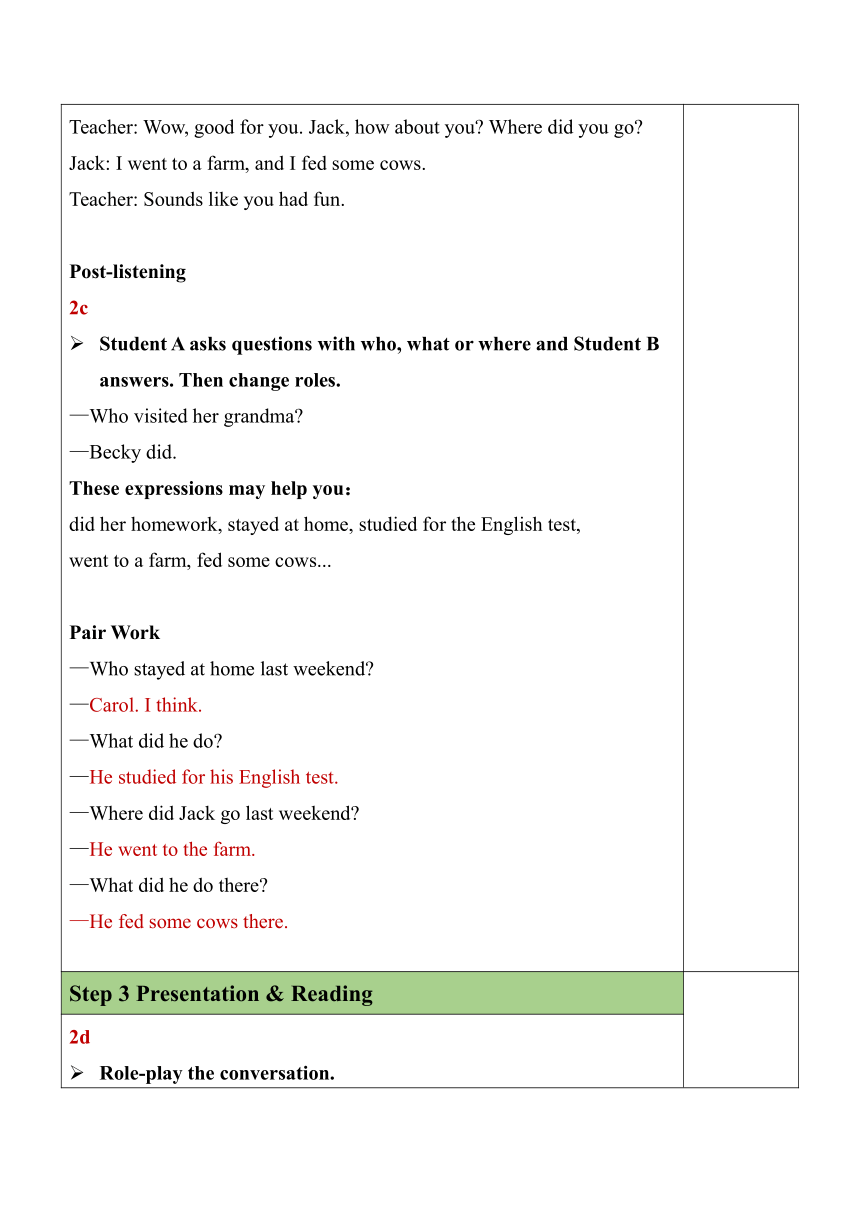
Ask the Ss to listen and read. Teacher: So, did everyone have a good weekend Students: Yeah, we did, Ms. Clark! Teacher: Good. What did you do last weekend, Becky Becky: I visited my grandma, and I did my homework. Teacher: Great. And how about you, Carol Did you go out Carol: No, I stayed at home. I studied for the English test. Teacher: Wow, good for you. Jack, how about you Where did you go Jack: I went to a farm, and I fed some cows. Teacher: Sounds like you had fun. Post-listening 2c Student A asks questions with who, what or where and Student B answers. Then change roles. —Who visited her grandma —Becky did. These expressions may help you: did her homework, stayed at home, studied for the English test, went to a farm, fed some cows... Pair Work —Who stayed at home last weekend —Carol. I think. —What did he do —He studied for his English test. —Where did Jack go last weekend —He went to the farm. —What did he do there —He fed some cows there.
Step 3 Presentation & Reading
2d Role-play the conversation. Explain the key words and phrases. Read the conversation in 2d and answer the questions below. 1. How was Lisa’s weekend 2. What did she do 3. How many kinds of butterflies do they have 4. What did Lisa tell the visitors 5. Why is Paul tired What did he do Answers:1.It was pretty good. 2.She went to the Natural History Museum and worked as a guide. 3.Over 200. 4.She told the visitors about the living habits of the butterflies. 5.He stayed up late to watch the soccer game. Group Work Make a survey. Ask classmates in your group what they did last weekend. Then give a report. A: Hi, Mike. What did you do last weekend B: I watched TV, and then I went fishing with my father. A: How was your last weekend B: It was boring. NamesActivities she/he didHow was his/
her weekend / feeling Mikeboring/terriblePeterbusy/tired/badEricgood/wonderful/ fantastic
Step 4 Language points learning
1. I fed some (sheep/cows). 我喂了一些 (绵羊/奶牛)。 sheep n. 羊;绵羊 【用法详解】 sheep是可数名词,意为“羊;绵羊”,其复数形式仍然是sheep。 Sheep are eating grass in the fields. 羊在田野里吃草。 单复数同形的可数名词: 中日鱼羊鹿,是单也是复。 (注:中 — Chinese 日—Japanese 鱼—fish 羊—sheep 鹿—deer) 2. —Who visited her grandma 谁看望了她的奶奶? — Becky did. 贝姬看望了(她的奶奶)。 do 代替上文的用法 【用法详解】在“Becky did.”中,did代替问句中的 visited her grandma。 英语中为了避免不必要的重复,经常用 do, does, did, so 等词来代替前面的动词(短语)或相关内容。 — Who broke the window 谁打破了窗户? — Jack did. 杰克打破的。 代替broke the window 3. I worked as a guide at the Natural History Museum. 我在自然历史博物馆当导游。 as prep. 作为;当作 【用法详解】as在此处作介词,意为“作为;当作”,其后常接表示职业或用途的名词。“ as+名词”位于句首时,其后要用逗号与句子的主体部分隔开。 She worked as a waitress in the restaurant. 她在饭店里当过服务员。 As a player, you should have a strong body. 作为一名运动员,你应该拥有强健的体魄。 【拓展延伸】as 的其他常见用法: 当……的时候 I saw my old friend as the car went past. 当汽车经过的时候,我看到了我的老朋友。 按照……方式 Please do as I say. 请按照我说的做。 因为;由于 As it was late, I ran for the bus stop. 由于晚了,我跑着去公交车站。 4. How interesting! 多么有趣啊! how引导的感叹句 【用法详解】本句是 how引导的感叹句,interesting后省略了it was。how引导感叹句时, 被强调部分为形容词或副词,其结构为“How+形容词或副词( + 主语 + 谓语)!” How happy they look! 他们看起来多么高兴啊! How hard they are working now! 他们现在干得多么起劲啊! 5. Yeah, it was good, but I’m kind of tired now. 是的,挺好的,不过我现在有点儿累。 tired adj. 疲倦的;疲劳的 be tired from…因……而疲倦 tired out 筋疲力尽的 I’m tired from the long flight. I want a rest. 长时间搭乘飞机,我累了。我想休息一下。 They were cold, hungry and tired out. 他们又冷又饿,疲惫不堪。 【拓展延伸】 tired作形容词,还可意为“厌倦的,厌烦的”。be tired of (doing) sth. 意为“厌烦(做)某事”。 She seemed to be tired of sharing everything. 她似乎厌倦了分享所有事物。 The language points are for reference only.
Step 5 Summary & Homework The homework can vary with the specific conditions.
Summary Ask the Ss to do exercises on PPT P30-P31. Homework Preview the new words and phrases. Do the exercises in students’ book.
Teaching Reflection Teacher needs to help the students analyze the girl and her sister’s feeling before and after they met the snake. And the teacher can encourage the students to share a weekend of them to remember in class.

展开更多......

收起↑

资源预览