【核心素养目标】Unit Unit 12 What did you do last weekend Section A(GF-3c)表格式教案

资源下载
  1. 二一教育资源

【核心素养目标】Unit Unit 12 What did you do last weekend Section A(GF-3c)表格式教案

资源简介

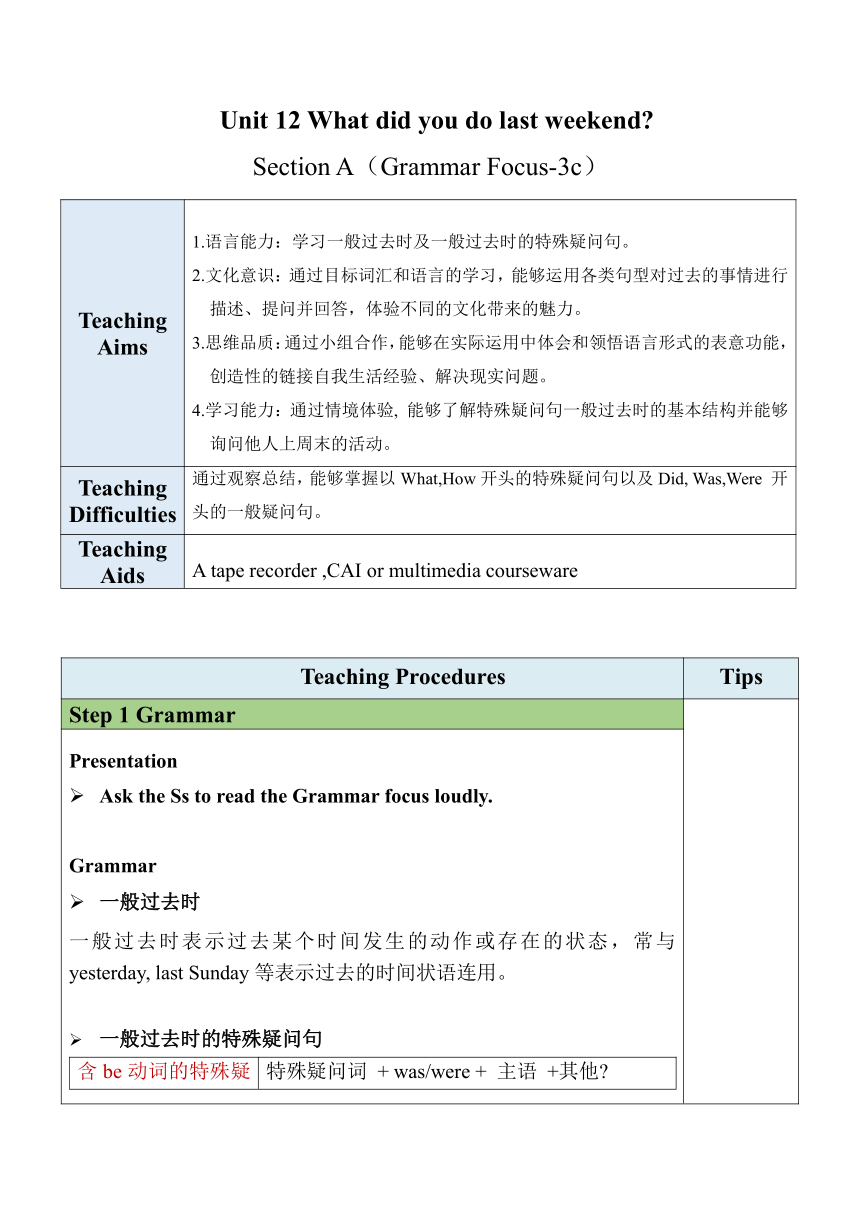
Unit 12 What did you do last weekend
Section A(Grammar Focus-3c)
Teaching Aims 1.语言能力:学习一般过去时及一般过去时的特殊疑问句。 2.文化意识:通过目标词汇和语言的学习,能够运用各类句型对过去的事情进行描述、提问并回答,体验不同的文化带来的魅力。 3.思维品质:通过小组合作,能够在实际运用中体会和领悟语言形式的表意功能,创造性的链接自我生活经验、解决现实问题。 4.学习能力:通过情境体验, 能够了解特殊疑问句一般过去时的基本结构并能够询问他人上周末的活动。
Teaching Difficulties 通过观察总结,能够掌握以What,How开头的特殊疑问句以及Did, Was,Were 开头的一般疑问句。
Teaching Aids A tape recorder ,CAI or multimedia courseware
Teaching Procedures Tips
Step 1 Grammar
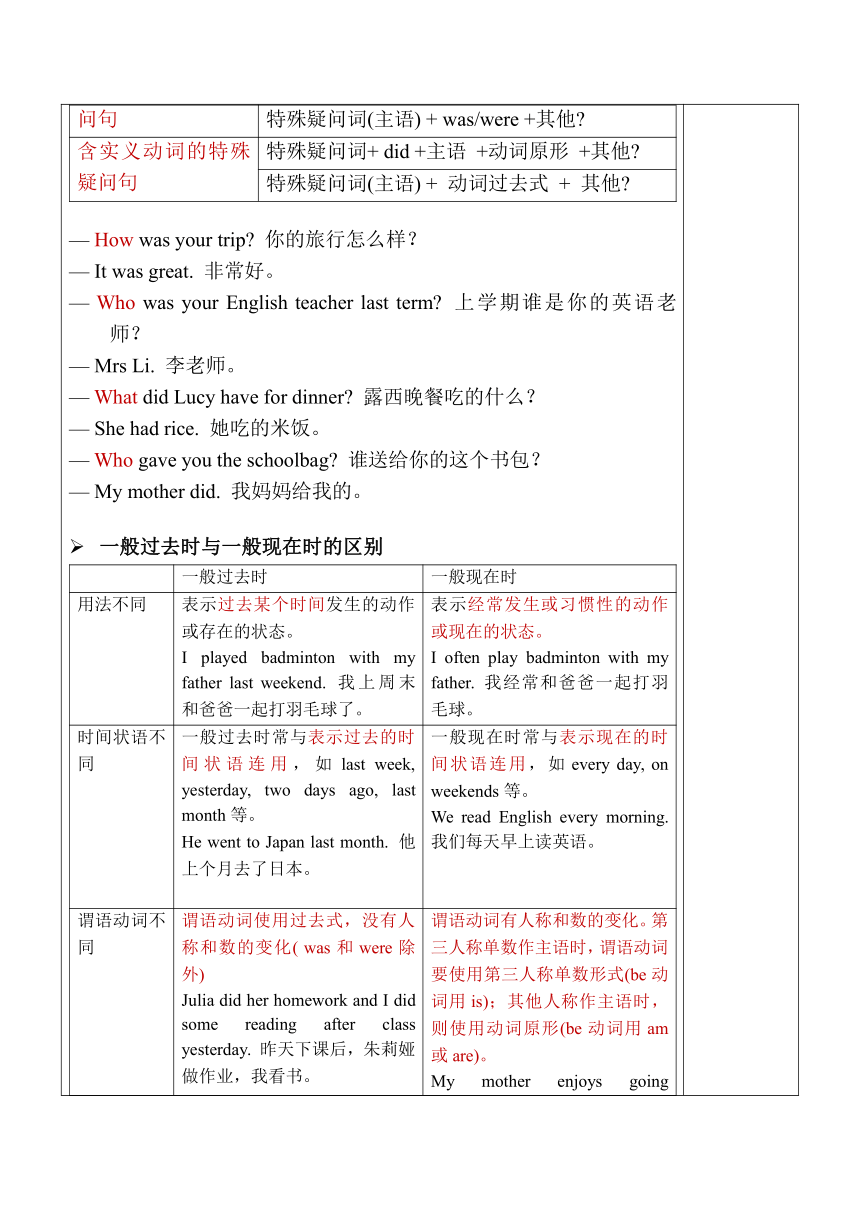
Presentation Ask the Ss to read the Grammar focus loudly. Grammar 一般过去时 一般过去时表示过去某个时间发生的动作或存在的状态,常与yesterday, last Sunday等表示过去的时间状语连用。 一般过去时的特殊疑问句 含be动词的特殊疑问句特殊疑问词 + was/were + 主语 +其他 特殊疑问词(主语) + was/were +其他 含实义动词的特殊疑问句特殊疑问词+ did +主语 +动词原形 +其他 特殊疑问词(主语) + 动词过去式 + 其他
— How was your trip 你的旅行怎么样? — It was great. 非常好。 — Who was your English teacher last term 上学期谁是你的英语老师? — Mrs Li. 李老师。 — What did Lucy have for dinner 露西晚餐吃的什么? — She had rice. 她吃的米饭。 — Who gave you the schoolbag 谁送给你的这个书包? — My mother did. 我妈妈给我的。 一般过去时与一般现在时的区别 一般过去时一般现在时用法不同 表示过去某个时间发生的动作或存在的状态。 I played badminton with my father last weekend. 我上周末和爸爸一起打羽毛球了。表示经常发生或习惯性的动作或现在的状态。 I often play badminton with my father. 我经常和爸爸一起打羽毛球。时间状语不同一般过去时常与表示过去的时间状语连用,如last week, yesterday, two days ago, last month等。 He went to Japan last month. 他上个月去了日本。 一般现在时常与表示现在的时间状语连用,如every day, on weekends等。 We read English every morning. 我们每天早上读英语。 谓语动词不同谓语动词使用过去式,没有人称和数的变化( was和were除外) Julia did her homework and I did some reading after class yesterday. 昨天下课后,朱莉娅做作业,我看书。 谓语动词有人称和数的变化。第三人称单数作主语时,谓语动词要使用第三人称单数形式(be动词用is);其他人称作主语时,则使用动词原形(be动词用am或are)。 My mother enjoys going shopping and I enjoy traveling. 我妈妈喜欢购物,我喜欢旅行。
Step 3 Presentation
3a Ask the Ss to fill in the blanks with who, what, when, where or how. 1. A: _____ did you do last weekend B: I played badminton on Saturday. A: Sounds fun! _____ did you play with B: I played with my father. He’s really good! 2. A: _____ was your weekend B: It was great! I had so much fun! A: _____ did you go B: The weather was beautiful, so I went to the beach with my parents. 3. A: _____ did Jim lose B: He lost his keys. He often loses things. A: That’s too bad. _____ did he lose them B: I heard it was yesterday. Answers:1.What Who 2.How Where 3.What When Ask and answer, then complete sentences according to the conversations in 3a. 1. I _________________ on Saturday. What 2. I played badminton _________________. When 3. I played badminton with _________________. Who 4. I went to _________________ with my parents last weekend. Where 5. He lost _________________ yesterday. What 6. He lost his keys _________________. When 7. _________________ lost his keys yesterday. Who Answers: 1.played badminton 2.on Saturday 3.my father 4.the beach 5.his keys 6.yesterday 7.Jim 3b Complete the passage with the correct forms of the words in the box. say be climb see run away A family of mice were in the kitchen on Saturday morning when they ________ a big cat. Baby Mouse ________ afraid and ________ onto his father’s back. Father Mouse shouted at the cat, “Woof, woof!” The cat quickly ________ “Wow, Dad, you’re good!” ________ Baby Mouse. “Well, son, that’s why it’s important to learn a second language,” answered Father Mouse. Answers: saw was climbed ran away said Group Work Ask the Ss to read and role-play the story in 3a. A family of mice were in the kitchen on Saturday morning when they saw a big cat. Baby Mouse was afraid and climbed onto his father’s back. Father Mouse shouted at the cat, “Woof, woof!” The cat quickly ran away. “Wow, Dad, you’re good!” said Baby Mouse. “Well, son, that’s why it’s important to learn a second language,” answered Father Mouse. 3c Think of two things you did last weekend. Draw pictures of them. Your classmates guess what you did. For example, —What did I do —You went boating. —You went with your daughter. —Where did you go on Dragon Boat Day —I went to the countryside. —What did you do there —I watched the boat race.
Step 4 Language points learning
1. Father Mouse shouted at the cat, “Woof, woof!” 鼠爸爸冲猫大叫:“汪汪,汪汪!” shout v. 呼叫;喊叫 【用法详解】shout 在此处作不及物动词,shout at意为“ 冲…… 大声叫嚷” ,at后接喊叫的对象。 There is someone shouting for help. 有人在大声求救。 Speak clearly and slowly. Don’t shout at others. 清楚地慢慢地说。不要冲他人喊叫。 【易混辨析】shout at与shout to shout at意为“冲...... 大声叫嚷”多指因生气或愤怒而冲着某人大声吼叫。 Li Ming’s mother shouted at him for his dishonesty. 妈妈因李明不诚实而对他大声嚷嚷。shout to意为“对 ..... 大声喊叫”,目的是让别人听见,多因距离远。Mary shouted to us to come in and help her. 玛丽大声喊我们进来帮助她。
2. “Well, son, that’s why it’s important to learn a second language,” answered Father Mouse. “所以嘛,儿子,这就是为什么再学一门语言很重要。”鼠爸爸回答道。 language n. 语言 【用法详解】language 在此是可数名词,a second language意为“又一门语言”。表示某种具体语言的词,如 Chinese, English, Japanese 等,是不可数名词。 How many languages can you speak 你会说几门语言? All the children must learn a foreign language. 所有的儿童必须学一门外语。 That’s why... 句型 【用法详解】该句型意为“这/那就是......的原因”,其中why引导的从句,表示结果。 Tom overslept this morning. That’s why he was late for school. 汤姆今天早晨睡过头了,这就是他上学迟到的原因。 【拓展延伸】“That’s because ... ”也是一 个常用句型,意为 “这/那是因为 …… ”, because引导的从句表示原因。 Tom was late for school this morning. That’s because he overslept. 汤姆今天早晨上学迟到了,那是因为他睡过头了。
Step 5 Summary & Homework The homework can vary with the specific conditions.
Summary Ask the Ss to do exercises on PPT P25-P28. Homework Preview the new words and phrases in Section B (1a-1e). Do the exercises in students’ book.
Teaching Reflection We always learn grammar when we have enough language materials to support. Students can practice grammar by using what they have learned. After they learn the main structure in the grammar focus frame, the students should practice in different activities.

展开更多......

收起↑

资源预览