【核心素养目标】Unit Unit 12 What did you do last weekend Section B(2a-2c)表格式教案

资源下载
  1. 二一教育资源

【核心素养目标】Unit Unit 12 What did you do last weekend Section B(2a-2c)表格式教案

资源简介

Unit 12 What did you do last weekend
Section B(2a-2c)
Teaching Aims 1.语言能力:能用英语描述过去发生的事情。 2.文化意识:通过读后讨论,建议学生面对危险要勇敢也要注意安全的自我保护。 3.思维品质:通过阅读让学生了解正确处理突发事件,培养学生的逻辑思维能力。 4.学习能力:学生通过阅读,继续培养用英语获取信息、处理信息、分析问题和 解决问题的能力。
Teaching Difficulties 能理解文中长难句及词汇,熟练运用一般过去时进行表达。
Teaching Aids A tape recorder ,CAI or multimedia courseware
Teaching Procedures Tips
Step 1 Lead in
Show some pictures to the Ss. Then ask them to answer the following questions. Do you know these animals What do you think of them snake tiger lion centipede spider caterpillar mouse lizard crocodile Free Talk Have you ever seen them in reality Are you afraid of them Why These words may help you : dangerous; poisonous (有毒的); disgusting (令人恶心的); scary; violent (凶猛的); ugly (丑陋的); Dirty (脏的) ...
Step 2 Presentation & Reading
Pre-reading 2a What kinds of animals are people sometimes afraid of Why Make a list. AnimalsReasonssnakesThey look disgusting and scary.lionsThey are dangerous and violent.spiderThey may be poisonous.
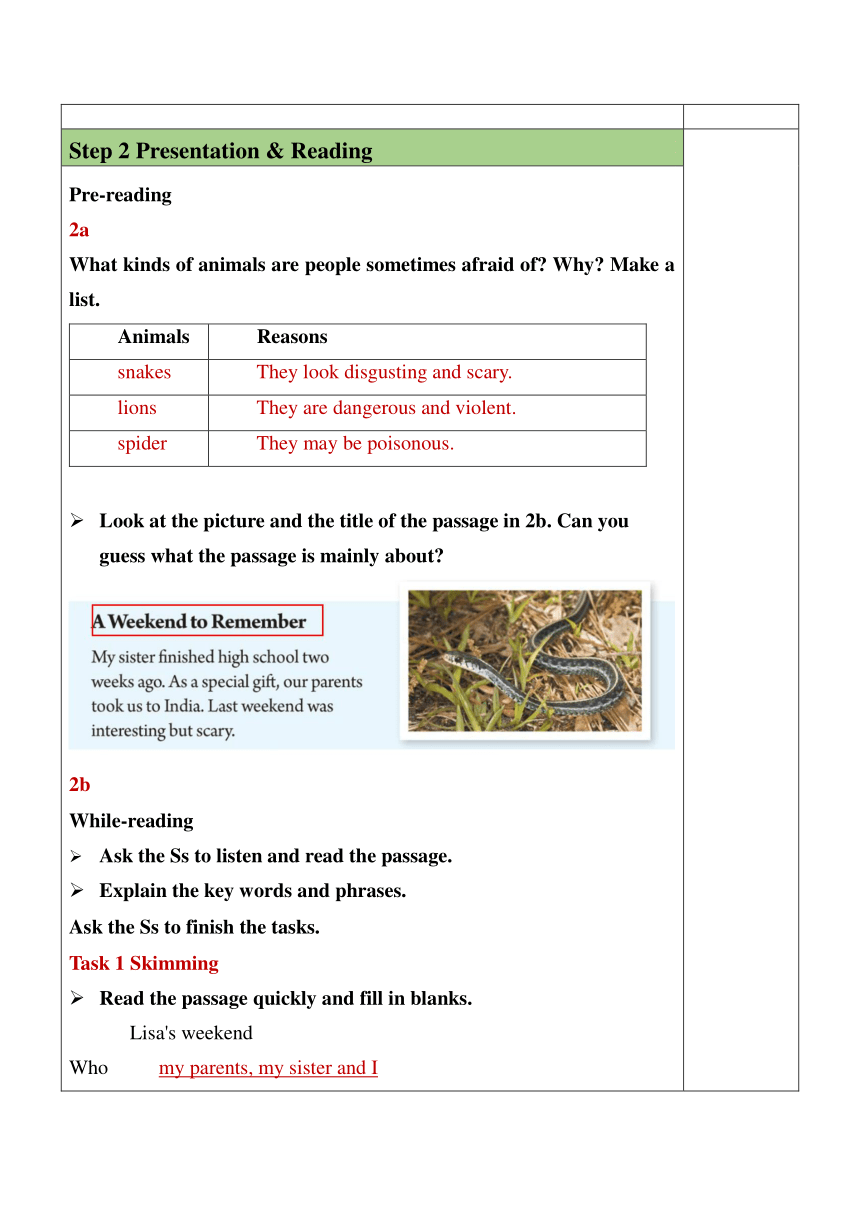
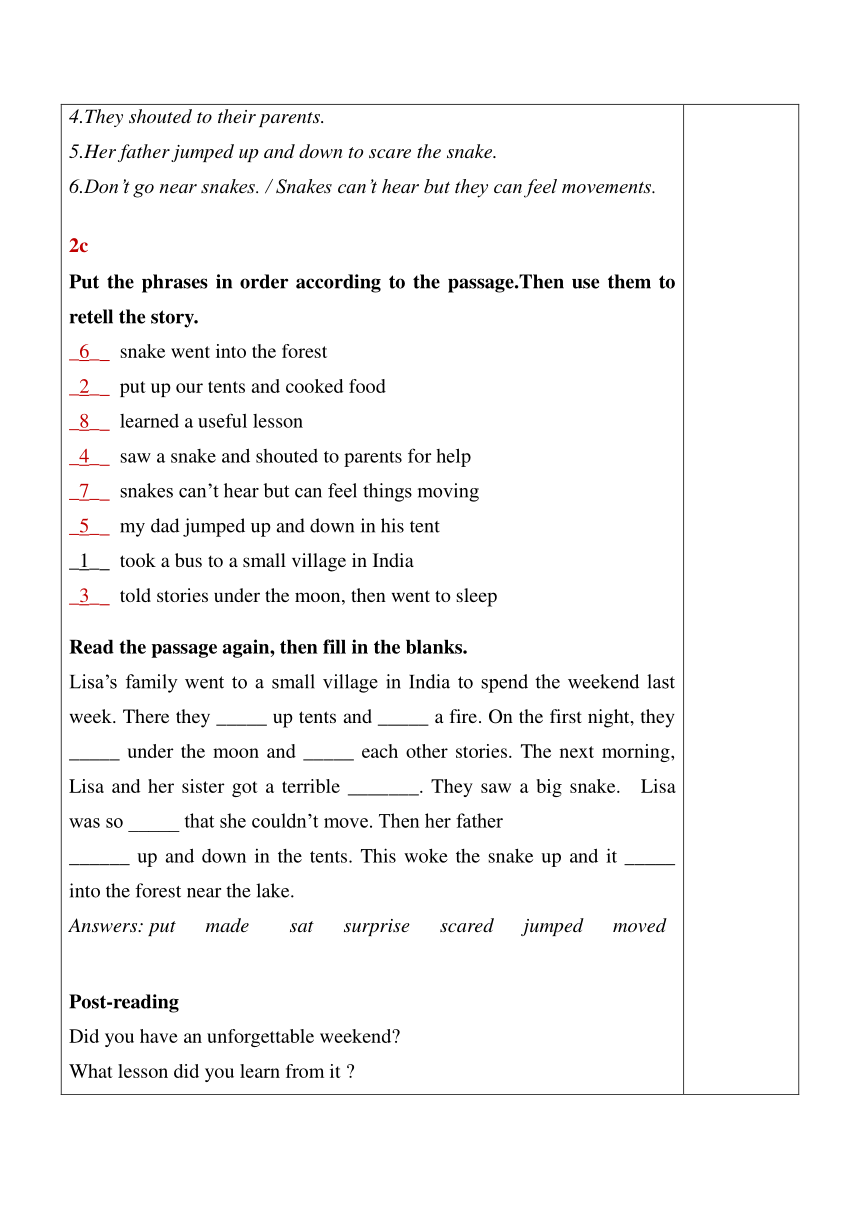
Look at the picture and the title of the passage in 2b. Can you guess what the passage is mainly about 2b While-reading Ask the Ss to listen and read the passage. Explain the key words and phrases. Ask the Ss to finish the tasks. Task 1 Skimming Read the passage quickly and fill in blanks. Lisa's weekend Who my parents, my sister and I Where India How interesting but scary What ①went camping in a small village ②got a terrible surprise and learnt a useful lesson Task 2 Scanning and mind-mapping Read the para.2 and complete the mind-map. go camping take a long bus ride put up tents make a fire cook food sit under the moon tell stories be tired go to sleep Task 3 Scanning and answering Read para.3 and answer the questions. 1.What was the terrible surprise 2.How did Lisa feel when she saw the snake 3.What did Lisa and her sister do then 4.What did their parents do Why did they do that Answers:1.When they looked out of their tent,they saw a big snake sleeping near the fire. 2.She was too scared to move. 3.They shouted to their parents to let them know about the danger. 4.Their dad jumped up and down, because this woke the snake up and it moved into the forest. Task 4 Retelling Retell Lisa’s trip to a village in India last weekend. A Weekend to Remember 交代背景 Para.1 时间: last weekend 地点: India 人物: my parents, my sister and I 原因: my sister finished high school; as a special gift 总结: Last weekend was interesting but scary. (引出下文) 详述经历Para.2-3 took a long bus ride→put up our tents, made a fire the first night: sat under the moon, told each other stories the next morning: got a surprise, saw a big snake sleeping, so scared, shouted to parents, Dad jumped up and down, the snake moved into the forest It was important not to go near a snake. 2b Read about Lisa’s weekend and answer the questions. 1.How was Lisa’s weekend 2. Where did Lisa and her family go last weekend 3. How did Lisa feel when she saw the snake 4. What did Lisa and her sister do 5. What did their parents do Why did they do that 6. What lesson did Lisa learn from the weekend Answers:1.It was interesting but scary. 2.They went to a small village in India. 3.She was so scared that she couldn’t move. 4.They shouted to their parents. 5.Her father jumped up and down to scare the snake. 6.Don’t go near snakes. / Snakes can’t hear but they can feel movements. 2c Put the phrases in order according to the passage.Then use them to retell the story. _6_ snake went into the forest _2_ put up our tents and cooked food _8_ learned a useful lesson _4_ saw a snake and shouted to parents for help _7_ snakes can’t hear but can feel things moving _5_ my dad jumped up and down in his tent _1_ took a bus to a small village in India _3_ told stories under the moon, then went to sleep Read the passage again, then fill in the blanks. Lisa’s family went to a small village in India to spend the weekend last week. There they _____ up tents and _____ a fire. On the first night, they _____ under the moon and _____ each other stories. The next morning, Lisa and her sister got a terrible _______. They saw a big snake. Lisa was so _____ that she couldn’t move. Then her father ______ up and down in the tents. This woke the snake up and it _____ into the forest near the lake. Answers: put made sat surprise scared jumped moved Post-reading Did you have an unforgettable weekend What lesson did you learn from it
Step 3 Language points learning
1. My sister finished high school two weeks ago. 我姐姐两周前中学毕业了。 high adj.& adv. 高的(地) 【用法详解】 (1) high作形容词,意为“高的” ,强调物体高出地面的空间高度。 The building is high. 这栋建筑很高。 (2) high作副词,意为“高地”。既可表示物理上的高,也可表示价格、价值、评价等抽象意义上的高。 He can jump very high. 他能跳很高。 You should aim high. 你应该志向远大。 ago adv. 以前 【用法详解】ago作副词,不能单独使用,常用于“一段时间 + ago”结构,常与一般过去时连用。 He started to play the piano three years ago. 他三年前开始弹钢琴。 2. There we put up our tents and made a fire to keep us warm and cook food on. 在那里我们搭起帐篷,生火取暖并做饭。 【句式剖析】 ①本句中 put up和made 作并列谓语,表示动作连续发生; ②本句中 to keep us warm and cook food on 作目的状语,表示 made a fire的目的。 put up 搭起;举起 【用法详解】put up在此意为“搭起”,是“动词 + 副词”型短语。其宾语为名词时,名词放在up之前或之后均可;宾语为代词时,代词要放在 put与up 之间。 It’s going to rain. Let’s put up the tent. 要下雨了。咱们把帐篷搭起来吧。 Here is the tent. Let’s put it up. 帐篷在这儿。咱们把它搭起来吧。 【拓展延伸】put up的其他常见含义: ①put up举起 He puts up his hand to ask a question. 他举起手来问问题。 ②put up张贴 They put up a notice on the wall. 他们在墙上贴了一张布告。 3. But I was so tired that I went to sleep early. 但是我太累了,所以早早就睡了。 so... that... 结构 【用法详解】so ... that ... 意为“如此…… 以至于 ……”,是固定结构,so 后接形容词或副词,that 后接句子表示结果。 Jim is so busy that he has little time for his family. 吉姆太忙了,以至于他几乎没有时间陪他的家人。 【拓展延伸】so... that ... 后的从句为肯定句时,该结构可与 ... enough to ... 互相转化;其后的从句为否定句时,它可以与 too ... to ... 互相转化。 The boy got up so early that he caught the early bus. = The boy got up early enough to catch the early bus. 这个男孩起得很早,以至于他赶上了早班车。 He is so young that he can’t go to school. =He is too young to go to school. 他那么小,以至于不能去上学。 4. The next morning, my sister and I got a terrible surprise. 第二天早上,我和姐姐大吃一惊。 surprise n. 惊奇;惊讶 v. 使吃惊 【用法详解】 (1) surprise 在此处作名词,意为“惊奇,惊讶”。表示抽象事物时,用作不可数名词;表示具体事物时,用作可数名词。 get a surprise 吃惊 give sb. a surprise 给某人一个惊喜 in surprise 惊奇地,惊讶地 to one’s surprise 让某人惊讶的是 I got a surprise when I saw the bill. 一看账单我吃了一惊。 They looked at each other in surprise. 他们惊讶地看着对方。 To my surprise, he didn’t pass the exam. 让我惊讶的是,他没有通过考试。 (2) surprise也可作及物动词,意为“使吃惊”。 The news surprised me a lot. 这消息使我非常惊讶。 5. When we looked out of our tent, we saw a big snake sleeping near the fire. 我们向帐篷外看时,看到了一条大蛇正在篝火旁睡觉。 look out of 向 ……外看 【用法详解】look out of后接名词或代词,其反义短语为 look into。 The boy is looking out of the window. 这个男孩正在向窗外看。 【拓展延伸】look out意为“当心”,相当于 be careful。 Look out! Here comes a car. 当心!过来一辆小汽车。 see sb./sth. doing sth. 看见某人/某物正在做某事 【用法详解】see sb./sth. doing sth. 意为“看见某人/某物正在做某事”,强调看到动作正在发生;而 see sb./sth. do sth. 意为“看到某人/某物做了某事”,强调看见动作发生的全过程,或者看到动作经常发生。 I saw him playing basketball at nine o’clock in the morning. 上午9点钟,我看到他正在打篮球。 I often see her read in the library. 我经常看到她在图书馆看书。 6. I was so scared that I couldn’t move. 我是那么害怕,一动都不敢动。 scared adj. 惊慌的;吓坏了的 【用法详解】scared作形容词,通常用来修饰人,常用结构有: be scared of sth. /doing sth.害怕某物/做某事 be scared to do sth.害怕做某事 My cousin isn’t scared of snakes. 我堂姐不害怕蛇。 She is scared to climb the tree. 她害怕爬树。 【拓展延伸】scary作形容词,意为“吓人的;恐怖的“常用来修饰物。 The movie is scary. Can you watch it with me 这部电影很恐怖。你能和我一起看吗? move v. 移动 【用法详解】move在句中作不及物动词,意为“移动”。move 作不及物动词时,还可意为“搬家,搬迁”,“move to + 地点名词”表示“搬到 ……”。 Don’t move, or you’ll be in danger. 不要动,否则你会有危险。 We’ll move to the countryside next month. 我们下个月将搬到乡下。 【拓展延伸】move 也可作及物动词,意为“使 …… 移动” ,还可表示“使感动,打动”。 He moved his chair nearer the old man. 他把椅子移得离这个老人更近了一些。 His speech moved me to tears. 他的演讲让我感动得流泪。 This woke the snake up and it moved into the forest near the lake.这一举动惊醒了蛇,它爬进了湖边的树林里。 wake... up 把…… 弄醒 【用法详解】wake ... up 中的 wake作动词,意为“弄醒,醒”;up为副词。该短语为“动词 + 副词”型短语,当宾语是名词时,名词可以放在wake和up之间,也可以放在up的后面;当宾语是代词时,代词必须放在wake和up之间。 Wake up your brother. It’s time for breakfast. 把你弟弟叫醒。该吃早饭了。 I’ll wake you up for the medicine. 我会叫醒你吃药的。 【拓展延伸】 wake up 还可作不及物动词短语,意为“醒,醒来”。 My grandma usually wakes up early. 我奶奶通常醒得早。 The language points are for reference only.
Step 4 Summary & Homework The homework can vary with the specific conditions.
Summary Ask the Ss to do the exercises on PPT P38-P42. Homework Read and recite the new words and phrases . Do the exercises in students’ book.
Teaching Reflection In this period,the most important thing is reading.It is a good time to train the students' ability of reading quickly and efficiently.Usually we do some work to deal with new words and phrases before reading.While reading,students should learn to catch the main and the most important ideas as quickly as they can.And the teacher should tell them to find the key words in the ads.

展开更多......

收起↑

资源预览