(新课标)Unit 6 Do you like bananas? SectionA1a-2c(表格式教学设计)

资源下载
  1. 二一教育资源

(新课标)Unit 6 Do you like bananas? SectionA1a-2c(表格式教学设计)

资源简介

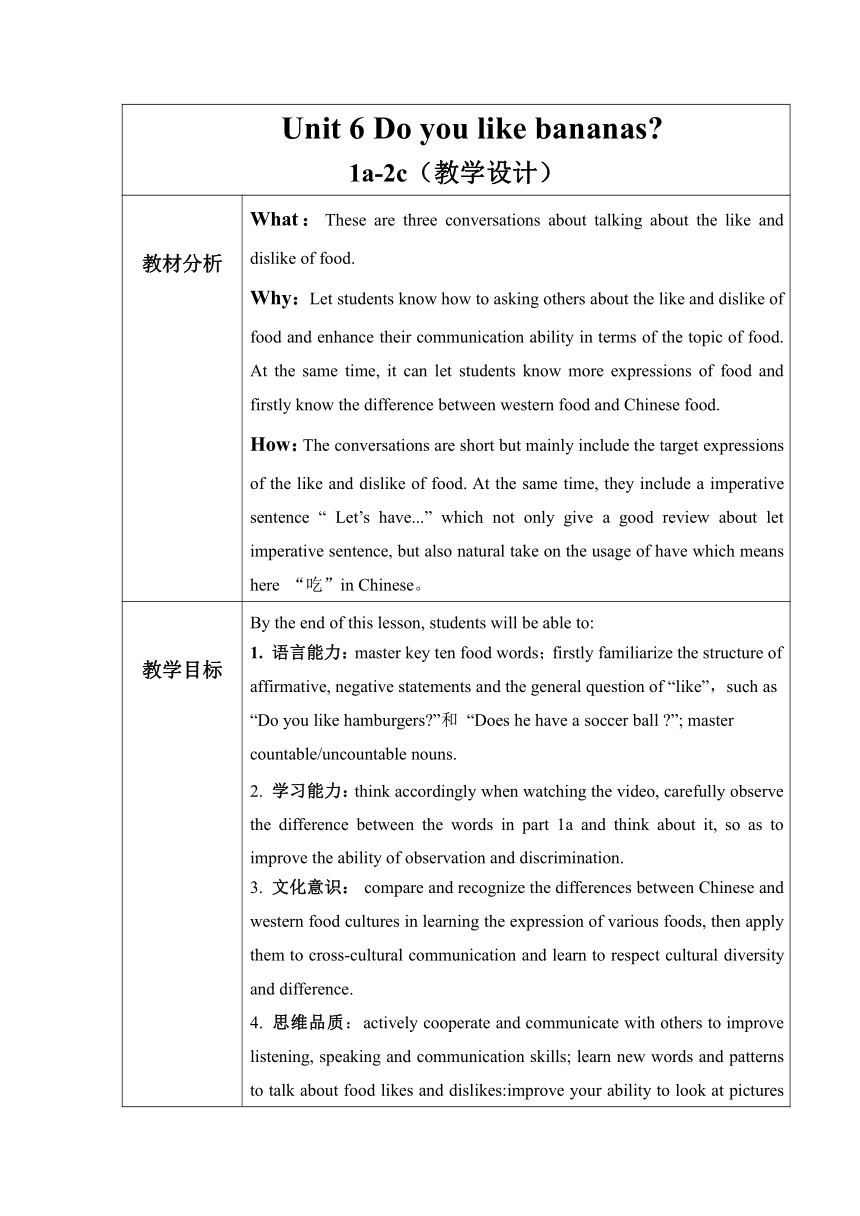
Unit 6 Do you like bananas 1a-2c(教学设计)
教材分析 What:These are three conversations about talking about the like and dislike of food. Why:Let students know how to asking others about the like and dislike of food and enhance their communication ability in terms of the topic of food. At the same time, it can let students know more expressions of food and firstly know the difference between western food and Chinese food. How:The conversations are short but mainly include the target expressions of the like and dislike of food. At the same time, they include a imperative sentence “ Let’s have...” which not only give a good review about let imperative sentence, but also natural take on the usage of have which means here “吃”in Chinese。
教学目标 By the end of this lesson, students will be able to: 1. 语言能力:master key ten food words;firstly familiarize the structure of affirmative, negative statements and the general question of “like”,such as “Do you like hamburgers ”和 “Does he have a soccer ball ”; master countable/uncountable nouns. 2. 学习能力:think accordingly when watching the video, carefully observe the difference between the words in part 1a and think about it, so as to improve the ability of observation and discrimination. 3. 文化意识: compare and recognize the differences between Chinese and western food cultures in learning the expression of various foods, then apply them to cross-cultural communication and learn to respect cultural diversity and difference. 4. 思维品质:actively cooperate and communicate with others to improve listening, speaking and communication skills; learn new words and patterns to talk about food likes and dislikes:improve your ability to look at pictures and videos.
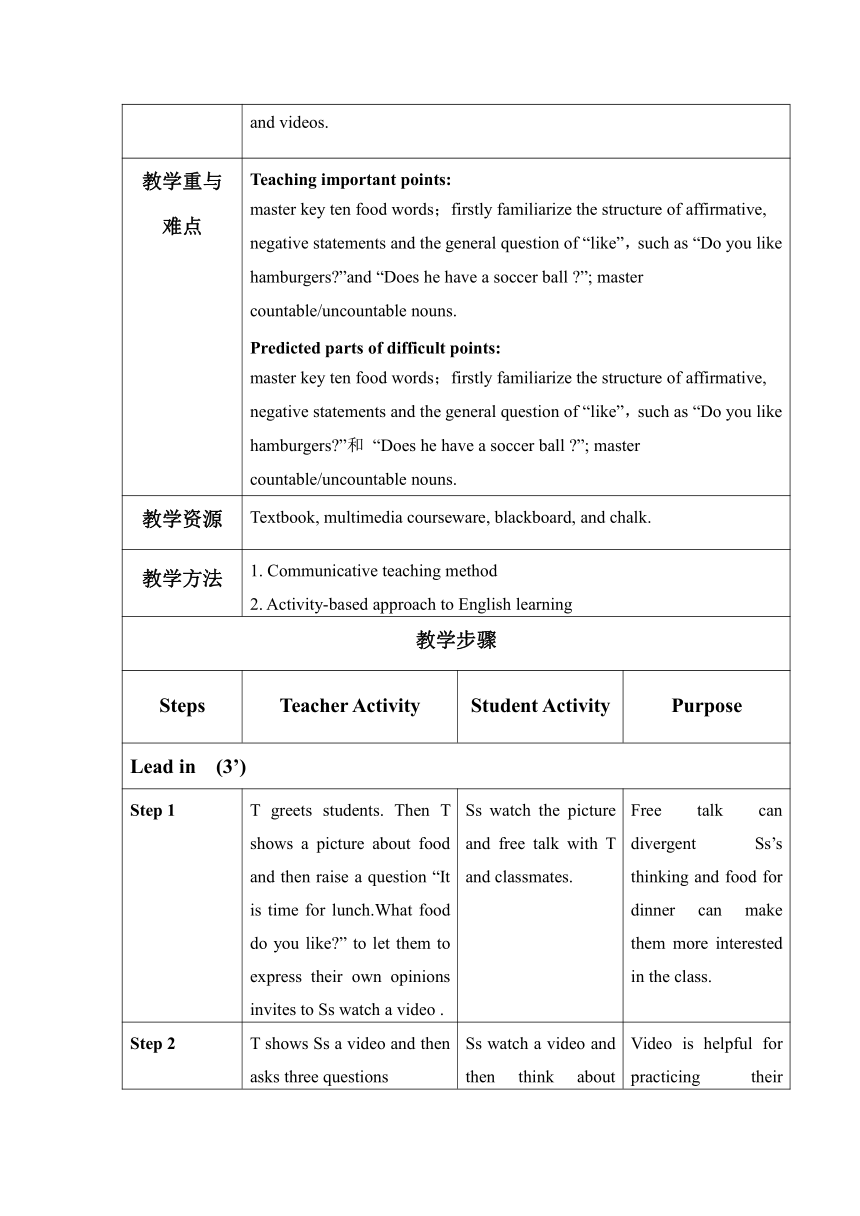
教学重与 难点 Teaching important points: master key ten food words;firstly familiarize the structure of affirmative, negative statements and the general question of “like”,such as “Do you like hamburgers ”and “Does he have a soccer ball ”; master countable/uncountable nouns. Predicted parts of difficult points: master key ten food words;firstly familiarize the structure of affirmative, negative statements and the general question of “like”,such as “Do you like hamburgers ”和 “Does he have a soccer ball ”; master countable/uncountable nouns.
教学资源 Textbook, multimedia courseware, blackboard, and chalk.
教学方法 1. Communicative teaching method 2. Activity-based approach to English learning
教学步骤
Steps Teacher Activity Student Activity Purpose
Lead in (3’)
Step 1 T greets students. Then T shows a picture about food and then raise a question “It is time for lunch.What food do you like ” to let them to express their own opinions invites to Ss watch a video . Ss watch the picture and free talk with T and classmates. Free talk can divergent Ss’s thinking and food for dinner can make them more interested in the class.
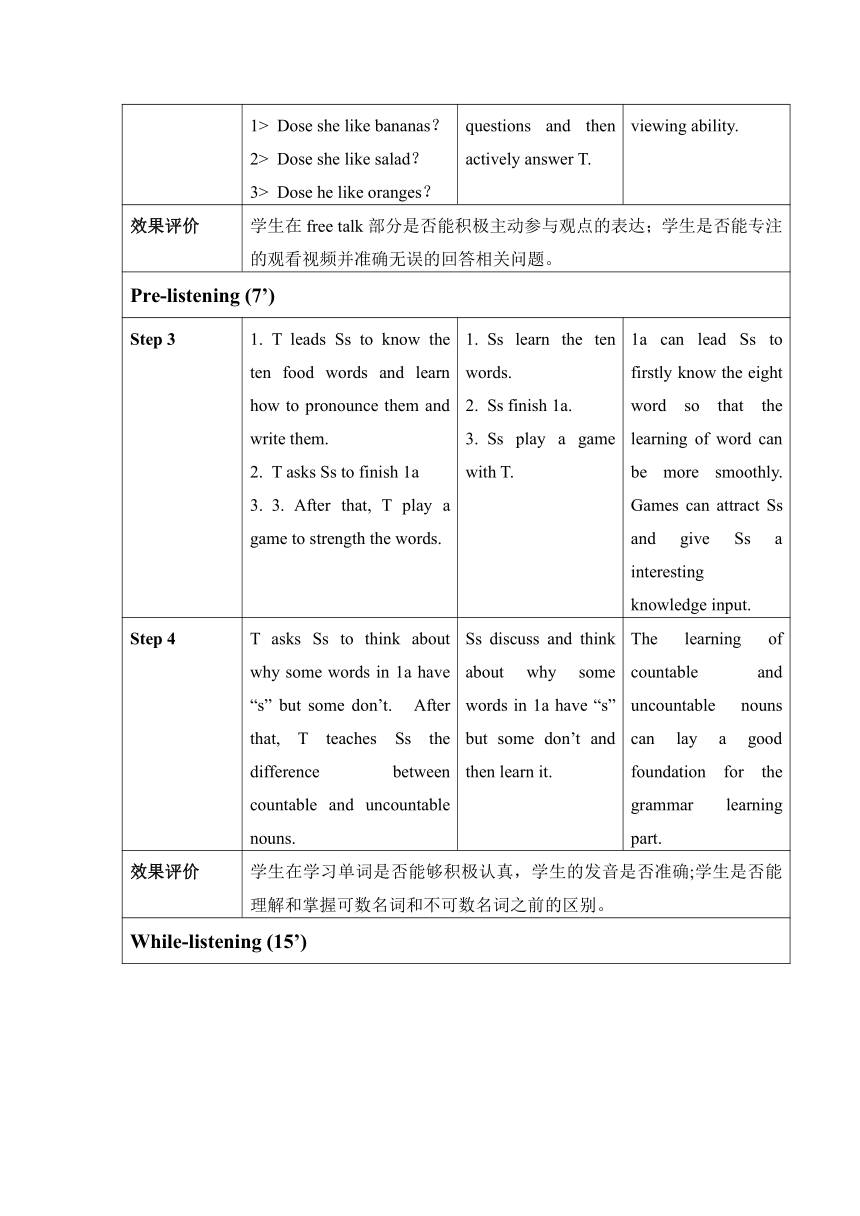
Step 2 T shows Ss a video and then asks three questions Dose she like bananas? Dose she like salad? Dose he like oranges? Ss watch a video and then think about questions and then actively answer T. Video is helpful for practicing their viewing ability.
效果评价 学生在free talk部分是否能积极主动参与观点的表达;学生是否能专注的观看视频并准确无误的回答相关问题。
Pre-listening (7’)
Step 3 T leads Ss to know the ten food words and learn how to pronounce them and write them. T asks Ss to finish 1a 3. After that, T play a game to strength the words. Ss learn the ten words. Ss finish 1a. Ss play a game with T. 1a can lead Ss to firstly know the eight word so that the learning of word can be more smoothly. Games can attract Ss and give Ss a interesting knowledge input.
Step 4 T asks Ss to think about why some words in 1a have “s” but some don’t. After that, T teaches Ss the difference between countable and uncountable nouns. Ss discuss and think about why some words in 1a have “s” but some don’t and then learn it. The learning of countable and uncountable nouns can lay a good foundation for the grammar learning part.
效果评价 学生在学习单词是否能够积极认真,学生的发音是否准确;学生是否能理解和掌握可数名词和不可数名词之前的区别。
While-listening (15’)
Step 5 T plays the recording for the first time to ask Ss to finish 1b. After that, T leads students reading the conversations in 1b. Ss listen to the record to finish 1b and them read the conversations in 1b. It can help Ss improve their ability of listening. Imitation and repeating can strengthen their tone and pronunciation .
Step 5 T plays a game called “Bomb game” to practice the conversations in 1b. T can set some punishments to activate Ss’ interests when the pointer is in booms. Ss play a game called “Bomb game” Game can activate Ss’ interests and practice their listening and speaking ability.
Step 4 T plays the recording in 2a for the first time to ask Ss to finish 2a. T plays the recording for the second time to ask Ss to complete 2b. After that. T invites some Ss to show their answers. Ss listen to the record two times, finish 2a for the first time and finish 2a for the second time. And then Ss share and discuss their answers. It can help Ss improve their ability of listening and speaking. Discussing and sharing answers can improve Ss’ ability of criticizing.
Step 5 T plays the conversation in 2a, and asks Ss to try their best to retell the content of recording and imitate the tone and pronunciation. Ss listen to the conversation , retell the content of recording and imitate the tone and pronunciation. It can help Ss further improve their ability of speaking.
效果汇总 学生是否能准确无误的完成练习;学生是否能在听录音时抓住关键词,准确无误的完成1b、2a和2b;学生是会认真模仿和复述录音原文。
Post-listening (10’)
Step 6 T asks Ss to do a role play by using the conversation in 1a. Ss do a role play by using the conversation in 1a. It can help Ss improve their ability of listening and speaking and boost confidence in speaking English.
效果汇总 学生是否能在积极主动地与同伴进行role play;学生是否足够自信在讲台上展示自己的成果。
Exercise (5’)
Step 7 T asks Ss to finish the exercises on ppt. Ss finish the exercises on ppt. Practice in time can help test students' knowledge of this class.
效果汇总 学生是否能够高效且正确的完成练习。
Conclusion (3’)
Step 8 T gives a mind map about what are learned today. Ss recall the learned knowledge of today. Mind map and summary of new knowledge can help students further understand and remember them.
效果汇总 学生是否能与老师一起总结出今日所学知识。
Homework (2’) 1. Practice the conversations in 1b and 2c with your desk mates. 2. Copy the new words of P1 and P2 for three times with Chinese meaning 3. Memorize the language points in this class. Homework can help students strengthen the knowledge which they have learned.
Unit 6 Do you like bananas 1a-2c
板书

展开更多......

收起↑

资源预览