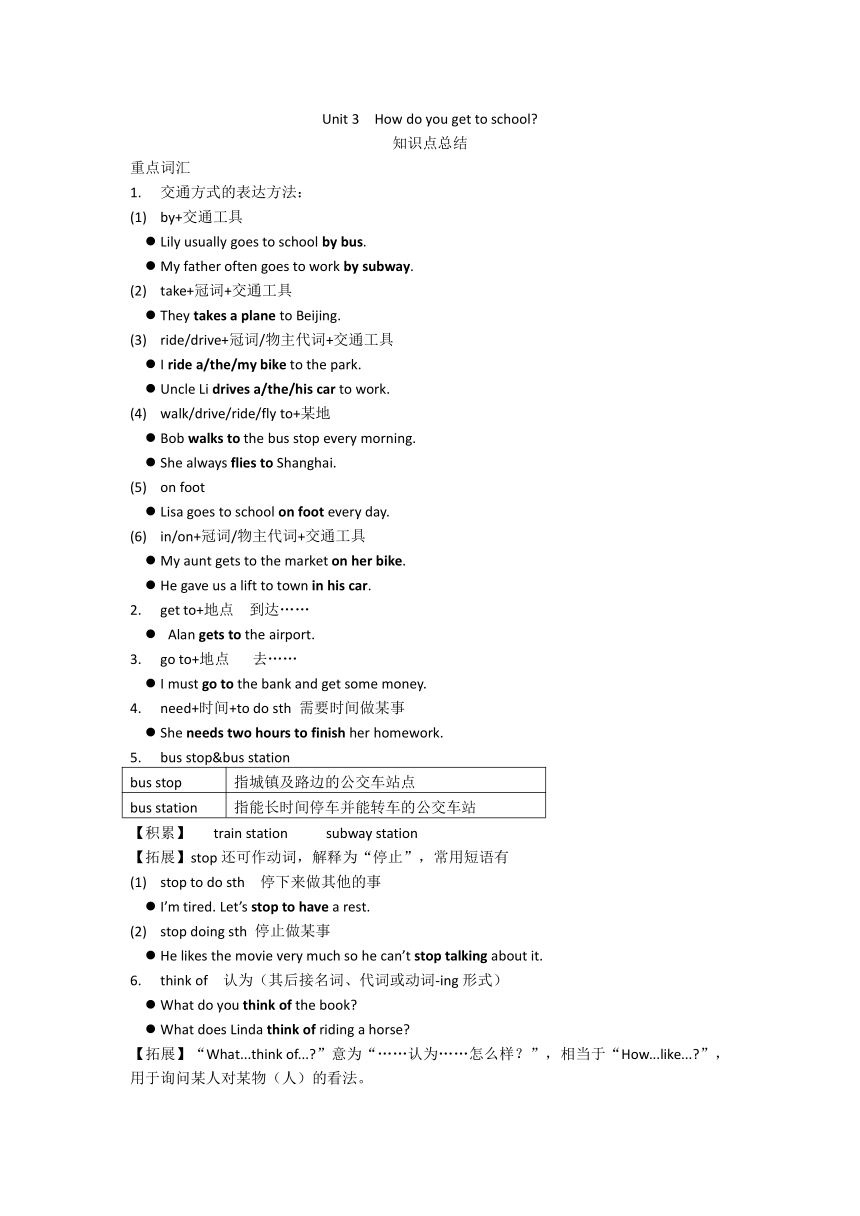
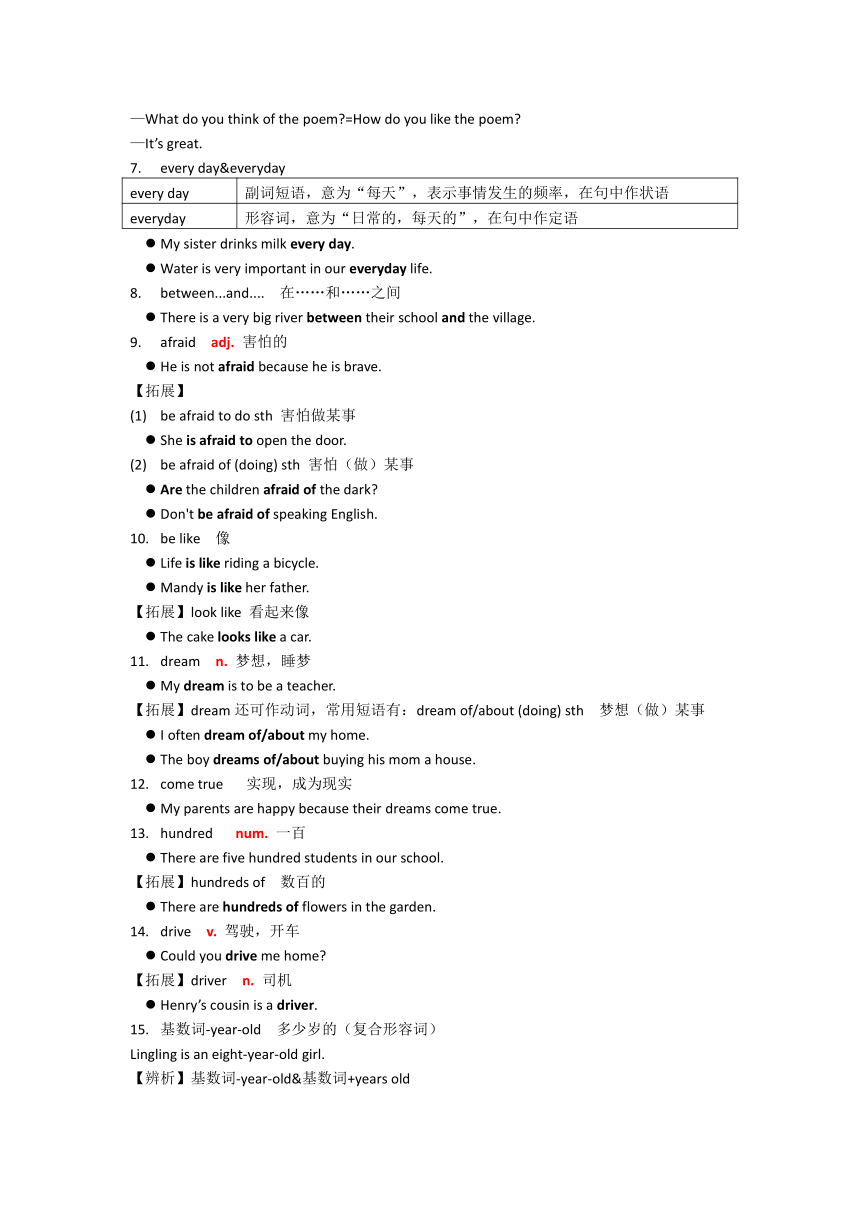
资源简介 Unit 3 How do you get to school 知识点总结重点词汇交通方式的表达方法:by+交通工具Lily usually goes to school by bus.My father often goes to work by subway.take+冠词+交通工具They takes a plane to Beijing.ride/drive+冠词/物主代词+交通工具I ride a/the/my bike to the park.Uncle Li drives a/the/his car to work.walk/drive/ride/fly to+某地Bob walks to the bus stop every morning.She always flies to Shanghai.on footLisa goes to school on foot every day.in/on+冠词/物主代词+交通工具My aunt gets to the market on her bike.He gave us a lift to town in his car.get to+地点 到达……Alan gets to the airport.go to+地点 去……I must go to the bank and get some money.need+时间+to do sth 需要时间做某事She needs two hours to finish her homework.bus stop&bus stationbus stop 指城镇及路边的公交车站点bus station 指能长时间停车并能转车的公交车站【积累】 train station subway station【拓展】stop还可作动词,解释为“停止”,常用短语有stop to do sth 停下来做其他的事I’m tired. Let’s stop to have a rest.stop doing sth 停止做某事He likes the movie very much so he can’t stop talking about it.think of 认为(其后接名词、代词或动词-ing形式)What do you think of the book What does Linda think of riding a horse 【拓展】“What...think of... ”意为“……认为……怎么样?”,相当于“How...like... ”,用于询问某人对某物(人)的看法。—What do you think of the poem =How do you like the poem —It’s great.every day&everydayevery day 副词短语,意为“每天”,表示事情发生的频率,在句中作状语everyday 形容词,意为“日常的,每天的”,在句中作定语My sister drinks milk every day.Water is very important in our everyday life.between...and.... 在……和……之间There is a very big river between their school and the village.afraid adj. 害怕的He is not afraid because he is brave.【拓展】be afraid to do sth 害怕做某事She is afraid to open the door.be afraid of (doing) sth 害怕(做)某事Are the children afraid of the dark Don't be afraid of speaking English.be like 像Life is like riding a bicycle.Mandy is like her father.【拓展】look like 看起来像The cake looks like a car.dream n. 梦想,睡梦My dream is to be a teacher.【拓展】dream还可作动词,常用短语有:dream of/about (doing) sth 梦想(做)某事I often dream of/about my home.The boy dreams of/about buying his mom a house.come true 实现,成为现实My parents are happy because their dreams come true.hundred num. 一百There are five hundred students in our school.【拓展】hundreds of 数百的There are hundreds of flowers in the garden.drive v. 驾驶,开车Could you drive me home 【拓展】driver n. 司机Henry’s cousin is a driver.基数词-year-old 多少岁的(复合形容词)Lingling is an eight-year-old girl.【辨析】基数词-year-old&基数词+years old基数词-year-old 复合形容词,连字符不可去掉,中间的year用单数形式,修饰名词,作定语基数词+years old 短语,意为“……岁”I have a ________ daughter.A.four-years-old B.four years old C.four-year-old D.four-year oldhave to&musthave to 情态动词,意为“不得不”,其后接动词原形,强调客观需要,否定形式是:don't/doesn’t have to,意为“不必,不需要”must 情态动词,意为“一定,必须”,表示主观愿望、看法等,没有人称、时态和数的变化I have to leave now.You must finish your homework at 9 o’clock.Thanks for... 因……而感谢,相当于Thank you for...。其后接名词、代词或动词-ing形式,表示感谢的内容和原因。Thanks for your help.Thanks for coming.重点句型How询问方式、方法,意为“如何”How do you go to work 询问看法,意为“怎么样”How is the soup 询问天气,意为“怎么样”How is the weather today 询问健康状况或工作、生活状况等,意为“怎么样”How are you How is your day How long 询问时长或物体的长度,意为“多久,多长”How long does it take to get to the library How long is the river How far 询问距离,意为“多远”How far is it from Nanchang to Shenyang 【拓展】距离的回答:It's+路程+from A to B.It’s about 10 km from my home to the zoo.A is+路程+from B.My home is about 10 km from the zoo.It is+时间名词的所有格+walk/ride/driveIt is 20 minutes’ walk.How many 询问可数名词的数量,意为“多少”How many strawberries do you want How much 询问不可数名词的数量,意为“多少”How much juice do you need How old 询问年龄,意为“多少岁”How old is your grandmother It’s+adj.(+for sb)+to do sth“(对某人来说)做某事是怎么样的”It’s hard for me to get up at 6 o’clock every day.It’s important to learn maths well.There be句型,意为“某地有某物”,遵循就近原则There are five people in my family.There is an apple and some bananas on the table. 展开更多...... 收起↑ 资源预览
 资源预览
资源预览
 资源预览
资源预览