2024届高考复习定语从句讲解素材

资源下载
  1. 二一教育资源

2024届高考复习定语从句讲解素材

资源简介

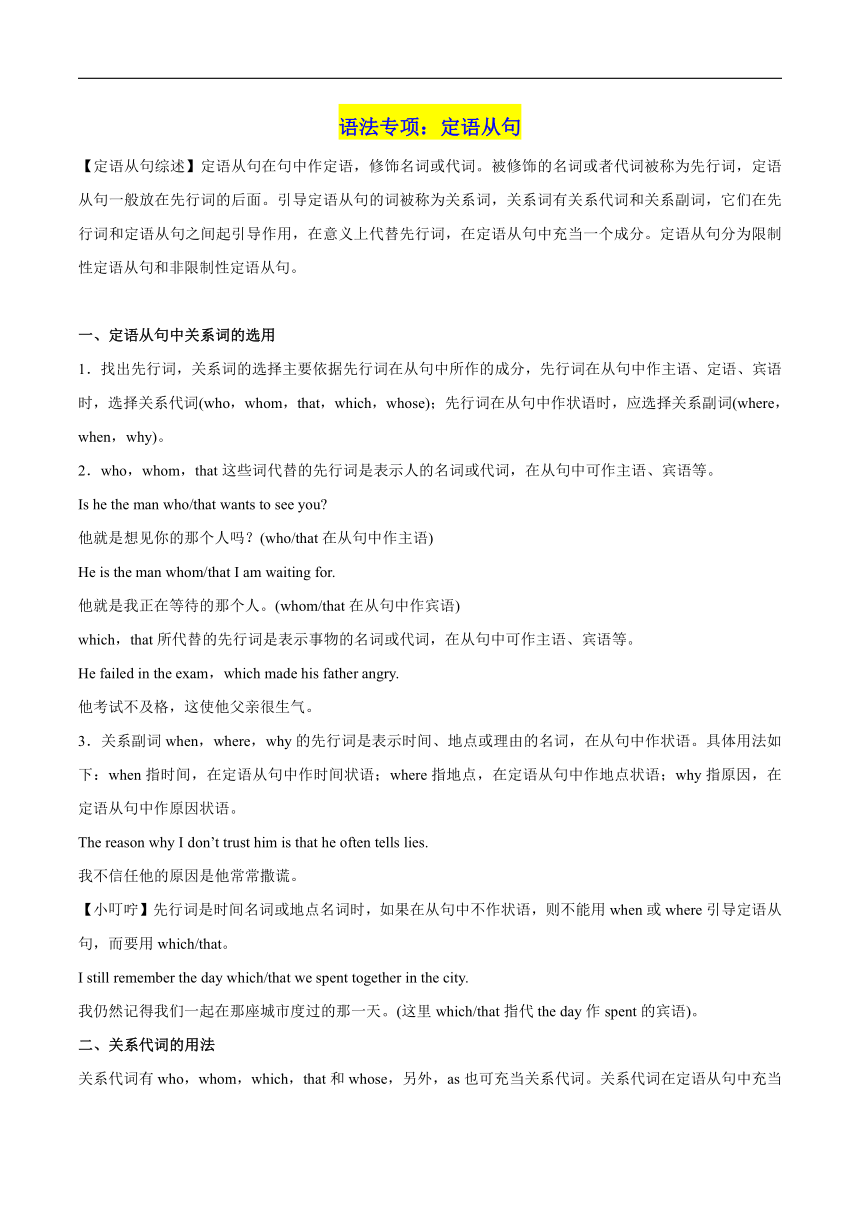
语法专项:定语从句
【定语从句综述】定语从句在句中作定语,修饰名词或代词。被修饰的名词或者代词被称为先行词,定语从句一般放在先行词的后面。引导定语从句的词被称为关系词,关系词有关系代词和关系副词,它们在先行词和定语从句之间起引导作用,在意义上代替先行词,在定语从句中充当一个成分。定语从句分为限制性定语从句和非限制性定语从句。
一、定语从句中关系词的选用
1.找出先行词,关系词的选择主要依据先行词在从句中所作的成分,先行词在从句中作主语、定语、宾语时,选择关系代词(who,whom,that,which,whose);先行词在从句中作状语时,应选择关系副词(where,when,why)。
2.who,whom,that这些词代替的先行词是表示人的名词或代词,在从句中可作主语、宾语等。
Is he the man who/that wants to see you
他就是想见你的那个人吗?(who/that在从句中作主语)
He is the man whom/that I am waiting for.
他就是我正在等待的那个人。(whom/that在从句中作宾语)
which,that所代替的先行词是表示事物的名词或代词,在从句中可作主语、宾语等。
He failed in the exam,which made his father angry.
他考试不及格,这使他父亲很生气。
3.关系副词when,where,why的先行词是表示时间、地点或理由的名词,在从句中作状语。具体用法如下:when指时间,在定语从句中作时间状语;where指地点,在定语从句中作地点状语;why指原因,在定语从句中作原因状语。
The reason why I don’t trust him is that he often tells lies.
我不信任他的原因是他常常撒谎。
【小叮咛】先行词是时间名词或地点名词时,如果在从句中不作状语,则不能用when或where引导定语从句,而要用which/that。
I still remember the day which/that we spent together in the city.
我仍然记得我们一起在那座城市度过的那一天。(这里which/that指代the day作spent的宾语)。
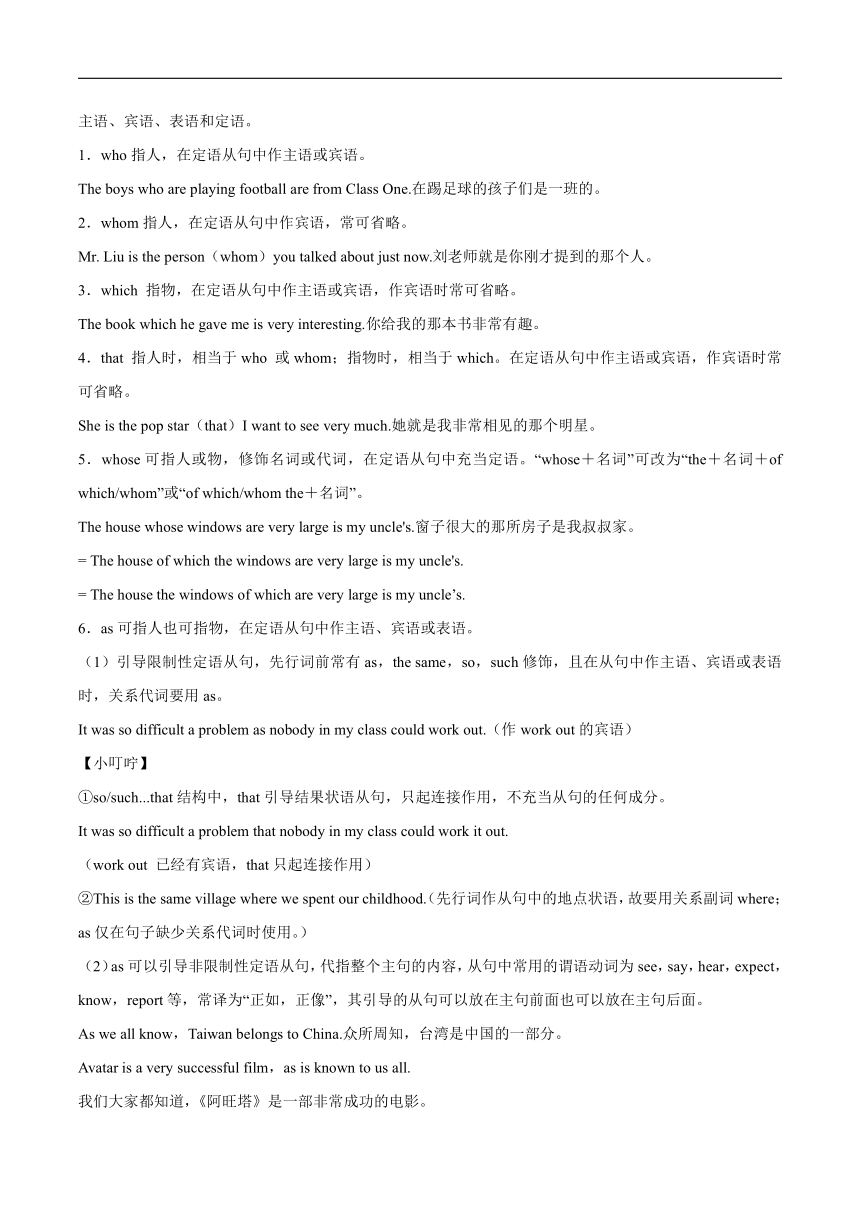
二、关系代词的用法
关系代词有who,whom,which,that和whose,另外,as也可充当关系代词。关系代词在定语从句中充当主语、宾语、表语和定语。
1.who指人,在定语从句中作主语或宾语。
The boys who are playing football are from Class One.在踢足球的孩子们是一班的。
2.whom指人,在定语从句中作宾语,常可省略。
Mr. Liu is the person(whom)you talked about just now.刘老师就是你刚才提到的那个人。
3.which 指物,在定语从句中作主语或宾语,作宾语时常可省略。
The book which he gave me is very interesting.你给我的那本书非常有趣。
4.that 指人时,相当于who 或whom;指物时,相当于which。在定语从句中作主语或宾语,作宾语时常可省略。
She is the pop star(that)I want to see very much.她就是我非常相见的那个明星。
5.whose可指人或物,修饰名词或代词,在定语从句中充当定语。“whose+名词”可改为“the+名词+of which/whom”或“of which/whom the+名词”。
The house whose windows are very large is my uncle's.窗子很大的那所房子是我叔叔家。
= The house of which the windows are very large is my uncle's.
= The house the windows of which are very large is my uncle’s.
6.as可指人也可指物,在定语从句中作主语、宾语或表语。
(1)引导限制性定语从句,先行词前常有as,the same,so,such修饰,且在从句中作主语、宾语或表语时,关系代词要用as。
It was so difficult a problem as nobody in my class could work out.(作work out的宾语)
【小叮咛】
①so/such...that结构中,that引导结果状语从句,只起连接作用,不充当从句的任何成分。
It was so difficult a problem that nobody in my class could work it out.
(work out 已经有宾语,that只起连接作用)
②This is the same village where we spent our childhood.(先行词作从句中的地点状语,故要用关系副词where;as仅在句子缺少关系代词时使用。)
(2)as可以引导非限制性定语从句,代指整个主句的内容,从句中常用的谓语动词为see,say,hear,expect,know,report等,常译为“正如,正像”,其引导的从句可以放在主句前面也可以放在主句后面。
As we all know,Taiwan belongs to China.众所周知,台湾是中国的一部分。
Avatar is a very successful film,as is known to us all.
我们大家都知道,《阿旺塔》是一部非常成功的电影。
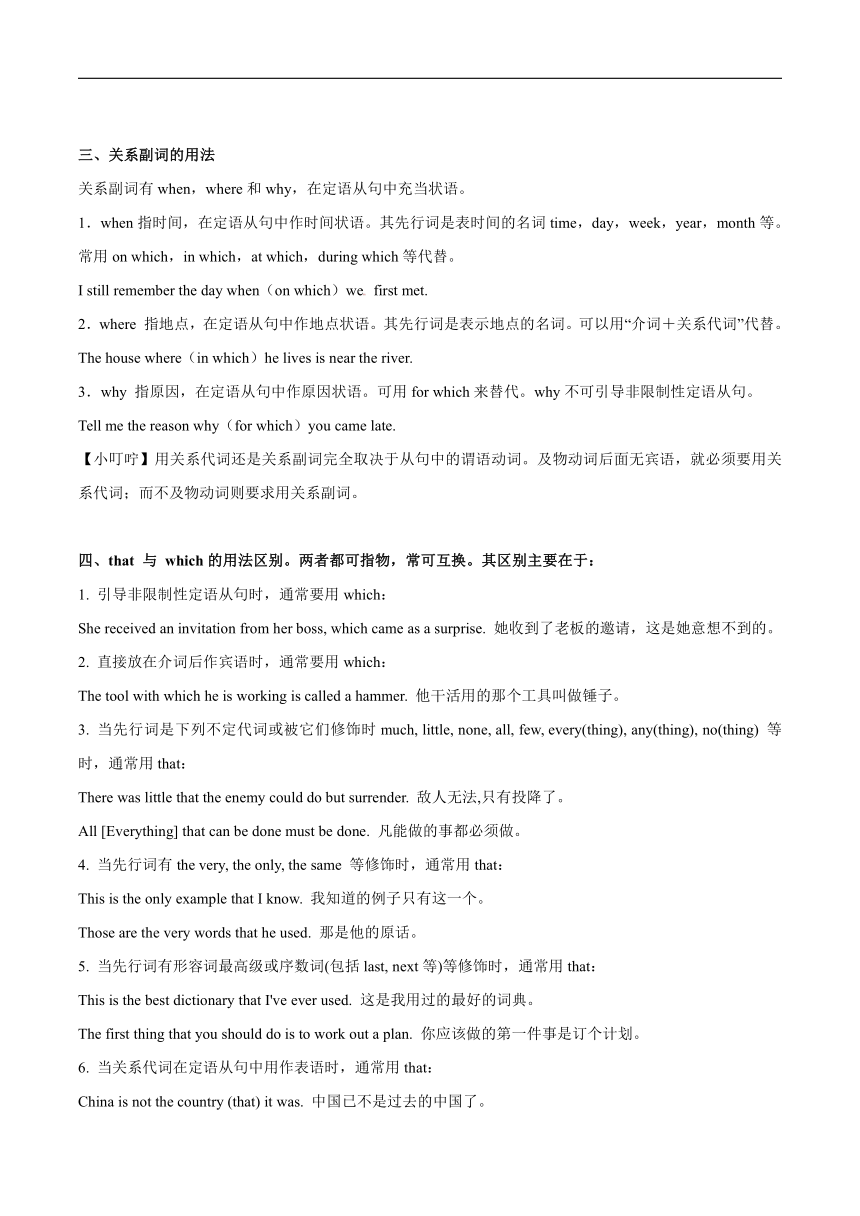
三、关系副词的用法
关系副词有when,where和why,在定语从句中充当状语。
1.when指时间,在定语从句中作时间状语。其先行词是表时间的名词time,day,week,year,month等。常用on which,in which,at which,during which等代替。
I still remember the day when(on which)we first met.
2.where 指地点,在定语从句中作地点状语。其先行词是表示地点的名词。可以用“介词+关系代词”代替。
The house where(in which)he lives is near the river.
3.why 指原因,在定语从句中作原因状语。可用for which来替代。why不可引导非限制性定语从句。
Tell me the reason why(for which)you came late.
【小叮咛】用关系代词还是关系副词完全取决于从句中的谓语动词。及物动词后面无宾语,就必须要用关系代词;而不及物动词则要求用关系副词。
四、that 与 which的用法区别。两者都可指物,常可互换。其区别主要在于:
1. 引导非限制性定语从句时,通常要用which:
She received an invitation from her boss, which came as a surprise. 她收到了老板的邀请,这是她意想不到的。
2. 直接放在介词后作宾语时,通常要用which:
The tool with which he is working is called a hammer. 他干活用的那个工具叫做锤子。
3. 当先行词是下列不定代词或被它们修饰时much, little, none, all, few, every(thing), any(thing), no(thing) 等时,通常用that:
There was little that the enemy could do but surrender. 敌人无法,只有投降了。
All [Everything] that can be done must be done. 凡能做的事都必须做。
4. 当先行词有the very, the only, the same 等修饰时,通常用that:
This is the only example that I know. 我知道的例子只有这一个。
Those are the very words that he used. 那是他的原话。
5. 当先行词有形容词最高级或序数词(包括last, next等)等修饰时,通常用that:
This is the best dictionary that I've ever used. 这是我用过的最好的词典。
The first thing that you should do is to work out a plan. 你应该做的第一件事是订个计划。
6. 当关系代词在定语从句中用作表语时,通常用that:
China is not the country (that) it was. 中国已不是过去的中国了。
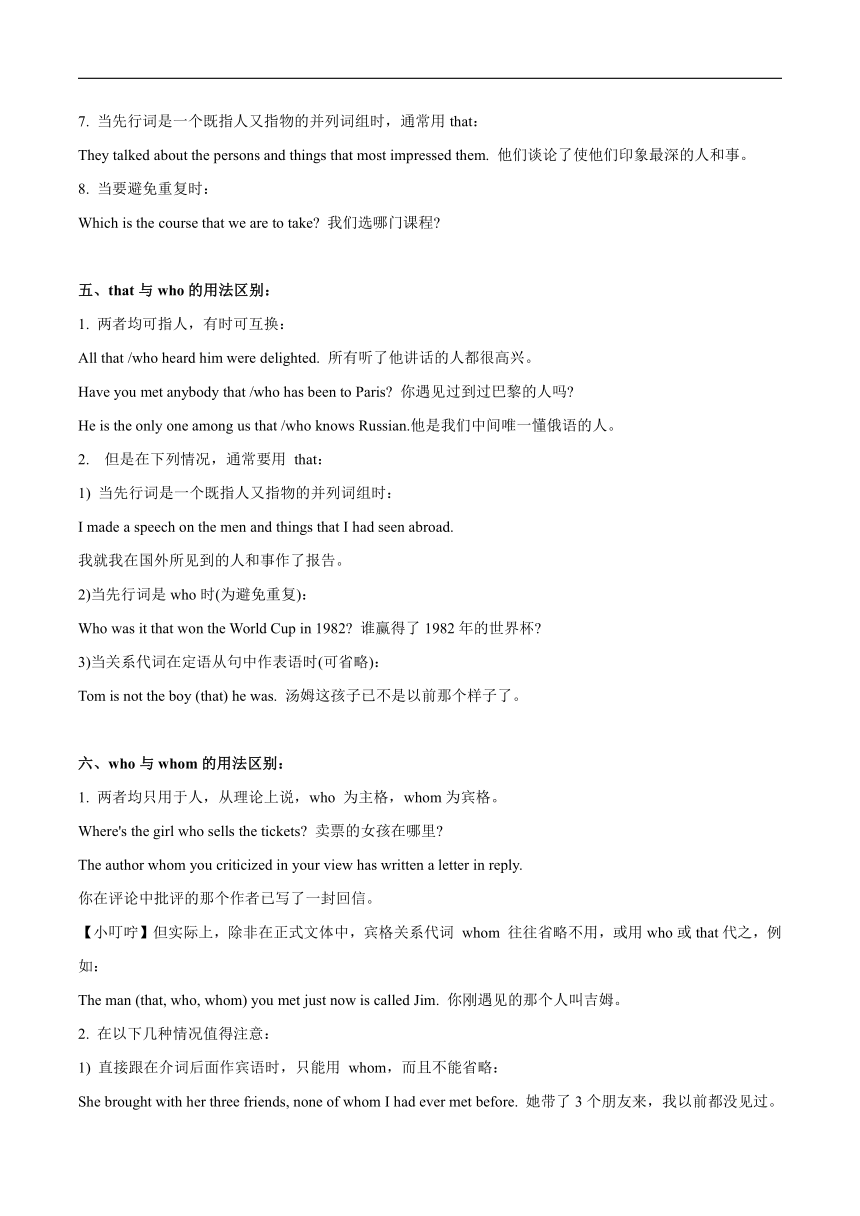
7. 当先行词是一个既指人又指物的并列词组时,通常用that:
They talked about the persons and things that most impressed them. 他们谈论了使他们印象最深的人和事。
8. 当要避免重复时:
Which is the course that we are to take 我们选哪门课程
五、that与who的用法区别:
1. 两者均可指人,有时可互换:
All that /who heard him were delighted. 所有听了他讲话的人都很高兴。
Have you met anybody that /who has been to Paris 你遇见过到过巴黎的人吗
He is the only one among us that /who knows Russian.他是我们中间唯一懂俄语的人。
2. 但是在下列情况,通常要用 that:
1) 当先行词是一个既指人又指物的并列词组时:
I made a speech on the men and things that I had seen abroad.
我就我在国外所见到的人和事作了报告。
2)当先行词是who时(为避免重复):
Who was it that won the World Cup in 1982 谁赢得了1982年的世界杯
3)当关系代词在定语从句中作表语时(可省略):
Tom is not the boy (that) he was. 汤姆这孩子已不是以前那个样子了。
六、who与whom的用法区别:
1. 两者均只用于人,从理论上说,who 为主格,whom为宾格。
Where's the girl who sells the tickets 卖票的女孩在哪里
The author whom you criticized in your view has written a letter in reply.
你在评论中批评的那个作者已写了一封回信。
【小叮咛】但实际上,除非在正式文体中,宾格关系代词 whom 往往省略不用,或用who或that代之,例如:
The man (that, who, whom) you met just now is called Jim. 你刚遇见的那个人叫吉姆。
2. 在以下几种情况值得注意:
1) 直接跟在介词后面作宾语时,只能用 whom,而且不能省略:
She brought with her three friends, none of whom I had ever met before. 她带了3个朋友来,我以前都没见过。
2) 引导非限制性定语从句且作宾语时,who 和 whom均可用,但以用 whom 为佳,此时也不能省略:
This is Jack, who /whom you haven't met before. 这是杰克,你以前没见过。
七、as与which的用法区别
1. 引导限制性定语从句时,在such, as, the same后只能用as,其他情况用 which:
I never heard such stories as he tells. 我从未听过他讲那样的故事。
It's the same story as I heard yesterday. 这故事跟我昨天听到的一样。
This is the photo which shows my house. 这张照片拍的是我的住宅。
2. 引导非限制性定语从句时,有时两者可互换:
I live a long way from work, as / which]you know. 我住得离工作单位很远,这你是知道的。
3. 在以下情况引导非限制性定语从句时,两者不可换用:
1)as引导的非限制性定语从句,既可在主句前,又可在主句后,有时还可插入主句中,而which引导的非限制性定语从句只能置于主句之后。相同的是两者都可替代主句的整个内容,而不是主句中的某一个词,例如:
As is known to everybody, the moon travels round the earth once every month.
月球每月绕地球转一周,这是每个人都清楚的。
The river, which flows through London, is called the Thames.
这条流经伦敦的河叫泰晤士河。(不用as)
2)as 引导的非限制性定语从句应与主句在意义上和谐一致,which无此限制:
He went abroad, as [which] was expected. 他出国了,这是大家预料到的。
He went abroad, which was unexpected. 他出国了,这让大家感到很意外。(不用as)
3) as 引导非限制性定语从句时,先行词通常不能是主句中某个具体的词,而应是整个句子、整个短语或某个短语推断出来的概念,而which则无此限制:
4)当as 引导非限制性定语从句作主语时,其谓语通常应是连系动词,而不宜是其他动词,而 which则无此限制:
She has married again, as [which] seemed natural. 她又结婚了,这似乎很自常。
She has married again, which delighted us. 她又结婚了,这使我们很高兴。(不用as)
八、关系代词必须用that的情况
1.当先行词是everything,anything,nothing,something,all,none,few,little,some等不定代词时,或当先行词被every,any,all,some,no,little,few,much等不定代词修饰时。
We should do all that is useful to the people. 我们应该做对人们有用的事情。
All that is needed is a supply of oil.所需的只是供油问题。
2.先行词被the only,the very,the same,the last等词修饰时。
This is the last place that I want to visit.这是我最不愿意参观的地方。
3.先行词是最高级或被最高级修饰时。
This is the best novel that I have ever read.这是我曾经读过的最好的一本小说。
4.先行词是序数词或被序数词修饰时。
This is the second time that you told us the story. 这是你第二次告诉我这个故事了。
5.当先行词同时含有人和物时。
We talked about the things and persons that we were interested in.
我们谈论了一些我们感兴趣的人和事。
6.以who或which开头的特殊疑问句中,含有定语从句,为避免重复时。
Who is the man that is standing under the tree 站在树底下的那个人是谁?
【小叮咛】Qingdao is the most beautiful city where I have ever worked.(即使有最高级修饰先行词city,但从句中work为不及物动词,先行词只作其地点状语,故要用关系副词)因此牢记,前面所述几种情况已有前提:需要用关系代词时,遇到这几种情况才选用that。
九、关系代词不能用that的情况
1.在“介词+关系代词”的结构中,关系代词只能用指物的which和指人的whom。
This is the train by which we went to Beijing.这就是我们去北京乘坐的火车。
2.在非限制性定语从句(即通常用逗号与主句隔开,若去掉整个句子仍能表达完整意义的定语从句)中。
Football,which is a very interesting game,is played all over the world.
足球是一项非常有趣的运动,全世界都在踢。
3.指人时,当先行词为everybody,anybody,everyone,anyone等时,关系代词要用who,不用that。
Is there anyone who can answer this question 有没有人能够回答这个问题?
4.先行词本身是指示代词that或those时,关系代词应用which。
What's that which she is looking at 他看的那个东西是什么?
十、介词+关系代词
1.介词+关系代词中介词的宾语只能是which或whom
The gentleman about whom you told me yesterday proved to be a thief.
你昨天告诉我的那位绅士证实是小偷。
In the dark street,there wasn’t a single person to whom she could turn for help.
在漆黑的大街上没有一个人能为她提供帮助。
2.当复合介词短语+which引导定语从句时,这种定语从句常与先行词用逗号隔开,从句用倒装语序
He lived in a big house,in front of which stood a big tall tree.
他住在一所大房子里,房前有一棵大树。
3.介词+which/whom+不定式结构
The poor man has no house in which to live.那个可怜的人没有房子住。
4.of+which/whom表示所属关系。(表所属关系也可用whose)
Recently I bought an ancient vase,the price of which(=whose price) was very reasonable.
最近我买了个古代的花瓶,它的价钱很合理。
十一、定语从句和其他从句的区别
1.定语从句与并列句
1). a. I saw some trees, and the leaves of them were black with disease.(并列句)
b. I saw some trees, the leaves of which were black with disease.(定语从句)
2). a. The professor is a little man, on the nose of whom there is a pair of glasses(定语从句)
b. The professor is a little man, and on the nose of him there is a pair of glasses(并列句)
【小叮咛】是否有连词是区分定语从句和并列句的关键
2. 定语从句与同位语从句
定语从句与前面的名词是修饰与被修饰的关系“……的(名词)”。而同位语从句是用来说明前面名词的内容。与that从句同位的名词必须是一些表事实或概念的抽象名词,如fact, news, belief, truth, reply等。that在定语从句中作成分,可用which 或who/whom代替;而that在同位语从句中不充当任何句子成分,只起连接作用。试比较:
We all have heard the news that our team won.
我们都听到了我们球队胜利的消息。 (同位语从句,that从句表示news的内容,that 在从句中不作任何成分)
We don’t believe the news that/which he told us yesterday. 我们不相信他昨天告诉我们的那个消息。(定语从句,that 作told 的宾语).请看例题:
1). a. The news that our volleyball team won the match made us excited.(同位语从句)
b. The news that /which he told me yesterday is exciting.(定语从句)
2) a. I made a promise that if anyone set me free, I would make him very rich. (同位语从句)
b. The mother made a promise that /which pleased all her children. (定语从句)
【小叮咛】that引导的定语从句是对其先行词的修饰或限制;在句中作成份(作宾语省略),指物时可用which代替;而同位语从句是对前面名词的说明和解释。that在从句中仅起连接作用,不充当成份,不能省略,不能用which代替。
3.定语从句与强调句型
1) a. It is in this room that I lived last year.(强调句)
b. It is the room where I lived last year.(定语从句)
2) a. It was at seven o’clock that he went to school this morning.(强调句)
b. It was seven o’clock when he went to school this morning.(定语从句)
【小叮咛】强调句型:It is/was+被强调的成份+that/who+其它部分; 去掉It is/was….that/who… ,句子照样成立;而定语从句的引导词在句中要作成份。
十二、几种特殊情况
1.当先行词为way,意为“方法、方式”,且在定语从句中作主语、宾语时,可用关系代词which或that;作状语时,要用in which 或that或不填任何关系词。
The way(that/in which)he finished the task successfully was difficult to understand.(作状语)
The way that/which he explained to me was not difficult to understand.(作宾语)
2.当先行词为case,stage,position,point,situation等表示抽象地点的名词,且在定语从句中作状语时,要用where 来引导,occasion表时间时,用when引导定语从句;表地点,译为“场合”时,用where引导定语从句。
We'll see a case where soft music can help to cure people.
3.当先行词为time时,若表示“一段时间”,后面定语从句用when引导,也可用at/during which;若表示“次数”,后面定语从句用that引导,that可以省略。
This is the second time(that)the President has visited our country.
There was a time when we had no TV sets.
十三、限制性定语从句与非限制性定语从句的区别
限制性定语从句 非限制性定语从句
从句与先行词的关系 从句是先行词不可缺少的定语,如果省去,主句的意思就会不完整或不明确。 从句只是对先行词的附加说明,如果省去,主句的意思仍然清楚或完整
标 点 从句和主句之间不用逗号分开 从句和主句之间通常用逗号分开
修饰 从句只修饰一个名词或代词 可以修饰一个名词或代词也可修饰整个主句
翻译 定语从句译在被修饰词的前面 定语从句通常被译成另一个独立的句子
He has a brother who is a physicist.他有一个当物理学家的哥哥。
He has a brother, who is a physicist. 他有一个哥哥,他是一个物理学家。
He returned all the books which are written in English.他归还了所有用英语写的书。
He returned all the books, which are written in English.
他归还了所有的书,那些书都是用英语写的。
The man who lives next door is a doctor.住在我隔壁的那个人是一个医生。
The man, who lives next door, is a doctor.那个人住在我隔壁,他是一个医生。
【小叮咛】当先行词为专有名词或是世界上独一无二的名词时,一般用非限定性定语从句修饰。The sun, which gives us light, is very big.
【巧学妙记】定语从句顺口溜
1.定从分类有奥妙, 限与非限看逗号;
定前必有先行词,名代两类最适宜;
定从先行很紧密,代副两词拉关系;

2.关系代词有六个,听我逐一来说破;
which表物人用who,人物都有that顾;
which用在逗号后,意表前句你要know;
who做主语很称职,whom用到宾语里;

3.that用法真有趣, 两个地方它不去;
逗号后边它不去, 介词之后不考虑;

4.That which代表物,区别听我来叙述;
先行若是不定代,that就把which 踹;
先行词前有两数, 就用that定无误;
先行词前最高级, 还用that必无疑;
句中若有there be, that应把which替;
先行主中做表语, 避免重复从句里;
(Just the only very same last, 其后也要用that;)

5.指人可用that who, 以下情况多用who;
Those people做先行,There be的结构中;
先行指人不定代,从中做主who要在;
两个定从一起来,不要重复你有才;

6.定从之中少定语,whose为你唱一曲;
Whose指人又指物,所属关系要记住。

7.As/which在句末,若有否定as错;
句首只能用as,还有认知猜想词;
固定结构用as, the same /such/so/as;
so /such …that宾不离,so/such…as宾要弃;

8.关系代词到这里,主宾表定作用起;
关系代词作宾语,省与不省全靠你;

9.关系副词when/where/why, 从中做状莫懈怠;
时间用when原因why,地点where经常在;
关系副词可替换,介词加上关系代;
关系代,关系代,that与who要除外;
挑选介词要聪明,必看动词和先行;
聪明反被聪明误,只因乱用关系副;
关系副,关系副,定缺主宾它不住;
它不住,它不住,关系代词来玩酷;

10.只记上边不可以,特殊情况告诉你;
先行用way 做状语, in which/ that /略可以;
one of +复做先行,从中谓语复数明,
one前若有only/very, 从中谓语定用单 ;
定从名从可转换,all that被 what换
【小试牛刀】
I 用适当的关系代词或关系副词填空
1.Mr. Smith has three sons,none of ____ is a computer expert.
2.He has three sisters,_____ are doctors.
3.She has three CDs,but none of_____ is interesting.
4.I have many friends,and all of_____ are nice and friendly.
5.Miss Yang has some relatives here;____ like her very much.
6. I know the university ____ my parents worked ten years ago.
7. The hospital ____ Mr. Li was operated on in has taken on a new look.
8.She is such a good girl ____does well in French.
9.She is such a good girl ____ all of us like to make friends with her.
10.The news ____ he told me sounds reasonable.
11.The news ____ China has joined the WTO excites all the Chinese.
12.It is the first time ____ I have been here.
13.It was the time ____ we had a hard life.
14.This is the longest train _____ I have ever seen.
15. ____ we all know, swimming is a very good sport.
16. I shall never forget those years _____ I lived in the farm ____ you visited last week.
II 根据汉语提示完成句子(每空仅填一词)。
1.我喜欢这两本关于英语的杂志。
I like the magazines , both_______ _______ are on English.
2.这是我读过的最有趣的小说。
This is the most interesting book ______ _______ ______ _________.
3.屋顶是红色的房子被毁坏了。
The house, ____________roof is red, was destroyed.
The house, ________roof __________ __________ is red, was destroyed.
The house, ________ ________ ___________roof is red, was destroyed.
4.他借了一本和我在读的一样的书。
He borrowed _______ __________book _________ I am reading.
5.读那些诸如你喜欢的书。
Read ___________books __________ you like.
6.这本书如此好以至于我经常读。
This is __________ a good novel _______I often read it.
Keys:1. whom 2. three of whom 3. them 4. them 5. They 6. where 7. where 8. as 9. that 10. (that/which) 11. that 12. that 13. when 14. (that )15. As 16. when; (that/ which)
II 1. of which 2. that I have read 3. whose; the, of which; of which, the 4. the same; as 5. such; as 6. such; that

展开更多......

收起↑

资源预览