2024届高考英语阅读理解高频词汇超详细梳理素材(社会道德类)

资源下载
  1. 二一教育资源

2024届高考英语阅读理解高频词汇超详细梳理素材(社会道德类)

资源简介

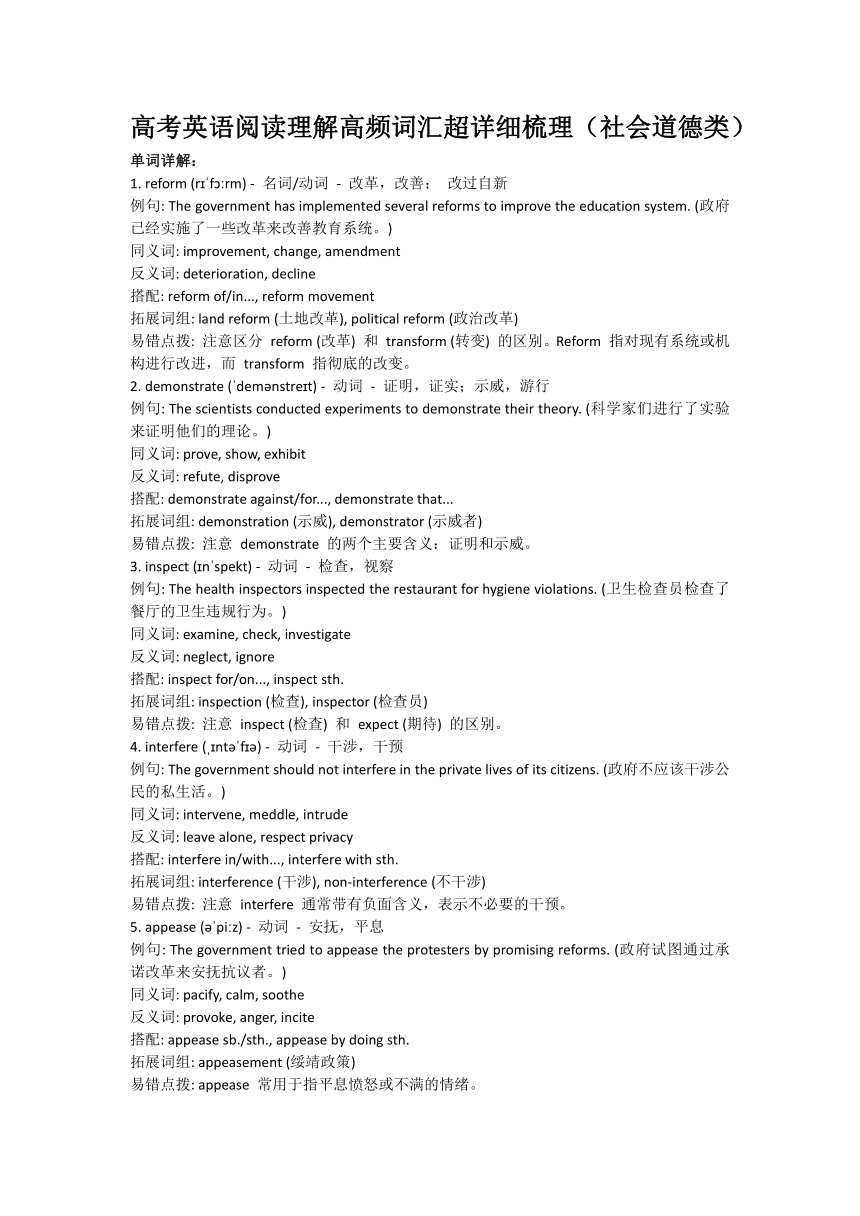
高考英语阅读理解高频词汇超详细梳理(社会道德类)
单词详解:
1. reform (r f rm) - 名词/动词 - 改革,改善; 改过自新
例句: The government has implemented several reforms to improve the education system. (政府已经实施了一些改革来改善教育系统。)
同义词: improvement, change, amendment
反义词: deterioration, decline
搭配: reform of/in..., reform movement
拓展词组: land reform (土地改革), political reform (政治改革)
易错点拨: 注意区分 reform (改革) 和 transform (转变) 的区别。Reform 指对现有系统或机构进行改进,而 transform 指彻底的改变。
2. demonstrate ( dem nstre t) - 动词 - 证明,证实;示威,游行
例句: The scientists conducted experiments to demonstrate their theory. (科学家们进行了实验来证明他们的理论。)
同义词: prove, show, exhibit
反义词: refute, disprove
搭配: demonstrate against/for..., demonstrate that...
拓展词组: demonstration (示威), demonstrator (示威者)
易错点拨: 注意 demonstrate 的两个主要含义:证明和示威。
3. inspect ( n spekt) - 动词 - 检查,视察
例句: The health inspectors inspected the restaurant for hygiene violations. (卫生检查员检查了餐厅的卫生违规行为。)
同义词: examine, check, investigate
反义词: neglect, ignore
搭配: inspect for/on..., inspect sth.
拓展词组: inspection (检查), inspector (检查员)
易错点拨: 注意 inspect (检查) 和 expect (期待) 的区别。
4. interfere ( nt f ) - 动词 - 干涉,干预
例句: The government should not interfere in the private lives of its citizens. (政府不应该干涉公民的私生活。)
同义词: intervene, meddle, intrude
反义词: leave alone, respect privacy
搭配: interfere in/with..., interfere with sth.
拓展词组: interference (干涉), non-interference (不干涉)
易错点拨: 注意 interfere 通常带有负面含义,表示不必要的干预。
5. appease ( pi z) - 动词 - 安抚,平息
例句: The government tried to appease the protesters by promising reforms. (政府试图通过承诺改革来安抚抗议者。)
同义词: pacify, calm, soothe
反义词: provoke, anger, incite
搭配: appease sb./sth., appease by doing sth.
拓展词组: appeasement (绥靖政策)
易错点拨: appease 常用于指平息愤怒或不满的情绪。
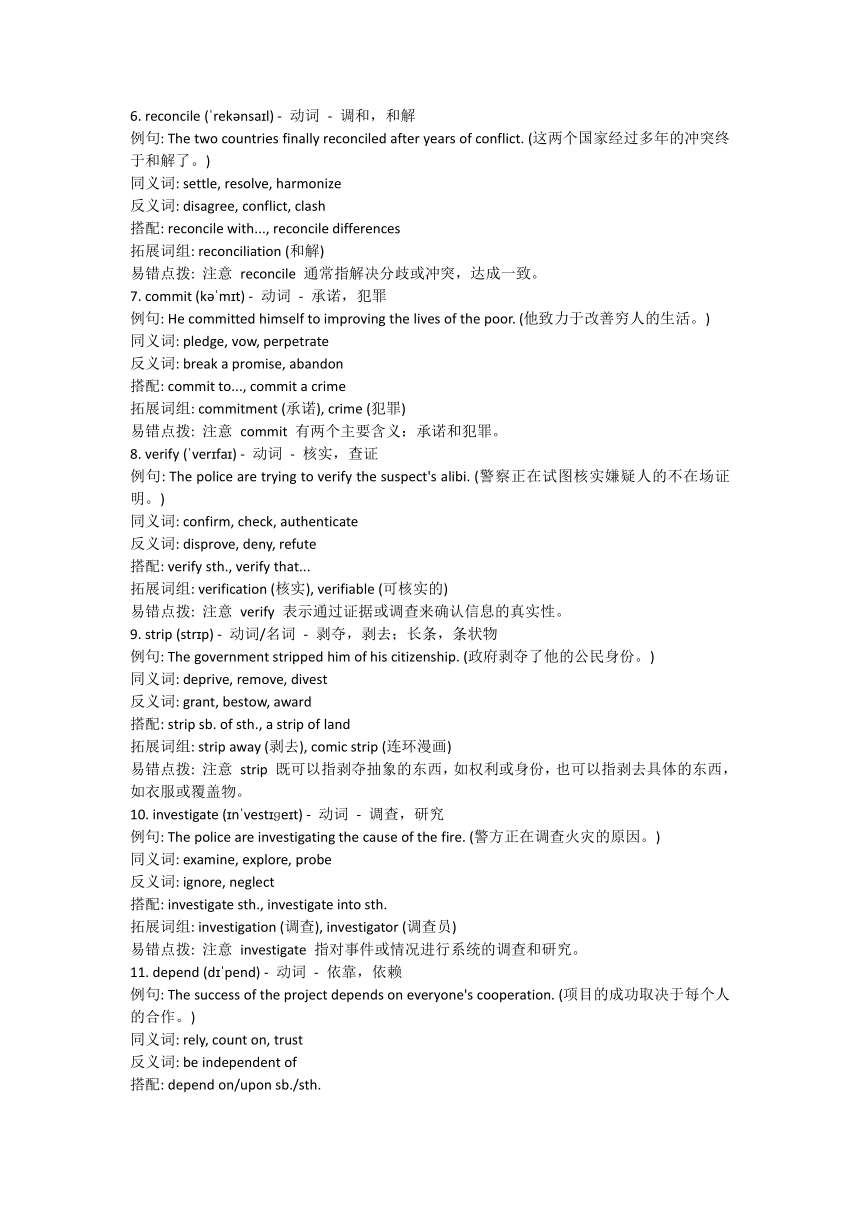
6. reconcile ( rek nsa l) - 动词 - 调和,和解
例句: The two countries finally reconciled after years of conflict. (这两个国家经过多年的冲突终于和解了。)
同义词: settle, resolve, harmonize
反义词: disagree, conflict, clash
搭配: reconcile with..., reconcile differences
拓展词组: reconciliation (和解)
易错点拨: 注意 reconcile 通常指解决分歧或冲突,达成一致。
7. commit (k m t) - 动词 - 承诺,犯罪
例句: He committed himself to improving the lives of the poor. (他致力于改善穷人的生活。)
同义词: pledge, vow, perpetrate
反义词: break a promise, abandon
搭配: commit to..., commit a crime
拓展词组: commitment (承诺), crime (犯罪)
易错点拨: 注意 commit 有两个主要含义:承诺和犯罪。
8. verify ( ver fa ) - 动词 - 核实,查证
例句: The police are trying to verify the suspect's alibi. (警察正在试图核实嫌疑人的不在场证明。)
同义词: confirm, check, authenticate
反义词: disprove, deny, refute
搭配: verify sth., verify that...
拓展词组: verification (核实), verifiable (可核实的)
易错点拨: 注意 verify 表示通过证据或调查来确认信息的真实性。
9. strip (str p) - 动词/名词 - 剥夺,剥去;长条,条状物
例句: The government stripped him of his citizenship. (政府剥夺了他的公民身份。)
同义词: deprive, remove, divest
反义词: grant, bestow, award
搭配: strip sb. of sth., a strip of land
拓展词组: strip away (剥去), comic strip (连环漫画)
易错点拨: 注意 strip 既可以指剥夺抽象的东西,如权利或身份,也可以指剥去具体的东西,如衣服或覆盖物。
10. investigate ( n vest ɡe t) - 动词 - 调查,研究
例句: The police are investigating the cause of the fire. (警方正在调查火灾的原因。)
同义词: examine, explore, probe
反义词: ignore, neglect
搭配: investigate sth., investigate into sth.
拓展词组: investigation (调查), investigator (调查员)
易错点拨: 注意 investigate 指对事件或情况进行系统的调查和研究。
11. depend (d pend) - 动词 - 依靠,依赖
例句: The success of the project depends on everyone's cooperation. (项目的成功取决于每个人的合作。)
同义词: rely, count on, trust
反义词: be independent of
搭配: depend on/upon sb./sth.
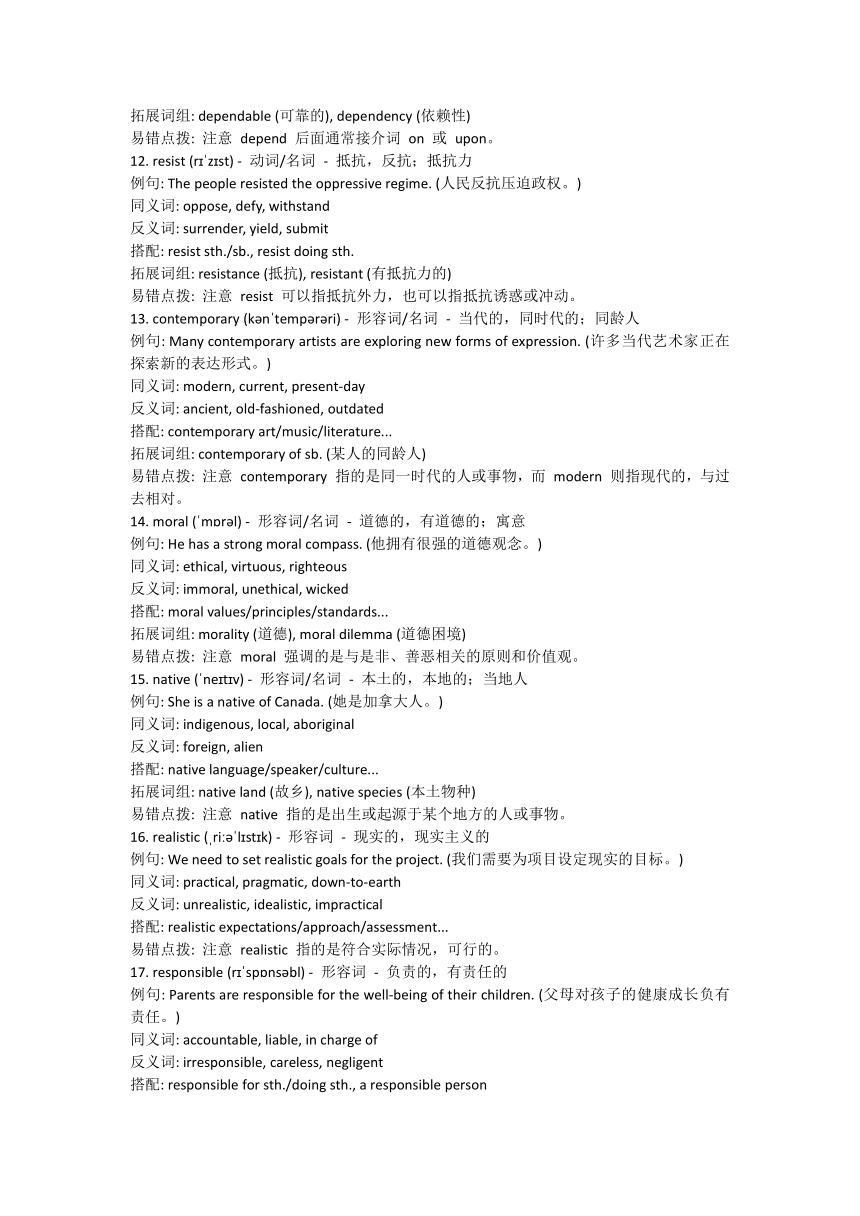
拓展词组: dependable (可靠的), dependency (依赖性)
易错点拨: 注意 depend 后面通常接介词 on 或 upon。
12. resist (r z st) - 动词/名词 - 抵抗,反抗;抵抗力
例句: The people resisted the oppressive regime. (人民反抗压迫政权。)
同义词: oppose, defy, withstand
反义词: surrender, yield, submit
搭配: resist sth./sb., resist doing sth.
拓展词组: resistance (抵抗), resistant (有抵抗力的)
易错点拨: 注意 resist 可以指抵抗外力,也可以指抵抗诱惑或冲动。
13. contemporary (k n temp r ri) - 形容词/名词 - 当代的,同时代的;同龄人
例句: Many contemporary artists are exploring new forms of expression. (许多当代艺术家正在探索新的表达形式。)
同义词: modern, current, present-day
反义词: ancient, old-fashioned, outdated
搭配: contemporary art/music/literature...
拓展词组: contemporary of sb. (某人的同龄人)
易错点拨: 注意 contemporary 指的是同一时代的人或事物,而 modern 则指现代的,与过去相对。
14. moral ( m r l) - 形容词/名词 - 道德的,有道德的;寓意
例句: He has a strong moral compass. (他拥有很强的道德观念。)
同义词: ethical, virtuous, righteous
反义词: immoral, unethical, wicked
搭配: moral values/principles/standards...
拓展词组: morality (道德), moral dilemma (道德困境)
易错点拨: 注意 moral 强调的是与是非、善恶相关的原则和价值观。
15. native ( ne t v) - 形容词/名词 - 本土的,本地的;当地人
例句: She is a native of Canada. (她是加拿大人。)
同义词: indigenous, local, aboriginal
反义词: foreign, alien
搭配: native language/speaker/culture...
拓展词组: native land (故乡), native species (本土物种)
易错点拨: 注意 native 指的是出生或起源于某个地方的人或事物。
16. realistic ( ri l st k) - 形容词 - 现实的,现实主义的
例句: We need to set realistic goals for the project. (我们需要为项目设定现实的目标。)
同义词: practical, pragmatic, down-to-earth
反义词: unrealistic, idealistic, impractical
搭配: realistic expectations/approach/assessment...
易错点拨: 注意 realistic 指的是符合实际情况,可行的。
17. responsible (r sp ns bl) - 形容词 - 负责的,有责任的
例句: Parents are responsible for the well-being of their children. (父母对孩子的健康成长负有责任。)
同义词: accountable, liable, in charge of
反义词: irresponsible, careless, negligent
搭配: responsible for sth./doing sth., a responsible person
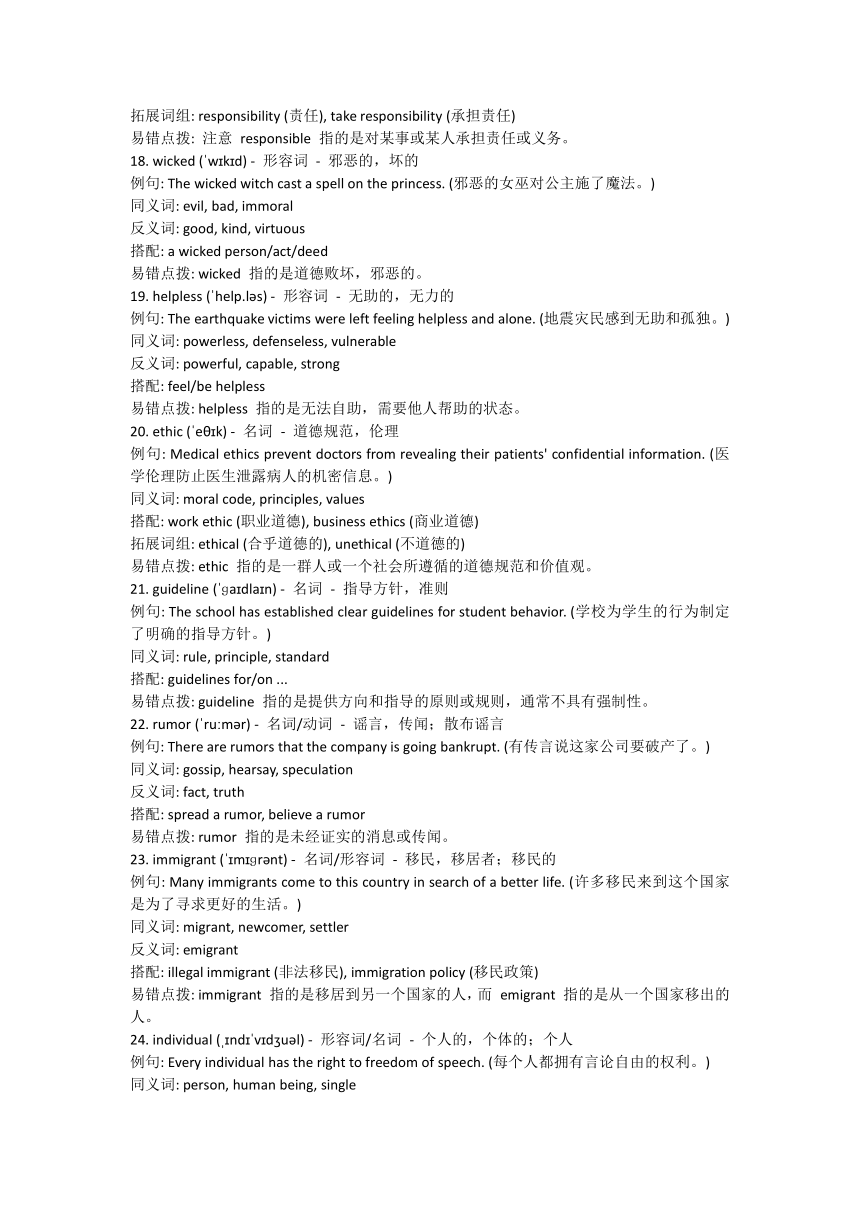
拓展词组: responsibility (责任), take responsibility (承担责任)
易错点拨: 注意 responsible 指的是对某事或某人承担责任或义务。
18. wicked ( w k d) - 形容词 - 邪恶的,坏的
例句: The wicked witch cast a spell on the princess. (邪恶的女巫对公主施了魔法。)
同义词: evil, bad, immoral
反义词: good, kind, virtuous
搭配: a wicked person/act/deed
易错点拨: wicked 指的是道德败坏,邪恶的。
19. helpless ( help.l s) - 形容词 - 无助的,无力的
例句: The earthquake victims were left feeling helpless and alone. (地震灾民感到无助和孤独。)
同义词: powerless, defenseless, vulnerable
反义词: powerful, capable, strong
搭配: feel/be helpless
易错点拨: helpless 指的是无法自助,需要他人帮助的状态。
20. ethic ( eθ k) - 名词 - 道德规范,伦理
例句: Medical ethics prevent doctors from revealing their patients' confidential information. (医学伦理防止医生泄露病人的机密信息。)
同义词: moral code, principles, values
搭配: work ethic (职业道德), business ethics (商业道德)
拓展词组: ethical (合乎道德的), unethical (不道德的)
易错点拨: ethic 指的是一群人或一个社会所遵循的道德规范和价值观。
21. guideline ( ɡa dla n) - 名词 - 指导方针,准则
例句: The school has established clear guidelines for student behavior. (学校为学生的行为制定了明确的指导方针。)
同义词: rule, principle, standard
搭配: guidelines for/on ...
易错点拨: guideline 指的是提供方向和指导的原则或规则,通常不具有强制性。
22. rumor ( ru m r) - 名词/动词 - 谣言,传闻;散布谣言
例句: There are rumors that the company is going bankrupt. (有传言说这家公司要破产了。)
同义词: gossip, hearsay, speculation
反义词: fact, truth
搭配: spread a rumor, believe a rumor
易错点拨: rumor 指的是未经证实的消息或传闻。
23. immigrant ( m ɡr nt) - 名词/形容词 - 移民,移居者;移民的
例句: Many immigrants come to this country in search of a better life. (许多移民来到这个国家是为了寻求更好的生活。)
同义词: migrant, newcomer, settler
反义词: emigrant
搭配: illegal immigrant (非法移民), immigration policy (移民政策)
易错点拨: immigrant 指的是移居到另一个国家的人,而 emigrant 指的是从一个国家移出的人。
24. individual ( nd v d u l) - 形容词/名词 - 个人的,个体的;个人
例句: Every individual has the right to freedom of speech. (每个人都拥有言论自由的权利。)
同义词: person, human being, single
反义词: group, collective, community
搭配: individual rights/needs/differences...
易错点拨: individual 强调的是个体,与群体相对。
25. consequence ( k ns kw ns) - 名词 - 后果,结果
例句: He had to face the consequences of his actions. (他不得不面对自己行为的后果。)
同义词: result, effect, outcome
反义词: cause, origin
搭配: the consequences of sth., suffer the consequences
易错点拨: consequence 指的是由某个事件或行为引起的结果,可以是好的,也可以是坏的。
26. status ( ste t s) - 名词 - 地位,身份
例句: She has achieved a high status in her profession. (她在她的职业领域取得了很高的地位。)
同义词: standing, position, rank
搭配: social status (社会地位), economic status (经济地位)
易错点拨: status 指的是一个人或事物在社会或组织中的地位或等级。
27. population ( p pju le n) - 名词 - 人口
例句: The population of the city has been growing rapidly in recent years. (近年来,这座城市的人口增长迅速。)
搭配: world population (世界人口), aging population (老龄化人口)
易错点拨: population 指的是一个地区或国家的人口总数。
28. crime (kra m) - 名词 - 犯罪,罪行
例句: The police are investigating a series of crimes in the neighborhood. (警方正在调查该社区发生的一系列犯罪事件。)
同义词: offense, felony, delinquency
反义词: law-abiding, legal
搭配: commit a crime, crime rate (犯罪率)
拓展词组: criminal (罪犯), criminology (犯罪学)
易错点拨: crime 指的是违反法律的行为。
29. abuse ( bju s) - 名词/动词 - 滥用,虐待;辱骂
例句: The report exposed the widespread abuse of children in the institution. (这份报告揭露了该机构普遍存在的虐待儿童现象。)
同义词: mistreatment, misuse, maltreatment
反义词: care, respect, protection
搭配: abuse of power (滥用权力), child abuse (虐待儿童)
拓展词组: abusive (虐待的), abuser (施虐者)
易错点拨: abuse 指的是对人或事物的错误或有害的使用。
30. gang (ɡ ) - 名词/动词 - 团伙,帮派;结伙
例句: The police arrested a gang of thieves. (警方逮捕了一伙窃贼。)
同义词: group, band, mob
搭配: street gang (街头帮派), join a gang (加入帮派)
易错点拨: gang 指的是一群人,通常指有组织地进行犯罪活动的人。
练习:
一、选择填空
The government's new policies aim to _____ the education system and provide better opportunities for all students.
(A) resist (B) reform (C) investigate (D) strip
The environmental group held a _____ to protest against the construction of a new factory.
(A) consequence (B) demonstration (C) inspection (D) population
The company was accused of unethical behavior and violating business _____.
(A) guidelines (B) rumors (C) ethics (D) crimes
The judge _____ the defendant of his right to a fair trial.
(A) reconciled (B) committed (C) stripped (D) inspected
The scientist's research helped to _____ the theory that the earth is round.
(A) investigate (B) demonstrate (C) interfere (D) depend
The success of the peace talks will _____ on the willingness of both sides to compromise.
(A) interfere (B) depend (C) resist (D) appease
Many people believe that it is important to _____ the rights of minorities.
(A) abuse (B) neglect (C) respect (D) oppose
The refugees are _____ and in desperate need of food, water, and shelter.
(A) realistic (B) helpless (C) wicked (D) responsible
The police are _____ the crime scene for clues.
(A) inspecting (B) demonstrating (C) reforming (D) abusing
The company's CEO is _____ for making decisions that affect the entire organization.
(A) realistic (B) responsible (C) native (D) contemporary
二、完成句子
The government introduced new _____ to reduce crime rates. (改革)
It is important to _____ facts before spreading rumors. (核实)
The charity is committed to providing aid to _____ people around the world. (无助的)
The two sides in the conflict need to find a way to _____ their differences. (调和)
The company's unethical practices had serious _____ for its employees and customers. (后果)
三、近义词辨析
Choose the word that best completes the sentence: The teacher's _____ behavior towards the students was unacceptable.
(A) abusive (B) responsible (C) realistic
Choose the word that is closest in meaning to "inspect":
(A) investigate (B) demonstrate (C) interfere
Choose the word that is closest in meaning to "rumor":
(A) guideline (B) ethic (C) gossip
Choose the word that is opposite in meaning to "moral":
(A) ethical (B) wicked (C) responsible
Choose the word that is opposite in meaning to "individual":
(A) group (B) native (C) contemporary
四、翻译句子
政府有责任保护其公民的权利。
我们应该尊重每个人的文化背景。
这个组织致力于打击犯罪和提高社区安全。
散布谣言会造成严重后果。
我们需要制定切实可行的计划来解决这个问题。
五、阅读理解
(一)
The rise of globalization has brought about a complex web of interconnectedness among nations, economies, and cultures. While this interconnectedness has facilitated advancements in trade, technology, and communication, it has also raised significant ethical concerns. One of the most pressing issues is the widening gap between the wealthy and the poor, both within and among nations. As multinational corporations expand their reach, questions arise about fair labor practices, worker exploitation, and the distribution of wealth.
Another ethical challenge associated with globalization is the impact on the environment. Increased production and consumption often lead to environmental degradation, including pollution, deforestation, and resource depletion. The pursuit of economic growth sometimes comes at the expense of environmental sustainability, raising concerns about the long-term consequences for the planet and future generations.
Furthermore, globalization has sparked debates about cultural homogenization and the loss of cultural diversity. As Western cultural influences spread through media and consumer products, there are concerns that local traditions and values may be eroded. The balance between embracing global interconnectedness and preserving cultural identity remains a complex and ongoing challenge.
1.What is the main issue discussed in the passage
(A) The benefits of globalization (B) The ethical challenges of globalization (C) Technological advancements (D) Political conflicts among nations
2. What is a concern regarding multinational corporations
(A) Their positive impact on local economies (B) Their commitment to fair labor practices (C) Their limited reach (D) Their potential for worker exploitation
3. What is a consequence of increased production and consumption
(A) Environmental sustainability (B) Reduced poverty (C) Cultural diversity (D) Environmental degradation
4. What is a concern regarding cultural homogenization
(A) The preservation of cultural diversity (B) The spread of Western cultural influences (C) The promotion of global understanding (D) The development of new technologies
5. What is the author's stance on globalization
(A) The author believes globalization is entirely positive. (B) The author believes globalization is entirely negative. (C) The author acknowledges both the benefits and challenges of globalization. (D) The author remains neutral on the issue of globalization.
(二)
The issue of immigration has sparked intense debate and controversy in many countries around the world. At the heart of the debate lie complex questions about national identity, economic impact, and social cohesion. Proponents of stricter immigration controls often argue that immigrants strain public resources, take jobs away from native-born citizens, and threaten national security. They may also express concerns about the preservation of cultural identity and social norms.
On the other hand, advocates for more open immigration policies highlight the economic benefits of immigration, such as filling labor shortages, boosting innovation, and contributing to economic growth. They emphasize the historical role of immigration in shaping diverse and dynamic societies and argue that inclusive policies promote tolerance and understanding.
The debate over immigration is often fueled by misinformation and stereotypes. It is essential to approach this issue with empathy, understanding, and a commitment to evidence-based policymaking. Finding a balance between national interests and the rights and dignity of immigrants remains a significant challenge for many nations.
1.What is the main focus of the passage
(A) The history of immigration (B) The economic benefits of immigration (C) The controversy surrounding immigration (D) The cultural impact of immigration
2.What is an argument often made by proponents of stricter immigration controls
(A) Immigrants contribute to economic growth. (B) Immigrants enrich cultural diversity. (C) Immigrants strengthen national security. (D) Immigrants strain public resources.
3.What is an argument often made by advocates for more open immigration policies
(A) Immigrants threaten cultural identity. (B) Immigrants take jobs away from citizens. (C) Immigrants contribute to innovation. (D) Immigrants create social divisions.
4.What does the author suggest is important when discussing immigration
(A) Stereotypes and misinformation (B) Evidence-based policymaking (C) Cultural assimilation (D) Economic nationalism
5.What is a significant challenge for many nations regarding immigration
(A) Closing borders completely (B) Encouraging mass emigration (C) Balancing national interests with the rights of immigrants (D) Promoting cultural homogenization
(三)
The rapid advancement of technology has raised a myriad of ethical dilemmas that society must grapple with. Artificial intelligence (AI), for example, has the potential to revolutionize many aspects of our lives, from healthcare to transportation. However, concerns exist about job displacement, algorithmic bias, and the potential misuse of AI for surveillance and control.
Social media platforms have transformed the way we communicate and access information. Yet, these platforms also raise concerns about privacy, the spread of misinformation, and the impact on mental health. The algorithms used by social media companies can create echo chambers, reinforcing existing beliefs and limiting exposure to diverse perspectives.
The increasing reliance on technology also raises questions about digital equity and the digital divide. Not everyone has equal access to technology and the skills needed to navigate the digital world. This can exacerbate existing inequalities and create new forms of social exclusion. As technology continues to evolve, it is crucial to engage in thoughtful discussions about its ethical implications and ensure that it is used responsibly for the benefit of all.
1.What is the main topic of the passage
(A) The benefits of technology (B) The ethical challenges of technology (C) The history of technology (D) The future of technology
2.What is a concern regarding artificial intelligence (AI)
(A) Its potential to improve healthcare (B) Its ability to create jobs (C) Its potential for bias and misuse (D) Its limited capabilities
3.What is a concern regarding social media platforms
(A) The promotion of diverse perspectives (B) The protection of privacy (C) The spread of accurate information (D) The positive impact on mental health
4.What is the digital divide
(A) The gap between those who have access to technology and those who do not. (B) The difference between online and offline communication. (C) The distinction between artificial intelligence and human intelligence. (D) The boundary between different social media platforms.
5.What does the author suggest is important regarding technology
(A) Unrestricted development and use of technology (B) Careful consideration of its ethical implications (C) Ignoring potential risks and focusing on benefits (D) Limiting access to technology for certain groups
参考答案:
一、选择填空
(B) reform - reform 指的是对现有系统或机构进行改进,符合句意。
(B) demonstration - demonstration 指的是示威或游行,符合句意。
(C) ethics - ethics 指的是道德规范和价值观,符合句意。
(C) stripped - strip 指的是剥夺,此处指剥夺被告获得公平审判的权利。
(B) demonstrate - demonstrate 指的是证明,此处指通过研究证实了地球是圆的理论。
(B) depend - depend 指的是依靠,此处指和平谈判的成功取决于双方的妥协意愿。
(C) respect - respect 指的是尊重,符合句意。
(B) helpless - helpless 指的是无助的,符合句意。
(A) inspecting - inspect 指的是检查,此处指警方正在检查犯罪现场寻找线索。
(B) responsible - responsible 指的是负责的,此处指 CEO 负责做出影响整个组织的决策。
二、完成句子
reforms - 名词复数,指“改革”。
verify - 动词,指“核实”。
helpless - 形容词,指“无助的”。
reconcile - 动词,指“调和”。
consequences - 名词复数,指“后果”。
三、近义词辨析
(A) abusive - abusive 指的是虐待的,符合句意。
(A) investigate - investigate 和 inspect 都指“调查”,但 investigate 更强调深入探究。
(C) gossip - rumor 和 gossip 都指“谣言”,但 gossip 更强调闲言碎语。
(B) wicked - wicked 指的是邪恶的,与 moral 的意思相反。
(A) group - group 指的是群体,与 individual 的意思相反。
四、翻译句子
The government has a responsibility to protect the rights of its citizens.
We should respect everyone's cultural background.
The organization is dedicated to fighting crime and improving community safety.
Spreading rumors can have serious consequences.
We need to develop realistic plans to address this issue.
五、阅读理解
Passage 1:
(B) 全球化带来的道德挑战 - 文章重点讨论了全球化带来的各种伦理问题,例如经济不平等、环境退化和文化同质化。
(D) 它们可能剥削工人 - 文章指出,“...出现了关于公平劳动实践、工人剥削和财富分配的问题。”这表明人们担心跨国公司可能会剥削工人。原文定位:第二段第一句。
(D) 环境退化 - 文章指出,“生产和消费的增加往往会导致环境退化,包括污染、森林砍伐和资源枯竭。”原文定位:第二段第三句。
(A) 保护文化多样性 - 文章对“文化同质化和文化多样性的丧失”表示担忧,因为西方文化影响力正在蔓延,这表明人们担心保护文化多样性。原文定位:第三段第一句。
(C) 作者承认全球化的利弊 - 文章介绍了全球化的积极方面,如贸易和技术的进步,以及消极后果,如不平等和环境问题。这种平衡的方法表明作者承认这个问题的两面性。
Passage 2:
(C) 围绕移民的争议 - 文章重点讨论了围绕移民问题的辩论,提出了正反两方面的观点。
(D) 移民会消耗公共资源 - 文章指出,“更严格的移民控制的支持者经常辩称,移民会消耗公共资源...” 原文定位:第二段第一句。
(C) 移民促进创新 - 文章指出,“...更开放的移民政策的倡导者强调移民的经济效益,例如填补劳动力短缺、促进创新和推动经济增长。”原文定位:第三段第一句。
(B) 基于证据的政策制定 - 文章强调需要“以同理心、理解和对基于证据的政策制定的承诺来处理这个问题”,这表明在制定移民决策时,使用事实和数据非常重要。原文定位:第四段第一句。
(C) 平衡国家利益和移民权利 - 文章最后指出,“在国家利益与移民的权利和尊严之间找到平衡,仍然是许多国家面临的一项重大挑战。”原文定位:第四段最后一句。
Passage 3:
(B) 技术带来的伦理挑战 - 文章讨论了与技术进步相关的各种伦理困境,例如人工智能、社交媒体和数字鸿沟。
(C) 它可能存在偏见和被滥用 - 文章提到了对“工作岗位流失、算法偏见以及人工智能可能被用于监控和控制的担忧”。原文定位:第一段最后一句。
(B) 保护隐私 - 文章指出,社交媒体平台“也引发了对隐私、错误信息传播和对心理健康影响的担忧。”原文定位:第二段第三句。
(A) 那些能够使用技术的人和那些不能使用技术的人之间的差距。 - 文章解释说,数字鸿沟是“并非每个人都能平等地获得技术以及驾驭数字世界所需的技能。”原文定位:第三段第二句。
(B) 仔细考虑其伦理影响 - 文章最后强调需要“就其伦理影响进行深思熟虑的讨论,并确保负责任地使用技术,造福所有人。”这表明考虑技术的伦理方面非常重要。原文定位:最后一段最后一句。

展开更多......

收起↑

资源预览