2023-2024学年北京市海淀区九年级一模考试英语试卷(含解析)

资源下载
  1. 二一教育资源

2023-2024学年北京市海淀区九年级一模考试英语试卷(含解析)

资源简介

2023-2024学年北京市海淀区九年级一模考试英语试卷
一、单选题:本大题共12小题,共6分。
1.Linda and her sister are book lovers. ________ often spend time reading in the library.
A. She B. They C. We D. You
2.—Shall we take the 7:00 bus —OK. The concert starts ________ 7:30. We can make it on time.
A. in B. on C. at D. to
3.—Must I sign up for the school music festival today —No, you ________. Tomorrow is the last day for signing up.
A. can't B. shouldn't C. mustn't D. needn't
4.Tom practices basketball every day, and he becomes ________ at it than before.
A. well B. better C. best D. the best
5.—________ is it from our school to the space museum —It's about five kilometers.
A. How soon B. How long C. How far D. How much
6.Remember to do warm-up exercise before swimming, ________ you may get hurt.
A. so B. and C. but D. or
7.—Eric, turn down the music, please. Your little brother ________.—OK, Mom. I'm sorry.
A. is sleeping B. sleeps C. was sleeping D. slept
8.—Lily, what housework do you often do at home —I ________ the dishes after dinner every day.
A. do B. did C. will do D. was doing
9.—Jim, I called you an hour ago, but you didn't pick up. What were you doing —Oh, I ________ the picnic plan with my parents.
A. discuss B. am discussing C. discussed D. was discussing
10.Lisa ________ the Summer Palace twice since she came to Beijing.
A. visits B. visited C. has visited D. was visiting
11.Last year, a garden ________ for students to grow vegetables in our school.
A. started B. was started C. starts D. is started
12.—Bob, can you tell me ________ the science club —Well, I really like doing experiments.
A. why you want to join B. why do you want to join
C. when you want to join D. when do you want to join
二、完形填空:本大题共8小题,共8分。

In her grandparents' old house, Maya discovered an old family calendar, with each page filled out carefully.
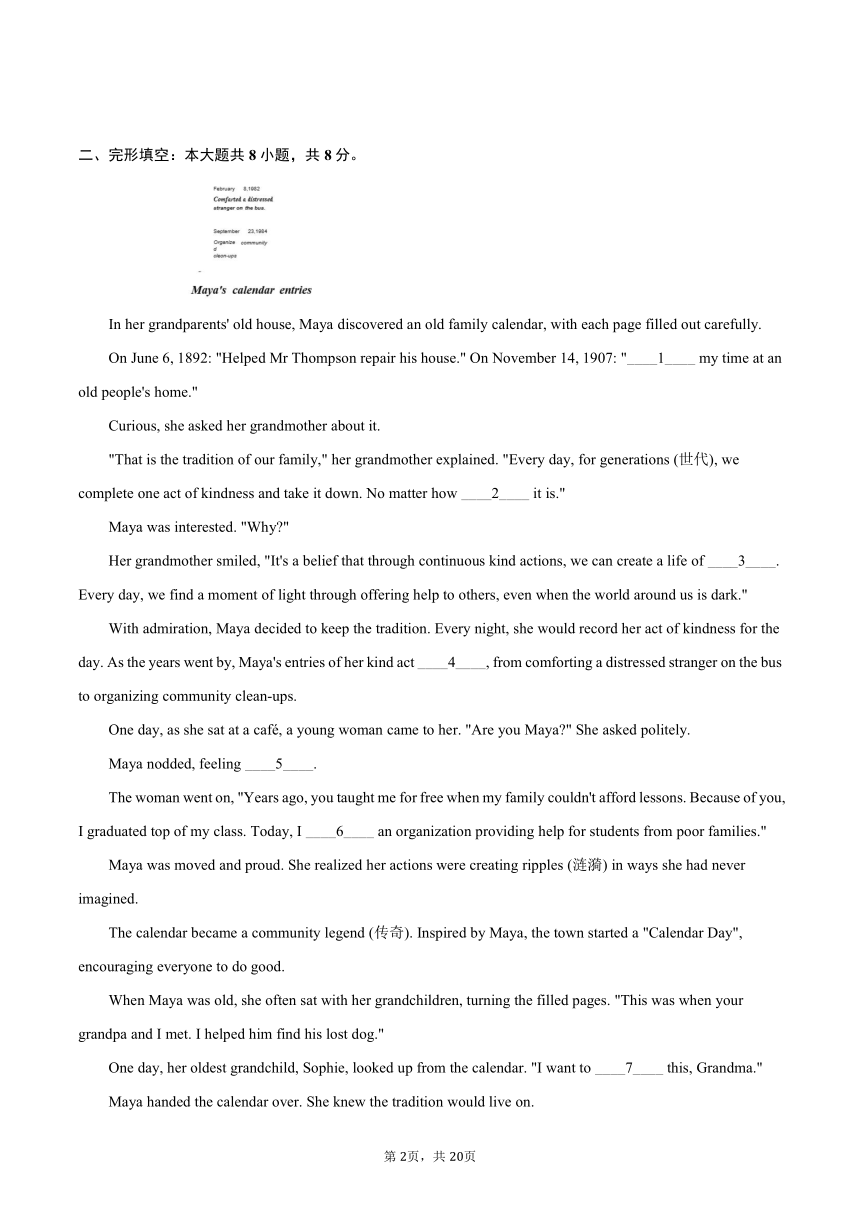
On June 6, 1892: "Helped Mr Thompson repair his house." On November 14, 1907: "____1____ my time at an old people's home."
Curious, she asked her grandmother about it.
"That is the tradition of our family," her grandmother explained. "Every day, for generations (世代), we complete one act of kindness and take it down. No matter how ____2____ it is."
Maya was interested. "Why "
Her grandmother smiled, "It's a belief that through continuous kind actions, we can create a life of ____3____. Every day, we find a moment of light through offering help to others, even when the world around us is dark."
With admiration, Maya decided to keep the tradition. Every night, she would record her act of kindness for the day. As the years went by, Maya's entries of her kind act ____4____, from comforting a distressed stranger on the bus to organizing community clean-ups.
One day, as she sat at a café, a young woman came to her. "Are you Maya " She asked politely.
Maya nodded, feeling ____5____.
The woman went on, "Years ago, you taught me for free when my family couldn't afford lessons. Because of you, I graduated top of my class. Today, I ____6____ an organization providing help for students from poor families."
Maya was moved and proud. She realized her actions were creating ripples (涟漪) in ways she had never imagined.
The calendar became a community legend (传奇). Inspired by Maya, the town started a "Calendar Day", encouraging everyone to do good.
When Maya was old, she often sat with her grandchildren, turning the filled pages. "This was when your grandpa and I met. I helped him find his lost dog."
One day, her oldest grandchild, Sophie, looked up from the calendar. "I want to ____7____ this, Grandma."
Maya handed the calendar over. She knew the tradition would live on.
Years after Maya passed, the town built a statue (雕塑) in her honor, with the words on its base:
In memory of Maya and the generations before her who believed in the power of everyday ____8____.
13.A. Saved B. Wasted C. Managed D. Volunteered
14.A. popular B. small C. unfair D. interesting
15.A. freedom B. balance C. purpose D. discovery
16.A. grew B. appeared C. remained D. mattered
17.A. worried B. relaxed C. excited D. confused
18.A. run B. need C. name D. visit
19.A. praise B. report C. continue D. remember
20.A. changes B. kindness C. happiness D. achievements
三、阅读理解:本大题共10小题,共20分。
A
"Why can't Grandpa just be normal Why does he take waveski as a hobby It's so weird (怪异的)," Carter asked Grandma.
Grandma laughed. "I've wondered that for many years."
They were sitting on the beach watching Grandpa and some of his friends in the ocean.
"None of my friends even knows what a waveski is," Carter continued.
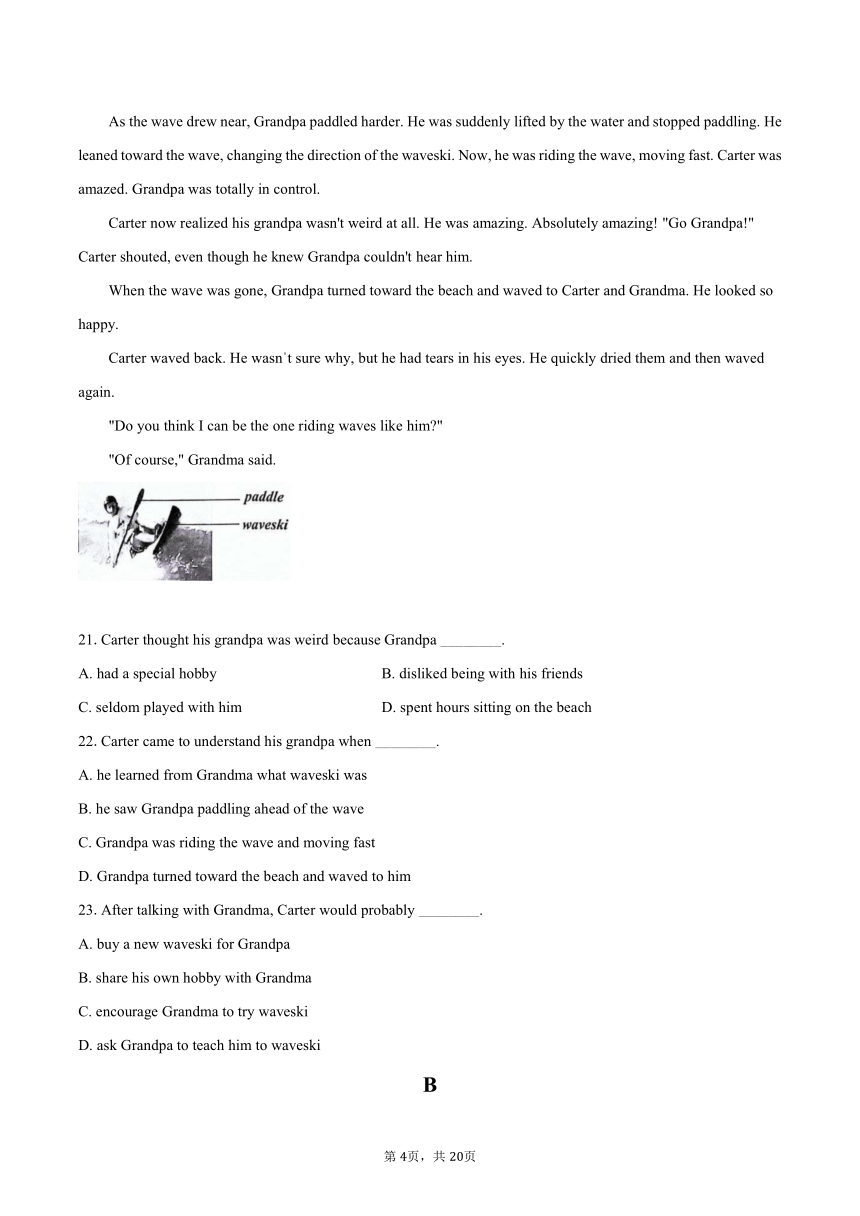
"Just tell them it s a lot like surfing (冲浪), but the riders sit on top of a waveski. When the waves come, they will ride the wave just like a surfer, only they paddle to get out to the waves."
"Nobody's grandpa does this."
Grandma laughed. "Well, what should he be doing instead "
"I don't know. Maybe things that old people do."
"Look! A big wave is coming in!" Grandma pointed to the ocean.
Carter saw Grandpa in front of his friends. He was leaning (倾斜) forward and paddling hard, just ahead of the large incoming wave. Carter was surprised at how hard Grandpa was paddling and how fast he was moving. Just then, another huge wave came. Carter jumped to his feet and held his breath. This was not good. What if something bad happened
As the wave drew near, Grandpa paddled harder. He was suddenly lifted by the water and stopped paddling. He leaned toward the wave, changing the direction of the waveski. Now, he was riding the wave, moving fast. Carter was amazed. Grandpa was totally in control.
Carter now realized his grandpa wasn't weird at all. He was amazing. Absolutely amazing! "Go Grandpa!" Carter shouted, even though he knew Grandpa couldn't hear him.
When the wave was gone, Grandpa turned toward the beach and waved to Carter and Grandma. He looked so happy.
Carter waved back. He wasn t sure why, but he had tears in his eyes. He quickly dried them and then waved again.
"Do you think I can be the one riding waves like him "
"Of course," Grandma said.
21.Carter thought his grandpa was weird because Grandpa ________.
A. had a special hobby B. disliked being with his friends
C. seldom played with him D. spent hours sitting on the beach
22.Carter came to understand his grandpa when ________.
A. he learned from Grandma what waveski was
B. he saw Grandpa paddling ahead of the wave
C. Grandpa was riding the wave and moving fast
D. Grandpa turned toward the beach and waved to him
23.After talking with Grandma, Carter would probably ________.
A. buy a new waveski for Grandpa
B. share his own hobby with Grandma
C. encourage Grandma to try waveski
D. ask Grandpa to teach him to waveski
B
Meditation is one kind of exercise in controlling attention. Meditators use some practices, like keeping focus on breathing, to strengthen the ability to take control over what their minds are doing. While meditators have long experienced its benefits, science only recently discovered that the mental effort of meditation is good exercise for the brain.
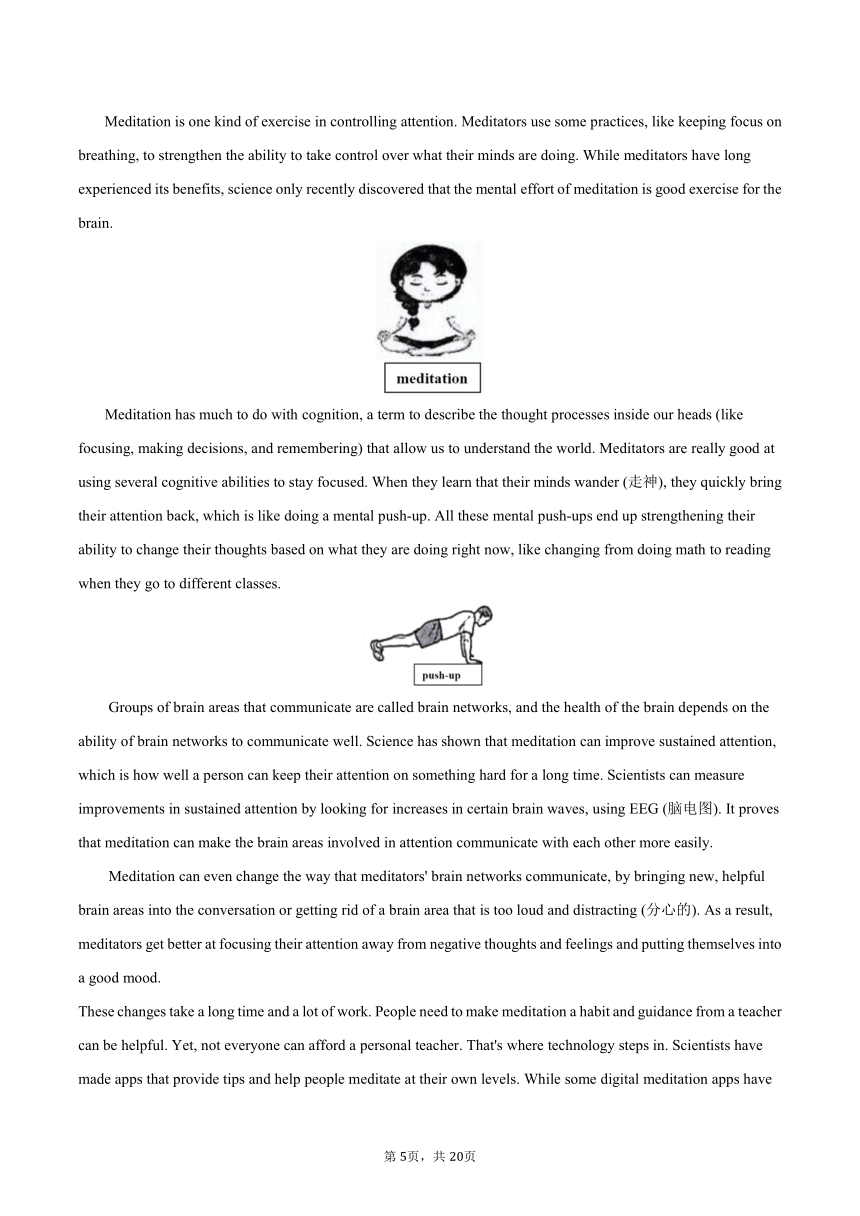
Meditation has much to do with cognition, a term to describe the thought processes inside our heads (like focusing, making decisions, and remembering) that allow us to understand the world. Meditators are really good at using several cognitive abilities to stay focused. When they learn that their minds wander (走神), they quickly bring their attention back, which is like doing a mental push-up. All these mental push-ups end up strengthening their ability to change their thoughts based on what they are doing right now, like changing from doing math to reading when they go to different classes.
Groups of brain areas that communicate are called brain networks, and the health of the brain depends on the ability of brain networks to communicate well. Science has shown that meditation can improve sustained attention, which is how well a person can keep their attention on something hard for a long time. Scientists can measure improvements in sustained attention by looking for increases in certain brain waves, using EEG (脑电图). It proves that meditation can make the brain areas involved in attention communicate with each other more easily.
Meditation can even change the way that meditators' brain networks communicate, by bringing new, helpful brain areas into the conversation or getting rid of a brain area that is too loud and distracting (分心的). As a result, meditators get better at focusing their attention away from negative thoughts and feelings and putting themselves into a good mood.
These changes take a long time and a lot of work. People need to make meditation a habit and guidance from a teacher can be helpful. Yet, not everyone can afford a personal teacher. That's where technology steps in. Scientists have made apps that provide tips and help people meditate at their own levels. While some digital meditation apps have been carefully studied by scientists, some need to be tested. So, it is important to be careful at first about whether an app really works.
24.According to the passage, when people meditate, they ________.
A. try to control their focus
B. focus on what goes around
C. make important decisions
D. develop the ability to communicate
25.What can we learn from the passage
A. Meditators end their practice when their minds wander.
B. Meditation makes it possible for people to have happier moods.
C. Certain brain waves decrease when sustained attention improves.
D. Digital meditation apps work better than personal meditation teachers.
26.What might be the best title for the passage
A. How does meditation benefit the brain
B. How do people make meditation a habit
C. How does technology improve meditation
D. How do meditalors better their mental health
C
Every time I look at the many recent orders on my online shopping account, or I receive a new package on my doorstep, I get a feeling of happiness that is hard to give up. Although I know that my shopping habits are bad for the planet, I just can't stop.
But Ann-Christine Duhaime's new book, Minding the Climate: How Neuroscience Can Help Solve Our Environmental Crisis, has helped me understand that my desire (渴望) to keep buying things isn't necessarily a personal weakness—it's the way our brains have developed.
According to Duhaime, we managed to stay alive even when things were hard because our brains learned to repeat decisions like moving towards a tasty treat or backing away from danger. Today, we have some 86 billion neurons (神经元) in the brain continuously working to strengthen rewarding behavior—a kind of action that results in a positive outcome, which makes a person want to do it again. As the neurons work, they produce dopamine (多巴胺), which makes our rewarding behavior feel even better than usual. We actively look for more dopamine, and at the same time, learn to repeat the actions that lead to it.
However, Duhaime stresses that our brains are not programmed to keep buying more and more. All humans are different, and our brains work differently depending on our genetics (遗传性) and our life experiences. The challenge is that our brain systems are designed for short-term decision-making. When we buy something new, we get rewarded immediately. But the long-term worsening of the planet is harder for the reward centers of our brains to understand, even if we know about it.
And there may be some ways to break the cycle. The best is not to stop buying things completely; a better solution may be to substitute the old rewards that we know aren't good in the long run with new ones. For example, you can have a glass of milk, which gives you fewer calories, instead of eating chocolate just before bed for comfort. Once you start losing weight, the reward of being able to fit into your old clothes feels as good as what the chocolate would do. We need that same substitution for shopping.
Buying used things could also help satisfy our desire to get more things without using more natural resources. Additionally, creating social rewards, like encouragement and support from a community with similar goals, can inspire positive changes. Humans naturally like to connect with others, and this social support can lead to more eco-friendly choices.
27.What do you know about human brains from the passage
A. The way brains work won't be influenced by life experiences.
B. Neurons play a role in people's repeating rewarding behavior.
C. Less dopamine is produced when people get positive outcomes.
D. Brains don't care about the short-term effects of people's actions.
28.The word "substitute" in Paragraph 5 probably means "________".
A. take the place of B. look forward to
C. get ready for D. make up for
29.The writer probably agrees that ________.
A. over-shopping harms the development of the human brain
B. keeping buying gets in the way of people finding happiness
C. the planet is free from the influence of people's buying behavior
D. creating social rewards can help people reduce the desire to over-shop
30.What is the writer's main purpose in writing this passage
A. To explain why over-shopping is not a personal weakness.
B. To show how dopamine makes people crazy about shopping.
C. To guide people to make eco-friendly choices when shopping.
D. To encourage people to buy used things to protect the environment.
四、任务型阅读-简答:本大题共1小题,共10分。
31. Inner painting, a kind of traditional Chinese art, is marked as a national-level intangible cultural heritage (非物质文化遗产). Inner painting artists traditionally create works on the inner surface of the glass bottle by using special fine brushes that can enter the tiny bottles. It has a long history and is mainly divided into four major schools: Beijing, Hebei, Shandong, and Guangdong.
When we look at the inner painting of an object, we experience an indescribable beauty. Patterns on the painting often symbolize people's wishes for good luck and a happy life. The most marketable ones are landscapes (风景), followed by flowers and birds.
The production of inner painting is difficult because it requires high precision (精确) and the process of painting is totally reversed (反向的). During painting, there is no room for corrections. And a shaky hand leads to mistakes. Only those skilled and confident in their abilities can paint well. Most artists need to learn inner painting for years before creating great and fine pieces. Even if they already know how to paint, they need to practice drawing lines from the beginning when they start inner painting.
Inner painting has its advantages due to its uniqueness (独特性), but it also faces challenges such as limited market needs, and a shortage of learners and talented artists to drive its development.
Luckily, today's artists are trying to make inner painting more included in our lives. It is now used on everyday objects, like tea sets and folding screens. One of the artists invented a new type of brush, which improved the speed of drawing. Some young artists are making use of social media to help more people learn about inner painting skills.
Looking ahead to the future, the inner painting artists wish the art to be more available to the public, and win high market acceptance. They also hope inner painting courses can be offered at school for young people to take.
(1) Where do inner painting artists traditionally create their works __________________________________________________________________
(2) What do patterns on the inner painting often symbolize __________________________________________________________________
(3) How are some young artists helping more people learn about inner painting skills __________________________________________________________________
(4) If your school offers an inner painting course, would you like to take it or not Why (Please give two reasons.) __________________________________________________________________
五、信息匹配:本大题共3小题,共6分。
Weekend Activities
A Enjoy a Night of Singing Plan a party and sing your favorite songs with friends or family. Pick catchy songs, design some games, take turns to sing, and have fun create a comfortable environment with snacks and laughter for a memorable evening. B Have a Yard Sale Tidy up your home and plan a yard sale. Choose things you don't need—like old books, clothes and toys. Clean, organize, and price them. You can even advertise the sale online or with posters. After the sale why not donate the money to charities
C Collect Leaves for Artworks Take a walk in a local park and collect fallen leaves. When you get home, create artworks with leaves of different colors and shapes as you like. You can cut, paint, or stick them. Get prepared to be amazed at your own work. D Bring a Meal to Neighbors Cook some delicious dishes, and pack them nicely. Take them to visit your neighbors or surprise them by leaving the dishes at their doorsteps with a kind note. It's a great way to strengthen the relationship with your neighbors.
____1____ I enjoy painting and creating works of art with various materials.
____2____ I just finished middle school and I don't know what to do with the things I no longer use.
____3____
I've recently moved into a new neighborhood and I d like to meet my neighbors.
32.A. A B. B C. C D. D
33.A. A B. B C. C D. D
34.A. A B. B C. C D. D
六、书面表达:本大题共2小题,共10分。
35.假设你是李华。你的好朋友Peter正在参与筹备他们学校的“校园劳动日”活动,他写信向你征求创意。请你用英语给他写一封回信,提供一些活动创意并说明理由。
提示词语:clean up, repair, garden, fun, responsibility
提示问题:● What activities would you like to suggest
● Why do you suggest so
Dear Peter,
I'm excited to hear that you re organizing activities for School Service Day.
__________________________________________________________________________________________________________________________________________________________________________________________________________________________________________________________________________________________________________________________________________________________________________________________________________________________________________________________________________________________________________________________________________________________________________________________________________________________________________________________________________________________________________________________________________________________________________________________________________________________________________________________________________
I do hope that my suggestions will be helpful.
Yours,
Li Hua
36.假设你是李华。某英文网站正在开展以“学以致用”为主题的征文活动。请用英语写一篇短文投稿,分享一次你运用所学解决实际问题的经历,并谈谈你的收获。
提示词语:skill, make use of, connect, improve, meaningful
提示问题:● What experience can you share about putting what you've learned into practice
● What have you learned from it
It's important to put what we've learned into practice. _____________________________________________________________________________________________________________________________________________________________________________________________________________________________________________________________________________________________________________________________________________________________________________________________________________________________________________________________________________________________________________________________________________________________________________________________________________________________________________________________________________________________________________________________________________________________________________________________________________________________________________________________________
答案和解析
1.【答案】B
【解析】句意:琳达和她的姐姐都是书迷。她们经常在图书馆看书。She她;They她/他/它们;We我们;You你,你们。根据Linda and her sister可知,此处指代琳达与她的姐姐两人,应用第三人称的复数they指代。故选B。
2.【答案】C
【解析】句意:——我们乘7点的公共汽车好吗?——好的。音乐会在7:30开始。我们可以准时到达。in用于表示较长的时间,如年份、月份、季节、世纪等;on用于表示具体的某一天或某一天的上午、下午、晚上等;at用于表示具体的时刻或几点几分; to朝,向。由于空格后是7:30,所以要用at。故选C。
3.【答案】D
【解析】句意:——我今天必须报名参加学校音乐节吗?——不,你不需要。明天是报名的最后一天。can't不能;shouldn't不应该;mustn't禁止;needn't不需要。根据No可知,此处作否定回答。回答以Must引导的一般疑问句,否定回答用needn't或don't have to。故选D。
4.【答案】B
【解析】句意:汤姆每天练习篮球,他比以前打得更好了。well好地(副词);better更好(比较级);best最好(最高级);the best最好(最高级)。根据than可知,空格处应用比较级。故选B。
5.【答案】C
【解析】句意:——从我们学校到太空博物馆有多远?——大约五公里。How soon询问“多久之后”,通常用于将来时态,回答一般用“in + 一段时间”;How long询问“多长时间”,既可以询问时间段,也可以询问物体的长度;How far询问“多远”,表示距离;How much询问“多少”,可以询问数量、价格等。根据It's about five kilometers.可知,此处对距离提问,疑问词应用How far“多远”。故选C。
6.【答案】D
【解析】句意:游泳前记得做热身运动,否则你可能会受伤。so“所以”,表示因果关系;and“和,并且”,连接两个并列的成分或句子,表示并列关系;but“但是”,表示转折关系;or“或者,否则”,表示选择关系或否定的结果。分析可知,此处用“祈使句+or+简单句”表示结果,其中or表示“否则”。故选D。
7.【答案】A
【解析】句意:——埃里克,请把音乐声关小点。你弟弟在睡觉。——好的,妈妈。我很抱歉。根据Eric, turn down the music, please.可知,此处指弟弟正在睡觉,用现在进行时。故选A。
8.【答案】A
【解析】句意:——莉莉,你在家经常做什么家务?——我每天晚饭后洗碗。根据every day可知,此处表示每天都会洗碗,应用一般现在时。故选A。
9.【答案】D
【解析】句意:——吉姆,我一小时前给你打过电话,但你没接,你在做什么?——噢,我当时正在和我父母讨论野餐计划。根据What were you doing 可知,此处表示过去某一刻正在发生的动作,应用过去进行时,谓语动词的构成为was/were doing。故选D。
10.【答案】C
【解析】句意:自从丽莎来北京后,她已经参观颐和园两次了。根据since she came to Beijing可知,该句为since引导的时间状语从句,主句应用现在完成时,谓语结构为have/has+过去分词。故选C。
11.【答案】B
【解析】句意:去年,我们在学校开辟了一个菜园,供学生种植蔬菜。根据a garden...for students可知,主语garden“菜园”与动词start“开辟”为逻辑上的动宾关系,应用被动语态;结合Last year可知,时态为一般过去时,谓语动词的构成为was/were+过去分词。故选B。
12.【答案】A
【解析】句意:——鲍勃,你能告诉我你为什么想加入科学俱乐部吗?——嗯,我真的很喜欢做实验。根据can you tell me ... the science club可知,句子是宾语从句,从句用陈述句语序,排除B、D选项;结合答语I really like doing experiments.可知,问句是问原因,用why引导宾语从句。故选A。
13~20.【答案】D、B、A、A、D、A、C、B
【解析】【文章大意】本文主要讲述了玛雅和她家族的一个传统,通过具体的事例展现了善良的传承和意义。
1.
句意:1907年11月14日:“在一家养老院做志愿者。”Saved节省;Wasted浪费;Managed管理;Volunteered志愿。根据句意可知,此处表示在养老院做志愿者。故选D。
2.
句意:不管它有多小。popular受欢迎的;small小的;unfair不公平的;interesting有趣的。根据Every day, for generations (世代), we complete one act of kindness and take it down.(世世代代,每一天,我们都完成一项善举并把它记录下来。)可知,空处应表达不管这件事有多小。故选B。
3.
句意:这是一种信念,即通过持续的善意行为,我们可以创造一种自由的生活。freedom自由;balance平衡;purpose目的;discovery发现。根据下文Every day, we find a moment of light through offering help to others, even when the world around us is dark.(每一天,即使当我们周围的世界是黑暗的,我们也能通过帮助他人找到片刻的光明。)可知,我们帮助别人从黑暗中找到光明,应是创造了一种自由的生活。故选A。
4.
句意:随着时间的推移,玛雅参加的善举越来越多,从在公交车上安慰一个痛苦的陌生人到组织社区清理。grew逐渐变得;appeared出现;remained仍然;mattered关系。根据from comforting a distressed stranger on the bus to organizing community clean-ups(从在公交车上安慰一个痛苦的陌生人到组织社区清理)可知,此处应表达善举越来越多。故选A。
5.
句意:玛雅点了点头,感到困惑。worried担心的;relaxed放松的;excited兴奋的;confused困惑的。根据上文One day, as she sat at a café, a young woman came to her. "Are you Maya "(一天,当她坐在咖啡馆里时,一位年轻女子走向她。“你是玛雅吗?”)可知,有陌生人喊出她的名字她应该是感到困惑。故选D。
6.
句意:现今,我经营着一个组织,为那些来自贫困家庭的学生提供帮助。run经营;need需要;name命名;visit参观。根据句意可知,此处指经营了一个为贫困学生提供帮助的组织。故选A。
7.
句意:“我想继续做下去,奶奶。”praise表扬;report汇报;continue继续;remember记住。根据Maya handed the calendar over. She knew the tradition would live on.(玛雅把日历递了过去。她知道这个传统会延续下去。)可知,应表达她想继续干这件事。故选C。
8.
句意:玛雅去世多年后,该镇为纪念她建造了一座雕像,基座上写着:为了深切缅怀玛雅以及在她之前的那些世代,他们坚信着日常善举的力量。changes改变;kindness善良;happiness幸福;achievements成就。根据第四段Every day, for generations (世代), we complete one act of kindness and take it down.(世世代代,每一天,我们都完成一项善举并把它记录下来。)可知,此处应表达相信日常善举的力量。故选B。
21~23.【答案】A、C、D
【解析】【文章大意】文章主要讲述了卡特一开始不理解爷爷把滑浪板作为爱好,觉得很怪异,但后来看到爷爷在海浪中娴熟地驾驭滑浪板,他才意识到爷爷其实很了不起,最后卡特对爷爷的态度发生了转变,并希望自己也能像爷爷一样。文章表达了对爷爷独特爱好的理解和对他的敬佩之情。
1.
根据第一段"Why can't Grandpa just be normal Why does he take waveski as a hobby It's so weird (怪异的)," Carter asked Grandma.(“为什么爷爷不能正常一点呢?为什么他把冲浪板当爱好?这太奇怪了。”卡特问奶奶。)可知,卡特觉得爷爷很怪异是因为爷爷有一个特殊的爱好。故选A。
2.
根据第十一段Now, he was riding the wave, moving fast. Carter was amazed. Grandpa was totally in control.(现在,他正在驾驭海浪,快速移动。卡特惊呆了。爷爷完全掌控着局面。)和第十二段Carter now realized his grandpa wasn't weird at all. He was amazing. Absolutely amazing!(卡特现在意识到他的爷爷一点也不奇怪。他太了不起了。绝对了不起!)可推知,当爷爷乘风破浪快速前进时,卡特开始理解他的爷爷。故选C。
3.
根据倒数第二段"Do you think I can be the one riding waves like him "(“你觉得我能像他一样驾驭海浪吗?”)可知,卡特问奶奶他是否能像爷爷那样乘风破浪。由此推知,卡特可能会要爷爷教他冲浪这项运动。故选D。
24~26.【答案】A、B、A
【解析】【文章大意】文章主要讲述了冥想是如何控制注意力的,以及冥想对认知能力的影响,包括让冥想者更好地集中注意力、改变思维、增强大脑网络的沟通能力等。同时还提到了冥想需要长期坚持和努力,科技可以提供帮助,但要谨慎选择数字冥想应用程序。
1.
根据第一段Meditators are really good at using several cognitive abilities to stay focused.(冥想者非常擅长运用多种认知能力来保持专注。)可知,当人们冥想时,他们试图控制自己的注意力。故选A。
2.
根据第三段As a result, meditators get better at focusing their attention away from negative thoughts and feelings and putting themselves into a good mood.(这样,冥想者能够更好地将注意力从消极的思想和感受上转移开,并让自己处于良好的情绪状态。)可知,冥想可以让人们有更快乐的心情。故选B。
3.
通读全文,尤其根据第一段While meditators have long experienced its benefits, science only recently discovered that the mental effort of meditation is good exercise for the brain.(尽管冥想者长期以来都体验到了其益处,但科学只是在最近才发现冥想这种心智努力对大脑是很好的锻炼。)以及第三段Meditation can even change the way that meditators brain networks communicate, by bringing new, helpful brain areas into the conversation or getting rid of a brain area that is too loud and distracting (分心的). (冥想甚至可以改变冥想者大脑网络的沟通方式,通过引入新的、有益的大脑区域参与对话,或者去除过于嘈杂且分散注意力的大脑区域。)可知,文章主要介绍了冥想对大脑有什么好处。故选A。
27~30.【答案】B、A、D、C
【解析】【文章大意】本文主要分析了人们过度购物的科学原理,并说明人们可以通过利用这种原理来改变购物习惯。
1.
根据第三段Today, we have some 86 billion neurons (神经元) in the brain continuously working to strengthen rewarding behavior—a kind of action that results in a positive outcome, which makes a person want to do it again.(如今,我们的大脑中有大约860亿个神经元在持续工作,以强化有益行为——这种行为能带来积极结果,让人想再次这样做。)可知,我们大脑中约有860亿个神经元不断努力加强奖励行为,这使得人们会想要重复受到奖励的行为。由此推知,神经元在人们重复奖励行为中发挥着作用。故选B。
2.
根据第五段For example, you can have a glass of milk, which gives you fewer calories, instead of eating chocolate just before bed for comfort.(比如,你可以喝一杯牛奶,它的卡路里更少,而不是在睡前为了舒适而吃巧克力。)可知,此处列举了一个例子:在睡前用喝牛奶来代替吃巧克力。由此猜测,substitute意为take the place of“代替”。故选A。
3.
根据最后一段Additionally, creating social rewards, like encouragement and support from a community with similar goals, can inspire positive changes.(此外,创造社会奖励,比如来自有相似目标的社区的鼓励和支持,能激发积极的变化。)可知,创造社会奖励可以激发积极的变化。由此推测,作者可能会赞同创造社会奖励可以帮助人们减少过度购物的欲望。故选D。
4.
根据第二段Minding the Climate: How Neuroscience Can Help Solve Our Environmental Crisis(《关注气候:神经科学如何帮助解决我们的环境危机》),第四段However, Duhaime stresses that our brains are not programmed to keep buying more and more.(然而,杜海姆强调,我们的大脑并非被编程为持续不断地购买更多东西。),第五段The best is not to stop buying things completely; a better solution may be to substitute the old rewards that we know aren't good in the long run with new ones.(最好的做法不是完全停止购买东西;一个更好的解决方案可能是用新的奖励来替代我们知道从长远看不好的旧奖励。)和最后一段Buying used things could also help satisfy our desire to get more things without using more natural resources...Humans naturally like to connect with others, and this social support can lead to more eco-friendly choices.(购买二手物品也能帮助满足我们获取更多东西而不使用更多自然资源的欲望。此外,创造社会奖励,比如来自有相似目标的社区的鼓励和支持,能激发积极的变化。人类自然喜欢与他人联系,这种社会支持能带来更环保的选择。)可知,文中反复提到了神经元、购物和环境保护之间的关系,我们可以采用更环保的方式来代替购物促使神经元分泌多巴胺,或者购买二手货物来满足我们的购物欲望。由此推测,作者的写作目的是引导人们在购物时做出环保的选择。故选C。
31.【答案】【小题1】
They create works on the inner surface of the glass bottle.
【小题2】
They symbolize people's wishes for good luck and a happy life.
【小题3】
By making use of social media.
【小题4】
I'd love to take it. Because inner painting is a kind of traditional Chinese art and patterns on the painting often symbolize people's wishes for good luck and a happy life.
【解析】1.
【文章大意】本文主要介绍了内画这一传统艺术,包括它的历史、流派、特点、制作难度、面临的挑战以及当下艺术家为推动其发展所做的努力,同时表达了对其未来发展的期望。
根据第一段Inner painting artists traditionally create works on the inner surface of the glass bottle by using special fine brushes that can enter the tiny bottles.(在传统上,内画艺术家使用能够进入小瓶的特殊细刷,在玻璃瓶的内表面创作作品。)可知,内画艺术家通过使用特殊的细刷在玻璃瓶的内表面创作作品。故填They create works on the inner surface of the glass bottle.。
2.
根据第二段Patterns on the painting often symbolize people's wishes for good luck and a happy life.(画上的图案常常象征着人们对好运和幸福生活的美好愿望。)可知,画中的图案往往象征着人们对好运和幸福生活的祝愿。故填They symbolize people's wishes for good luck and a happy life.。
3.
根据第五段Some young artists are making use of social media to help more people learn about inner painting skills.(一些年轻的艺术家正在利用社交媒体帮助更多人了解内画技巧。)可知,一些年轻艺术家正在利用社交媒体帮助更多人了解内画技巧。故填By making use of social media.。
4.
开放性问题,结合实际,言之有理即可。参考答案为I'd love to take it. Because inner painting is a kind of traditional Chinese art and patterns on the painting often symbolize people's wishes for good luck and a happy life.。
32~34.【答案】C、B、D
【解析】1.
【文章大意】本文主要介绍了三个人物及四个周末活动。
根据Annie: I enjoy painting and creating works of art with various materials.可知,安妮喜欢用各种材料绘画和创作艺术作品;C项“收集树叶做艺术品。在当地公园散步,收集落叶。当你回到家时,根据你的喜好,用不同颜色和形状的叶子创作艺术品。你可以切割、绘制或粘贴它们。准备好为自己的工作感到惊讶吧。”与之对应。故选C。
2.
根据Peter: I just finished middle school and I don't know what to do with the things I no longer use.可知,彼得刚中学毕业,不知道如何处理自己不用的东西;B项“举办庭院拍卖会。整理你的家,计划一个庭院拍卖会。选择你不需要的东西,比如旧书、衣服和玩具。清洁、整理和定价。你甚至可以在线或使用海报宣传销售。出售后,为什么不把钱捐给慈善机构呢?”与之对应。故选 B。
3.
根据Harry: I've recently moved into a new neighborhood and I'd like to meet my neighbors.可知,哈里最近搬到了一个新社区,他想认识一下邻居;D项“给邻居送食物。做一些美味的菜肴,并将它们包装得很好。带它们去拜访你的邻居,或者把盘子放在他们家门口,并附上一张善意的便条,给他们一个惊喜。”与之对应。故选D。
35.【答案】Dear Peter,
I'm excited to hear that you're organizing activities for School Service Day. And I'd like to share some ideas with you.
①First, I think it's a good idea to organize clean-up activities.②For example, students can clean the classroom and playground, which can make the school much cleaner and more beautiful. What's more, you can ask students to repair the broken desks and chairs. It will be great fun. Moreover, you can arrange for students to water the garden. ③They will feel a strong sense of responsibility to beautify the school.
I do hope that my suggestions will be helpful.
Yours,
Li Hua
【解析】【思路点拨】
【思路点拨】
本文是一篇提示作文,给好朋友Peter提供一些关于“校园劳动日”活动的创意想法并说明理由。写作时可结合提示词语和提示问题进行语言组织,注意多人称的使用,时态主要为一般现在时和一般将来时。注意不要遗漏提示信息,适当添加细节,并突出写作重点。适当使用连接词,以使行文连贯。
【亮点词汇】
① share...with... 和……分享……
② What's more 另外
③ arrange for 安排
④ water the garden 给花园浇水
⑤ feel a strong sense of responsibility 有强烈的责任感
⑥ beautify the school 美化学校
【高分句型】
① First, I think it's a good idea to organize clean-up activities.(that引导宾语从句,that省略;it作形式主语)
② For example, students can clean the classroom and playground, which can make the school much cleaner and more beautiful.(which引导非限制性定语从句)
③ They will feel a strong sense of responsibility to beautify the school.(动词不定式作定语)
【结构布局】
引言:表明写作意图。借用“我想和你分享一些想法”来引出重点介绍的内容
中心:具体阐述写作内容。从“清洁活动、修理活动、给花园浇水活动等”几个方面重点介绍
结尾:书写结语。表达“希望建议能有所帮助”的愿望
36.【答案】 It's important to put what we've learned into practice.
Last summer holiday, I learned some first aid knowledge such as CPR and Heimlich Maneuver. One day, my little sister was choked by a candy and couldn't breathe. ①Seeing this, I thought of what I learnt last summer holiday shortly. Then, I stood behind my sister and applied pressure to her abdomen. Fortunately, the candy in her throat was spit out. At last, I called 120 for further check.
②From this experience, I have learned the importance of the combination of theory and practice, which not only enables us to have a better understanding of what we have learned, but also makes contributions to our society.
【解析】【思路点拨】
【思路点拨】
本文是一篇提示作文,分享一次你运用所学解决实际问题的经历,并谈谈你的收获。写作时,人称以第一人称为主,时态以一般过去时为主。根据所给提示问题完成写作,注意标点符号及大小写等问题,不要犯语法错误。注意上下文之间的逻辑关系,语意连贯。
【亮点词汇】
① first aid 急救
② such as 例如
③ think of 想起
④ apply ... to... 将……运用……
⑤ spit out 吐出
⑥ enable sb. to do sth. 使某人能够做某事
⑦ make contributions to 为……做出贡献
【高分句型】
① Seeing this, I thought of what I learnt last summer holiday shortly. (现在分词作状语;what引导宾语从句)
② From this experience, I have learned the importance of the combination of theory and practice, which not only enables us to have a better understanding of what we have learned, but also makes contributions to our society.(which引导非限定性定语从句;what引导宾语从句)
【结构布局】
引言:表明写作意图
中心:介绍自己学以致用的一次经历
结尾:阐述自己的感受
第1页,共1页

展开更多......

收起↑

资源预览