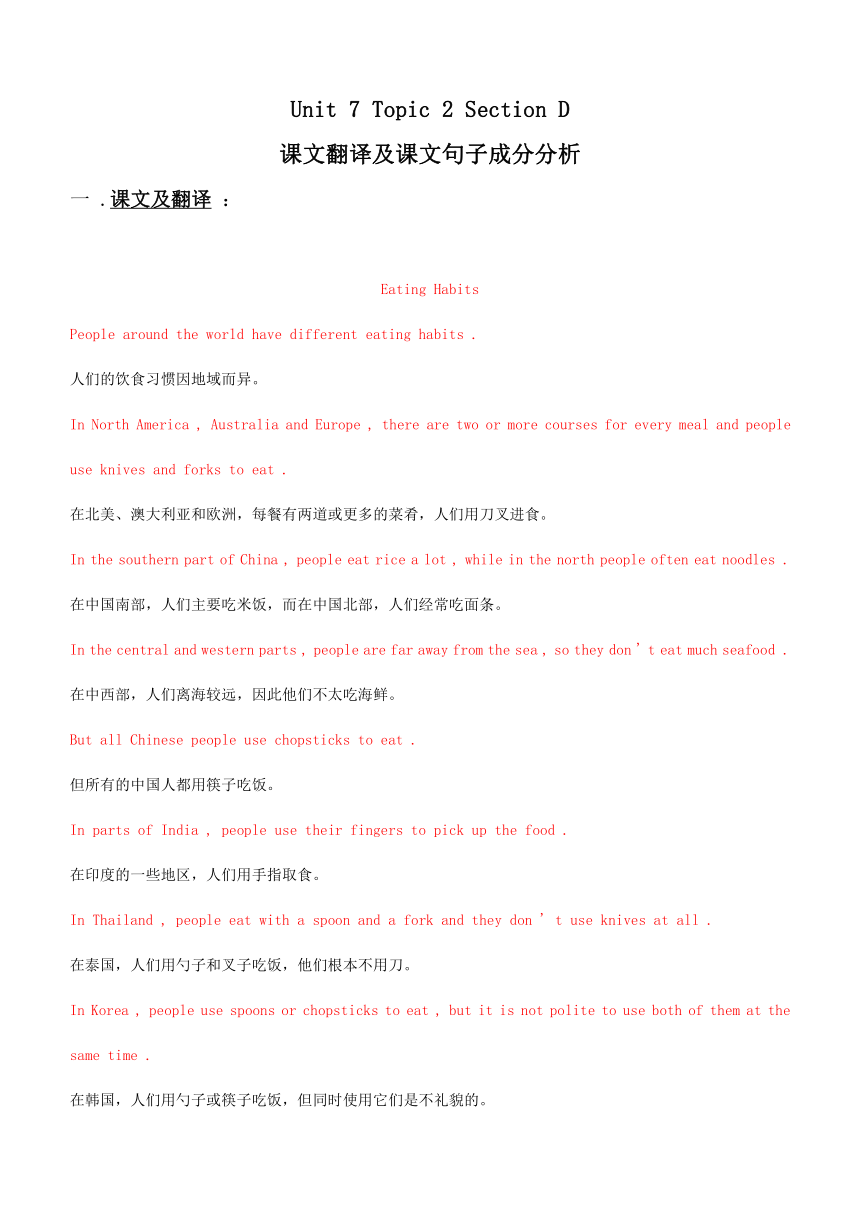
资源简介 Unit 7 Topic 2 Section D课文翻译及课文句子成分分析一 .课文及翻译 :Eating HabitsPeople around the world have different eating habits .人们的饮食习惯因地域而异。In North America , Australia and Europe , there are two or more courses for every meal and people use knives and forks to eat .在北美、澳大利亚和欧洲,每餐有两道或更多的菜肴,人们用刀叉进食。In the southern part of China , people eat rice a lot , while in the north people often eat noodles .在中国南部,人们主要吃米饭,而在中国北部,人们经常吃面条。In the central and western parts , people are far away from the sea , so they don ' t eat much seafood .在中西部,人们离海较远,因此他们不太吃海鲜。But all Chinese people use chopsticks to eat .但所有的中国人都用筷子吃饭。In parts of India , people use their fingers to pick up the food .在印度的一些地区,人们用手指取食。In Thailand , people eat with a spoon and a fork and they don ' t use knives at all .在泰国,人们用勺子和叉子吃饭,他们根本不用刀。In Korea , people use spoons or chopsticks to eat , but it is not polite to use both of them at the same time .在韩国,人们用勺子或筷子吃饭,但同时使用它们是不礼貌的。二 .课文句子成分分析及常见短语 :People around the world have different eating habits.句子成分:主语(People around the world)+ 谓语(have)+ 宾语(different eating habits)。短语及其拓展:around the world(全世界);eating habits(饮食习惯)。In North America, Australia and Europe, there are two or more courses for every meal and people use knives and forks to eat.句子成分:状语(In North America, Australia and Europe)主语(there)+ 谓语(are)+ 宾语(two or more courses)并列句(and people use knives and forks to eat),其中主语(people)+ 谓语(use)+ 宾语(knives and forks)+ 目的状语(to eat)。短语及其拓展:there be 结构,就近原则two or more(两个或更多);use sth to do sth。In the southern part of China, people eat rice a lot, while in the north people often eat noodles.句子成分:状语(In the southern part of China)+ 主语(people)+ 谓语(eat)+ 宾语(rice)+ 状语(a lot)并列句(while in the north people often eat noodles),其中状语(in the north)+ 主语(people)+ 谓语(eat)+ 宾语(noodles)+ 状语(often)。短语及其拓展:a lot(很多);the southern part of China(中国南部);the north(中国北部)。In the central and western parts, people are far away from the sea, so they don't eat much seafood.句子成分:状语(In the central and western parts)+ 主语(people)+ 谓语(are)+ 表语(far away from the sea)因果句(so they don't eat much seafood),其中主语(they)+ 谓语(don't eat)+ 宾语(much seafood)。短语及其拓展:central and western parts(中西部);far away from(远离);seafood(海鲜)。But all Chinese people use chopsticks to eat.句子成分:状语(But)+ 主语(all Chinese people)+ 谓语(use)+ 宾语(chopsticks)+ 目的状语(to eat)。短语及其拓展:all Chinese people(所有中国人)。In parts of India, people use their fingers to pick up the food.句子成分:状语(In parts of India)+ 主语(people)+ 谓语(use)+ 宾语(their fingers)+ 目的状语(to pick up the food)。短语及其拓展:parts of India(印度的一些地区);pick up(拿起;搭载某人;开车去接某人;接收)。In Thailand, people eat with a spoon and a fork and they don't use knives at all.句子成分:状语(In Thailand)+ 主语(people)+ 谓语(eat)+ 状语(with a spoon and a fork)并列句(and they don't use knives at all),其中主语(they)+ 谓语(don't use)+ 宾语(knives)+ 状语(at all)。短语及其拓展:with a spoon and a fork(用勺子和叉子);not…at all(根本不,一点也不)。In Korea, people use spoons or chopsticks to eat, but it is not polite to use both of them at the same time.句子成分:状语(In Korea)+ 主语(people)+ 谓语(use)+ 宾语(spoons or chopsticks)+ 目的状语(to eat)并列句(but it is not polite to use both of them at the same time),其中主语(it)+ 谓语(is not polite)+ 状语(to use both of them at the same time)。短语及其拓展:both of them(它们两个);at the same time(同时)。【语法】宾语从句(II)--if或whether引导的宾语从句宾语从句表示不确定或疑问时,由 whether/if引导,表示“是否;能否”等。引导宾语从句通常用 whether 而不用 if 的几种情况:(1) whether引导的从句居于句首。(2)从句位于介词后作介词宾语。(3) whether在不定式前,与不定式组成词组。(4)主句的谓语动词是 discuss等动词。 展开更多...... 收起↑ 资源预览
 资源预览
资源预览
 资源预览
资源预览