2024届上海市浦东新区高三下学期三模英语试卷(含答案)

资源下载
  1. 二一教育资源

2024届上海市浦东新区高三下学期三模英语试卷(含答案)

资源简介

浦东新区高三英语综合练习卷(三模)
2024. 5
第一卷
Ⅰ. Listening Comprehension (略)
II. Grammar and Vocabulary (20分)
Section A
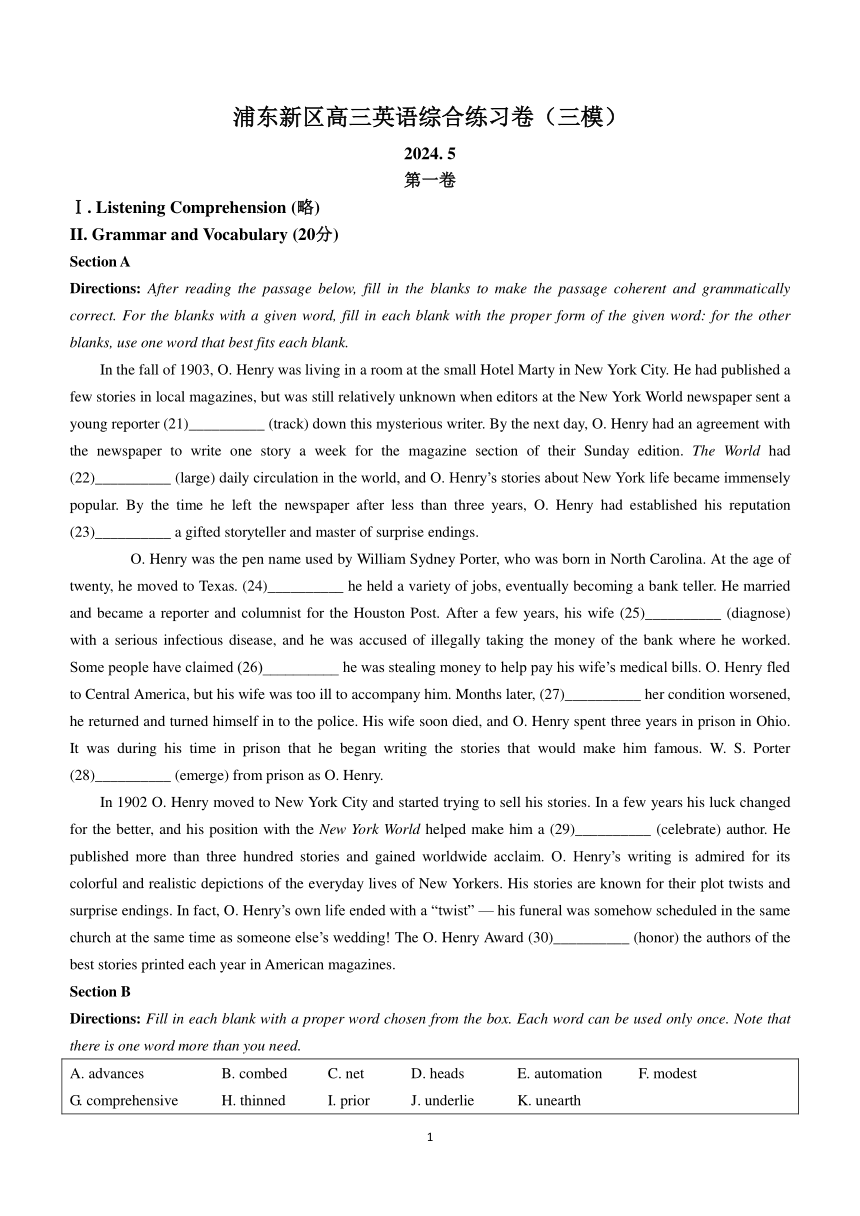
Directions: After reading the passage below, fill in the blanks to make the passage coherent and grammatically correct. For the blanks with a given word, fill in each blank with the proper form of the given word: for the other blanks, use one word that best fits each blank.
In the fall of 1903, O. Henry was living in a room at the small Hotel Marty in New York City. He had published a few stories in local magazines, but was still relatively unknown when editors at the New York World newspaper sent a young reporter (21)__________ (track) down this mysterious writer. By the next day, O. Henry had an agreement with the newspaper to write one story a week for the magazine section of their Sunday edition. The World had (22)__________ (large) daily circulation in the world, and O. Henry’s stories about New York life became immensely popular. By the time he left the newspaper after less than three years, O. Henry had established his reputation (23)__________ a gifted storyteller and master of surprise endings.
O. Henry was the pen name used by William Sydney Porter, who was born in North Carolina. At the age of twenty, he moved to Texas. (24)__________ he held a variety of jobs, eventually becoming a bank teller. He married and became a reporter and columnist for the Houston Post. After a few years, his wife (25)__________ (diagnose) with a serious infectious disease, and he was accused of illegally taking the money of the bank where he worked. Some people have claimed (26)__________ he was stealing money to help pay his wife’s medical bills. O. Henry fled to Central America, but his wife was too ill to accompany him. Months later, (27)__________ her condition worsened, he returned and turned himself in to the police. His wife soon died, and O. Henry spent three years in prison in Ohio. It was during his time in prison that he began writing the stories that would make him famous. W. S. Porter (28)__________ (emerge) from prison as O. Henry.
In 1902 O. Henry moved to New York City and started trying to sell his stories. In a few years his luck changed for the better, and his position with the New York World helped make him a (29)__________ (celebrate) author. He published more than three hundred stories and gained worldwide acclaim. O. Henry’s writing is admired for its colorful and realistic depictions of the everyday lives of New Yorkers. His stories are known for their plot twists and surprise endings. In fact, O. Henry’s own life ended with a “twist” — his funeral was somehow scheduled in the same church at the same time as someone else’s wedding! The O. Henry Award (30)__________ (honor) the authors of the best stories printed each year in American magazines.
Section B
Directions: Fill in each blank with a proper word chosen from the box. Each word can be used only once. Note that there is one word more than you need.
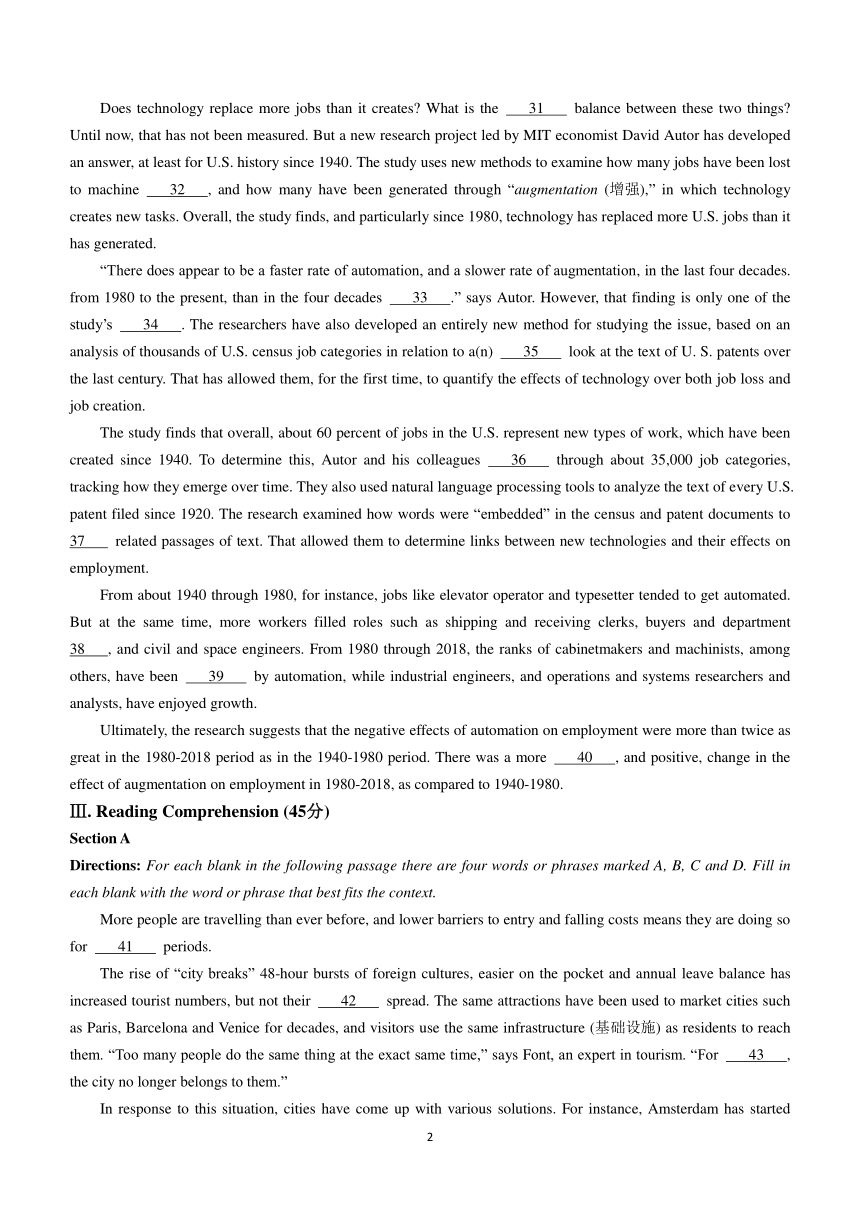
A. advances B. combed C. net D. heads E. automation F. prehensive H. thinned I. prior J. underlie K. unearth
Does technology replace more jobs than it creates What is the 31 balance between these two things Until now, that has not been measured. But a new research project led by MIT economist David Autor has developed an answer, at least for U.S. history since 1940. The study uses new methods to examine how many jobs have been lost to machine 32 , and how many have been generated through “augmentation (增强),” in which technology creates new tasks. Overall, the study finds, and particularly since 1980, technology has replaced more U.S. jobs than it has generated.
“There does appear to be a faster rate of automation, and a slower rate of augmentation, in the last four decades. from 1980 to the present, than in the four decades 33 .” says Autor. However, that finding is only one of the study’s 34 . The researchers have also developed an entirely new method for studying the issue, based on an analysis of thousands of U.S. census job categories in relation to a(n) 35 look at the text of U. S. patents over the last century. That has allowed them, for the first time, to quantify the effects of technology over both job loss and job creation.
The study finds that overall, about 60 percent of jobs in the U.S. represent new types of work, which have been created since 1940. To determine this, Autor and his colleagues 36 through about 35,000 job categories, tracking how they emerge over time. They also used natural language processing tools to analyze the text of every U.S. patent filed since 1920. The research examined how words were “embedded” in the census and patent documents to 37 related passages of text. That allowed them to determine links between new technologies and their effects on employment.
From about 1940 through 1980, for instance, jobs like elevator operator and typesetter tended to get automated. But at the same time, more workers filled roles such as shipping and receiving clerks, buyers and department 38 , and civil and space engineers. From 1980 through 2018, the ranks of cabinetmakers and machinists, among others, have been 39 by automation, while industrial engineers, and operations and systems researchers and analysts, have enjoyed growth.
Ultimately, the research suggests that the negative effects of automation on employment were more than twice as great in the 1980-2018 period as in the 1940-1980 period. There was a more 40 , and positive, change in the effect of augmentation on employment in 1980-2018, as compared to 1940-1980.
Ⅲ. Reading Comprehension (45分)
Section A
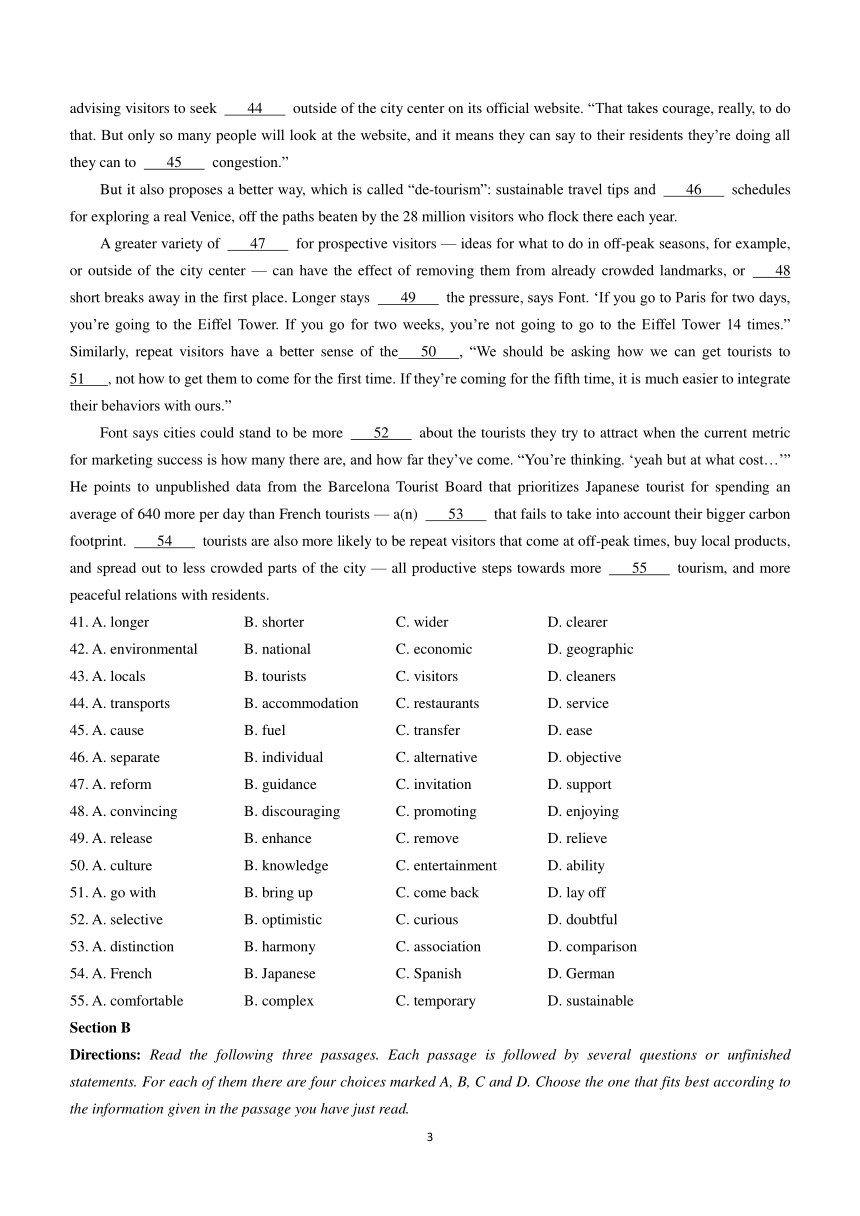
Directions: For each blank in the following passage there are four words or phrases marked A, B, C and D. Fill in each blank with the word or phrase that best fits the context.
More people are travelling than ever before, and lower barriers to entry and falling costs means they are doing so for 41 periods.
The rise of “city breaks” 48-hour bursts of foreign cultures, easier on the pocket and annual leave balance has increased tourist numbers, but not their 42 spread. The same attractions have been used to market cities such as Paris, Barcelona and Venice for decades, and visitors use the same infrastructure (基础设施) as residents to reach them. “Too many people do the same thing at the exact same time,” says Font, an expert in tourism. “For 43 , the city no longer belongs to them.”
In response to this situation, cities have come up with various solutions. For instance, Amsterdam has started advising visitors to seek 44 outside of the city center on its official website. “That takes courage, really, to do that. But only so many people will look at the website, and it means they can say to their residents they’re doing all they can to 45 congestion.”
But it also proposes a better way, which is called “de-tourism”: sustainable travel tips and 46 schedules for exploring a real Venice, off the paths beaten by the 28 million visitors who flock there each year.
A greater variety of 47 for prospective visitors — ideas for what to do in off-peak seasons, for example, or outside of the city center — can have the effect of removing them from already crowded landmarks, or 48 short breaks away in the first place. Longer stays 49 the pressure, says Font. ‘If you go to Paris for two days, you’re going to the Eiffel Tower. If you go for two weeks, you’re not going to go to the Eiffel Tower 14 times.” Similarly, repeat visitors have a better sense of the 50 , “We should be asking how we can get tourists to 51 , not how to get them to come for the first time. If they’re coming for the fifth time, it is much easier to integrate their behaviors with ours.”
Font says cities could stand to be more 52 about the tourists they try to attract when the current metric for marketing success is how many there are, and how far they’ve come. “You’re thinking. ‘yeah but at what cost…’” He points to unpublished data from the Barcelona Tourist Board that prioritizes Japanese tourist for spending an average of 640 more per day than French tourists — a(n) 53 that fails to take into account their bigger carbon footprint. 54 tourists are also more likely to be repeat visitors that come at off-peak times, buy local products, and spread out to less crowded parts of the city — all productive steps towards more 55 tourism, and more peaceful relations with residents.
41. A. longer B. shorter C. wider D. clearer
42. A. environmental B. national C. economic D. geographic
43. A. locals B. tourists C. visitors D. cleaners
44. A. transports B. accommodation C. restaurants D. service
45. A. cause B. fuel C. transfer D. ease
46. A. separate B. individual C. alternative D. objective
47. A. reform B. guidance C. invitation D. support
48. A. convincing B. discouraging C. promoting D. enjoying
49. A. release B. enhance C. remove D. relieve
50. A. culture B. knowledge C. entertainment D. ability
51. A. go with B. bring up C. come back D. lay off
52. A. selective B. optimistic C. curious D. doubtful
53. A. distinction B. harmony C. association D. comparison
54. A. French B. Japanese C. Spanish D. German
55. A. comfortable B. complex C. temporary D. sustainable
Section B
Directions: Read the following three passages. Each passage is followed by several questions or unfinished statements. For each of them there are four choices marked A, B, C and D. Choose the one that fits best according to the information given in the passage you have just read.
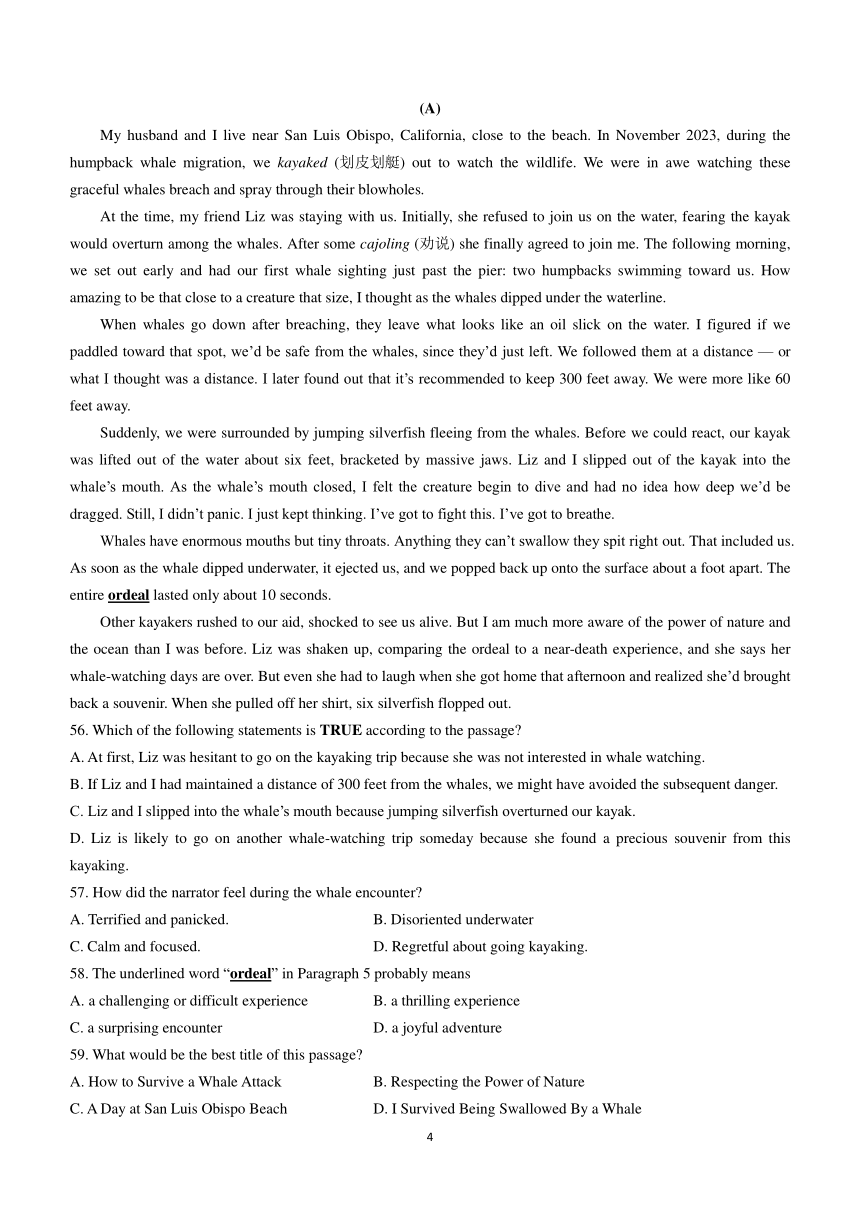
(A)
My husband and I live near San Luis Obispo, California, close to the beach. In November 2023, during the humpback whale migration, we kayaked (划皮划艇) out to watch the wildlife. We were in awe watching these graceful whales breach and spray through their blowholes.
At the time, my friend Liz was staying with us. Initially, she refused to join us on the water, fearing the kayak would overturn among the whales. After some cajoling (劝说) she finally agreed to join me. The following morning, we set out early and had our first whale sighting just past the pier: two humpbacks swimming toward us. How amazing to be that close to a creature that size, I thought as the whales dipped under the waterline.
When whales go down after breaching, they leave what looks like an oil slick on the water. I figured if we paddled toward that spot, we’d be safe from the whales, since they’d just left. We followed them at a distance — or what I thought was a distance. I later found out that it’s recommended to keep 300 feet away. We were more like 60 feet away.
Suddenly, we were surrounded by jumping silverfish fleeing from the whales. Before we could react, our kayak was lifted out of the water about six feet, bracketed by massive jaws. Liz and I slipped out of the kayak into the whale’s mouth. As the whale’s mouth closed, I felt the creature begin to dive and had no idea how deep we’d be dragged. Still, I didn’t panic. I just kept thinking. I’ve got to fight this. I’ve got to breathe.
Whales have enormous mouths but tiny throats. Anything they can’t swallow they spit right out. That included us. As soon as the whale dipped underwater, it ejected us, and we popped back up onto the surface about a foot apart. The entire ordeal lasted only about 10 seconds.
Other kayakers rushed to our aid, shocked to see us alive. But I am much more aware of the power of nature and the ocean than I was before. Liz was shaken up, comparing the ordeal to a near-death experience, and she says her whale-watching days are over. But even she had to laugh when she got home that afternoon and realized she’d brought back a souvenir. When she pulled off her shirt, six silverfish flopped out.
56. Which of the following statements is TRUE according to the passage
A. At first, Liz was hesitant to go on the kayaking trip because she was not interested in whale watching.
B. If Liz and I had maintained a distance of 300 feet from the whales, we might have avoided the subsequent danger.
C. Liz and I slipped into the whale’s mouth because jumping silverfish overturned our kayak.
D. Liz is likely to go on another whale-watching trip someday because she found a precious souvenir from this kayaking.
57. How did the narrator feel during the whale encounter
A. Terrified and panicked. B. Disoriented underwater
C. Calm and focused. D. Regretful about going kayaking.
58. The underlined word “ordeal” in Paragraph 5 probably means
A. a challenging or difficult experience B. a thrilling experience
C. a surprising encounter D. a joyful adventure
59. What would be the best title of this passage
A. How to Survive a Whale Attack B. Respecting the Power of Nature
C. A Day at San Luis Obispo Beach D. I Survived Being Swallowed By a Whale
(B)
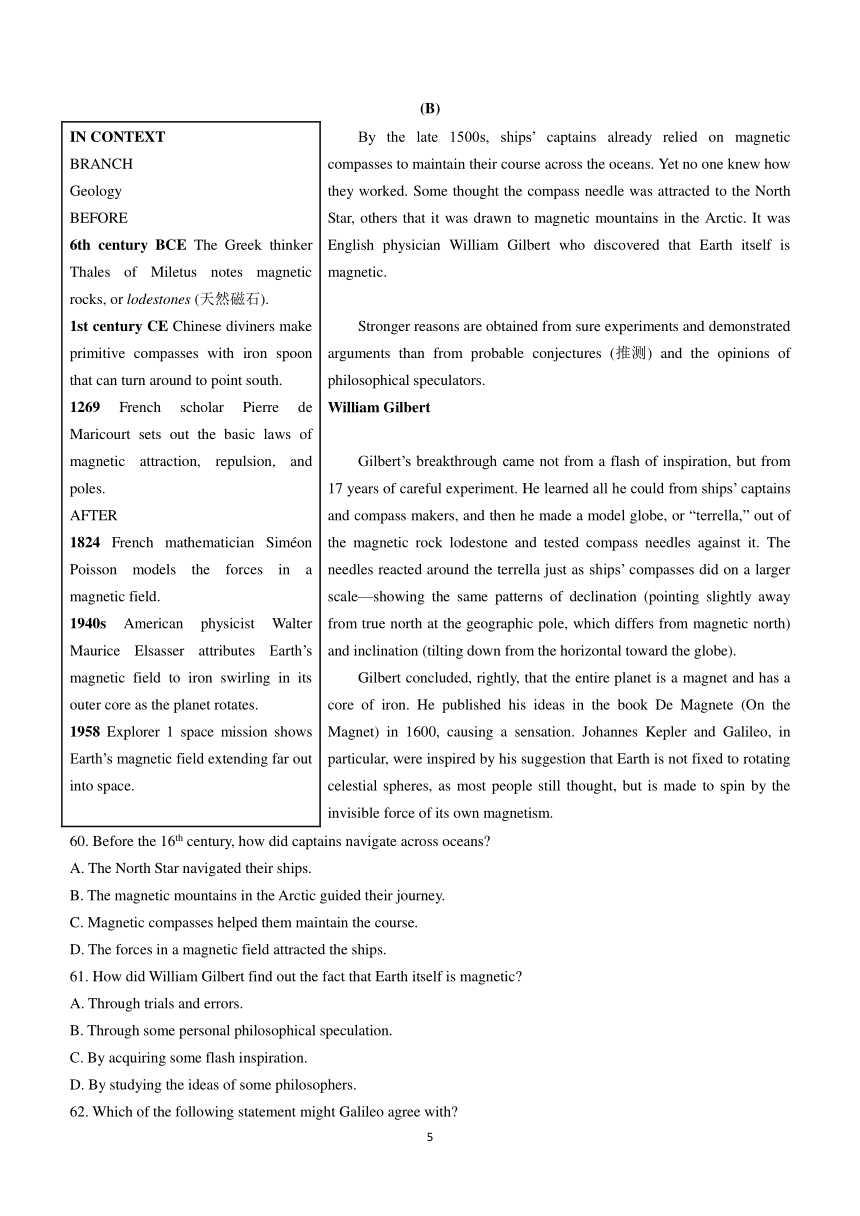
IN CONTEXTBRANCHGeologyBEFORE6th century BCE The Greek thinker Thales of Miletus notes magnetic rocks, or lodestones (天然磁石).1st century CE Chinese diviners make primitive compasses with iron spoon that can turn around to point south.1269 French scholar Pierre de Maricourt sets out the basic laws of magnetic attraction, repulsion, and poles.AFTER1824 French mathematician Siméon Poisson models the forces in a magnetic field.1940s American physicist Walter Maurice Elsasser attributes Earth’s magnetic field to iron swirling in its outer core as the planet rotates.1958 Explorer 1 space mission shows Earth’s magnetic field extending far out into space. By the late 1500s, ships’ captains already relied on magnetic compasses to maintain their course across the oceans. Yet no one knew how they worked. Some thought the compass needle was attracted to the North Star, others that it was drawn to magnetic mountains in the Arctic. It was English physician William Gilbert who discovered that Earth itself is magnetic.Stronger reasons are obtained from sure experiments and demonstrated arguments than from probable conjectures (推测) and the opinions of philosophical speculators.William GilbertGilbert’s breakthrough came not from a flash of inspiration, but from 17 years of careful experiment. He learned all he could from ships’ captains and compass makers, and then he made a model globe, or “terrella,” out of the magnetic rock lodestone and tested compass needles against it. The needles reacted around the terrella just as ships’ compasses did on a larger scale—showing the same patterns of declination (pointing slightly away from true north at the geographic pole, which differs from magnetic north) and inclination (tilting down from the horizontal toward the globe).Gilbert concluded, rightly, that the entire planet is a magnet and has a core of iron. He published his ideas in the book De Magnete (On the Magnet) in 1600, causing a sensation. Johannes Kepler and Galileo, in particular, were inspired by his suggestion that Earth is not fixed to rotating celestial spheres, as most people still thought, but is made to spin by the invisible force of its own magnetism.
60. Before the 16th century, how did captains navigate across oceans
A. The North Star navigated their ships.
B. The magnetic mountains in the Arctic guided their journey.
C. Magnetic compasses helped them maintain the course.
D. The forces in a magnetic field attracted the ships.
61. How did William Gilbert find out the fact that Earth itself is magnetic
A. Through trials and errors.
B. Through some personal philosophical speculation.
C. By acquiring some flash inspiration.
D. By studying the ideas of some philosophers.
62. Which of the following statement might Galileo agree with
A. The earth stays still.
B. Gilbert successfully refuted the laws of magnetic attraction.
C. Gilbert’s findings and conclusions are sensational.
D. The earth has its own magnetic field.
(C)
Could your dog be prone to a fatal disease Is your new shelter pup part beagle or boxer Many pet owners seek answers to these questions, and as a result, direct-to-consumer dog DNA testing is booming.
Human interfering with dog DNA has long been the driving factor behind dogs’ breed diversity — or lack thereof. But a dog’s DNA can also be used to confirm their lineage (血统) or identify their breed, a boon for pet owners on the lookout for breed-specific health or behavioral challenges or those looking to confirm their dog really has the heritage claimed by a breeder or seller. During DNA analysis, labs sequence the dog’s DNA and look for similarities with a dataset of identified dog breeds.
But breed identification isn’t as simple as it might seem. In a study published in the Journal of the American Veterinary Medical Association last month, scientists looked into the accuracy of breed prediction in commercially available DNA tests that required a photo of the dog in addition to its DNA sample. The results were mixed, says Casey Greene, a professor who co-authored the study.
“Most tests could accurately distinguish the breed of purebred dogs,” says Greene. But the analysis suggested that some testing companies might rely on the photo more than the dog’s actual genetics — and revealed big differences between companies’ business practices and the genetic datasets they use to determine dog breeds.
The researchers submitted photos and DNA of 12 purebred dogs to a total of six commercial canine (犬的) ancestry identification services. Since each pup was purebred and possessed extensive American Kennel Club paperwork, the researchers knew their breed conclusively—but in some cases they provided a photo of a different dog to see if the photo influenced the DNA results. One of the companies misidentified a purebred Chinese crested dog — almost entirely hairless — as a long-haired Brittany spaniel, seemingly based on the photo alone. The other five did identify the registered breed correctly, but often gave different predictions for other “ancestor” breeds in dogs whose DNA suggested mixed breeding in prior generations. The researchers concluded that veterinarians and pet owners alike should “approach direct-to-consumer tests with caution” given the lack of industry standardization and at least one company’s reliance on photographs instead of DNA analysis.
Despite these concerns, though. dog DNA seems headed for a golden age — and the insights revealed through further study of Fido’s genome (基因组) have already reached far beyond the doghouse. Domesticated dogs have emerged as surprising superstars in medical research that benefits humans. According to researchers, that’s just the beginning. With implications ranging from entertaining to consequential, there’s no telling what dog DNA will continue to unleash.
63. The underlined word “boon” in paragraph two is closest in meaning to ________.
A. blessing B. substitute C. duty D. struggle
64. According to the passage, dog DNA testing can serve the following purposes except that ________.
A. it assists in accurately determining the breed a dog belongs to
B. it helps to predict whether dogs are subject to certain diseases
C. it provides pet owners with insights into dogs’ behavioral challenges
D. it sequences the DNA of identified dog breeds to find their similarities
65. Which of the following statements can be concluded from the passage
A. Photos play a more significant role in identifying a dog’s breed than its actual genetics.
B. It is a common phenomenon that the DNA analysis of dogs may yield mixed results.
C. Commercial dog DNA tests still have limitations and should be dealt with cautiously.
D. Direct-to-consumer tests overshadow DNA analysis in identifying purebred dogs.
66. What does the passage suggest about the future of dog DNA testing
A. Controversies regarding its reliability are here to stay.
B. It is bound to make breakthroughs in the fields of medicine and entertainment.
C. It can step into a golden age as long as some research limitations are fixed.
D. It may have far-reaching significance and be applied to a wider range of areas.
Section C
Directions: Read the following passages. Fill in each blank with a proper sentence given in the box. Each sentence can be used only once. Note that there are two more sentences than you need.
A. Early interventions are key, so you’ve got to stay active.B. Perhaps surprisingly, those who deal with it have struggled to settle on a single definition.C. It’s not something we’re born with, but also it’s not something we learn, but an ability that we gain early and lose over time.D. For some people. just try to build in an element of balance and muscle strengthening.E. Maybe you used to be able to quickly stand on one leg to put a shoe on, and you’ve stopped doing that at some point.F. Whatever activity you choose. the lesson is to work on your balance before you need to, not when it becomes an issue
Until we start to lose our balance. we barely notice that it’s there at all. “It starts for a lot of people with simple stuff.” says Dr Anna Lowe, an expert on healthy ageing and physical activity. “ 67 It’s easy to either miss the signs or just put it down to ageing — but it really is something you can affect.”
The key, it is increasingly becoming clear, is to address the decline before it gets serious: and that can happen earlier than you might think.
What is balance Technically, it’s the complex interaction of several different systems in your body — from muscles, nerves, eyesight and the inner ear to the sensory system that lets you recognise where your body is touching the ground, along with movement receptors within your joints that tell you where your body is in space. 68
A lack of balance is, globally, associated with serious health problems. Earlier this year, the British Journal of Sports Medicine published the results of a decade-long study involving more than 1,700 middle-aged participants, which concluded that an inability to balance was associated with an almost twofold increase in risk of death.
“ 69 ” agrees Lowe, an associate professor researching strength and balance in midlife. “Older women are far less active than older men, and general activity, just moving around and doing stuff, affects balance a lot. Single-legged movements, such as walking lunges, are a great test of dynamic (动态的) balance, but even bilateral movements, like squats (深蹲), can provide a challenge.”
70 Resistance exercise, whether that means lifting weights or hiking with a backpack, comes with a host of other proven health benefits, from improved bone density to a reduced risk of Alzheimer’s. As Locker puts it: everyone’s told to save money for their retirement, and nobody’s taught to save their balance. But both are difficult to get back once they’re gone.
Ⅳ. Summary Writing (10分)
71. Directions: Read the following passage. Summarize the main idea and the main point(s) of the passage in no more than 60 words. Use your own words as far as possible.
It seems that deep, long-lasting happiness comes from intangible things, rather than things like chocolates and smart-phones. One essential factor is human relationships. People who have the support of family members and also have strong friendships are more likely to be happy. Feeling protected and respected and knowing you can trust in the people around you is vital. But happiness means you have to give and take. Performing acts of kindness and generosity on a regular basis, for example, listening to a friend in need for carrying a neighbor’s shopping, will make you feel on top of the world. Even a simple smile can work wonders. In fact, they say that one smile makes a person feel as good as eating 2,000 bars of chocolates (not all at once, of course).
It is not surprising that health is another key contributor to happiness. Poor health will certainly make you feel down in the mouth. But being healthy and staying healthy require some effort. A healthy diet is crucial and so is regular exercise. Laziness will not make you happy. Exercising for 20 to 30 minutes a day helps to reduce stress and anxiety and makes you feel more positive and optimistic because it releases endorphins (feel-good chemicals). So, if you have been feeling blue and worrying too much about your exams, get exercising. You’ll also find that you sleep better.
Talking of sleep, do you often wake up feeling miserable If so, it’s probably because you haven’t had enough of it. Teenagers tend to go to bed too late and have to get up early, so many suffer from a lack of sleep. Tiredness will certainly affect your happiness levels and put you in a bad mood. It also affects your ability to concentrate and may slow your growth. So if you want to be happy and do well at school, try to get at least eight hours of sleep a night. Now that you know the theory, it’s time to put it all into practice.
第二卷
Ⅴ. Translation (15分)
Directions: Translate the following sentences into English, using the words given in the brackets.
72. 景区可利用短视频提升知名度,助力文旅宣传。(facilitate)
73. 他运动之前习惯热身和拉伸以避免受伤。(ritual)
74. 为缓解人口老龄化的压力,中国政府正在建立更多的社区机构来为老年人的生活提供支持。(ease)
75. 网络红包的乐趣在于它的未知性,因为收到红包的人只有打开它时才知道自己到底抢到了多少钱。(until)
Ⅵ. Guided Writing (25分)
76. Directions: Write an English composition in 120-150 words according to the instructions given below in Chinese.
假如你是明启中学的吴磊,高考结束之后,你的学校组织校友活动,请即将毕业的高三学生进班给高一高二的学弟学妹们传授经验,请结合自身经历写一篇发言稿。你的发言稿须:
1. 描述你在高中三年最大的收获;
2. 就如何过好高中生活,给出你的建议。
浦东高三英语 练习卷 2024.5 参考答案
21. to track 22. the largest 23. as 24. where 25. was diagnosed
26. that 27. when 28. emerged 29. celebrated 30. honors
31-35 CEIAG 36-40 BKDHF
C. net E. automation I. prior A. advances G. comprehensive
B. combed K. unearth D. heads H. thinned F. modest
41-45 BDABD 46-50 CBBDA 51-55 CADAD
56-59 BCAD
60-62CAD
63-66 ADCD
67-70 ECAF
71. (60 words)
Sustainable happiness may well be more spiritual than material. The cozy relationship, at home or in the workplace, often makes people feel good. Another element of happiness is staying healthy. To attain this, one needs to
keep a healthy diet and exercise regularly. Finally, happiness comes from good sleep. Quality sleep ensures cheerful mood and brings about sound academic performance.
72. (3分) Scenic spots can use short videos to raise reputation/profile and facilitate the cultural tourism promotion.
73. (3分) He makes it a ritual to warm up and stretch before exercising to avoid getting injured.
(4分) To ease the pressure from the aging population, the Chinese government is now establishing more community agencies to support the lives of the elderly.
75. (5分) The joy of online red packet lies in its unpredictability, for the one receiving it will never know how much he has grabbed until he opens it.
76.
Dear fellow students,
As we gather here today. I am filled with nostalgia, reminiscing about the journey we’ve undertaken together in our school. These three years have been a period of immense growth and learning for all of us. As a graduating senior. I am honored to share with you the most significant lessons I’ve learned during my time here.
First and foremost, the greatest takeaway from my high school experience has been the importance of perseverance and hard work. High school is not just about academics; it’s also about personal growth and development. For example, when I first joined the debate club in my sophomore year, I struggled with public speaking. However, through consistent practice and determination. I not only improved my speaking skills but also gained confidence in myself.
My advice to all of you is simple: embrace every opportunity and challenge that comes your way. Step out of your comfort zone, join clubs, participate in extracurricular activities, and make new friends. High school is a time to explore your interests, discover your passions, and develop important life skills.
Moreover, never underestimate the power of time management and organization. Learn to prioritize your tasks, set realistic goals, and manage your time effectively. By staying organized and focused, you’ll be able to balance your academic responsibilities with your personal life and extracurricular activities.
Lastly, remember to take care of yourself both mentally and physically. High school can be stressful, but it’s essential to find healthy ways to cope with the pressure. Make sure to get enough sleep, eat well, and find activities that help you relax and unwind.
In conclusion, high school is a journey filled with ups and downs, but it’s also a time of incredible growth and discovery. Embrace every moment, cherish your friendships, and never stop striving for excellence. I wish you all the best in the high school journey and beyond.
Thank you.
Al
Dear fellow students,
As Wu Lei from Mingqi Middle School, it’s an honor to stand here and share my experiences with you. High school has been a transformative journey for me, and I’m excited to pass on the wisdom I’ve gained.
Firstly, the greatest lesson I learned in high school is the importance of perseverance. The journey is challenging, but it’s the consistent effort that leads to success. Remember, every step counts, and every struggle shapes us.
For those of you starting your high school journey, my first suggestion is to set clear goals. Whether it’s academic, extracurricular, or personal, having a direction gives you focus and momentum.
Secondly, don’t be afraid to take risks. High school is a time for exploration and discovery. Embrace opportunities to try new things, even if they’re outside your comfort zone. You’ll learn more about yourself and what you’re capable of.
Moreover, make the most of your relationships. High school is not just about academics; it’s also about making lifelong friends. Cherish the moments you spend with your classmates, as they will become precious memories in the future.
Lastly, enjoy the ride. High school is a once-in-a-lifetime experience, so make sure to savor every moment. Don’t take yourself too seriously; after all, it’s just a phase of life, and it will pass. Embrace the fun, the challenges, and the growth that come with it.
In conclusion, high school is a time of growth and discovery. With perseverance, focus, bravery, and 珍惜, you can make it a transformative experience. I wish you all the best in your high school journey and beyond.

展开更多......

收起↑

资源预览