外研版(2024)七年级上册Unit 1 A new start重点知识点笔记

资源下载
  1. 二一教育资源

外研版(2024)七年级上册Unit 1 A new start重点知识点笔记

资源简介

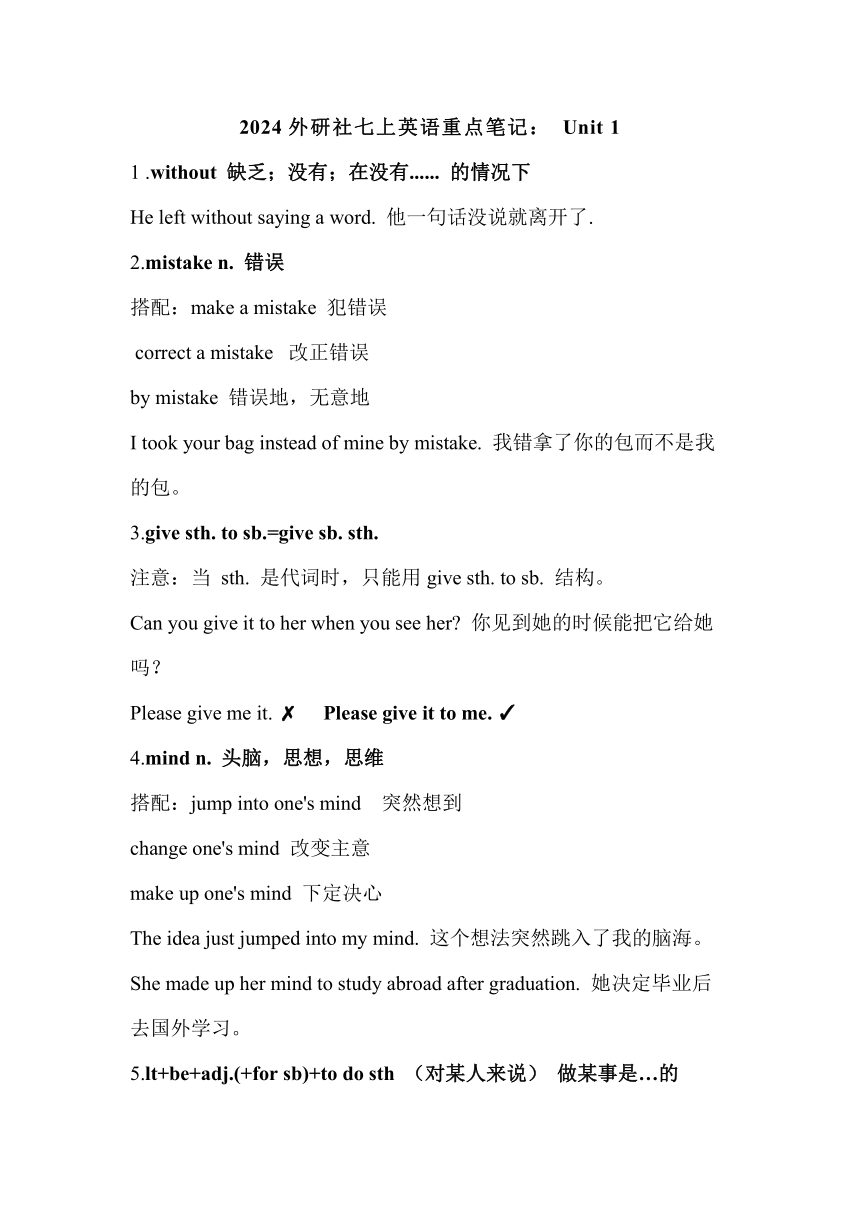
2024外研社七上英语重点笔记: Unit 1
1 .without 缺乏;没有;在没有...... 的情况下
He left without saying a word. 他一句话没说就离开了.
2.mistake n. 错误
搭配:make a mistake 犯错误
correct a mistake 改正错误
by mistake 错误地,无意地
I took your bag instead of mine by mistake. 我错拿了你的包而不是我的包。
3.give sth. to sb.=give sb. sth.
注意:当 sth. 是代词时,只能用give sth. to sb. 结构。
Can you give it to her when you see her 你见到她的时候能把它给她吗?
Please give me it. Please give it to me.
4.mind n. 头脑,思想,思维
搭配:jump into one's mind 突然想到
change one's mind 改变主意
make up one's mind 下定决心
The idea just jumped into my mind. 这个想法突然跳入了我的脑海。
She made up her mind to study abroad after graduation. 她决定毕业后去国外学习。
5.lt+be+adj.(+for sb)+to do sth (对某人来说) 做某事是…的
lt+be+adj.(+of sb)+to do sth 某人做某事是…的
It's difficult for him to learn a new language. 对他来说学习一门新语言是困难的。
It's impossible for them to finish the project in one day. 对他们来说一天之内完成这个项目是不可能的。
【易混辨析】该句型中for与of的用法区别
① 若句中的形容词是用来描述事物或者客观情况的,
如easy, hard, dangerous, difficult, important, necessary, possible等,用介词for
It' 's dangerous for you to swim in the river. 你在河里游泳是危险的。
② 若句中的形容词是用来描述或者说明人的性格、品质的,如good, kind, nice, clever等,用介词of
It's very kind of you to help me.你帮助我真是太好了。
It’s careless of you to make lots of mistakes. 你犯许多错误真是太粗心了。
6.write down 写下,记下
Please write down your name and address on the form. 请在表格上写下你的名字和地址。
I'll tell you the answer, but you have to write it down. 我会告诉你答案,但你必须把它写下来。
7.point out 指出
Thank you for pointing out my mistakes.
point at 指着(强调的是对象)
注意:at 有“向”的意思。
look at 看;smile at 对……微笑;shout at 对……大喊; laugh at 嘲笑
He points at the jacket over there.
point to 指向 (强调的是方向)
She points to the wrong direction. 她指向错误的方向。
point 作名词用时,表示“点,小数点,尖端”,3.5读作:three point five
8. how many 与 how much (笔记省略)
How much is the bag = What's the price of the bag
9.find out “发现,查明”, 其后常接 truth, fact 等抽象名词
find out the truth 查明真相
辨析:look for ,find, find out
10.辨析:say, speak, tell, talk (笔记省略)
11. choose 挑选,选择,选取
choose...as...选择....作为......
We chose him as our team leader because he is responsible. 我们选择他作为我们的队长,因为他很负责任。
12.辨析:take, spend, pay, cost
1). It takes sb. + 时间+ to do sth. 花费某人一段时间来做某事
It takes me two hours to finish my homework every day. 我每天花费两个小时来完成作业。
How long does it take you to finish your homework every day
2).Sb. spends + 时间/金钱 + (in) doing sth. 某人花费时间/金钱做某事
Sb. spends + 时间/金钱 + on sth. 某人花费时间/金钱在某事上
Don't spend much time playing computer games. =Don't spend much time on computer games.
I spend two hours doing my homework every day. 我每天花费两个小时做作业。
3).Sth. costs sb. +金钱 :某物花费某人多少钱
How much does this house cost (新1第89课)
The new computer cost me five thousand yuan.这台新电脑花费了我五千元。
4).Sb. pays +金钱 for sth. :某人为某物支付了多少钱
I paid 100 dollars for the concert ticket.
13.try one's best 尽某人最大的努力
try one's best to do sth. 尽某人最大的努力去做某事
The team tried their best to win the game. 队伍尽了他们最大的努力去赢得比赛。
14.decide to do sth. 决定去做某事
make a decision 做决定
He decided to study abroad next year. 他决定明年去国外学习。
The manager needs to make a decision quickly. 经理需要迅速做出决定。
15.特殊疑问句+动词不定式
“疑问词+不定式”结构可在句子中作主语、表语、宾语。常用的疑问词有how、who、what、when、which、where 等,注意why不能用于 “疑问词+不定式”结构。
1). 作主语:
Who will attend the meeting has not been decided. 谁会参加会议还没有决定。
What to do next is a difficult decision. 下一步做什么是一个艰难的决定。
Which book to choose depends on your interests. 选择哪本书取决于你的兴趣。
2). 作表语:
My biggest headache is how to be polite in English. 我最头痛的问题是如何用英语礼貌地表达。
The problem is what to do with the old computer. 问题是如何处理这台旧电脑。
3). 作宾语:
I don't know how to use this software. 我不知道如何使用这个软件。
Can you tell me where to buy this book 你能告诉我在哪里可以买到这本书吗?
She wondered which movie to watch tonight. 她在想今晚看哪部电影。
I don't know what to do.=I don't know what I should do.
16.protect ...from... 保护...免受...
The medicine can protect you from getting sick.
17.problem 与 question
1). problem 多指“麻烦,问题”,通常指要解决或处理的问题,常和 solve (解决)连用
The teacher helped us with the math problem. 老师帮助我们解决了数学问题。
That's your problem. 那是你的问题。
2). question 常指需要对方答复的问题,常和answer (回答)连用。
Can you answer this question about history 你能回答这个历史问题吗?
The students asked a lot of questions. 学生们问了很多问题。
18.辨析:across, through, over
through:"穿过“, 从立体空间内穿过 ,例如go through the tunnel 穿过隧道
across ” 横穿“,从物体表面穿过或从一边到另一边。go across the road 过马路
over"穿越”,指从物体上方穿过或越过 jump over the fence 翻越栅栏
19.look up at 向上看, 抬头看
When I walked outside, I looked up at the clear blue sky. 当我走到外面时,我抬头看向清澈的蓝天。
look up 还有“查阅,查找”的意思
I had to look up the word in the dictionary because I didn't know its meaning.
我不得不在字典里查找那个词,因为我不知道它的意思。
20.put up
1).举起,抬起
She put up her hand to ask a question. 她举手提问。
2).搭建,搭起
They put up a tent in the backyard for the party. 他们在后院搭起一个帐篷来开派对。
3).张贴
She decided to put up posters around the school. 她决定在学校周围张贴海报。
21.polite (有礼貌的)-impolite (不礼貌的)-politely (adv. 有礼貌地)
It's impolite to stare at people. 盯着人看是不礼貌的。
It's impolite of you to speak loudly in the library. 在图书馆大声说话是不礼貌的。
22.forget 与 remember
1). forget to do sth. 忘记要去做某事
forget doing sth. 忘记做过某事
Don't forget to lock the door when you leave the house.
I forgot locking the door. I thought it was open.
2). remember to do sth. 与 remember doing sht.
remember to do sth. 记住要做某事
remember doing sth. 记得做过某事
Remember to call your mother when you get to school.
I remember meeting her at a party last year.
23.advice 用法
表示“建议”的词汇总结:
名词: advice (不可数) suggestion (可数)
He gave me some good advice on how to study effectively. 他给了我一些如何有效学习的好建议。
a piece of advice 一条建议
a suggestion 一条建议
take/follow one's advice 听取劝告
ask sb. for advice 向某人寻求建议
Well, next time you'd better take my advice! 下次你最好还是听从我的劝告吧!(新l L129)
动词:advise, suggest
搭配:advise sb. to do sth.
suggest doing sth.
24. few, a few, little, a little 用法 (以前讲过,笔记省略)
25. sound, voice, noise (以前讲过,笔记省略)
26.take off
1). 脱掉
I need to take off my shoes before entering the house. 我需要在进屋前脱掉鞋子。
2). 起飞
The airplane will take off in 10 minutes. 飞机将在10分钟后起飞。
27.get to know sb./sth. 开始了解某人/某事
The new student got to know his classmates by joining the school club.新学生通过加入学校俱乐部开始了解他的同学们。
I got to know him two years ago.
28.What do you think of sb./sth.= How do you like sb./sth.
你觉得……怎么样?/你认为……如何?
What do you think of the movie we watched last night
How do you like the new smartphone(智能手机)your parents bought you
29. take part in 与join
take part in “参加”,通常表示参加群体性活动
join “参加,加入”,通常表示加入某个团体,组织或人群
Many students took part in the science competition. 许多学生参加了科学竞赛。
My brother joined the basketball team last month.我哥哥上个月加入了篮球队。
He joined the army to serve his country. 他参军为国家服务。
He joined us in the discussion yesterday. 他昨天参加了我们的讨论。
30.smile 用法
with a smile 面带微笑
smile at sb. 对某人微笑
She answered the question with a smile. 她面带微笑地回答了问题。
I smiled at the stranger, and he smiled back.我对陌生人微笑,他也回以微笑。
31.traditional 与 tradition
traditional adj. 传统的
tradition n.传统
traditional culture 传统文化
She wore a traditional wedding dress on her big day. 她在大喜之日穿着传统的婚纱。
It's a tradition in our family to give red envelopes during the Chinese New Year. 在我们家,春节给红包是一个传统。
32. hope 用法
hope to do sth. 希望做某事
hope ( that)... 希望...
She hopes to travel around the world. 她希望能周游世界。
I hope it will rain tomorrow. 我希望明天会下雨。
33.away adv. 朝另一方向;离开
run away - 逃跑
throw away - 扔掉
put away - 收起来
go away - 离开(走掉)
be away 离开,不在
be away from 离开某地/远离某物
Why is he away from home 他为什么离开家?
The teacher tells us to be away from fire. 老师告诉我们要远离火。
34. happen v. (尤指意外地)发生
sth. happens to sb. 某人发生某事
sb. happens to do sth. 某人碰巧做某事
A traffic accident happened to an old man and I happened to see it on my way home. 一位老人发生了一场交通事故,我在回家的路上碰巧看到了。
35.辨析:other, the other, another, others, the others
1). other adj. 其余的,另外的
I have other books to read. 我还有其他书要读。
2). the other : 指“两者中的另一个”,表示特指。
常用搭配:one... the other 一个... 另一个
I have two pens, one is red and the other is blue. 我有两支笔,一支是红色的,另一支是蓝色的。
3). another (三者或三者以上的)另一个
I don't like this one, please show me another.我不喜欢这个,请给我看另一个。
4). others “另外的人或事物”,单独使用
He is friendly to others. 他对其他人很友好。
常用搭配:some... others ...一些...另一些...
Some students were playing basketball while others were reading books in the library. 一些学生在打篮球,而另一些学生在图书馆看书。
5). the others 特指“其余所有的(人或物)
I don't like this one, and show me the others. 我不喜欢这个,把剩余的都拿来给我看看。
There are 20 students in the class, 10 are girls, the others are boys. 班里有20个学生,10个是女生,其他的是男生。
注意:some... others... some...the others 有些区别 (使用“some... the others...”时,意味着这两部分覆盖了所有可能的情况,没有遗漏。而“some... others...”则不强调这一点,可能还有其他未提及的部分)
36.meaning 与 mean
the meaning of ...的意思/意义
"......是什么意思?“ 的表达法:
What's the meaning of...
What do/does... mean
What do you mean by...
What's the meaning of life 生命的意义是什么?
What's the meaning of this sentence 这个句子是什么意思?
37. lonely 与 alone
lonely孤独的,寂寞的
He felt lonely even though he was surrounded by people.
I feel lonely when I am away from my friends.
alone: 单独的,独自的 (相当于 by oneself)
He decided to travel alone.
You can't leave a five-year-old child alone.
She finished the project by herself.

展开更多......

收起↑

资源预览