Unit2School life 知识点讲义牛津译林版八年级英语上册

资源下载
  1. 二一教育资源

Unit2School life 知识点讲义牛津译林版八年级英语上册

资源简介

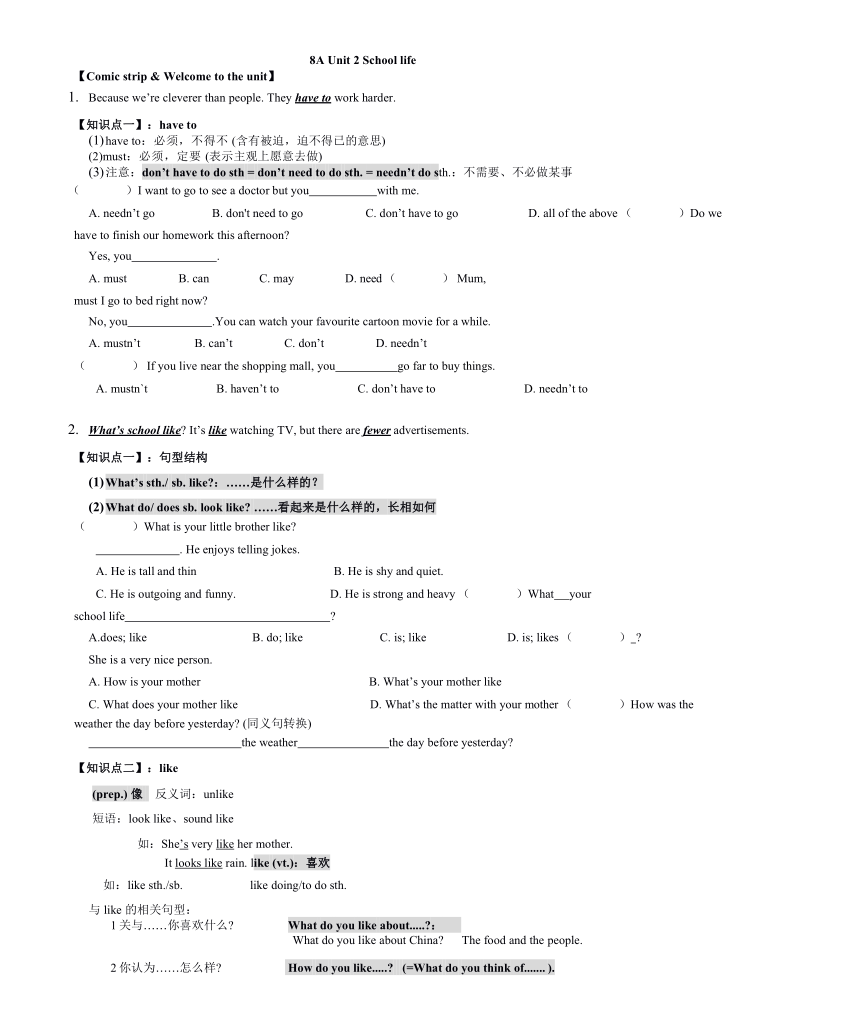
8A Unit 2 School life
【Comic strip & Welcome to the unit】
Because we’re cleverer than people. They have to work harder.
【知识点一】:have to
have to:必须,不得不 (含有被迫,迫不得已的意思)
(2)must:必须,定要 (表示主观上愿意去做)
注意:don’t have to do sth = don’t need to do sth. = needn’t do sth.:不需要、不必做某事
( )I want to go to see a doctor but you with me.
A. needn’t go B. don't need to go C. don’t have to go D. all of the above ( )Do we have to finish our homework this afternoon
Yes, you .
A. must B. can C. may D. need ( ) Mum, must I go to bed right now
No, you .You can watch your favourite cartoon movie for a while.
A. mustn’t B. can’t C. don’t D. needn’t
( ) If you live near the shopping mall, you go far to buy things.
A. mustn`t B. haven’t to C. don’t have to D. needn’t to
What’s school like It’s like watching TV, but there are fewer advertisements.
【知识点一】:句型结构
What’s sth./ sb. like :……是什么样的?
What do/ does sb. look like ……看起来是什么样的,长相如何
( )What is your little brother like
. He enjoys telling jokes.
A. He is tall and thin B. He is shy and quiet.
C. He is outgoing and funny. D. He is strong and heavy ( )What your school life
A.does; like B. do; like C. is; like D. is; likes ( )
She is a very nice person.
A. How is your mother B. What’s your mother like
C. What does your mother like D. What’s the matter with your mother ( )How was the weather the day before yesterday (同义句转换)
the weather the day before yesterday
【知识点二】:like
(prep.) 像 反义词:unlike
短语:look like、sound like
如:She’s very like her mother.
It looks like rain. like (vt.):喜欢
如:like sth./sb. like doing/to do sth.
与 like 的相关句型:
1关与……你喜欢什么 What do you like about..... :
What do you like about China The food and the people.
2你认为……怎么样 How do you like..... (=What do you think of ).
如:How do you like the film It’s very interesting.
( )Lucy, her elder sister, dressing up.
A.dislike; unlikes B.unlike; unlikes
C.unlike; dislikes D.dislike; dislikes
( ) QQ chatting
Wonderful! It’s like with a real person in front of you.
A.What do you think of;to chat B.How do you find;chatting
C.What do you like;chatting D.How do you think of;to chat
【知识点三】:fewer
更少
注意区分:little—less—least (不可数)
few—fewer—fewest (可数)
回顾:a few few;k’ a little little
( )Spanish (西班牙语) has the second number of speakers in the world, but it has
speakers than Chinese.
A. larger; fewest B. larger; fewer C. largest; fewest D. largest; fewer ( )The you are, the mistakes (错误) you will make.
A.careful; few B. more careful; fewer
C.carefuler; fewer D. most careful; fewest
British English vacation fall
【知识点一】:British
British (adj.) 英国的,英国人 如:My uncle is a British man. = My uncle is British.
Britain (n.) 英 国
( )Do you like (Britain) English or American English
( )My family and I visited the National Museum of (英国的) History yesterday.
【知识点二】:vacation (n.) 假 期
vocation?
英式表达:holiday
相关短语:on vacation 度假中 go on vacation 去度假 have a vacation 休假
【知识点三】:fall
(1)(n.) 秋 天
(2)英式表达:autumn
(3)fall:(n.) 瀑 布 如:Niagara Falls in Canada 尼亚加拉瀑布
(4)fall:(v.) 掉 落
I’m going to buy a toy lorry for my cousin in the shop near our school. Do you have any plans for
the weekend I’d love to, but the school football team will practise this Sunday.
【知识点一】:buy
buy sth. for sb.= buy sb. sth. (双宾语) (2)buy—bought—bought
(3)双宾语用 for 的:cook sb. sth. = cook sth. for sb.
make sb. sth. = make sth. for sb.
( )I want to buy some clothes my son my way home.
A. to; on B. for; in C.to;in D. for; on
( )I’d like to buy a new watch.
A.me B. your C. his D. her
【 知 识 点 二 】:plan V+N
N: plans for:……的计划 如:What are your plans for the weekend
V: plan to do sth. = make a plan to do sth.
plan—planned—planned—planing
( )What’s your the new job
A. plan on B. plan for C. plans to D. plans for
【知识点三】:practise V+N
practise doing sth.:练习做某事
谚语:Practice makes perfect.
( )Mr Liu often tells us English after class.
A. to practise to speak B. to practise speaking
C. practising speaking D. practise speaking
( )Lisa is a little poor at Chinese. I think she needs it every day.
A.practice to speak B.to practice speaking
C.practice speaking D.to practice speak
( )Why don’t you an English club to practice English
A. to join; speaking B. join; speaking C. to join; to speak D. join; to speak
【Reading】
My name is Nancy. I am in Year 8 at Woodland School near London. It is a mixed school.
【知识点一】:Year 8
Grade 8 = the 8th grade
英式英语常用 year 表示年级,美式英语常用 grade 表示年级
( )I’m a student now.
A. grade 8th B. year 8 C. Grade 8 D. Year 8th ( )Lily, is your cousin in Grade too
No. She is in the grade this year.
A. Eight; ninth B. Eighth; ninth C. Eight; nine D. Eight; nineth ( )Is your e-friend in Year
No, He is in the Grade.
A. Eight, Ninth B. Eighth, Ninth C. Eight, Nine D.Eighth, Nine
【知识点二】:mixed
(adj.) 混合的;混杂的;男女混合的如:
a mixed school 男女合校 mixed doubles 男女混合双打
(2)(v.) 使……混合,掺和,融合
如:If you mix blue with yellow, you’ll get green. (3)mix ture (n.) 混合物
Among all my subjects, I like French best. Learning foreign languages is fun.
【知识点一】:among 在……之中
表示在至少三个的“同类”中的比较,相当于介词 of,常用于最高级的句型
【知识点二】:French (n.) 法 语
France(n.)法国——French(adj.)法国的;法国人的;法语的——Frenchman(n.)法国人
中日不变,英法变,其余后面 s 添
【知识点三】:learning 动名词:作句子的主语,谓语动词用单数
( ) Flying to Beijing less time than taking the bus there but more money.
takes; spends B. takes; costs C. costs; costs D. spends; takes
( ) (take) a bus is much faster than walking.
( ) a car less time than taking a bus.
A. Drive; takes B. To drive; spends
C. Driving; takes D. To driving; spends
【知识点四】:fun 不可数名词
have fun (doing sth.)=enjoy oneself/ have a good time
make fun of sb.嘲弄,取笑某人
( )Don’t make your friends. It’s not polite.
A. fun with B. funs of C. funs to D. fun of
( )Did you have fun with your cousin on the Internet last night
A. to chat B. to chatting C. chatting D. chat
During the week, we can borrow more books from the school library. We can also bring in books and magazines from home.
【知识点一】:during
(1)(prep.) 在……的期间,在……的时候
(2)注意:因为 during 是介词,因而其后通常不能加从句,往往后加单词或短语如:during the war,during the holidays
( ) my stay in Beijing, I had fun many places of interest.
A.When; to visit B.During; visiting C.While; visiting D.During; to visit
【知识点二】:borrow
borrow sth. from sb.:从某人处借某物(表示借入)
lend sth. to sb.:把某物借给某人(表示借出)
keep:长动作,保留,留着
( )Can I your bike
With pleasure. But you mustn’t it to others.
A. lend; borrow B. borrow; lend C. lend; lend D. borrow; borrow ( )How long may I your book
For a week. But you mustn’t it to others.
borrow; lend B. keep; lend C. lend; borrow D. keep; borrow
【知识点三】:also
=too 或 as well,三者都用于肯定句
also 用于“助后行前”(助动词之后,行为动词之前)的位置,too 和 as well 用于句末
either 用于否定句句末,表示“也”
( )If I don’t go to London, my sister won’t go there .
A.too B. also C. as well D. either
Near the end of the week, we discuss the books with our classmates in class.
【知识点一】:near the end of
……快结束时,临近……的尽头
相关短语:at the end of…… 在……结束时,在……末端(尽头)
in the end = at last = finally 最终,终于
without end 无穷尽;永远
to the end 到(某一)终点为止
( )He scored a goal the football match and his team beat the other team .
A. in the end of; at the end B. at the end of; to the end
C. at the end of; in the end D. in the end of; to the end
【知识点二】:discuss
discuss sth. with sb. = talk about sth. with sb.:跟某人讨论某
discussion (n.)讨论
( )What are they the principal in the meeting room
A. discussing about B. talking with C. talking about D. discussing with ( )After you discuss it your desk mate, you may know to say about it.
A. with; how B. with; what C. about; how D. for; what Let’s have a further (discuss) with our friends.
【知识点三】:in class
class 前不用任何修饰词,也不用复数形式
相关短语:before class 课前 after class 课后 between classes 课间
Time seems to go faster when we are reading interesting books.
【知识点一】:seem 连系动词
1 sb seem to do sth.:某人似乎做某事 如:She seemed to feel sorry for him.
2 seem +adj. 系表结构 如:The man seemed to be ill. = The man seemed ill.
3 seem like:好像;似乎;看来 如 :It seemed like a good idea at that time.
4 It seems that... / It seems as if... 如:It seems to me that there is nothing new.
( )He seems ill. Shall we take him to the hospital right now
I don’t think it matters. Maybe he’s caught a bit of a cold.
A. terrible B. terribly C. even D. to be terrible
( )This week, the weather to change every day. One day is hot, the next is cold.
A. seems B. looks C. sounds D. feels
( )Long time no see!
Oh, it like years since(自从) I last saw you.
A. looks B. seems C. feels D. sounds ( )Millie after she chatted with her close friends on WeChat.
A.seems be happy B.seemed happily C.seems to happy D.seemed happy
In the club, older students help new students learn more about the school. He often listen carefully
to my problems and offers me help. He is my hero.
【知识点一】:learn/know about
了解,知道……的情况
变形:learn a little/ little/ more/ no about
【知识点二】:listen carefully to ……
listen carefully to …… = listen to… carefully:认真听……
look happily/ angrily at…… = look at……happily/angrily:开心地/生气地看……
( )My father looked at me when I told him the good news.
A.well B. glad C. excited D. happily ( )Look! How Nancy is writing!
Oh, she is the girl in my class.
A. carefully; most careful B. careful; most careful
C.carefully; careful D. careful; careful
【知识点三】:offer
N: 出价,提议,意图如:an offer
V: 提供,主动
offer sb. sth. = offer sth. to sb. (双宾语) offer to do sth.:主动做某事
【知识点四】:hero
复数形式:heroes 类似词:tomatoes、potatoes、mangoes
On Friday afternoon, our school ends earlier than usual. My friends and I often do sports together.
【知识点三】:than usual 比往常,比平时,用于比较级句型
as usual:像往常一样
注意:a usual day an unusual action
( )I’s time us to sweep the floor .
A. to; as usually B. for; as usual C. to; than usual D. for; than usual
【知识点四】:do sports
做运动,锻炼
同义短语:do/ take exercise = exercise (vi)
Twice a week, I play basketball after school. Our team won two games last month.
【知识点一】:twice a week
提问用:how often
对次数提问:how many times
一次 once,两次 twice 三次或三次以上用“数字+times”表示如:three times、four times
( ) does your brother watch TV
Once a week.
How long B. How soon C. How often D. How
【知识点二】:win
win—won—won
注意:win 后面通常不加表示“人”的词语,而是加“game、match、prize(奖品)”等词语要想表达“战胜(打败)某人”我们常说 beat sb 而想表示输了比赛,通常用 lose 如 :Unluckily, we lost the game.
winner(n.) 获 胜者 loser(n.) 失败者
( )Most of us wondered if Wang Nan could Zhang Yining in the final match.
A. beat B. win C. hit D. fail
( )Great! Our women's volleyball team the gold medal in the 13th Women's World Cup.
Yes. We see the great spirit (精神) of Chinese Women's Volleyball Team once again.
A. won B. beat C. lost D. missed
words used in speaking and writing.
【知识点一】:过去分词作后置定语
use—used—used
words 和 use 之间的关系是:被写
分词有:现在分词——表主动关系 过去分词——表被动关系如:The woman wearing a dress is my mom. (现在分词)
I love the books written by Mo Yan. (过去分词)
I read an article by a boy from USA.What else do you know about John
【知识点一】:by 一篇由一个男孩写的文章
完整结构:an article written by a boy
注意:an article:an apple tree、an email; an umbrella、an hour、an honest man
( )I read article Mark Twain the USA.
A. a; of; at B. an; by; from
C. an; with; from D. an; from; by
【知识点二】:else
(1)(adv.) 其他的,别的,另外的
位置:在使用时常位于疑问代词、副词或不定代词之后如:
We didn’t go anywhere else.
When else can we meet
In the dark the girl student hurried to put on someone else’s coat.
( )I have to do. Can I go home now
A. something other B. nothing other C. anything else D. nothing else ( )What did the boy see in the accident
A. else; else B. other; other C. else; other D. other; else What other things can you see on the Christmas tree (同义句转换)
can you sce on the Christmas tree
Sandy came second in the race. She ran faster than Millie. She ran the fastest.
【知识点一】:come first/ second/ third
注意:序数词前不加定冠词 the , 其词性为副词
the first/ second/ third to do:第几个做某事
( ) Mary is in . She often in the school 800-meter race.
A. grade 8; come second B. 8th year; came first
C. Year 8; comes first D. the 8th Grade; came first
【Integrated skills】
Number of students
【知识点一】:number
the number of……:……的数量
a number of……:许多,大量
(3)注意: the number of 后面的谓语动词必须是单.数.
a number of 后面的谓语动词必须是复.数.
( ) How many doctors are there in your hospital, David
them over one hundred.
A.woman; The number of; is B.women; A number of; are C.woman; A number of; is D.women; The number of; is
( ) of giant pandas is getting because their living areas are becoming farmland.
A. The number; larger and larger B. A number; larger and larger
C. The number; smaller and smaller D. A number; smaller and smaller
( ) Excuse me, is the number of the students in your school
A. what B. how many C. how much D. how
( ) The number of the students in our school than in Rocky Mountain High School.
A.is more; that B.are larger; the ones
C.are more; that of ones D.is larger; that of the students
( ) In our school, the number of the girl students bigger and bigger and a number of the girls hard at all the subjects.
is, works B. are, work C. is, work D. are, works
Chinese students have fewer weeks off for the summer holiday than British students.
【知识点一】:have……off…… 休息,休假
同义短语:=take……off……
( ) You’d better take a week . I think you need a holiday.
A.up B. on C. out D. off
( ) They planned to take at the end of this month.
A.two days holiday B.two-day holiday C.two days' off D.two days off
How much time do you speed on your hobbies every day, Daniel Half an hour for playing computer games and another half an hour for playing chess. I have only an hour for my hobbies at most.
【知识点一】:spend
SB+pay (s) +金钱+for sth.
lt+takes+SB+时间/金钱+to do sth.
sth. +cost (s) +SB+时间/金钱
SB+ spend(s) +时间/金钱+on sth./(in) doing sth.
( ) How much did you for these books
I about one hundred yuan on these books.
take;cost B. spend; took C. pay; spent D. cost; spent
( ) How much did you the coat
We thirty-six thousand yuan.
A.spend; pay for B.pay for; cost for C.pay for; paid D.take; pay
( ) You’d better spend as much time as you can (look) after your kid.
( ) I spend more time my homework than you do.
A. on B. in C. of D. about
【知识点二】:for 表示目的或用途:给,供,用于
如:Do you have time for your hobbies
have (lots of/ no) time for sth./to do sth.:有(很多/没有)时间做某事
如:We have no time for TV.
=We have no time to watch TV.
相关句型:It’s time for sth
It’s time to do sth.
It’s time for sb. to do sth.
【知识点三】: 半小时:half an hour 复数:halves
一个半小时:one and a half hours (即:1+0.5 小时) one hour and a half (即:1 小时+0.5 小时)
【知识点四】:at most 至多,最多,不超过
= not more than 反义词组:at least 至少
( ) How much does this young elephant
50 pounds . It eats a lot for a meal.
A. weight; at most B. weight; at least
C. weigh; at most D. weigh; at least
( ) It's a pity that I can only live here for two day .
Why not stay for another day I know you have three days off.
A. at first B. at last C. at least D. at most
【Study skills】
I looked through the questions quickly. I read very slowly at first. I also keep writing in English
about my daily life.
【知识点一】:look through 浏览,快速查看
如:I should look through the questions before I do the quiz.
相关短语:look after 照顾 look for 寻找 look at 看
look like 看起来像 look down 看不起 look up 抬头看;查字典
look around 环顾 look forward to 期待 look out 小心
( ) Here are clear instructions. First them and then tell us how to make a fruit salad.
A. look into B. look up C. look through D. look after
( ) If you want to know more information about the coming party, please the website.
get into B. look through C. pick up D. turn off
( ) Sandy, you'd better your notes before you do your homework every evening.
OK, I will, Mum.
A. look through B. look out C. look after D. look around
( ) Before you choose a book, you’d better the first few pages to know whether it is too easy or too difficult for you.
A. look out B. look after C. look through D. look for
【知识点二】:at first
起初,首先,最初
同义短语:at/ in the beginning
(3)反义短语:finally = at last = in the end 最后,最终
【知识点三】:keep
连系动词+(adj)表语 如:keep healthy keep busy
keep+宾语+宾语补足语:使……保持(状态)
如:keep the children warm (adj.)
keep her in hospital (prep.) keep you waiting (v+ing)
keep sb. from doing sth.:防止(阻止、避免)某人做某事
如:keep farmers from cutting down trees
(4)keep doing sth.:一直做某事 (不.间.断.)
如:keep waiting for me
区分 keep on doing:一直做某事 (可.能.含.有.间.断.的.意.思.)
(6)keep sb. doing sth.:使某人一直做某事
如:keep the boy standing outside
( ) of the runners was tired, but they till the finishing line.
A.Every; keep run B.Each; keep running C.Every; keep to run D.Each; kept running
( ) The little girl kept the house, because she wanted to keep it .
A. cleaning; clean B. cleaning; cleaning
C. clean; clean D. clean; cleaning
( ) The boss wants to keep his shop for another three hours.
A. opening B. opened C. open D. opens ( ) They kept the fields they got a good harvest.
A.to water; when B.watering; while C.watering; until D. to water, before
【知识点四】:in
in+语言:表示使用某种语言如:sing a song in Chinese
say the sentence in English
表示“用”的介词:with 有形,by 手段,语言声音 in 在前,at 用在价格速度前
如:He is writing with a pencil.
The man earned money by writing.
He read the text in a loud (sweet, low, beautiful) voice. The car ran at a speed of 120 miles an hour.
( ) The little girt is writing a letter to her parents a pen.
A. with B. by C.at D. in ( ) Susan, please answer the question a loud voice.
A. in B. with C.at D. on
【Task】
When do you finish school How often do you go on school trips
【知识点一】:finish
finish doing sth.:完成做某事,做完某事
区分:finish 短暂性动词 end 短暂性动词,表示事情 be over 表延续,强调状态
( ) If you finish your homework, you can keep to improve(提高) your study.
A. doing; trying B. to do; to try C. doing; to try D. to do; trying ( ) The reporter didn’t go to bed until he finished the article.
A. writing B. write C. to write D. wrote
( ) Why not your teacher for help when you can’t finish the story by yourself.
A. to ask; write B. to ask; writing C. ask; writing D. asking; to write
【知识点二】:go on a school trip 参加学校旅行
go on trip to spl.:去某地旅行
(3)go on:继续
go on with sth.:继续某事
go on doing sth.:继续做(同一件事)
(6)go on to do sth.:继续做(另外一件事)
( ) I went on through my notebook after I finished my homework.
A. look B. to look C. looking D. to looking ( ) He didn’t go on because of the heavy rain.
A. work B. to work C. working D. to working ( ) What if you have 7 days
I'd like to go a trip Beijing.
A. of; for; to B. off; on; for C. off; on; to D. of; for; for
Do you think your school is a good one We do not need to go early.
【知识点一】:need
need 作情态动词 无人称或数的变化,后接动词原形如:You needn’t worry.
由 need 引出的一般疑问句,肯定回答常用 must 或 have to;否定答语常用 needn’t.
Yes, you must. / Yes, you have to.
如:Need I answer the question
No, you needn’t.
由 must 引出的一般疑问句,肯定回答用 must,否定答语用 needn’t 或 don’t have to.
Yes, you must.
如:Must I do the work now
No, you needn’t/ don’t have to.
need 作为行为动词有人称和数的变化,后面可接名词、代词、动名词及带 to 的动词不定式
如:She needs help.
I don’t need to see the doctor.
Do you need to go at once Yes,I do. No,I don’t.
(3)拓展:need to be done = need doing (主动表被动)
如:My bike is broken. It needs to be mended.
=It needs mending.
( ) We get up early today because it’s Saturday.
A. needn’t to B. don’t need to C. doesn’t need to D. don’t need( ) Must I return the book to the library today
No, you . You can keep it until next Sunday.
mustn’t B. can’t C. don’t need D. needn’t
( ) There is nothing important this afternoon, so you come to school.
Really Thank you very much.
A. needn’t to B. needn’t C. don’t need D. not need ( ) You to worry about your homework.
Tomorrow is Sunday, so you finish all the homework today.
A. don’t need, needn’t B. needn’t, don’t need
C. don’t need; needn’t to D. needn’t; don’t need to

展开更多......

收起↑

资源预览