Unit 11 Sad movies make me cry. 讲义与习题(无答案)2024-2025学年人教版英语九年级全册

资源下载
  1. 二一教育资源

Unit 11 Sad movies make me cry. 讲义与习题(无答案)2024-2025学年人教版英语九年级全册

资源简介

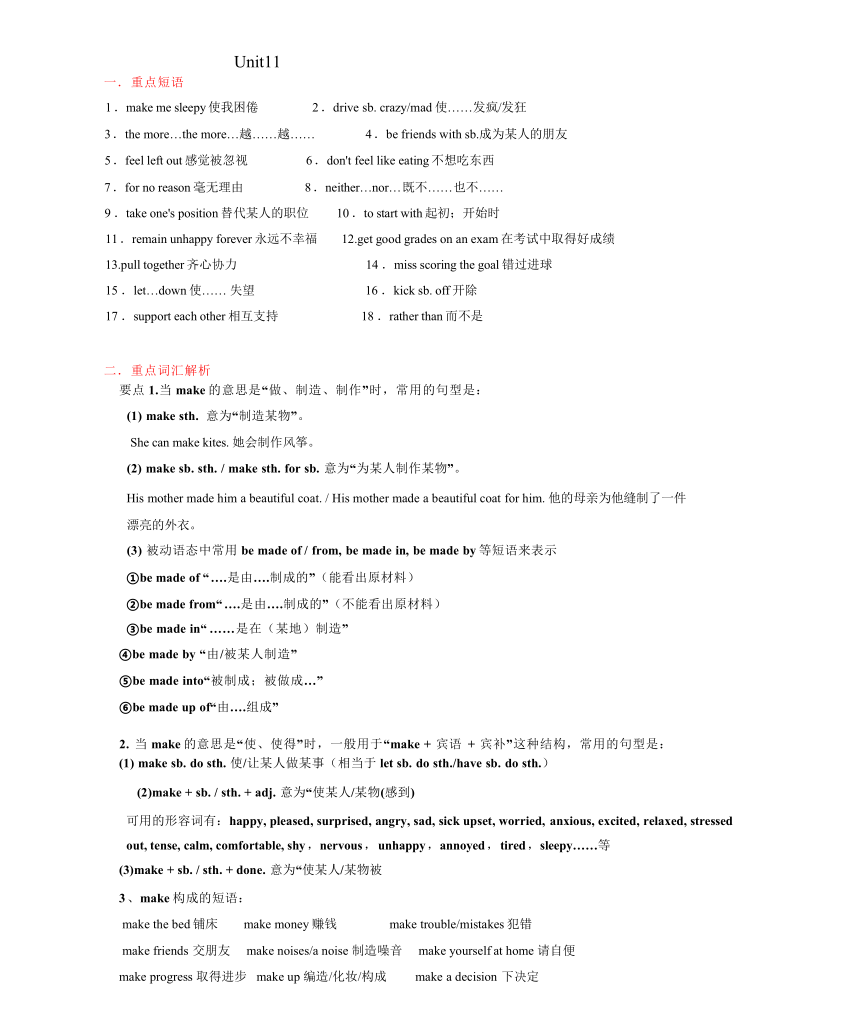
Unit11
一.重点短语
1 .make me sleepy使我困倦 2 .drive sb. crazy/mad使……发疯/发狂
3 .the more…the more…越……越…… 4 .be friends with sb.成为某人的朋友
5 .feel left out感觉被忽视 6 .don't feel like eating不想吃东西
7 .for no reason毫无理由 8 .neither…nor… 既不…… 也不……
9 .take one's position替代某人的职位 10 .to start with起初;开始时
11 .remain unhappy forever永远不幸福 12.get good grades on an exam在考试中取得好成绩
13.pull together齐心协力 14 .miss scoring the goal错过进球
15 .let…down使…… 失望 16 .kick sb. off开除
17 .support each other相互支持 18 .rather than而不是
二.重点词汇解析
要点1.当make的意思是“做、制造、制作”时,常用的句型是:
(1) make sth. 意为“制造某物”。
She can make kites. 她会制作风筝。
(2) make sb. sth. / make sth. for sb. 意为“为某人制作某物”。
His mother made him a beautiful coat. / His mother made a beautiful coat for him. 他的母亲为他缝制了一件漂亮的外衣。
(3) 被动语态中常用be made of / from, be made in, be made by等短语来表示
①be made of “ ….是由 ….制成的”(能看出原材料)
②be made from“ ….是由 ….制成的”(不能看出原材料)
③be made in“ ……是在(某地)制造”
④be made by “由/被某人制造”
⑤be made into“被制成;被做成 …”
⑥be made up of“由 ….组成”
2. 当make的意思是“使、使得”时,一般用于“make + 宾语 + 宾补”这种结构,常用的句型是:
(1) make sb. do sth. 使/让某人做某事(相当于let sb. do sth./have sb. do sth.)
(2)make + sb. / sth. + adj. 意为“使某人/某物(感到)
可用的形容词有:happy, pleased, surprised, angry, sad, sick upset, worried, anxious, excited, relaxed, stressed out, tense, calm, comfortable, shy ,nervous , unhappy ,annoyed , tired ,sleepy……等
(3)make + sb. / sth. + done. 意为“使某人/某物被
3 、make构成的短语:
make the bed铺床 make money赚钱 make trouble/mistakes犯错
make friends 交朋友 make noises/a noise 制造噪音 make yourself at home 请自便
make progress 取得进步 make up 编造/化妆/构成 make a decision 下决定
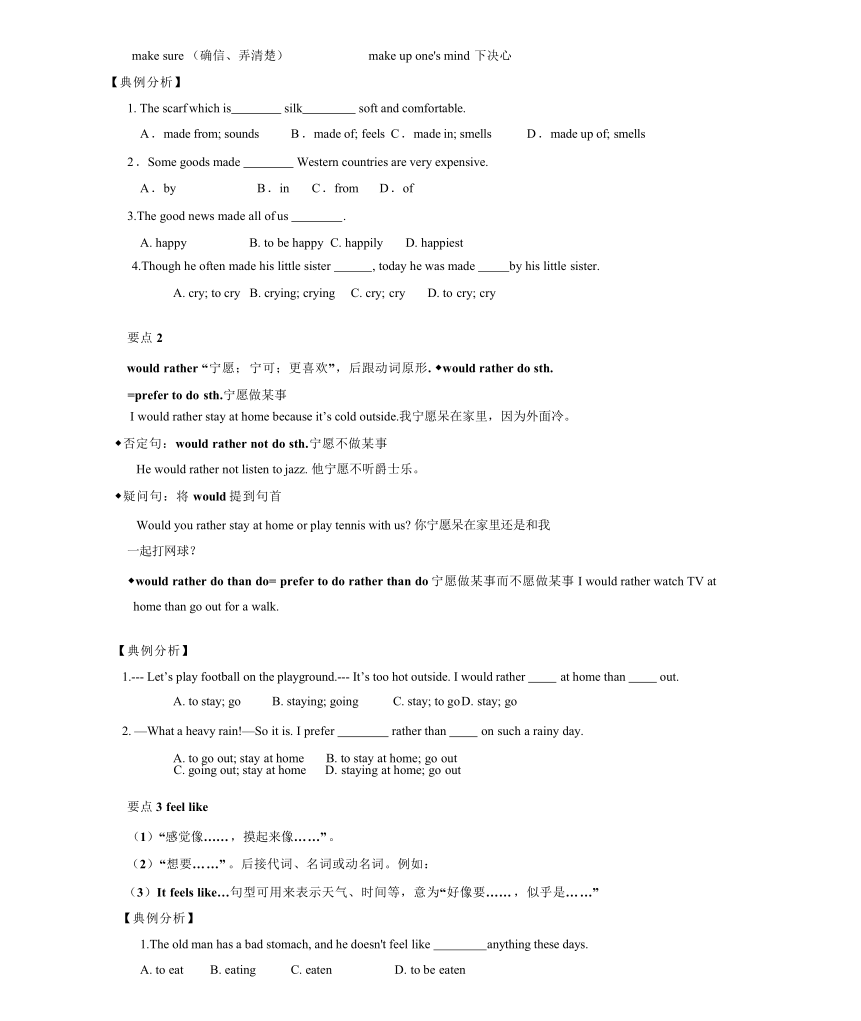
make sure (确信、弄清楚) make up one's mind 下决心
【典例分析】
1. The scarf which is silk soft and comfortable.
A .made from; sounds B .made of; feels C .made in; smells D .made up of; smells
2 .Some goods made Western countries are very expensive.
A .by B .in C .from D .of
3.The good news made all of us .
A. happy B. to be happy C. happily D. happiest
4.Though he often made his little sister , today he was made by his little sister.
A. cry; to cry B. crying; crying C. cry; cry D. to cry; cry
要点2
would rather “宁愿; 宁可;更喜欢”,后跟动词原形. ◆would rather do sth. =prefer to do sth.宁愿做某事
I would rather stay at home because it’s cold outside.我宁愿呆在家里,因为外面冷。
◆否定句:would rather not do sth.宁愿不做某事
He would rather not listen to jazz. 他宁愿不听爵士乐。
◆疑问句:将would提到句首
Would you rather stay at home or play tennis with us 你宁愿呆在家里还是和我一起打网球?
◆would rather do than do= prefer to do rather than do宁愿做某事而不愿做某事 I would rather watch TV at home than go out for a walk.
【典例分析】
1.--- Let’s play football on the playground.--- It’s too hot outside. I would rather at home than out.
A. to stay; go B. staying; going C. stay; to go D. stay; go
2. —What a heavy rain!—So it is. I prefer rather than on such a rainy day.
A. to go out; stay at home B. to stay at home; go out
C. going out; stay at home D. staying at home; go out
要点3 feel like
(1)“感觉像 …… ,摸起来像 … …” 。
(2)“想要 … …” 。后接代词、名词或动名词 。例如:
(3)It feels like…句型可用来表示天气、时间等,意为“好像要 …… ,似乎是 … …”
【典例分析】
1.The old man has a bad stomach, and he doesn't feel like anything these days.
A. to eat B. eating C. eaten D. to be eaten
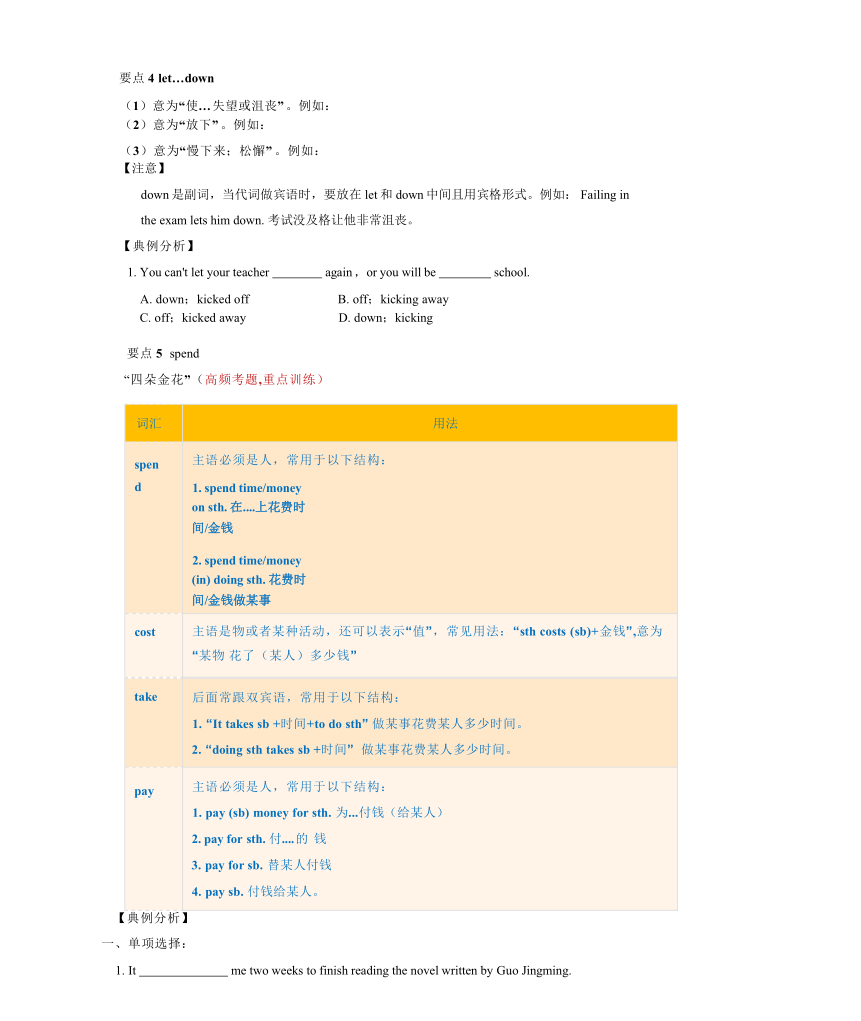
要点4 let…down
(1)意为“使 … 失望或沮丧” 。例如:
(2)意为“放下” 。例如:
(3)意为“慢下来;松懈” 。例如:
【注意】
down是副词,当代词做宾语时,要放在let和down中间且用宾格形式。例如: Failing in the exam lets him down. 考试没及格让他非常沮丧。
【典例分析】
1. You can't let your teacher again ,or you will be school.
A. down;kicked off B. off;kicking away
C. off;kicked away D. down;kicking
要点5 spend
“四朵金花”(高频考题,重点训练)
词汇 用法
spen d 主语必须是人,常用于以下结构: 1. spend time/money on sth. 在....上花费时间/金钱 2. spend time/money (in) doing sth. 花费时间/金钱做某事
cost 主语是物或者某种活动,还可以表示“值”,常见用法: “sth costs (sb)+金钱”,意为“某物 花了(某人) 多少钱”
take 后面常跟双宾语,常用于以下结构: 1. “It takes sb +时间+to do sth” 做某事花费某人多少时间。 2. “doing sth takes sb +时间” 做某事花费某人多少时间。
pay 主语必须是人,常用于以下结构: 1. pay (sb) money for sth. 为...付钱(给某人) 2. pay for sth. 付.... 的 钱 3. pay for sb. 替某人付钱 4. pay sb. 付钱给某人。
【典例分析】
一、单项选择:
1. It me two weeks to finish reading the novel written by Guo Jingming.
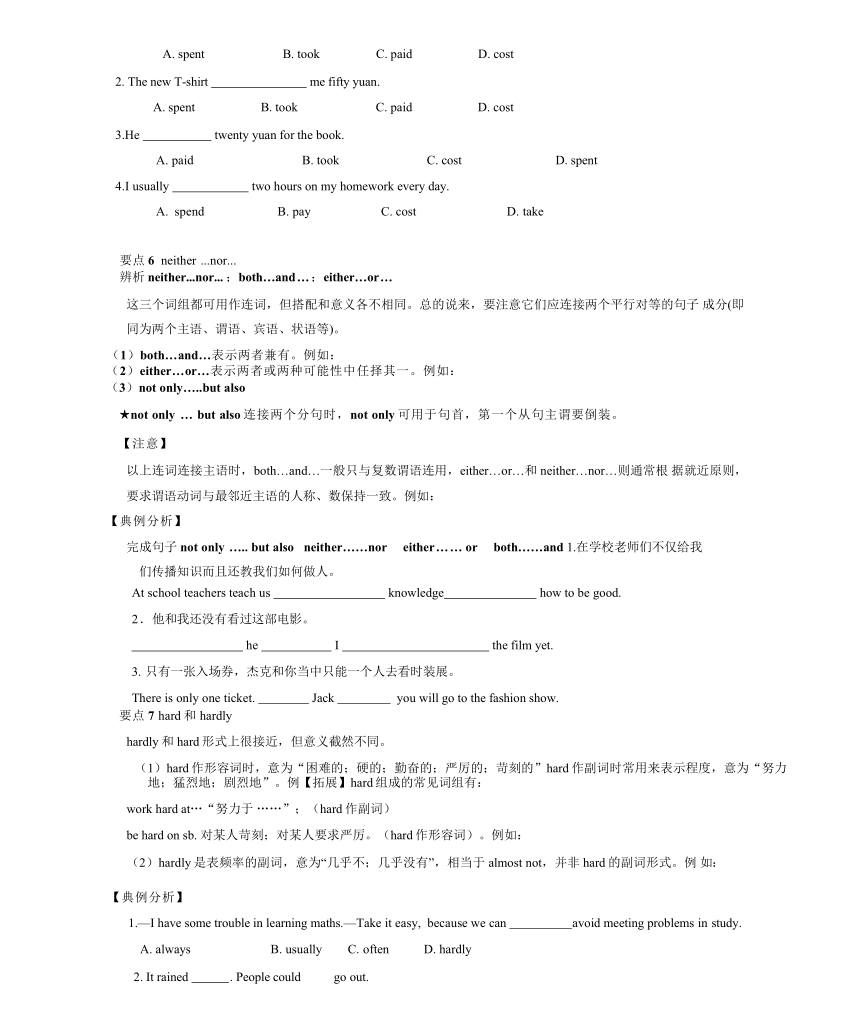
A. spent B. took C. paid D. cost
2. The new T-shirt me fifty yuan.
A. spent B. took C. paid D. cost
3.He twenty yuan for the book.
A. paid B. took C. cost D. spent
4.I usually two hours on my homework every day.
spend B. pay C. cost D. take
要点6 neither ...nor...
辨析neither...nor... ;both…and … ;either…or …
这三个词组都可用作连词,但搭配和意义各不相同。总的说来,要注意它们应连接两个平行对等的句子 成分(即同为两个主语、谓语、宾语、状语等)。
(1)both…and…表示两者兼有 。例如:
(2)either…or…表示两者或两种可能性中任择其一 。例如:
(3)not only…..but also
★not only … but also连接两个分句时,not only可用于句首,第一个从句主谓要倒装。
【注意】
以上连词连接主语时,both…and…一般只与复数谓语连用,either…or…和neither…nor…则通常根 据就近原则,要求谓语动词与最邻近主语的人称、数保持一致。例如:
【典例分析】
完成句子not only ….. but also neither……nor either … … or both……and 1.在学校老师们不仅给我们传播知识而且还教我们如何做人。
At school teachers teach us knowledge how to be good.
2 .他和我还没有看过这部电影。
he I the film yet.
3. 只有一张入场券,杰克和你当中只能一个人去看时装展。
There is only one ticket. Jack you will go to the fashion show.
要点7 hard和hardly
hardly和hard形式上很接近,但意义截然不同。
(1)hard作形容词时,意为“困难的;硬的;勤奋的;严厉的;苛刻的”hard作副词时常用来表示程度,意为“努力地;猛烈地;剧烈地”。例【拓展】hard组成的常见词组有:
work hard at…“努力于 ……”;(hard作副词)
be hard on sb. 对某人苛刻;对某人要求严厉。(hard作形容词)。例如:
(2)hardly是表频率的副词,意为“几乎不;几乎没有”,相当于almost not,并非hard的副词形式。例 如:
【典例分析】
1.—I have some trouble in learning maths.—Take it easy, because we can avoid meeting problems in study.
A. always B. usually C. often D. hardly
2. It rained . People could go out.
A. hardly, hardly B. hard, hardly C. hardly, hard D. hard, hard
3.It is for him to get to school on time, because it is raining .
A .hard ; hardly B. hardly; hard C. hard; hard D. hardly hardly
要点8
disappointed作形容词,意为“感到失望的;沮丧的” 。常用搭配:be disappointed with/in sb.“对某人 感到失望”;be disappointed at/about sth.“对某事/某一行为感到失望”;be disappointed to do sth.“对做 某事感到失望” 。例如:
辨析disappointed与disappointing
disappointed 意为“感到失望的”,主语通常是人,表示人的一种感受。
disappointing 意为“令人失望的”,通常修饰事物,表示事物的一种特点或给人的一种感觉。
【拓展】
英语中,带-ing的形容词,用来形容事物,指某事物的性质、特征,意为“令人…… 的”“让人…… 的”,常用事物作主语或作定语修饰物。而带-ed的是用来形容人的,意为“感到…… 的”“使人…… 的”, 其主语是人,类似的词有:
exciting 令人兴奋的 boring 令人厌烦的 moving 令人感动的
excited (人)感到兴奋的 bored(人)感到厌烦的 moved(人)感动的
tiring 令人厌倦的 surprising令人惊讶的
tired(人)感到疲倦/累/厌烦的 surprised(人)感到惊讶的
【典例分析】
1.We are all very (disappoint), because the result is too (disappoint).
2.I failed the exam .What news! My parents said that they were at my grades .
A. disappointing;disappointing B. disappointing;disappointed
C. disappointed;disappointed D. disappointed;disappointing
3.Mr. Wang is an man .He is in telling jokes .
A. interesting , interested B. interested , interesting
C. interesting , interesting D. interested , interested
要点9 besides adv.而且
besides作副词,意为“而且”,引出另一种情况,以作补充。可用于句首、句尾,也可用于句中常用逗号 隔开。It's too late to go out now. Besides, it's going to rain. 现在出去太晚了。而且要下雨了。
【辨析】except 、except for与besides
except:“除 …之外”,后面的内容不包括在内
except for:“除 …之外”,说明整体基本情况后,对细节加以纠正,表示“美中不足的是 …”
besides :“除 …之外还有 …”,后面的内容包括在内 【典例分析】
What other languages do you like English ---I also like French and Janpanese.
A. except B. besides C. beside D. but
要点10
agreement的用法
1.agreement作名词,意为“同意;协定;协议” 。常用短语in agreement意为“持相同意见” 。若表示“与某 人意见一致”时,后面接介词with,即in agreement with sb. 。但表示“在某方面意见一致” 时,应接介词 on或upon,即in agreement on/upon sth. 。例如:
My teacher nodded in agreement.我的老师同意地点了点头。
He is in agreement with you on that point.在那一点上,他与你意见一致。 2.agreement的动词形式为agree,意为“答应;同意” 。用法如下:
(1)agree to do sth.意为“同意做某事”
(2)agree with sb.意为“同意某人的意见”
(3)agree to sth.意为“同意某事”,to后面一般接表示计划、建议、办法等 的名词。 【典例分析】
1.—Would you like to go on a picnic with us this Sunday
—I'd love to, but I have to get my parents' first.
A. agreement B. surprise C. offer D. share
要点11
(1) weigh表示“称 …… 的重量”,是及物动词;表示“重(多少)” ,是不及物动词 。例如: He weighed the fish. 他称了这条鱼。
Do you often weigh yourself 你经常称体重吗 He weighs 60 kilos. 他体重60公斤。
The meat weighs five pounds. 这肉重五磅。 【拓展】
(1)weight是名词,意为“重量,体重” 。例如: What’s your weight 你体重是多少?
(2) 比较:by weight 和 in weight
by weight表示“按重量”,in weight表示“重量上” 。例如: Do they charge carriage by weight 他们是按重量收取运费吗
It’s smaller in size but greater in weight. 它体积比较小,但分量比较重。
(3)常用于以下表达中:
①What’s the weight of... 意为“……的重量是多少? -What’s the weight of the elephant 大象多重?
-I’ve no idea.我不知道。
②put on/lose weight 意为“长胖/减肥”
You can do more exercise to lose weight.你可以多锻炼来减肥。 【典例分析】
1.用weight 和weigh填空
1)Please the apples.
2)How much does the elephant
3)It is 46 meters high and 229 tons.
4)The car about two tons.
5)what is the bag's
要点12
be worried about 为 ……担忧
【解析】be worried about意为“担心”,强调状态,后面接名词、代词、或动词-ing形式作宾语。 其中worried是形容词,意为“担心的;担忧的”。
We are all worried about her health. 我们都为她的健康担忧。
【拓展】worry作动词,意为“担心;担忧”,worry about 意为“担心”,强调动作。 Don't worry about her. She can pass the test because she studies hard.
不要担心她 。因为她努力学习,她可以通过考试的。 【典例分析】
1. It was getting too dark. Lisa didn't arrive home. Her parents were her safety.
A. relaxed about B. excited about C. worried about D. busy with
要点13 give up
give up意为“放弃”,give up doing sth.意为“放弃做某事”,give up后若跟动词,只能跟动名 词。
【典例分析】
1 .—Song Joong ki is a movie star in Asia now.
—That's true. He was once an excellent skater but had to skating because of an accident.
A. give up B. set up C. take up D. put up
要点15
“so+ adj. +that.…”结构,表示“如此 … 以至于 …” ,that引导结果状语从句。
【辨析】so…that.与such…that.. so...that , such...that与so that
so…..that 引导结果状语从 句 常用结构有: so+ adj. /adv.+that 从句; so+ adj.+a / an +可数名词单数+ that从句
such...that 引导结果状语从 句 常 用 结 构 有 : such+a/an+adj.+ 可 数 名 词 单 数 +that 从 句 ; such+adj.+可数名词复数+that从such+adj.+不可数名词+that从句
so that 既可 引导 目 的状 语 , 也可 引导 结 果状语从句 引导 目 的状语从句 时 ,意为 “ 以便; 为 了 ” ,从句 中常使用 can/could/would/should等情态动词;引导结果状语从句时,意为 “因此;所以“ ,从句中一般不用情态动词,从句在so that前可以 用逗号
【典例分析】
1.—What do you think of the new movie Wandering Earth(《流浪地球》) —It’s wonderful I really like it.
A. so; that B. such; that C. too; to D. enough; to
2. He has to earn lots of money he can buy his children nice food and clothes.
A. so that B. such that C. that D. in order
I’ve had many falls that I am black and blue all over.
A. so B. such C. too D. very
It was yesterday that they went out for a picnic.
A. a such fine day B. such a fine day C. so a fine day D. a so fine day
要点16
本句属于“The+比较级 … ,the+比较级 …”结构,表示“越 …….越.……”.前一个分句作状语,表示假 条件、时间等,后一个分句表示结果。
The more he eats, the heavier he will be.他吃得越多,就会越胖。
【拓展】(1)“比较级+and+比较级”意为“越来越 …”表示事物的逐渐递进。
When spring comes, the weather gets warmer and warmer.
当春天到来时,天气变得越来越暖和。
(2)多音节或部分双音节的形容词或副词表达“越来越..…”时,用“more and more+形容词或副词的原 级”结构。
Our city is becoming more and more beautiful . 我们的城市正变得越来越美丽。
【典例分析】
1.The you study at your lessons, the grades you will get.
A. hard; good B. harder; good C. hard; better D. harder;better 2.—You shouldn't eat too much junk food. It's bad for your health.—You're right. junk food I eat, I will be.
A. The less;the healthier B. The less;the healthy
C. The more ;the healthier D. The more ;the healthy
一.根据提示填单词。
1.In fact, the queen doesn't have great p .
2.Mrs. Wang is very rich. She has a lot of w .
3.The soldier was so brave. We admired him for his c . 4.The nurse was e her patient when the telephone rang. 5.We couldn't stand the noise. It us crazy.
6.He became an actor at a very young age but he gained (获得) f nearly 10 years later. 7.What do you know about the q of England
8.You'd better set a g before you start to study English. .
9.He fell down from his bike yesterday. The pain nearly (迫使) him crazy. 10.Bob stayed up late last night and now he feels (困倦的).
11.It's cloudy and (阴沉的). It's going to rain.
12.Both of the businessmen felt sorry as their talk broke off without a (n) (agree) . 13.Larry has put on too much (weigh) because of his unhealthy diet.
14.In class the teacher handed back our test papers. That made me (worry) 15.You shouldn't let your friend feel (leave) out.
二 .翻译句子。
1.他的自行车没有什么毛病。
There is with his bicycle.
2.他的老板经常大动肝火,有时毫无理由。
His boss often gets mad, sometimes for at all.
3.他和我都对唱歌跳舞不感兴趣。
he I interested in singing or dancing. 4.每次考试结束,我都会担心(考试的)结果。
Every time the exam is over, I'll the result.
5.伤感的电影让我想离开电影院。
Sad movies -the cinema.
完形填空
With the development of technology, there are lots of new inventions around our daily life. Here are some of them that come from technology magazine.
Things Spotter
If you often lose things, you’ll be happy with a new 1 called Things Spotter. It’ll look like a small keytag(跟踪器) which can be put into your things. The tag will 2 to your mobile phone through Blue Tooth technology. When you find something missing, don’t worry! Just press somewhere 3 your mobile phone and a map on your screen will tell you where to look for it.
Fire Recharger
It is really popular to camp in the wild! But what can you do if 4 the batteries(电量) on your mobile phone are empty Some engineers are 5 a Fire Recharger. It produces electricity from the heat of fire. This means you can use a small fire to charge(充电) your mobile phone. It is not only very 6 but also good for the environment, because it will use 7 electricity than other methods. And it will be used widely in the future.
DigGoggles
Those lively underwater photos are so beautiful and in different forms. 8 , it’s not easy for us to take them. Besides, under water cameras are not cheap enough. But soon you will have the chance to buy a new invention that will bring you great pleasure. 9 name is DigGoggles. We can use the invention to take underwater photos with our eyes. Just open and close your
10 twice, a photo will be taken.
1.A. introduction B. inventor C. instruction D. invention
2.A. compare B. connect C. lend D. fail
3.A. on B. off C. with D. without
4.A. recently B. suddenly C. properly D. simply
5.A. giving up B. working on C. waking up D. throwing away
6.A. useful B. well-known C. difficult D. fair
7 A. more B. much C. fewer D. less
8.A. Since B. So that C. However D. Though
9.A. His B. Its C. Her D. Their
10.A. ears B. arms C. eyes D. legs
四.阅读理解
My name is Jenny. My favorite book is A Midsummer Night s (’) Dream written by Shakespeare. I enjoy reading it very much. In the story, there are two parallel(平行的) worlds. One is the human
world, and the other is the fairy world(童话世界). Hermia,Helena, Lysander and Demetrius are all human beings. Oberon and Titania are the king and the queen of the fairy world.
Hermia is my favorite character in this story because she is independent and has the courage to
fight for her own choices. Her father suggests that she marry Demetrius, but she doesn’t love
Demetrius. Instead she loves Lysander and decides to run away with him. Later, because of a trick
played by the fairy king, Lysander falls in love with Helena. Hermia feels hurt, but she doesn’t give up. Her decision leads to the story’s happy ending.I also love Oberon, the fairy king, very much. He loves playing tricks. He quarrels(吵架) a lotwith the queen because of his jealousy(嫉妒). When he loses to the queen, he plays a trick on her. In many other stories I have read a king is always serious and powerful. Oberon is very different and acts like a child!In A Mid summer Nights Dream, I find characters of different personalities. That is why I think the book is so interesting. The story shows us what life is like in an imaginative and humorous way.
1. Who is the author(作者) of A Midsummer Night s (’) Dream
A. Mark Twain. B. Shakespeare. C. Margaret Mitchell. D. Charlotte Bront .
2. Jenny’s favourite character is Hermia because of her being .
A. beautiful and magical B. serious and powerful C. wise and honest D. independent and courageous
3. 在第三段“He loves playing tricks.” 中划线单词“tricks”的意思可能是 .
A. jokes B. instruments C. excuses D. apologies
4. The story .
A. has a sad ending B. has a happy ending
C. has a boring ending D. has an unknown ending
5. What can we learn in the story according to the passage
A. There are 7 characters in A Mid summer Nights Dream and 5 of them are human beings.
B. Oberon is the only character that Jenny loves in the story.
C. The story shows us what life is like in an imaginative and humorous way. D. The story shows us how cruel the war is and how important the peace is .

展开更多......

收起↑

资源预览