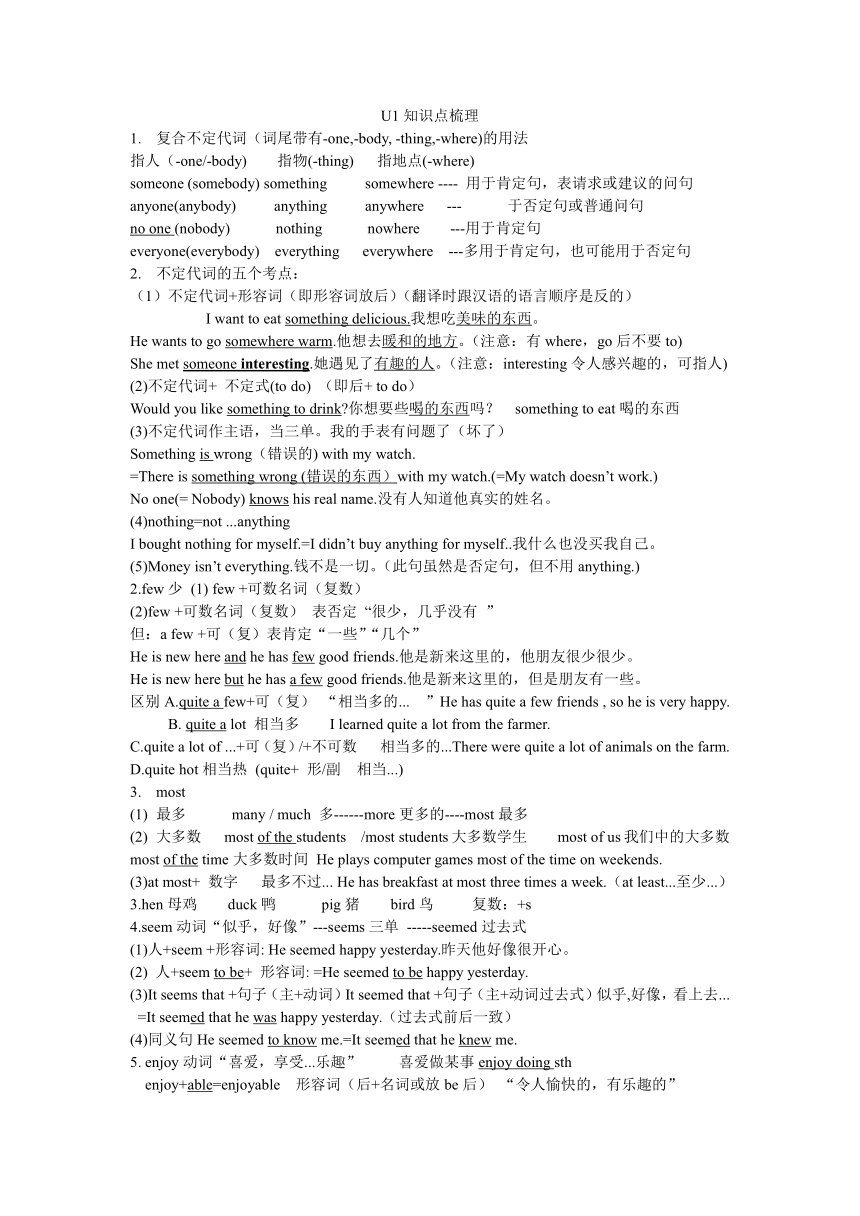
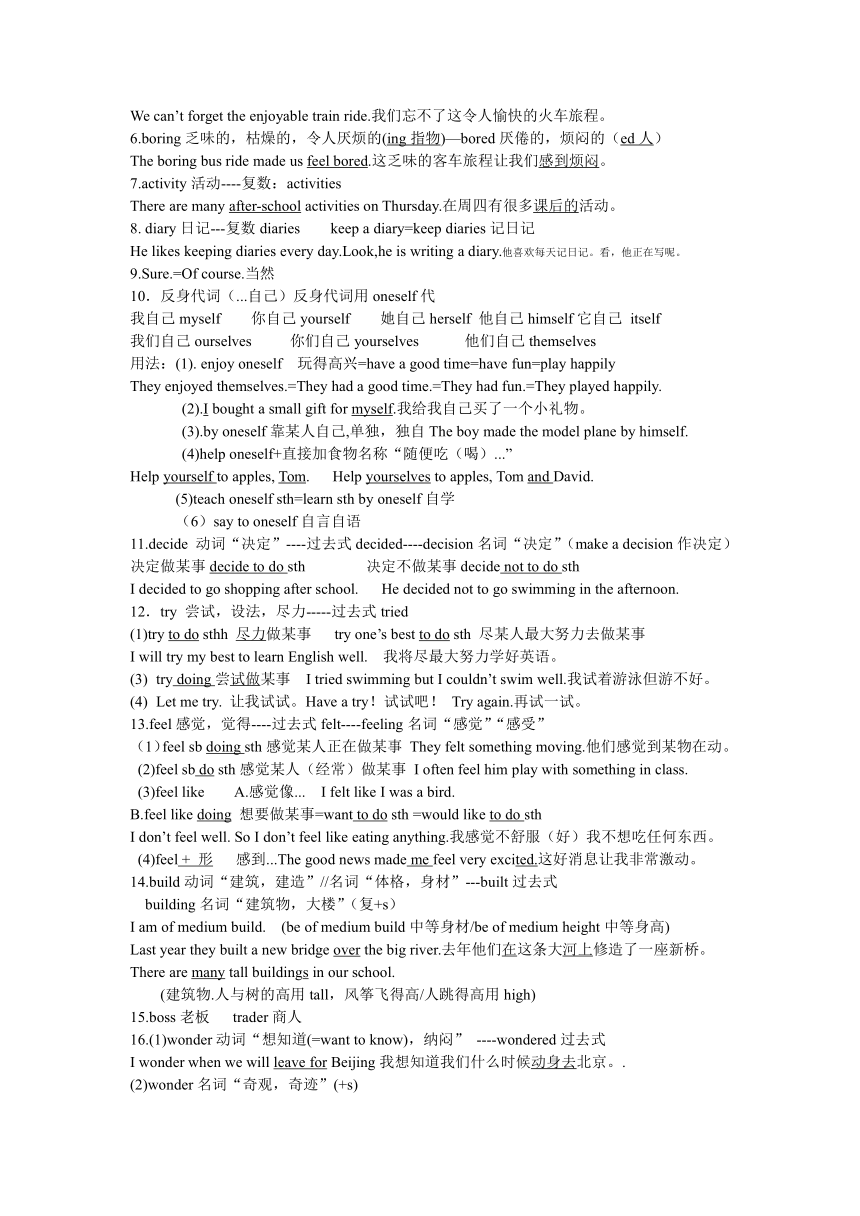
资源简介 U1知识点梳理复合不定代词(词尾带有-one,-body, -thing,-where)的用法指人(-one/-body) 指物(-thing) 指地点(-where)someone (somebody) something somewhere ---- 用于肯定句,表请求或建议的问句anyone(anybody) anything anywhere --- 于否定句或普通问句no one (nobody) nothing nowhere ---用于肯定句everyone(everybody) everything everywhere ---多用于肯定句,也可能用于否定句不定代词的五个考点:(1)不定代词+形容词(即形容词放后)(翻译时跟汉语的语言顺序是反的)I want to eat something delicious.我想吃美味的东西。He wants to go somewhere warm.他想去暖和的地方。(注意:有where,go后不要to)She met someone interesting.她遇见了有趣的人。(注意:interesting令人感兴趣的,可指人)(2)不定代词+ 不定式(to do) (即后+ to do)Would you like something to drink 你想要些喝的东西吗? something to eat喝的东西(3)不定代词作主语,当三单。我的手表有问题了(坏了)Something is wrong(错误的) with my watch.=There is something wrong (错误的东西)with my watch.(=My watch doesn’t work.)No one(= Nobody) knows his real name.没有人知道他真实的姓名。(4)nothing=not ...anythingI bought nothing for myself.=I didn’t buy anything for myself..我什么也没买我自己。(5)Money isn’t everything.钱不是一切。(此句虽然是否定句,但不用anything.)2.few少 (1) few +可数名词(复数)(2)few +可数名词(复数) 表否定 “很少,几乎没有 ”但:a few +可(复)表肯定“一些”“几个”He is new here and he has few good friends.他是新来这里的,他朋友很少很少。He is new here but he has a few good friends.他是新来这里的,但是朋友有一些。区别A.quite a few+可(复) “相当多的... ”He has quite a few friends , so he is very happy.B. quite a lot 相当多 I learned quite a lot from the farmer.C.quite a lot of ...+可(复)/+不可数 相当多的...There were quite a lot of animals on the farm.D.quite hot相当热 (quite+ 形/副 相当...)most最多 many / much 多------more更多的----most最多大多数 most of the students /most students大多数学生 most of us我们中的大多数most of the time大多数时间 He plays computer games most of the time on weekends.(3)at most+ 数字 最多不过... He has breakfast at most three times a week.(at least...至少...)3.hen母鸡 duck鸭 pig猪 bird鸟 复数:+s4.seem动词“似乎,好像”---seems三单 -----seemed过去式(1)人+seem +形容词: He seemed happy yesterday.昨天他好像很开心。(2) 人+seem to be+ 形容词: =He seemed to be happy yesterday.(3)It seems that +句子(主+动词)It seemed that +句子(主+动词过去式)似乎,好像,看上去...=It seemed that he was happy yesterday.(过去式前后一致)(4)同义句He seemed to know me.=It seemed that he knew me.5. enjoy动词“喜爱,享受...乐趣” 喜爱做某事enjoy doing sthenjoy+able=enjoyable 形容词(后+名词或放be后) “令人愉快的,有乐趣的”We can’t forget the enjoyable train ride.我们忘不了这令人愉快的火车旅程。6.boring乏味的,枯燥的,令人厌烦的(ing指物)—bored厌倦的,烦闷的(ed人)The boring bus ride made us feel bored.这乏味的客车旅程让我们感到烦闷。7.activity活动----复数:activitiesThere are many after-school activities on Thursday.在周四有很多课后的活动。8. diary日记---复数diaries keep a diary=keep diaries记日记He likes keeping diaries every day.Look,he is writing a diary.他喜欢每天记日记。看,他正在写呢。9.Sure.=Of course.当然10.反身代词(...自己)反身代词用oneself代我自己myself 你自己yourself 她自己herself 他自己himself它自己 itself我们自己ourselves 你们自己yourselves 他们自己themselves用法:(1). enjoy oneself 玩得高兴=have a good time=have fun=play happilyThey enjoyed themselves.=They had a good time.=They had fun.=They played happily.(2).I bought a small gift for myself.我给我自己买了一个小礼物。(3).by oneself靠某人自己,单独,独自The boy made the model plane by himself.(4)help oneself+直接加食物名称“随便吃(喝)...”Help yourself to apples, Tom. Help yourselves to apples, Tom and David.(5)teach oneself sth=learn sth by oneself自学(6)say to oneself自言自语11.decide 动词“决定”----过去式decided----decision名词“决定”(make a decision作决定)决定做某事decide to do sth 决定不做某事decide not to do sthI decided to go shopping after school. He decided not to go swimming in the afternoon.12.try 尝试,设法,尽力-----过去式tried(1)try to do sthh 尽力做某事 try one’s best to do sth 尽某人最大努力去做某事I will try my best to learn English well. 我将尽最大努力学好英语。try doing尝试做某事 I tried swimming but I couldn’t swim well.我试着游泳但游不好。Let me try. 让我试试。Have a try!试试吧! Try again.再试一试。13.feel感觉,觉得----过去式felt----feeling名词“感觉”“感受”(1)feel sb doing sth感觉某人正在做某事 They felt something moving.他们感觉到某物在动。(2)feel sb do sth感觉某人(经常)做某事 I often feel him play with something in class.(3)feel like A.感觉像... I felt like I was a bird.B.feel like doing 想要做某事=want to do sth =would like to do sthI don’t feel well. So I don’t feel like eating anything.我感觉不舒服(好)我不想吃任何东西。(4)feel + 形 感到...The good news made me feel very excited.这好消息让我非常激动。14.build动词“建筑,建造”//名词“体格,身材”---built过去式building名词“建筑物,大楼”(复+s)I am of medium build. (be of medium build中等身材/be of medium height中等身高)Last year they built a new bridge over the big river.去年他们在这条大河上修造了一座新桥。There are many tall buildings in our school.(建筑物.人与树的高用tall,风筝飞得高/人跳得高用high)15.boss老板 trader商人16.(1)wonder动词“想知道(=want to know),纳闷” ----wondered过去式I wonder when we will leave for Beijing我想知道我们什么时候动身去北京。.(2)wonder名词“奇观,奇迹”(+s)There are many wonders in the world.有很多世界奇观。(3)wonder+ful=wonderful形容词“精彩的”The basketball game is wonderful!17.(1)different形容词“不同的differently副词“不同地difference名词“不同点,不同之处”(2) A be different from B A与B不同describe the same person differently(动+副,be+形)描述同一个人都描述得不一样(3)different----difference (t 变为ce 再+s)There are three differences between the two pictures.在这两幅图之间有三处不同。18.top顶部,表面 at/on the top of ...在...的顶部 at the foot of ...在...的脚下19.(1)wait动词“等待,等候”---waited过去式(2)waiter男服务员 waitress女服务员(3)wait for sb 等... They are waiting for the bus now.他们正在等客车。(4) wait at sp在某地等They are waiting _____the bus stop.他们正在车站等。(at)20.umbrella 伞, 雨伞an umbrella一把雨伞You can take an umbrella with you.你可以随身带一把雨伞。21.wet潮湿的-----干旱的 dry22.because 因为 (+句子(主+动)) because of (因为,由于)(+名词短语)We had to stay at home because it rained heavily(rain heavily=rain hard雨下得大).=We had to stay at home because of the heavy rain.(这场大雨)23.below在下面(放名词后) Look at the pictures below.看下面的图片。24.enough足够的,充足的,充分的 (1)enough +名词 足够的... enough time/money(2)形容词/副词+enough 足够... 足够大:old enough (与汉语相反)(3)not...enough to do sth不够...做某事He is not old enough to go to school.他不是足够的大去上学。=He is too young to go to school.他太小以致于不能上学。=He is so young that he can’t go to school.他是如此小以致于不能上学。25.(1)hungry饥饿的----full饱的,满的I am hungry.=I feel hungry.我饿了。 I am full.我吃饱了。Next week is full for me.=I am busy next week.下周我忙。(忙:be busy 忙于...be busy with 忙于做...be busy doing)(3) be full of...充满了...挤满了...装满了...My school life is full of joy.(我的学校生活充满了欢乐)The school bus is full of students.(校车上挤满了学生)26.as像一 样,如同(1) (be/ look ) the same as...与...相同/一样-------反be different from...与...不同Picture 1 looks the same as Picture 2.work as ...作为,当... He works as a waiter in the restaurant.He wants to work as a soldier.=He wants to be a soldier.他想成为一名战士。(3) as+原级(形容词)+as as long as 一样长 as tall as一样高 as old as一样大A + be+as+原级(形容词)+as+B A与B一样... (be+形容词)A +动词 +as+原级(副词)+as+B A与B一样...得...(动+副词)This umbrella is as big as that one. He jumps as high as his father.He works as ____(hard)as his sister.He gets to school as___( late) as his sister.(hard, late本身是副词,不再+ly) ( 填:hard, late)As a teacher,... 作为一名教师,...As for fruit,... 至于...方面As for fruit, I like apples best.至于水果,我最喜欢苹果。like动词“喜欢”/名词“喜好”(+s)----dislike 动词“不喜欢”/名词“厌恶”(+s)Nobody knows his likes and dislikes.没有人知道他的好恶。like doing / like to do sth dislike doing / dislike to do sthdislike=don’t like // doesn’t like disliked过去式= didn’t like28.三大同义句:(1)sb be+so+形+that+句子 如此...以致于...The boy is so young that he can’t go to school.这个男孩是如此小以致于他不能去上学。sb be +too+形+to do sth 太...以致于不能...The boy is too young to go to school.sb be not +形+enough to do 不是足够的...做某事The boy is not old enough to go to school.几个句子:(1)Bye for now.就此别过。(=Bye.=Goodbye.再见)The only problem is that+句子 唯一的难题是...The only problem was that I didn’t have enough money.唯一的难题是我钱不够。We waited over an hour for the train.我们等火车等了一个多小时。(4)We walked for another two hours before getting to the top.在到达山顶之前我们又走了两小时。another+数字+名= 数字+more+名 another two hours=two more hours另外两小时Everyone took a bag with food and water.每个人都背着(带去了)一个装有食物和水的包。My classmate told me to keep going, so I went on.tell sb to do sth叫某人做某事 keep doing 坚持做某事go on继续: go on doing sth继续做原来的事情 go on to do sth继续做另一件事go on with sth继续做某事(原来的)Twenty minutes later,the sun started to come up.二十分钟后,太阳开始升起来了。时间段+later=after+时间段 twenty minutes later= twenty minutes later (20分钟后)find---过去式found (1)find it +形 to do 发现做某事...I found it hard to learn to swim last year.去年我发现学游泳困难。find out 查明,弄清楚 / find 找到 /look for寻找...Let’s find out who cleaned the room last night.He looked for his watch every where but he couldn’t find it.after three hours三小时后= three hours laterfor a long time= for long很久 He cooked the soup for a long time.He didn’t bring back anything. 他没带回来任何东西。=He brought back nothing.(动+back ...回, 回...) go back to school返校,返回到学校=return to schoolkeep---- 过去式keptkeep+形: keep healthy保持健康 keep quiet保持安静 keep clean保持干净keep+名+形: 保持某物... We should (应该)keep our classroom clean.keep doing sth 坚持(保持)做某事 :He keeps running every morning.他坚持每天跑步。the first time第一次 the last time最后一次 first name名 last name姓the first few years头几年 the last five hours最后五小时(刚过去的五小时)区别几个看:look at the map看地图 look at the picture看图片(看...look at...)read a book, read a newspaper, read a magazinewatch TV, watch a soccer game , watch a moviesee pandas, see Huangguoshu Waterfall, see a movie(see a film),see friends 展开更多...... 收起↑ 资源预览
 资源预览
资源预览
 资源预览
资源预览