2024-2025学年人教版九年级全册Unit 1 How can we become a learners?知识点讲解(2)

资源下载
  1. 二一教育资源

2024-2025学年人教版九年级全册Unit 1 How can we become a learners?知识点讲解(2)

资源简介

2024-2025学年九年级英语
Unit 1 How can we become a learners 知识点讲解
【重点短语】
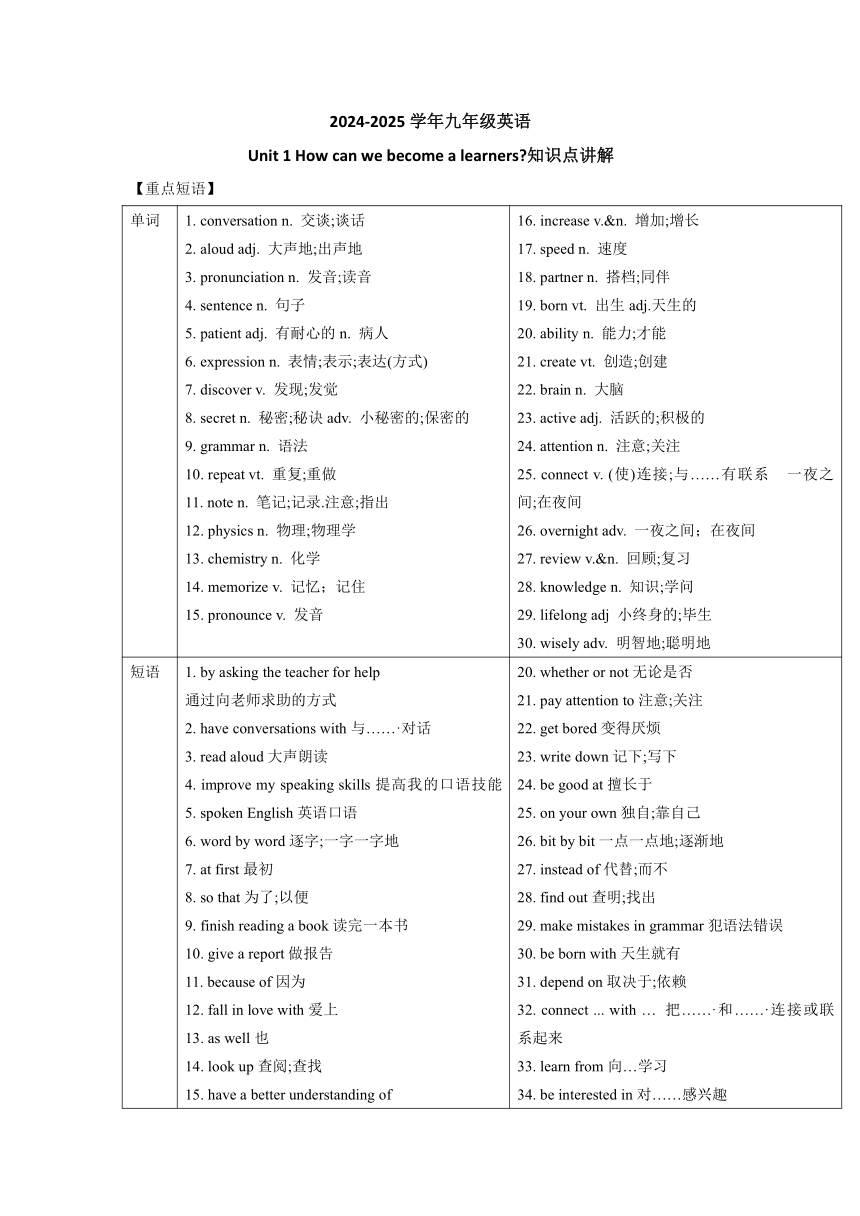
单词 1. conversation n. 交谈;谈话 2. aloud adj. 大声地;出声地 3. pronunciation n. 发音;读音 4. sentence n. 句子 5. patient adj. 有耐心的n. 病人 6. expression n. 表情;表示;表达(方式) 7. discover v. 发现;发觉 8. secret n. 秘密;秘诀adv. 小秘密的;保密的 9. grammar n. 语法 10. repeat vt. 重复;重做 11. note n. 笔记;记录.注意;指出 12. physics n. 物理;物理学 13. chemistry n. 化学 14. memorize v. 记忆;记住 15. pronounce v. 发音 16. increase v.&n. 增加;增长 17. speed n. 速度 18. partner n. 搭档;同伴 19. born vt. 出生adj.天生的 20. ability n. 能力;才能 21. create vt. 创造;创建 22. brain n. 大脑 23. active adj. 活跃的;积极的 24. attention n. 注意;关注 25. connect v. (使)连接;与……有联系 一夜之间;在夜间 26. overnight adv. 一夜之间;在夜间 27. review v.&n. 回顾;复习 28. knowledge n. 知识;学问 29. lifelong adj 小终身的;毕生 30. wisely adv. 明智地;聪明地
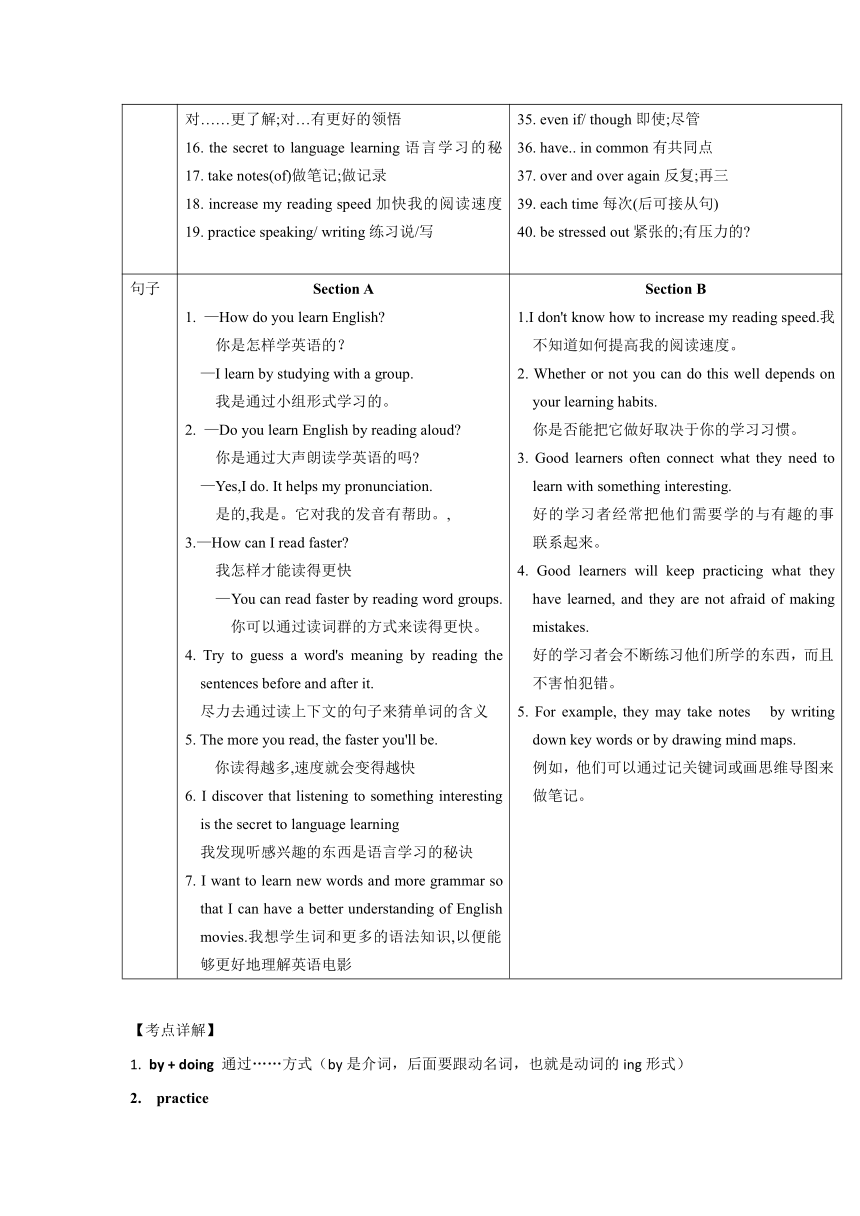
短语 1. by asking the teacher for help 通过向老师求助的方式 2. have conversations with与……·对话 3. read aloud大声朗读 4. improve my speaking skills提高我的口语技能5. spoken English英语口语 6. word by word逐字;一字一字地 7. at first最初 8. so that为了;以便 9. finish reading a book读完一本书 10. give a report做报告 11. because of因为 12. fall in love with爱上 13. as well也 14. look up查阅;查找 15. have a better understanding of 对……更了解;对…有更好的领悟 16. the secret to language learning语言学习的秘17. take notes(of)做笔记;做记录 18. increase my reading speed加快我的阅读速度 19. practice speaking/ writing练习说/写 20. whether or not无论是否 21. pay attention to注意;关注 22. get bored变得厌烦 23. write down记下;写下 24. be good at擅长于 25. on your own独自;靠自己 26. bit by bit一点一点地;逐渐地 27. instead of代替;而不 28. find out查明;找出 29. make mistakes in grammar犯语法错误 30. be born with天生就有 31. depend on取决于;依赖 32. connect ... with … 把……·和……·连接或联系起来 33. learn from向…学习 34. be interested in对……感兴趣 35. even if/ though即使;尽管 36. have.. in common有共同点 37. over and over again反复;再三 39. each time每次(后可接从句) 40. be stressed out紧张的;有压力的
句子 Section A 1. —How do you learn English 你是怎样学英语的? —I learn by studying with a group. 我是通过小组形式学习的。 2. —Do you learn English by reading aloud 你是通过大声朗读学英语的吗 —Yes,I do. It helps my pronunciation. 是的,我是。它对我的发音有帮助。, 3.—How can I read faster 我怎样才能读得更快 —You can read faster by reading word groups.你可以通过读词群的方式来读得更快。 4. Try to guess a word's meaning by reading the sentences before and after it. 尽力去通过读上下文的句子来猜单词的含义 5. The more you read, the faster you'll be. 你读得越多,速度就会变得越快 6. I discover that listening to something interesting is the secret to language learning 我发现听感兴趣的东西是语言学习的秘诀 7. I want to learn new words and more grammar so that I can have a better understanding of English movies.我想学生词和更多的语法知识,以便能够更好地理解英语电影 Section B 1.I don't know how to increase my reading speed.我不知道如何提高我的阅读速度。 2. Whether or not you can do this well depends on your learning habits. 你是否能把它做好取决于你的学习习惯。 3. Good learners often connect what they need to learn with something interesting. 好的学习者经常把他们需要学的与有趣的事联系起来。 4. Good learners will keep practicing what they have learned, and they are not afraid of making mistakes. 好的学习者会不断练习他们所学的东西,而且不害怕犯错。 5. For example, they may take notes by writing down key words or by drawing mind maps. 例如,他们可以通过记关键词或画思维导图来做笔记。
【考点详解】
by + doing 通过……方式(by是介词,后面要跟动名词,也就是动词的ing形式)
practice
(1)vt. “练习;实践”,后接名词、代词或 v-ing形式作宾语。
John with his brother practices playing the piano every day.
约翰和他的弟弟每天练习弹钢琴。
n.【U】“练习;训练”
Practice makes perfect熟能生巧。
拓展 后只接v-ing作宾语的动词或短语
finish, practice, enjoy, mind, consider,
miss, suggest, escape, feel like,
be used to(习惯于), give up, be busy,
be worth(值得), keep on, can' t help(情不自禁), have fun/ trouble/ problems(in) doing,
spend time/ money(in) doing等。
talk about sth谈论,议论,讨论
The students often talk about movie after class. 学生们常常在课后讨论电影。
talk to sb= talk with sb 与某人说话
3. 提建议的句子:
①What/ how about +doing sth. 做…怎么样?
(about后面要用动词的ing形式)
如:What/ How about going shopping
②Why don't you + do sth. 你为什么不做…?
如:Why don't you go shopping
③Why not + do sth. 为什么不做…?
如:Why not go shopping
④Let's + do sth. 让我们做…...吧。
如:Let's go shopping
⑤Shall we/I + do sth. 我们/我...…好吗?
如:Shall we/I go shopping
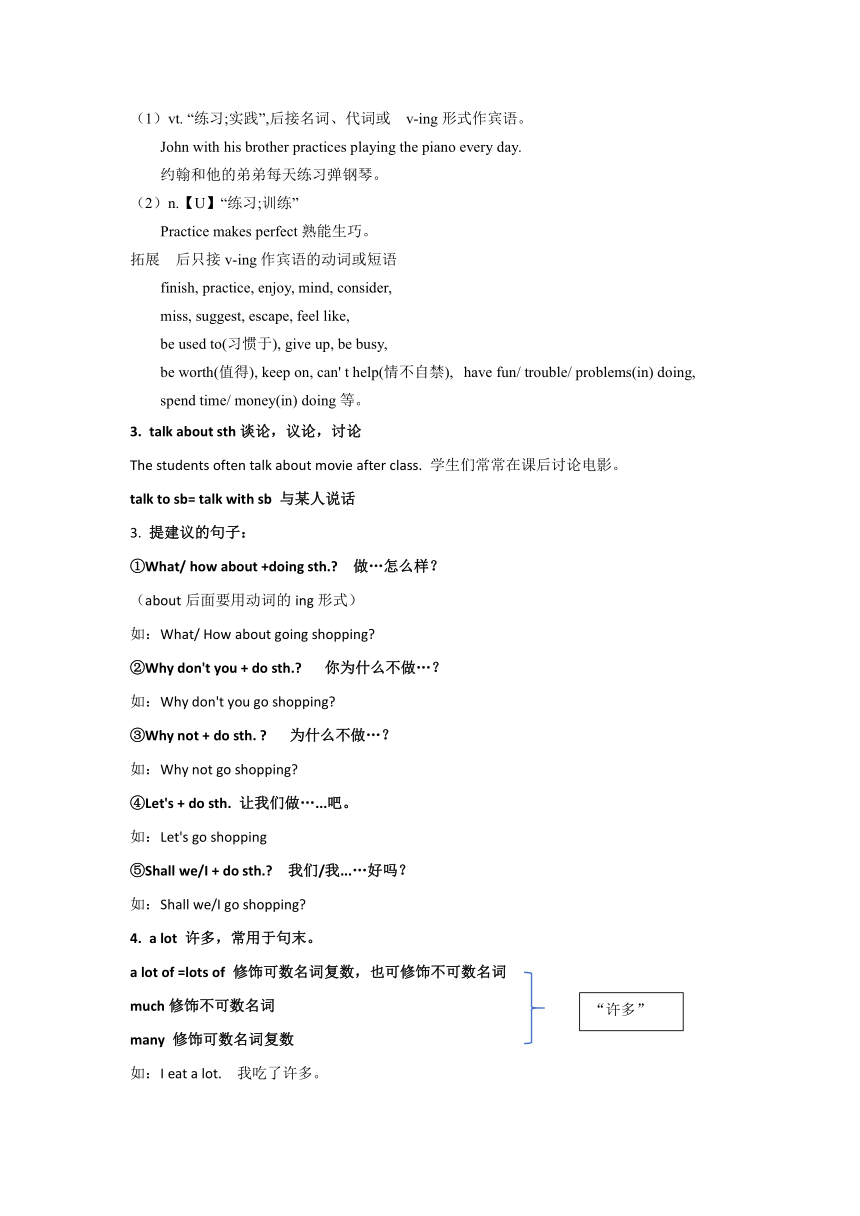
a lot 许多,常用于句末。
a lot of =lots of 修饰可数名词复数,也可修饰不可数名词
much修饰不可数名词
many 修饰可数名词复数
如:I eat a lot. 我吃了许多。
5. too…to... 太…...而不能
常用的句型:
主语+谓语+too+形容词/副词+ to do sth.
主语+谓语+形容词/副词+enough +to do sth
主语+谓语+so +形容词/副词+that从句
如:I'm too tired to say anything. 我太累了,什么都不想说。
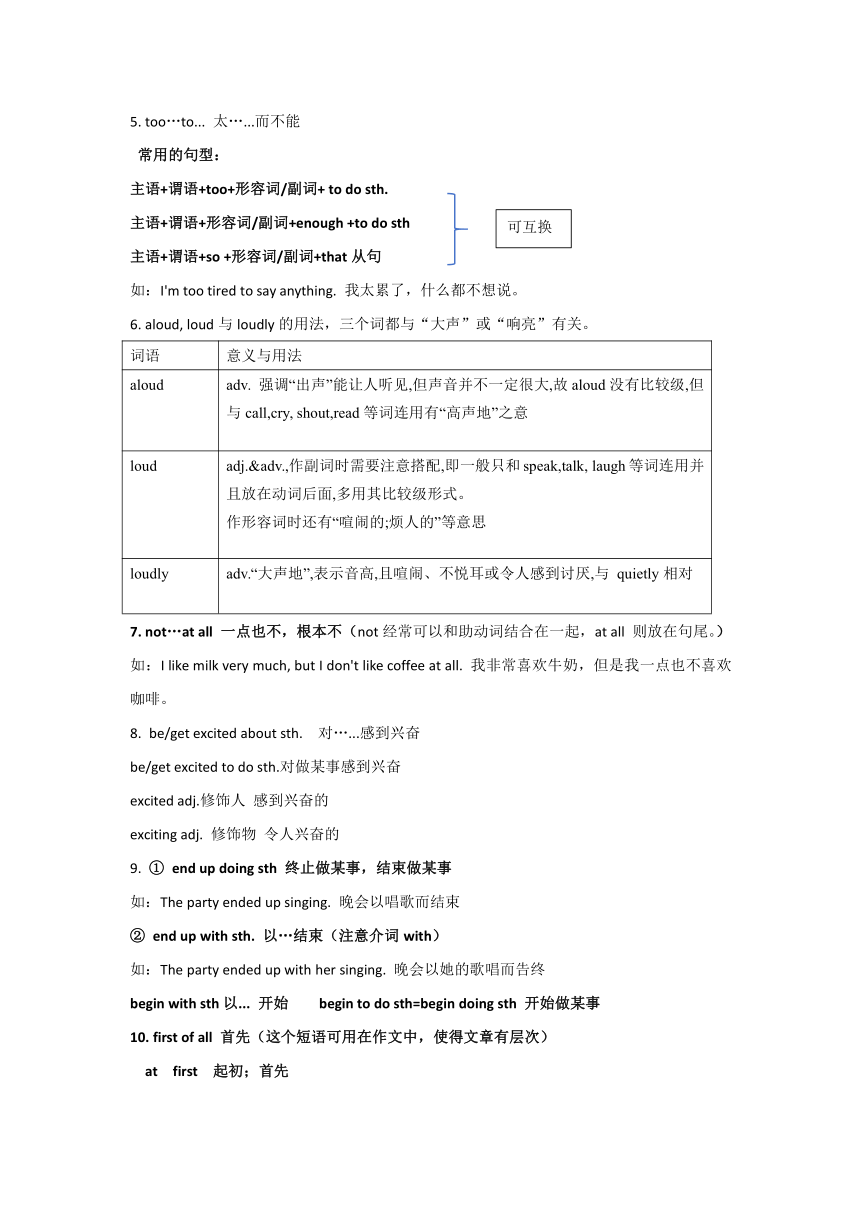
6. aloud, loud与loudly的用法,三个词都与“大声”或“响亮”有关。
词语 意义与用法
aloud adv. 强调“出声”能让人听见,但声音并不一定很大,故aloud没有比较级,但与call,cry, shout,read等词连用有“高声地”之意
loud adj.&adv.,作副词时需要注意搭配,即一般只和speak,talk, laugh等词连用并且放在动词后面,多用其比较级形式。 作形容词时还有“喧闹的;烦人的”等意思
loudly adv.“大声地”,表示音高,且喧闹、不悦耳或令人感到讨厌,与 quietly相对
7. not…at all 一点也不,根本不(not经常可以和助动词结合在一起,at all 则放在句尾。)
如:I like milk very much, but I don't like coffee at all. 我非常喜欢牛奶,但是我一点也不喜欢咖啡。
be/get excited about sth. 对…...感到兴奋
be/get excited to do sth.对做某事感到兴奋
excited adj.修饰人 感到兴奋的
exciting adj. 修饰物 令人兴奋的
9. ① end up doing sth 终止做某事,结束做某事
如:The party ended up singing. 晚会以唱歌而结束
② end up with sth. 以…结束(注意介词with)
如:The party ended up with her singing. 晚会以她的歌唱而告终
begin with sth以... 开始 begin to do sth=begin doing sth 开始做某事
10. first of all 首先(这个短语可用在作文中,使得文章有层次)
at first 起初;首先
for the first time 第一次
11. also 也、而且(用于肯定句)常在句子的中间
either 也(用于否定句)常在句末
too 也 (用于肯定句)常在句末
either 也不(用在否定句),常在句末
(它们四个的区分要清楚,尤其要知道用在什么句子中以及各自的位置)
12. make mistakes 犯错=make a mistake
如:I often make mistakes. 我经常犯错。
如:I have made a mistake. 我已经犯了一个错误。
13. laugh at sb. 笑话;取笑(某人)(常见短语)
如:Don't laugh at me! 不要取笑我!
take notes 做笔记,做记录
patient
(1)adj.有耐心的
be patient with对某人有耐心
be patient of sth.对某事能容忍
Luckily, his mother was very patient with him
幸运的是,他母亲对他很有耐心。
The young man was patient of hardships
那个年轻人能忍受苦难。
(2)n.病人
She sat by the patient.
她守护在病人身旁。
拓展 impatient adj.没耐心的 patiently adv.耐心地
patience n.耐心;忍耐
lose patience with对……·失去耐
have(no) patience with对……(没)有耐心
out of patience失去耐心
enjoy doing sth . 喜欢做…,乐意做…
如:She enjoys playing football. 她喜欢踢足球。
enjoy oneself 过得愉快
如:He enjoyed himself. 他过得愉快。
Have fun doing sth =have a good time doing sth
native speaker 说本族语的人
a native to ...本地特有的
make up 组成、构成
be made up of 由...组成
be made in ...制造
be made of 由...制造(看得出原材料)
be made from 由...制造(看不 出原材料)
18. one of +(the+ 形容词最高级)+名词复数形式 : …其中之一(这一题主要考两点,一是最高级,一是名词复数,大家做题的时候要小心)
如:She is one of the most popular teachers. 她是最受欢迎的教师之一。
19. I
It is+adj. for sb. to do sth 为表示客观情况的形容词,如easy, necessary, important, possible
of sb.to do sth 表示主观情感或态度的形容词如,nice, kind, clever, foolish, honest可以转化为动词不定式作状语的句子
句中的it 是形式主语,真正的主语是to study English。
20. discover “发现;发觉”,后可接简单宾语、连接副词+不定式、含不定式的复合宾语及that引导的宾语从句。
We never discovered how to open the box
我们从未弄清楚如何打开这个盒子
I discovered she was excited.我发现她很激动
辨析 discover,find, find out与 invent
词语 意义与用法 例句
discover 指有意或无意地发现已经存在但尚不为人知的事物, 可有形或无形 China has discovered oil under the South China Sea.中国在南海发现了石油。
find 可指偶然发现或经过一番寻找得到所需的东西,强调找的结果 I found the book I was looking for.我找到了我一直在找的书。
find out 表示“查明;找出”,指经过观察、调查、研究把某事或某物查出来,多用于复杂而不容易直接查出的情况 Please find out when the meeting starts.请查一下会议什么时候开始。
invent 指经过研究、设计而创造出前所未有的东西 Who invented the bicycle 自行车是谁发明的
21. decide to do sth. 决定做某事(重要考点,大家需要记住decide后面跟的是不定式,也就是to do)
如:LiLei has decided to go to BeiJing . 李雷已经决定去北京。
22. unless 如果不,除非,引导条件状语从句(主将从现)
如:You will fail unless you work hard. 假如你不努力你就会失败。
23. deal with 处理=do with
deal with常与how连用;do with常与what连用
如:I dealt with a lot of problem.
24. worry about sb./ sth. 担心某人/某事=be worried about
如:Mother worried about his son just now. 妈妈刚才担心他的儿子。
25. be angry with sb. 对某人生气 be angry about/at sth 对某事感到生气
26. ability n.能力;才能
ability to do做……的能力
have ability in doing 有…才干/才能
to the best of one’ s ability尽其所能
I doubt his ability to do the job.
我认为他没有做这个工作的能力。
She has great ability in teaching English.
她很有教英文的才干。
拓展 disability n.残疾
able adj.能够做;有能力的
be able to do能够做某事
disable vt.,使……残疾 disabled adj残疾的
enable vt.使……能够 unable adj.不能够的
27. go by (时间) 过去 . pass by (时间)流逝;(人)过世
如:Two years went by. 两年过去了。
28. see sb / sth doing 看见某人正在做某事(如果是看到正在做什么,要用动词ing形式)
See sb/sth do sth 看见某人做了某事(全过程)
如:She saw him drawing a picture in the classroom. 她看见他正在教室里画画。
29. each other 彼此=one another
30. regard… as … ;把…...看作为...…
Be regarded as 被视为...
如:The boys regarded Anna as a fool. 这些男孩把安娜看成傻瓜。
31. too many 许多,修饰可数名词 如:too many girls
too much 许多,修饰不可数名词 如:too much milk
much too 太,修饰形容词 如:much too beautiful(too much和much too意思不同)
32.change…into… 将…变为…
33. with the help of sb. = with one's help 在某人的帮助下(注意介词of和with,容易出题)
如:with the help of LiLei = with LiLei's help 在李雷的帮助下
pare…to… 把…比作...(比喻)
compare...with...,这也是一个重要的短语,意思是:拿…和…比较(比较)
35. instead 代替 用在句末,副词
instead of sth/doing sth 代替,而不是 (这个地方考的较多的就是instead of doing sth,也是就说如果of后面跟动词,要用动名词形式,也就是动词的ing形式)
如:I will go instead of you. 我将代替你去
36.二、动名词的用法
1. 动名词的构成
动名词一般由“动词原形+ing”构成
2.动名词的句法功能
功能 例句 说明
主语 Eating too much is bad for your health.吃得太多对你的健康有害。 谓语动词用单数形式
宾语 动词宾语 I like playing basketball very much我非常喜欢打篮球 表示一般的习惯或抽象行为或经常性的动作
介词宾语 Stamps are used for sending letters.邮票是用来寄信的。
表语 His hobby is collecting stamps.=Collecting stamps is his hobby.他的爱好是集邮。 多数情况下,v-ing作表语可转换成作主语
定语 She is in the reading room.她在阅览室里。 We should improve our teaching methods.我们应该改进我们的教学方法。 表明它所修饰的词的用途、所属关系等,位于被修饰词之前

展开更多......

收起↑

资源预览