Unit 6 A Day in the Life Section A(1a-1e) 教学设计(表格式)

资源下载
  1. 二一教育资源

Unit 6 A Day in the Life Section A(1a-1e) 教学设计(表格式)

资源简介

Unit 6 A Day in the Life
Section A How do you spend your school day
(1a-1e) 教学设计
课题 U6 Section A(1a-1e)How do you spend your school day 课型 听说课 课时 1
语篇研读 【What】本课有2个语篇,均为听说活动的对话类型,生动地展现了来自英国的学生Peter在中国的初中日常生活。第一篇对话发生在Peter家里,早晨Peter的妈妈叫他起床,提醒他今天要做值日,于是Peter立刻起床并匆忙洗漱;第二篇对话发生在校园里,Peter来到学校做值日,遇到了同样早到的同学Han Lin,两人互相询问早到的原因,同时谈到了各自的日常作息习惯。【Why】本课时围绕“上学日的早晨”话题展开,是单元的第一个课时。学生在教师的指导下,能通过浏览开篇页大问题明确学习目标,理解本单元的主要学习任务,以终为始,明确任务重难点。通过两个对话的学习,学生能够通过观察主题图和图片,积极思考并回答问题,提升其观察力和思维能力,更好地理解和吸收语言知识;通过模仿和表演对话,提高口语表达能力和听力理解能力;同时,认识到时间管理的重要性,学会合理安排自己的时间,提高学习效率和生活质量。【How】对话是以简单的问答形式,包含了一系列有关日常活动的动词短语,如get up, get dressed, brush my teeth, do some reading, have breakfast, take a shower等。同时还呈现了有关时间的表达,如a quarter past six, only seven o’clock, half past six等。在第一篇对话中,由于时间紧迫,Peter妈妈的语言多用祈使句,如“Get up!”“Quickly!”“Take it to school.”“Be safe.”等,营造出早起上学的紧张气氛。只要根据这些时间点梳理相关的活动细节,学生就可以整理出Peter早上的作息规律。
学情分析 K (Know) — 已知 W (Wonder) — 想知 L (Learned) — 已学
学生已学习过一些与日常活动相关的基础词汇,如get up等,对于时间的表达,他们也有初步的认识,能够说出整点和半点的表达方式,为他们理解和表达日常作息提供了一定的基础;熟悉简单的陈述句结构,对于一般疑问句及其回答也有一定的了解。 希望学习更多关于日常活动的词汇,特别是在日常生活中经常提及但尚未掌握英文表达的活动;渴望学习时间表达,包括如何准确地表达分钟数不是整点或半点的时间,以及在不同情境下时间表达的灵活运用;希望能够在日常作息话题下进行更流畅、自然的口语交流。 掌握了一些与时间表达和日常活动相关的新词汇;学会了用“What time… When... ” 谈论生活日常,丰富了英语表达;提高了对此话题的听力理解能力,能够更好地捕捉关键信息;增强了在真实情境下运用英语表达自己想法的自信和流利度。
学习重点难点 重点:日常活动和时间点的表达;用what time 和when谈论上学日的日常作息;
难点:礼貌地使用准确的语言表达上学日的日常作息。
学习目标 能够通过听获取对话中人物活动的信息和活动的时间,根据所听内容和教材提供的信息,完成细节信息的补充;运用目标语言“What time… When... ” 谈论生活日常,并能正确认读时间;(应用实践)能够用目标语言谈论日常的活动及时间安排,在小组内相互礼貌得体地完成角色扮演,并在班级中展示,语言运用得体、正确,并学会关注时间,且学习时间管理;(迁移创新)
当堂评价 能够正确认读、书写有关时间表达和日常活动的目标词汇,在语境中理解其意义;能正确识别并读出四组辅音音素,准确读出含有这些辅音音素的常见词汇;根据所给的句中重音符号,准确识别并正确读出句子中单词的强读单词,做到举一反三;能根据听力文本内容进行关于生活日常的对话(检测学习目标1)2. 能够通过听准确获取对话中人物活动的信息和活动的时间,准确、全面地完成细节信息的补充;能够使用对话中的句型,准确、得体地谈论日常的活动及时间安排,通过角色扮演能说出人物角色的语气和心理活动;(检测学习目标2)3. 能够与至少3位同学进行生活日常的对话,语言运用得体、正确。(检测学习目标3)
教学活动设计
学习活动 教师导学 学习评价
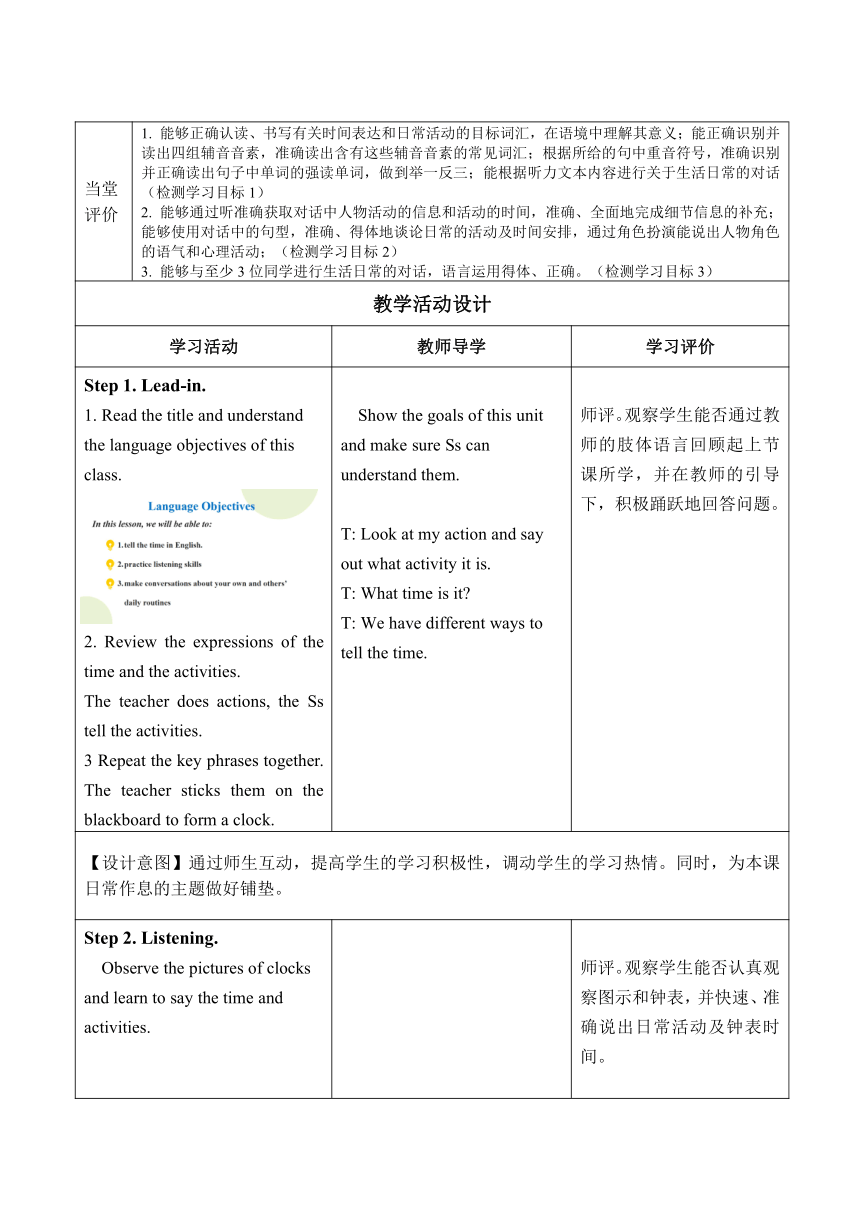
Step 1. Lead-in.1. Read the title and understand the language objectives of this class.2. Review the expressions of the time and the activities.The teacher does actions, the Ss tell the activities. 3 Repeat the key phrases together. The teacher sticks them on the blackboard to form a clock. Show the goals of this unit and make sure Ss can understand them. T: Look at my action and say out what activity it is.T: What time is it T: We have different ways to tell the time. 师评。观察学生能否通过教师的肢体语言回顾起上节课所学,并在教师的引导下,积极踊跃地回答问题。
【设计意图】通过师生互动,提高学生的学习积极性,调动学生的学习热情。同时,为本课日常作息的主题做好铺垫。
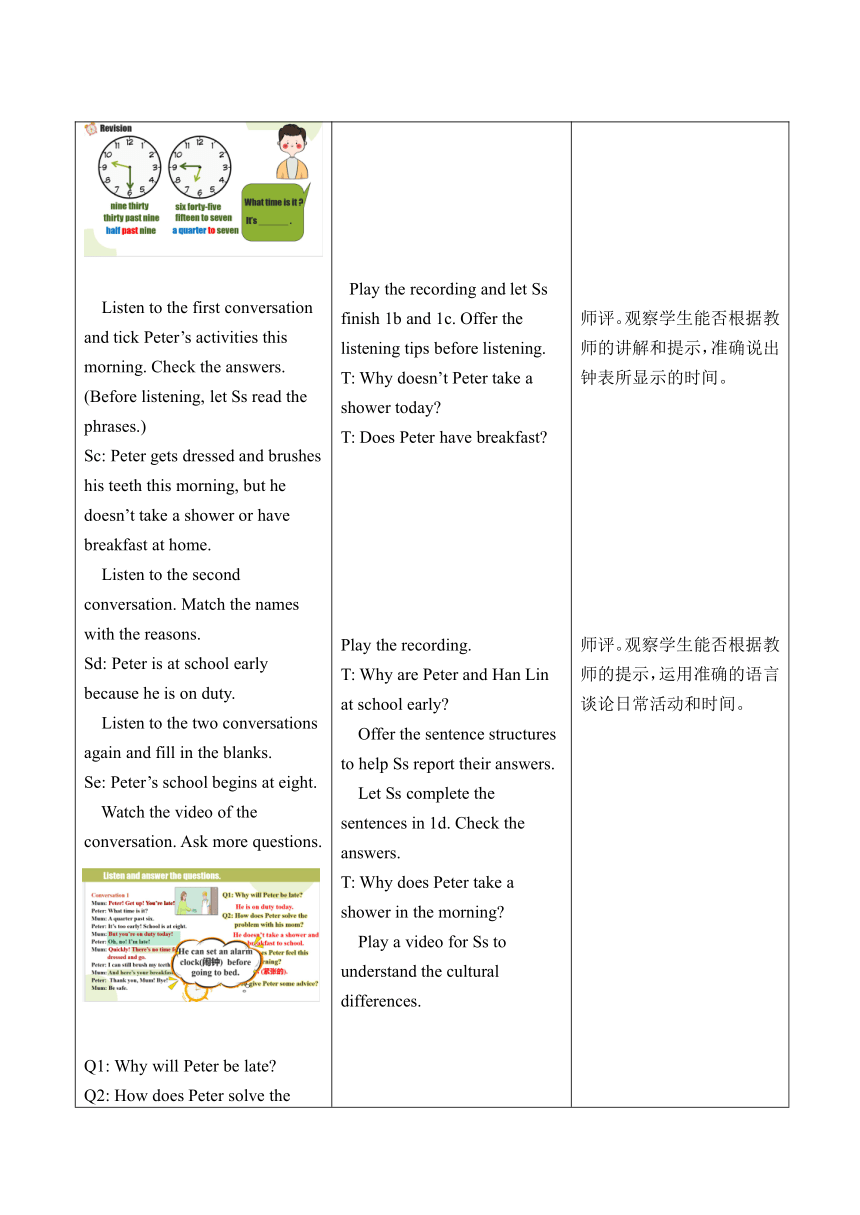
Step 2. Listening. Observe the pictures of clocks and learn to say the time and activities. Listen to the first conversation and tick Peter’s activities this morning. Check the answers.(Before listening, let Ss read the phrases.)Sc: Peter gets dressed and brushes his teeth this morning, but he doesn’t take a shower or have breakfast at home.Listen to the second conversation. Match the names with the reasons.Sd: Peter is at school early because he is on duty.Listen to the two conversations again and fill in the blanks. Se: Peter’s school begins at eight. Watch the video of the conversation. Ask more questions.Q1: Why will Peter be late Q2: How does Peter solve the problem with his mom Q3: How does Peter feel this morning Q4: Can you give Peter some advice Sa: He is on duty today.Sb: He doesn’t take a shower and take breakfast to school.Sc: Nervous.Sd: He can set an alarm clock before going to bed.Q1: What do you think of Han Lin Q2: Does Han Lin make good use his time Sa: He likes reading and he is hard-working.Sb: Yes, he gets up early and does some reading before class. Play the recording and let Ss finish 1b and 1c. Offer the listening tips before listening.T: Why doesn’t Peter take a shower today T: Does Peter have breakfast Play the recording.T: Why are Peter and Han Lin at school early Offer the sentence structures to help Ss report their answers. Let Ss complete the sentences in 1d. Check the answers.T: Why does Peter take a shower in the morning Play a video for Ss to understand the cultural differences. Provide some questions to help Ss get more information.T: Why will Peter be late T: How does Peter solve the problem with his mom T: How does Peter feel this morning T: What do you think of Han Lin T: Does Han Lin make good use of his time 师评。观察学生能否认真观察图示和钟表,并快速、准确说出日常活动及钟表时间。师评。观察学生能否根据教师的讲解和提示,准确说出钟表所显示的时间。师评。观察学生能否根据教师的提示,运用准确的语言谈论日常活动和时间。师评。观察学生能否准确、全面地获取有关Peter日常活动的信息,审题并预测听力内容。听第一遍录音时,能否准确地找到Peter早上从事活动的信息,为接下来的细节信息的获取奠定基础。听第二遍录音时,能否快速、正确匹配人物和原因。听第三遍录音时,能否准确、快速地获取句子中的信息,即活动时间,将答案完整地填写到课本上。师评。观察学生能否在听第四遍录音时,根据问题提示准确、快速地获取文中更多细节信息。
【设计意图】创设向新同学介绍上学日常的学习情境,通过听力选择、信息匹配、听力填空、回答问题等多种类型的任务设置,帮助学生整体感知对话内容,并培养学生准确获取和记录关键信息的能力。引导学生认真研读对话内容,利用多种工具和手段,学会在零散的新旧知识之间建立关联,自主建构基于语篇的结构化新知,为下一步的角色扮演做好铺垫。
Step 3. Post-listening. Read the conversations and analyze the sentence structures.Sa: What time is it Sb: What time do you usually... Work in pairs and role-play the conversation. Several minutes later, some Ss do a presentation.Fill in the routine table and talk about their school day routine in the morning. Sa: What time do you usually get up Sb: I usually get up at half past six.Sa: When do you have breakfast Guide Ss to analyze the sentences in the conversations.T: How to ask about time Encourage Ss to play the roles and provide the evaluation standards.T: How about your school day routine in the morning Offer the sentence structures and checklist to help Ss. 自评、互评、师评。观察学生在小组讨论和小组展示中能否准确地询问和回答关于日常的活动和时间。使用的语言是否准确,是否使用介词at表示时间,能否在小组内礼貌得体地完成角色扮演,语言运用得体、正确。
【设计意图】引导学生在归纳和整理核心语言的基础上,通过角色扮演,理解语言意义,促进语言内化,从学习理解过渡到应用实践,为后面的真实表达做准备。引导学生进行超越语篇、联系实际生活的活动,用所学语言做事情,根据新情境整合运用相关的语言表达,模拟对话角色扮演,完成交际任务,学以致用,培养学生在真实情境中运用语言和文化知识解决实际问题的能力,推动迁移创新。
Step 4. Conclusion. With T’s help, have a conclusion about what they’ve learned this lesson. Offer the self-assessment to help Ss have a reflection. 自评、互评、师评。观察学生能否准确对本节课所学作出小结。
【设计意图】引导学生进行课堂小结和学情反思。
作业设计 必做 Listen to the tape and repeat.Recite the language points.3. Write down the conversation between you and your partner on your morning routine, improve it and reflect on how well you use your time.
选做 Surf the Internet to learn more about how to make good use of your morning time.

展开更多......

收起↑

资源预览