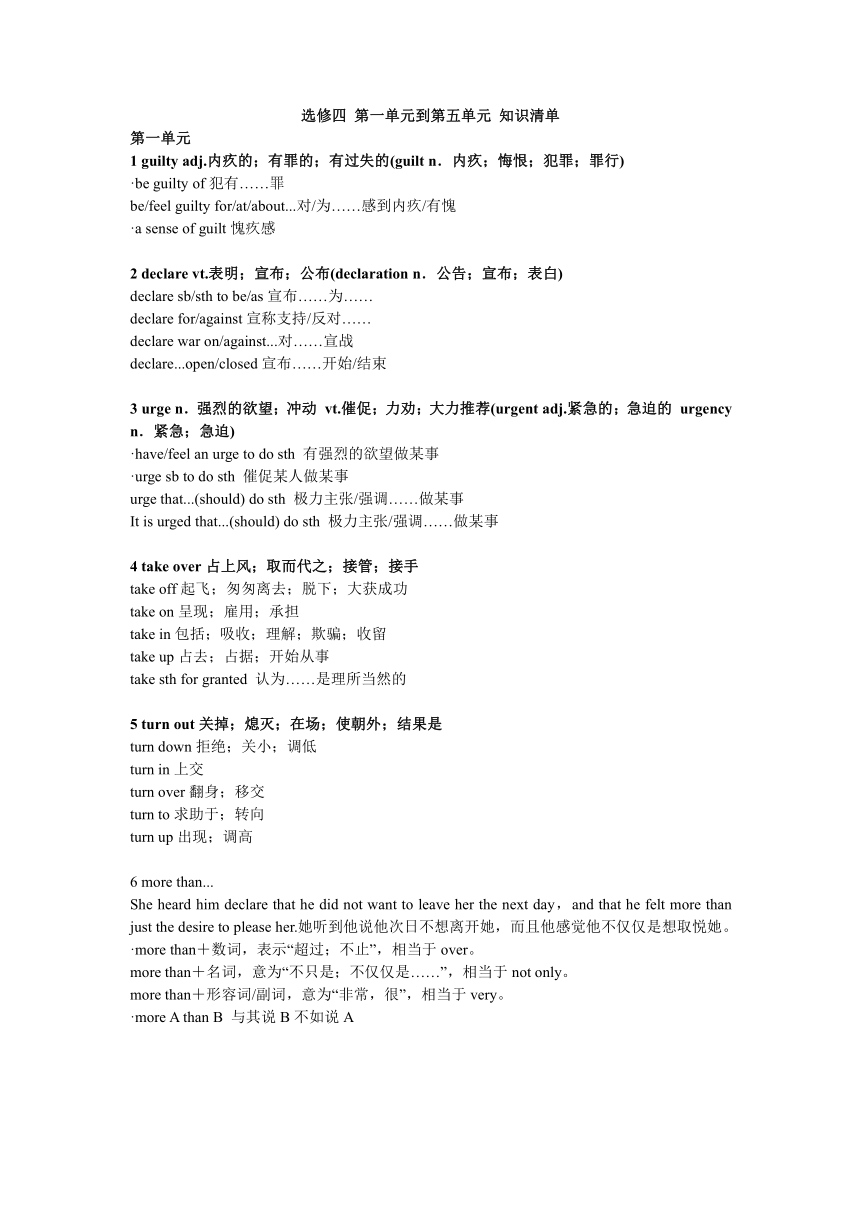
资源简介 选修四 第一单元到第五单元 知识清单第一单元1 guilty adj.内疚的;有罪的;有过失的(guilt n.内疚;悔恨;犯罪;罪行)·be guilty of犯有……罪be/feel guilty for/at/about...对/为……感到内疚/有愧·a sense of guilt愧疚感2 declare vt.表明;宣布;公布(declaration n.公告;宣布;表白)declare sb/sth to be/as宣布……为……declare for/against宣称支持/反对……declare war on/against...对……宣战declare...open/closed宣布……开始/结束3 urge n.强烈的欲望;冲动 vt.催促;力劝;大力推荐(urgent adj.紧急的;急迫的 urgency n.紧急;急迫)·have/feel an urge to do sth 有强烈的欲望做某事·urge sb to do sth 催促某人做某事urge that...(should) do sth 极力主张/强调……做某事It is urged that...(should) do sth 极力主张/强调……做某事4 take over占上风;取而代之;接管;接手take off起飞;匆匆离去;脱下;大获成功take on呈现;雇用;承担take in包括;吸收;理解;欺骗;收留take up占去;占据;开始从事take sth for granted 认为……是理所当然的5 turn out关掉;熄灭;在场;使朝外;结果是turn down拒绝;关小;调低turn in上交turn over翻身;移交turn to求助于;转向turn up出现;调高6 more than... She heard him declare that he did not want to leave her the next day,and that he felt more than just the desire to please her.她听到他说他次日不想离开她,而且他感觉他不仅仅是想取悦她。·more than+数词,表示“超过;不止”,相当于over。more than+名词,意为“不只是;不仅仅是……”,相当于not only。more than+形容词/副词,意为“非常,很”,相当于very。·more A than B 与其说B不如说A第二单元1 located adj.处于;位于;坐落于[locate vt.找出……的位置;把……设置(在);使……坐落(于) location n.地点;位置]be located in/on/at位于;坐落于2 freedom n.自由;不受……影响的状态(free adj.免费的;自由的;不受约束的 vt.使自由;解放;释放 freely adv.自由地;不受限制地)be free to do sth 自由做某事set...free使……获得自由;释放……free from/of...不受……影响的;无……的3 “介词+关系代词”引导的定语从句 Most of their musical instruments are really just sticks found on the ground,among which there is an amazing instrument called the didgeridoo.他们的大多数乐器其实就是在地上找到的树枝,其中就有一种叫作迪吉里杜管的神奇乐器。当关系代词在定语从句中作介词的宾语时,我们通常用“介词+关系代词”引导定语从句。如果指人,用“介词+whom”;如果指物,用“介词+which”。·另外,whose也可放在介词后构成“介词+whose+名词”结构。·该句式中介词的选用可根据从句中动词、形容词等与介词的搭配或根据语意确定。第三单元1 extend vt.扩展;使伸长;延长;提供;伸展,展开 vi.& vt.持续,延续(extensive adj.广阔的;大量的;广泛的 extension n.延伸;扩大;延期)extend...to...向……提供/给予……extend to延长到extend by延长了2 mercy n.仁慈;宽恕;恩惠(merciful adj.仁慈的;慈悲的;宽容的 merciless adj.残忍的;无慈悲心的)·show mercy to对……怜悯/宽恕have mercy on/upon对……怜悯/宽恕at the mercy of...任由……摆布·be merciful to...对……仁慈3 possession n.[usually pl.]个人财产;拥有;控制(possess vt.拥有;具有;支配)·take possession of (表动作)占有;拥有in possession of (表状态)具有;拥有in the possession of被……拥有;归……所有·be possessed of sth具有(某种品质或特征)4 in hand在手头;可供使用at hand近在手边;在附近by hand手工,用手的hand in hand手挽手;密切关联on the one hand...on the other (hand)一方面……另一方面(用于表示不同的尤其是相对立的两个方面)give sb a hand 帮助……;施以援手5 so that引导目的状语从句 We need to understand what is happening to our planet so that we can take action.我们需要了解我们的星球正在发生什么,以便我们可以采取行动。·本句中so that引导目的状语从句,相当于in order that,从句中往往含有情态动词,如can,could,may,might等。·so that也可以引导结果状语从句,此时从句中往往没有情态动词。第四单元1.drag vt.拖;拉;扯 vt.& vi.缓慢而费力地移动读后续写之手部肢体动作:drag/draw/pull拉;cup one’s hands over...把手窝成杯状;slide one’s hands into...将手伸进……;put one’s hands to one’s cheeks/bury one’s face with one’s hands双手掩面;spread one’s hands摊开双手2 privilege n.特权;优惠待遇;荣幸 v.给予特权;特别优待(privileged adj.有特权的;受特别优待的;荣幸的)·It is a privilege to do sth.做某事是一种殊荣。have the privilege to do/of doing sth 有特权做某事·be privileged to do sth 有幸做某事3 resign v.辞职;辞去resign from...从……辞职resign as...辞去……的职务resign oneself to (doing) sth听任/顺从/只好接受……4 deserve vi.& vt.应受;应得;值得(deserving adj.值得的;应得的)deserve sth 值得/应得某事/某物deserve doing/to be done值得被……(此处用动名词的主动形式表示被动意义,类似用法的动词还有:need,want,require等)deserve it(口语)活该;自作自受5 since引导原因状语从句 There is no equipment,and since there isn’t even a washroom,if I need water I have to carry it from my house in a basin! 这里没有设备,甚至连洗手间都没有。如果需要用水,我得用盆子从我的房子里端来!·since用作连词,可引导原因状语从句,意为“因为,既然”,侧重大家已知的事实;也可引导时间状语从句,意为“自从……以来”,主句谓语动词为延续性动词且多用现在完成时。·since作介词,意为“从……以来;自……以后”,后接名词或代词。·since作副词,意为“从那时以后;后来”。第五单元1 debt n.债务;欠款in debt负债out of debt不欠债pay off one’s debt还清某人的欠款或债务2 accuse vt.控告;控诉;谴责 (accusation n.指责;控告)accuse sb of (doing) sth/charge sb with (doing) sth 控告/指责某人(做)某事the accused被告3 greedy adj.贪婪的;贪心的;贪吃的 (greed n.贪婪;贪心 greedily adv.贪婪地)be greedy for sth 对……贪婪/渴望be greedy to do sth 渴望做某事4 dedicate v.把……奉献给(dedication n.奉献;献身 dedicated adj.献身的;专心致志的)dedicate sth to...把……奉献给……dedicate oneself to= be dedicated to献身于……;致力于……5 wish后宾语从句中的虚拟语气 You don’t want to look back in years to come and say,“I wish I had thought more about what I really wanted to do.”你不会想在多年之后回顾过去时说:“我真希望当年能再多想想自己真正想要做什么。”wish后宾语从句中的虚拟语气,与现在事实相反,从句谓语动词用一般过去时;与过去事实相反,从句谓语动词用过去完成时;对将来发生的事表示祝愿或愿望,从句谓语动词用“would/could/should+动词原形”。(1)我的头脑里有几个方案在蹦来蹦去,我的确希望现在可以决定一个。With several scenarios bouncing around in my mind,I do wish that I decided on one now.(2)我希望在即将到来的高考中,我不会辜负父母和老师的期望。I wish I would live up to the expectations of my parents and teachers in the coming college entrance examination.(3)我站在那里,默默地流着悔恨的泪水,我希望我没对爸爸说如此刻薄的话。(读后续写之悔恨心理描写)I stood there,shedding tears of regret in silence and I wished that I hadn’t said such sharp words to my father. 展开更多...... 收起↑ 资源预览
 资源预览
资源预览
 资源预览
资源预览