全册讲义(无答案)2024-2025学年外研版(2024)英语七年级上册

资源下载
  1. 二一教育资源

全册讲义(无答案)2024-2025学年外研版(2024)英语七年级上册

资源简介

目录
Starter Welcome to junior high !
【词汇讲解】 ........................................................2
【课文讲解】 ........................................................9 【作文讲解】 ........................................................13
Unit 1 A new start
【词汇讲解】 ........................................................14
【课文讲解】 ........................................................19 【作文讲解】 .........................................................25 【语法练习】 .........................................................27
Unit 2 More than fun
【词汇讲解】 .........................................................36
【课文讲解】 .........................................................44 【作文讲解】 .........................................................50【语法练习】 .........................................................52
Unit 3 Family ties
【词汇讲解】 .........................................................64
【课文讲解】 .........................................................71 【作文讲解】 .........................................................79【语法练习】 .........................................................81
Unit 4 Time to celebrate
【词汇讲解】 .........................................................93
【课文讲解】 .........................................................102 【作文讲解】 .........................................................108【语法练习】 .........................................................110
Unit 5 Fantastic friends
【词汇讲解】 .......................................................120
【课文讲解】 .......................................................128 【作文讲解】 .......................................................136 【语法练习】 ........................................................138
Unit 6 The power of plants
【词汇讲解】 ........................................................150
【课文讲解】 ........................................................157 【作文讲解】 ........................................................163【语法练习】 .........................................................165
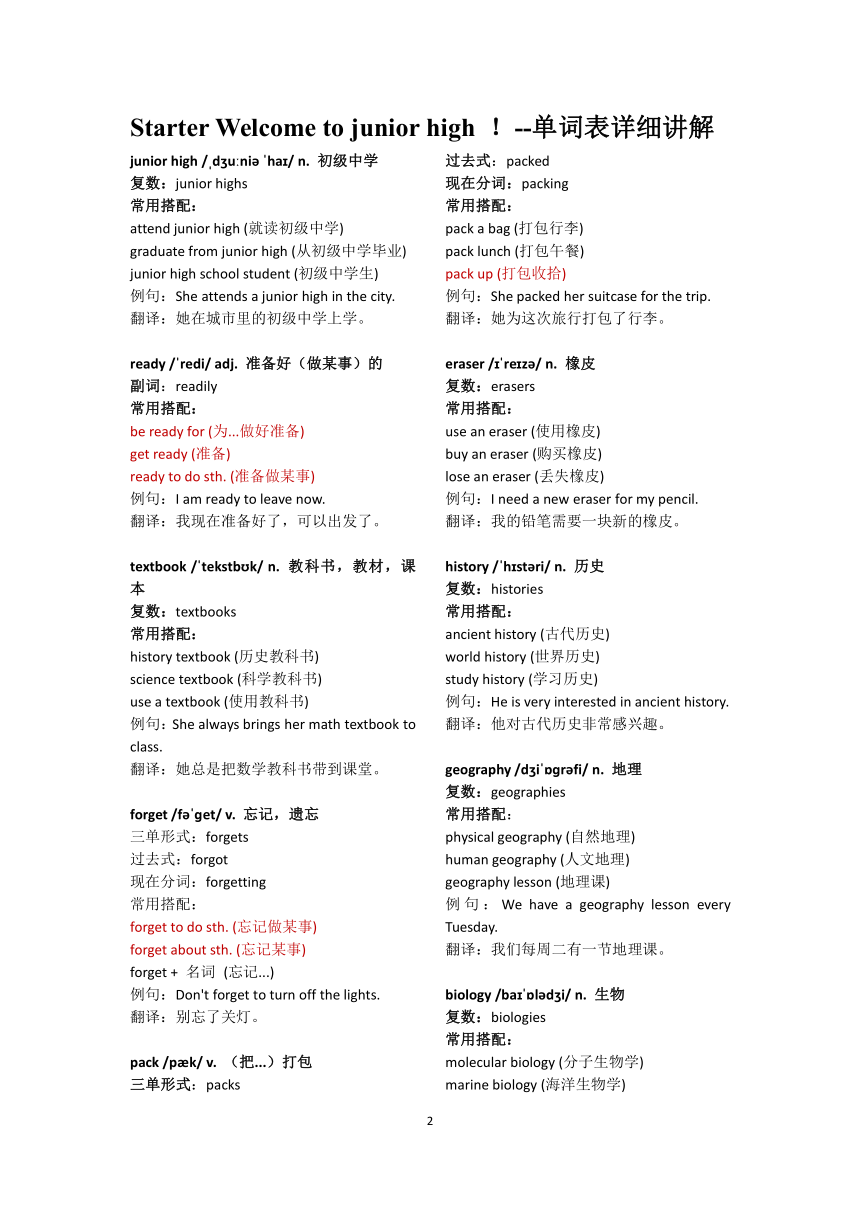
Starter Welcome to junior high !--单词表详细讲解
2
junior high / d u ni ha / n. 初级中学
复数:junior highs
常用搭配:
attend junior high (就读初级中学)
graduate from junior high (从初级中学毕业)
junior high school student (初级中学生)
例句:She attends a junior high in the city.
翻译:她在城市里的初级中学上学。
ready / redi/ adj. 准备好(做某事)的
副词:readily
常用搭配:
be ready for (为...做好准备)
get ready (准备)
ready to do sth. (准备做某事)
例句:I am ready to leave now.
翻译:我现在准备好了,可以出发了。
textbook / tekstb k/ n. 教科书,教材,课本
复数:textbooks
常用搭配:
history textbook (历史教科书)
science textbook (科学教科书)
use a textbook (使用教科书)
例句:She always brings her math textbook to class.
翻译:她总是把数学教科书带到课堂。
forget /f ɡet/ v. 忘记,遗忘
三单形式:forgets
过去式:forgot
现在分词:forgetting
常用搭配:
forget to do sth. (忘记做某事)
forget about sth. (忘记某事)
forget + 名词 (忘记...)
例句:Don't forget to turn off the lights.
翻译:别忘了关灯。
pack /p k/ v. (把...)打包
三单形式:packs
过去式:packed
现在分词:packing
常用搭配:
pack a bag (打包行李)
pack lunch (打包午餐)
pack up (打包收拾)
例句:She packed her suitcase for the trip.
翻译:她为这次旅行打包了行李。
eraser / re z / n. 橡皮
复数:erasers
常用搭配:
use an eraser (使用橡皮)
buy an eraser (购买橡皮)
lose an eraser (丢失橡皮)
例句:I need a new eraser for my pencil.
翻译:我的铅笔需要一块新的橡皮。
history / h st ri/ n. 历史
复数:histories
常用搭配:
ancient history (古代历史)
world history (世界历史)
study history (学习历史)
例句:He is very interested in ancient history.
翻译:他对古代历史非常感兴趣。
geography /d i ɡr fi/ n. 地理
复数:geographies
常用搭配:
physical geography (自然地理)
human geography (人文地理)
geography lesson (地理课)
例句:We have a geography lesson every Tuesday.
翻译:我们每周二有一节地理课。
biology /ba l d i/ n. 生物
复数:biologies
常用搭配:
molecular biology (分子生物学)
marine biology (海洋生物学)
biology textbook (生物教科书)
例句:She decided to major in biology.
翻译:她决定主修生物学。
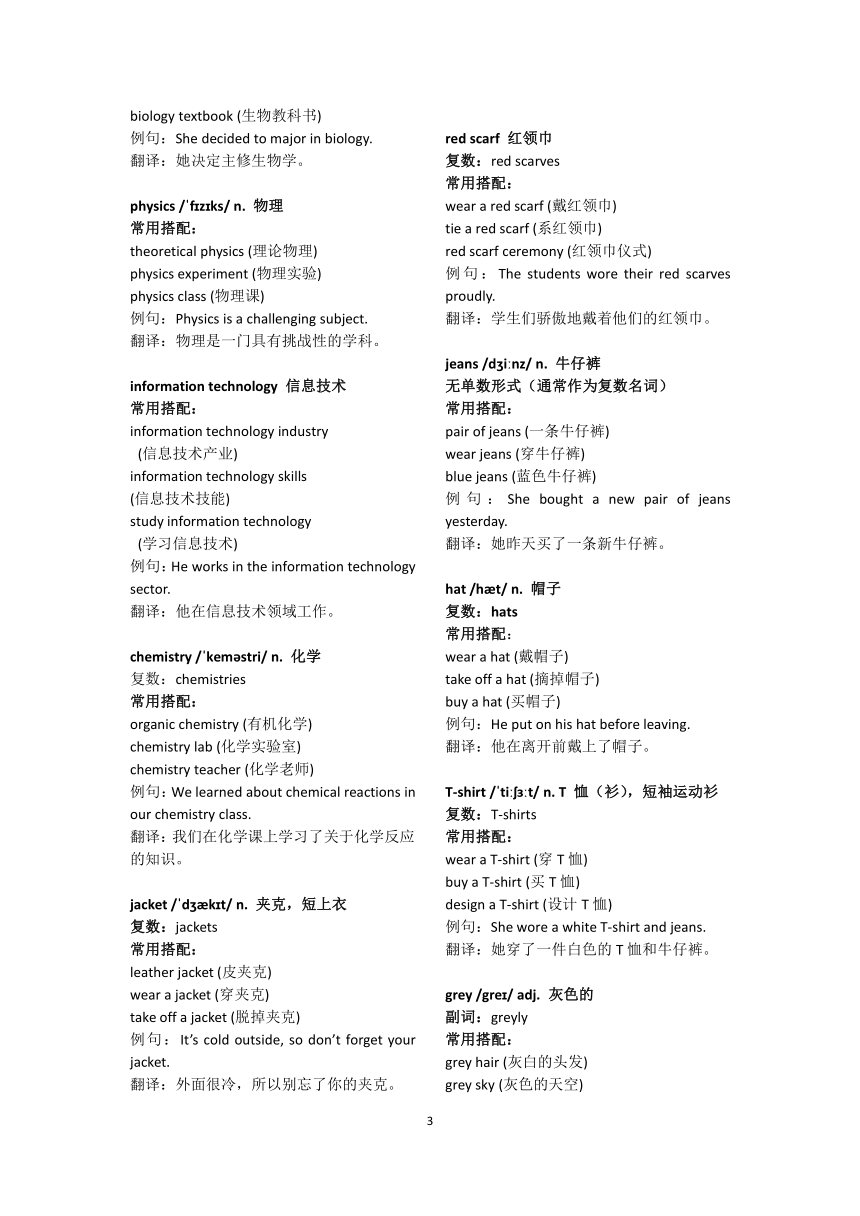
physics / f z ks/ n. 物理
常用搭配:
theoretical physics (理论物理)
physics experiment (物理实验)
physics class (物理课)
例句:Physics is a challenging subject.
翻译:物理是一门具有挑战性的学科。
information technology 信息技术
常用搭配:
information technology industry
(信息技术产业)
information technology skills
(信息技术技能)
study information technology
(学习信息技术)
例句:He works in the information technology sector.
翻译:他在信息技术领域工作。
chemistry / kem stri/ n. 化学
复数:chemistries
常用搭配:
organic chemistry (有机化学)
chemistry lab (化学实验室)
chemistry teacher (化学老师)
例句:We learned about chemical reactions in our chemistry class.
翻译:我们在化学课上学习了关于化学反应的知识。
jacket / d k t/ n. 夹克,短上衣
复数:jackets
常用搭配:
leather jacket (皮夹克)
wear a jacket (穿夹克)
take off a jacket (脱掉夹克)
例句:It’s cold outside, so don’t forget your jacket.
翻译:外面很冷,所以别忘了你的夹克。
red scarf 红领巾
复数:red scarves
常用搭配:
wear a red scarf (戴红领巾)
tie a red scarf (系红领巾)
red scarf ceremony (红领巾仪式)
例句:The students wore their red scarves proudly.
翻译:学生们骄傲地戴着他们的红领巾。
jeans /d i nz/ n. 牛仔裤
无单数形式(通常作为复数名词)
常用搭配:
pair of jeans (一条牛仔裤)
wear jeans (穿牛仔裤)
blue jeans (蓝色牛仔裤)
例句:She bought a new pair of jeans yesterday.
翻译:她昨天买了一条新牛仔裤。
hat /h t/ n. 帽子
复数:hats
常用搭配:
wear a hat (戴帽子)
take off a hat (摘掉帽子)
buy a hat (买帽子)
例句:He put on his hat before leaving.
翻译:他在离开前戴上了帽子。
T-shirt / ti t/ n. T 恤(衫),短袖运动衫
复数:T-shirts
常用搭配:
wear a T-shirt (穿T恤)
buy a T-shirt (买T恤)
design a T-shirt (设计T恤)
例句:She wore a white T-shirt and jeans.
翻译:她穿了一件白色的T恤和牛仔裤。
grey /gre / adj. 灰色的
副词:greyly
常用搭配:
grey hair (灰白的头发)
grey sky (灰色的天空)
grey suit (灰色的西装)
例句:The sky was grey and overcast.
翻译:天空是灰色的,阴云密布。
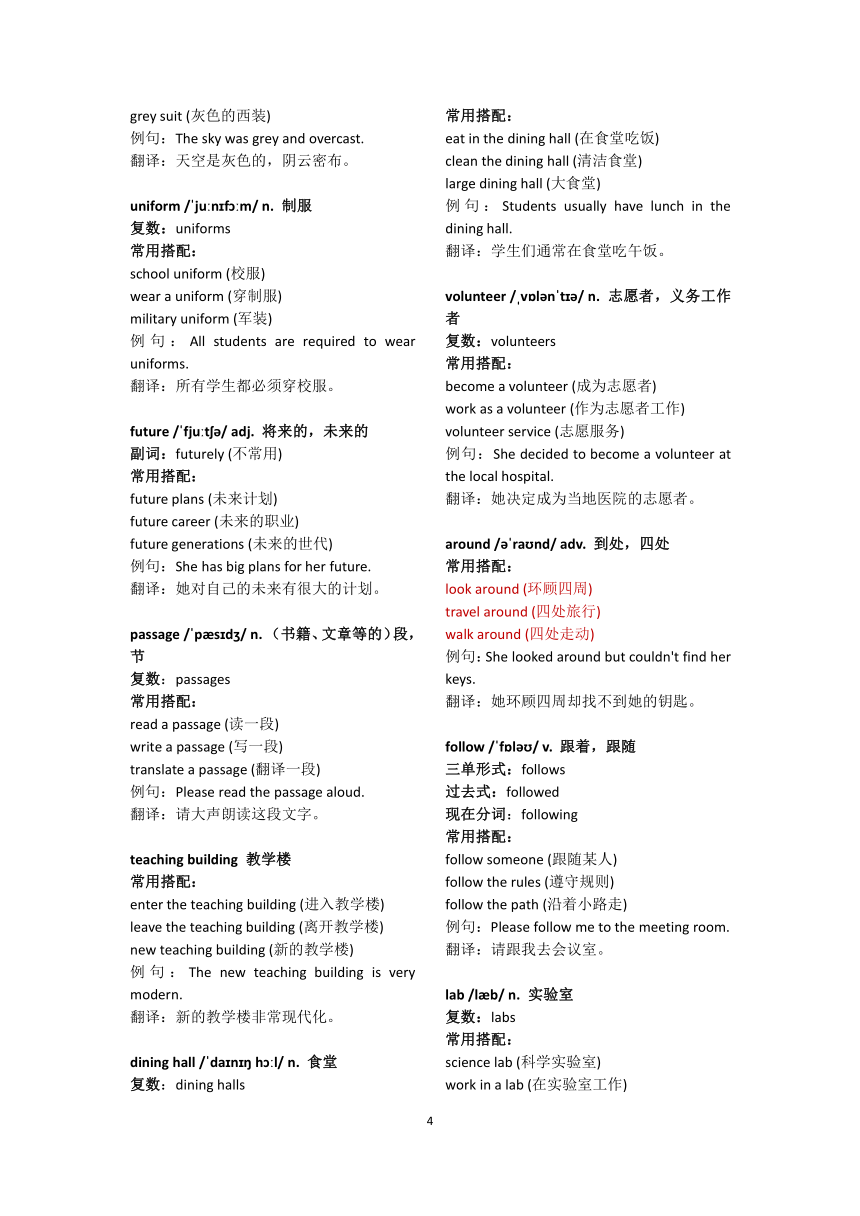
uniform / ju n f m/ n. 制服
复数:uniforms
常用搭配:
school uniform (校服)
wear a uniform (穿制服)
military uniform (军装)
例句:All students are required to wear uniforms.
翻译:所有学生都必须穿校服。
future / fju t / adj. 将来的,未来的
副词:futurely (不常用)
常用搭配:
future plans (未来计划)
future career (未来的职业)
future generations (未来的世代)
例句:She has big plans for her future.
翻译:她对自己的未来有很大的计划。
passage / p s d / n. (书籍、文章等的)段,节
复数:passages
常用搭配:
read a passage (读一段)
write a passage (写一段)
translate a passage (翻译一段)
例句:Please read the passage aloud.
翻译:请大声朗读这段文字。
teaching building 教学楼
常用搭配:
enter the teaching building (进入教学楼)
leave the teaching building (离开教学楼)
new teaching building (新的教学楼)
例句:The new teaching building is very modern.
翻译:新的教学楼非常现代化。
dining hall / da n h l/ n. 食堂
复数:dining halls
常用搭配:
eat in the dining hall (在食堂吃饭)
clean the dining hall (清洁食堂)
large dining hall (大食堂)
例句:Students usually have lunch in the dining hall.
翻译:学生们通常在食堂吃午饭。
volunteer / v l n t / n. 志愿者,义务工作者
复数:volunteers
常用搭配:
become a volunteer (成为志愿者)
work as a volunteer (作为志愿者工作)
volunteer service (志愿服务)
例句:She decided to become a volunteer at the local hospital.
翻译:她决定成为当地医院的志愿者。
around / ra nd/ adv. 到处,四处
常用搭配:
look around (环顾四周)
travel around (四处旅行)
walk around (四处走动)
例句:She looked around but couldn't find her keys.
翻译:她环顾四周却找不到她的钥匙。
follow / f l / v. 跟着,跟随
三单形式:follows
过去式:followed
现在分词:following
常用搭配:
follow someone (跟随某人)
follow the rules (遵守规则)
follow the path (沿着小路走)
例句:Please follow me to the meeting room.
翻译:请跟我去会议室。
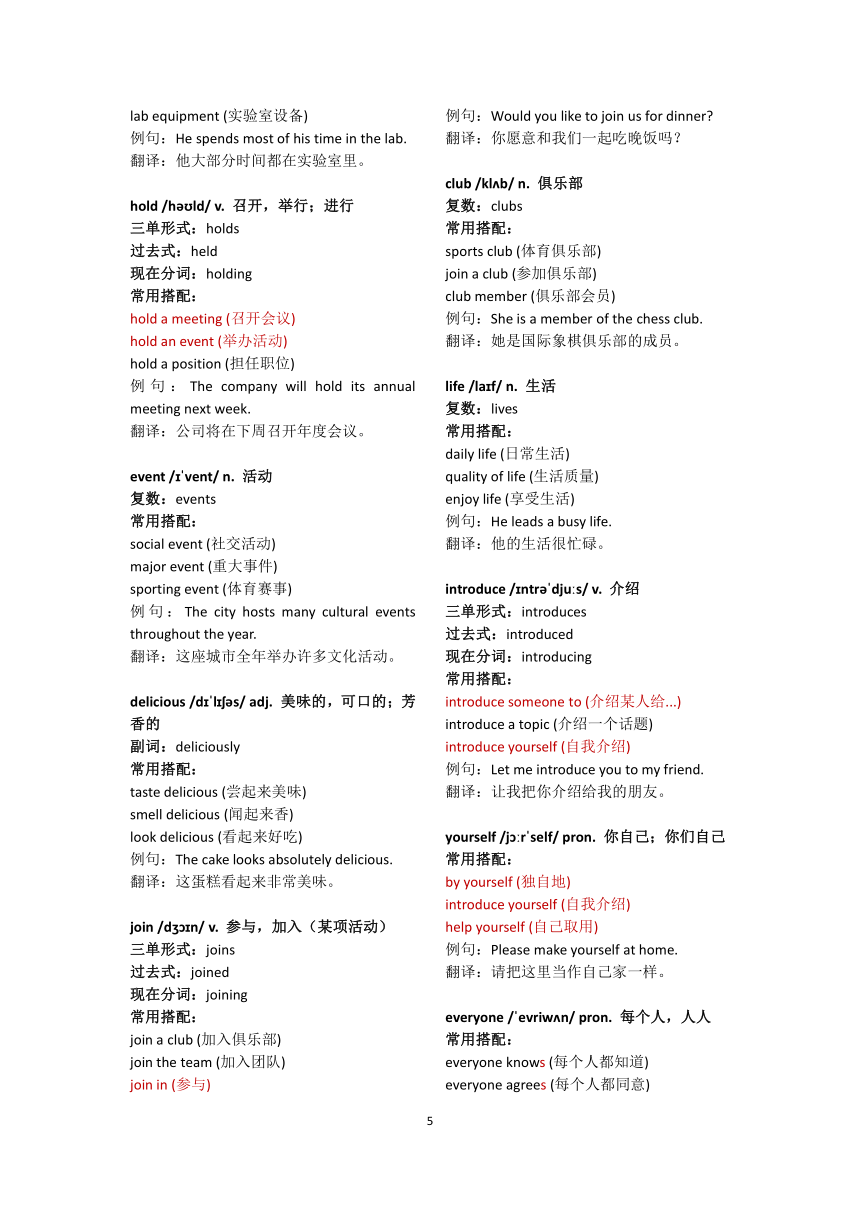
lab /l b/ n. 实验室
复数:labs
常用搭配:
science lab (科学实验室)
work in a lab (在实验室工作)
lab equipment (实验室设备)
例句:He spends most of his time in the lab.
翻译:他大部分时间都在实验室里。
hold /h ld/ v. 召开,举行;进行
三单形式:holds
过去式:held
现在分词:holding
常用搭配:
hold a meeting (召开会议)
hold an event (举办活动)
hold a position (担任职位)
例句:The company will hold its annual meeting next week.
翻译:公司将在下周召开年度会议。
event / vent/ n. 活动
复数:events
常用搭配:
social event (社交活动)
major event (重大事件)
sporting event (体育赛事)
例句:The city hosts many cultural events throughout the year.
翻译:这座城市全年举办许多文化活动。
delicious /d l s/ adj. 美味的,可口的;芳香的
副词:deliciously
常用搭配:
taste delicious (尝起来美味)
smell delicious (闻起来香)
look delicious (看起来好吃)
例句:The cake looks absolutely delicious.
翻译:这蛋糕看起来非常美味。
join /d n/ v. 参与,加入(某项活动)
三单形式:joins
过去式:joined
现在分词:joining
常用搭配:
join a club (加入俱乐部)
join the team (加入团队)
join in (参与)
例句:Would you like to join us for dinner
翻译:你愿意和我们一起吃晚饭吗?
club /kl b/ n. 俱乐部
复数:clubs
常用搭配:
sports club (体育俱乐部)
join a club (参加俱乐部)
club member (俱乐部会员)
例句:She is a member of the chess club.
翻译:她是国际象棋俱乐部的成员。
life /la f/ n. 生活
复数:lives
常用搭配:
daily life (日常生活)
quality of life (生活质量)
enjoy life (享受生活)
例句:He leads a busy life.
翻译:他的生活很忙碌。
introduce / ntr dju s/ v. 介绍
三单形式:introduces
过去式:introduced
现在分词:introducing
常用搭配:
introduce someone to (介绍某人给...)
introduce a topic (介绍一个话题)
introduce yourself (自我介绍)
例句:Let me introduce you to my friend.
翻译:让我把你介绍给我的朋友。
yourself /j r self/ pron. 你自己;你们自己
常用搭配:
by yourself (独自地)
introduce yourself (自我介绍)
help yourself (自己取用)
例句:Please make yourself at home.
翻译:请把这里当作自己家一样。
everyone / evriw n/ pron. 每个人,人人
常用搭配:
everyone knows (每个人都知道)
everyone agrees (每个人都同意)
greet everyone (问候每个人)
例句:Everyone is invited to the party.
翻译:每个人都被邀请参加聚会。
holiday / h l de / n. 假期,休假日
复数:holidays
常用搭配:
summer holiday (暑假)
public holiday (公共假日)
go on holiday (去度假)
例句:We are planning to go on holiday in July.
翻译:我们计划在七月去度假。
enjoy / n d / v. 喜欢;享受...的乐趣
三单形式:enjoys
过去式:enjoyed
现在分词:enjoying
常用搭配:
enjoy doing sth. (喜欢做某事)
enjoy oneself (玩得开心)
enjoy the moment (享受当下)
例句:They enjoyed their trip to the mountains.
翻译:他们享受了去山里的旅行。
nervous / n v s/ adj. 神经紧张的;焦虑不安的
副词:nervously
常用搭配:
feel nervous (感到紧张)
look nervous (看起来紧张)
make someone nervous (让某人紧张)
例句:He felt nervous before the exam.
翻译:考试前他感到紧张。
classmate / klɑ sme t/ n. 同班同学
复数:classmates
常用搭配:
meet a classmate (见同学)
talk with a classmate (与同学交谈)
old classmate (老同学)
例句:She met her old classmate at the reunion.
翻译:她在聚会上见到了她的老同学。
hobby / h bi/ n. 业余爱好,嗜好
复数:hobbies
常用搭配:
favorite hobby (最喜欢的爱好)
take up a hobby (开始一个爱好)
common hobby (共同的爱好)
例句:Reading is one of my hobbies.
翻译:阅读是我的爱好之一。
organise / ɡ na z/ v. 组织,策划,安排
三单形式:organises
过去式:organised
现在分词:organising
常用搭配:
organise an event (组织活动)
organise a meeting (安排会议)
organise a trip (策划旅行)
例句:She helped organise
need /ni d/ v. 需要
三单形式:needs
过去式:needed
现在分词:needing
常考搭配:
need to do sth.(需要做某事)
need help(需要帮助)
need something(需要某物)
例句及翻译:
She needs to finish her homework before dinner. 她需要在晚饭前完成作业。
snack /sn k/ n. (正餐以外的)小吃,点心
复数形式:snacks
常用搭配:
have a snack(吃点心)
healthy snacks(健康的小吃)
snack time(点心时间)
例句及翻译:
I usually have a snack in the afternoon. 我通常在下午吃点心。
activity / k t v ti/ n. 活动
复数形式:activities
常用搭配:
outdoor activities(户外活动)
school activities(学校活动)
free time activities(自由时间的活动)
例句及翻译:
We enjoy many outdoor activities on the weekends. 我们在周末喜欢进行许多户外活动。
decoration / dek re n/ n. 装饰物
复数形式:decorations
常用搭配:
Christmas decorations(圣诞装饰)
party decorations(派对装饰)
home decorations(家庭装饰)
例句及翻译:
The Christmas decorations look beautiful. 圣诞装饰看起来很漂亮。
balloon /b lu n/ n. 气球
复数形式:balloons
常用搭配:
blow up a balloon(吹气球)
helium balloons(氦气球)
balloon ride(热气球旅行)
例句及翻译:
The children enjoyed blowing up balloons at the party. 孩子们在派对上喜欢吹气球。
leaf /li f/ n. 叶,叶子
复数形式:leaves
常用搭配:
fall leaves(秋天的树叶)
green leaves(绿叶)
leaf blower(吹叶机)
例句及翻译:
The ground was covered with fall leaves. 地面上铺满了秋天的落叶。
grow /gr / v. 成长,长大
三单形式:grows
过去式:grew
现在分词:growing
常考搭配:
grow up(成长)
grow plants(种植植物)
grow quickly(快速成长)
例句及翻译:
Children grow up so fast. 孩子们长得真快。
paint /pe nt/ v. (给……)涂颜料
三单形式:paints
过去式:painted
现在分词:painting
常考搭配:
paint a picture(画一幅画)
paint the walls(刷墙)
face painting(面部彩绘)
例句及翻译:
She likes to paint pictures of landscapes. 她喜欢画风景画。
start /stɑ t/ v. 创办;建立
三单形式:starts
过去式:started
现在分词:starting
常考搭配:
start to do sth.(开始做某事)
start a business(创办企业)
start early(早点开始)
例句及翻译:
He started to learn English last year. 他去年开始学英语。
better / b t / adj. 更好的,较好的
副词形式:better
常用搭配:
feel better(感觉好些)
get better(变好)
better than(比……更好)
例句及翻译:
I hope you feel better soon. 希望你很快感觉好些。
plan /pl n/ n. 计划
复数形式:plans
常用搭配:
make a plan(制定计划)
travel plan(旅行计划)
work plan(工作计划)
例句及翻译:
We need to make a plan for the weekend. 我们需要制定一个周末的计划。
Starter Welcome to junior high !
重点短语
Welcome to junior high! - 欢迎来到初中!
a new stage of your study - 你学习的新阶段
go to a new school - 前往一所新学校
learn new subjects - 学习新科目
make new friends - 结交新朋友
Are you ready for all these - 你为这一切准备好了吗?
in this unit - 在这个单元中
let's get prepared - 让我们做好准备
it will be fun - 这将会很有趣
Junior high school - 初中
Pack your schoolbag - 收拾你的书包
Pencil case - 铅笔盒
Two pencils, three pens, an eraser, and a ruler - 两支铅笔,三支钢笔,一块橡皮和一把尺子
Textbooks - 教科书
Building 2 - 2号楼
on the first floor - 在一楼
science and computer labs - 科学和计算机实验室
on the second floor - 在二楼
Music rooms - 音乐室
art rooms - 美术室
a dance hall - 舞厅
there's also a library - 还有一个图书馆
it's on the third floor - 它在三楼
showed me around - 带我参观
I really like it - 我真的很喜欢它
I love sports very much - 我非常喜欢运动
This summer holiday - 这个暑假
went to Dalian with my parents - 和我的父母去了大连
swam in the sea - 在海里游泳
played on the beach - 在沙滩上玩耍
I enjoyed it a lot - 我非常喜欢
a helpful girl - 一个乐于助人的女孩
helping people with their difficulties - 帮助别人解决困难
a bit nervous - 有点紧张
excited to meet new teachers and classmates - 很兴奋能够遇见新的老师和同学
make friends with you all - 和大家成为朋友
课文句子详解
原文
This is Building 2. On the first floor,-we have science and computer labs. Music rooms, art rooms and a dance hall are on the second floor. And there's also a library. It's on the third floor.
This is our playground. We do morning exercises and hold school sports events here. After school,
we run or play football in it. It's my favourite place in school.
This is our dining hall.It's not big, but the food
is delicious and healthy.
句子详解
This is Building 2.
句型:主语 + 系动词 + 宾语
时态:一般现在时
短语:Building 2 (2号楼)
考点:This is...句型;对某物做出陈述或描述。
举例:This is my house.(这是我的房子。)
On the first floor, we have science and computer labs.
句型:介词短语 + 主语 + 动词 + 宾语
时态:一般现在时
短语:the first floor (一楼), science and computer labs (科学实验室和计算机实验室)
考点:介词短语的位置及其作用,描述某地拥有的设施或物品。
举例:In the kitchen, we have a fridge and a stove.(在厨房里,我们有一个冰箱和一个炉子。)
Music rooms, art rooms and a dance hall are on the second floor.
句型:主语 + 系动词 + 介词短语
时态:一般现在时
短语:music rooms (音乐教室), art rooms (美术教室), a dance hall (舞蹈厅), the second floor (二楼)
考点:并列结构和系动词的使用,描述多个事物所在的位置。
举例:The bedrooms and bathrooms are on the third floor.(卧室和浴室在三楼。)
And there's also a library.
句型:连词 + 主语 + 系动词 + 副词 + 宾语
时态:一般现在时
短语:a library (图书馆)
考点:连词的使用和句子的扩展,补充说明额外的信息。
举例:And there's also a gym.(并且还有一个健身房。)
It's on the third floor.
句型:主语 + 系动词 + 介词短语
时态:一般现在时
短语:the third floor (三楼)
考点:位置表达的介词短语,描述某物的位置。
举例:It's in the corner.(它在角落里。)
This is our playground.
句型:主语 + 系动词 + 宾语
时态:一般现在时
短语:our playground (我们的操场)
考点:系动词和名词短语的使用,对某物做出陈述或描述
举例:This is our classroom.(这是我们的教室。)
We do morning exercises and hold school sports events here.
句型:主语 + 动词 + 宾语 + 连词 + 动词 + 宾语 + 状语
时态:一般现在时
短语:morning exercises (早操), school sports events (学校体育活动)
考点:并列结构和地点状语的使用,描述在特定地点进行的多项活动。
举例:We have lunch and take breaks here.(我们在这里吃午饭和休息。)
After school, we run or play football in it.
句型:时间状语从句 + 主句
时态:一般现在时
短语:after school (放学后), play football (踢足球)
考点:时间状语从句和并列结构的使用,描述特定时间后的活动。
举例:After dinner, we watch TV or read books.(晚饭后,我们看电视或读书。)
It's my favourite place in school.
句型:主语 + 系动词 + 宾语补足语
时态:一般现在时
短语:my favourite place (我最喜欢的地方)
考点:形容词短语作宾语补足语,表达个人喜好
举例:It's my favorite book.(这是我最喜欢的书。)
原文
Hello everyone! My name is Zhu Xiaomeng. Today is my first day in junior high. The volunteers showed me around the school. I really like it. I love sports very much. I like running, playing football and swimming. This summer holiday, I went to Dalian with my parents. We swam in the sea and played on the beach. I enjoyed it a lot. I'm also a helpful girl. I like helping people with their difficulties. I'm a bit nervous now, but I'm also excited to meet new teachers and classmates. I want to make friends with you all!
句子详解
My name is Zhu Xiaomeng.
句型: 主语 + 系动词 + 名词短语
时态: 一般现在时
短语: My name(我的名字)
考点: 句型结构、自我介绍常用语句。
举例: Her name is Lily.(她的名字是莉莉。)
Today is my first day in junior high.
句型: 时间状语 + 主语 + 系动词 + 名词短语
时态: 一般现在时
短语: my first day in junior high (我上初中的第一天)
考点: 时间表达、状态描述、日常生活语句。
举例: Yesterday was a busy day for us.(昨天我们很忙。)
The volunteers showed me around the school.
句型: 主语 + 动词 + 宾语 + 介词短语
时态: 一般过去时
短语: showed sb. around (到某人转)
I really like it.
句型: 主语 + 喜好动词 + 宾语
时态: 一般现在时
考点: 喜好动词、喜爱描述、简单现在时。
举例: They enjoy playing chess together.(他们喜欢一起下棋。)
I love sports very much.
句型: 主语 + 喜好动词 + 名词短语 + 副词
时态: 一般现在时
短语: very much 非常
考点: 喜好动词、爱好表达、副词修饰。
举例: She deeply loves music.(她非常喜爱音乐。)
I like running, playing football and swimming.
句型: 主语 + 喜好动词 + 动名词短语
时态: 一般现在时
短语: running (跑步), playing football (踢足球), swimming (游泳)
考点: 动名词用法、多种活动描述、喜好表达。
举例: They enjoy reading books and watching movies.(他们喜欢看书和看电影。)
This summer holiday, I went to Dalian with my parents.
句型: 时间状语 + 主语 + 动词 + 介词短语
时态: 一般过去时
短语: this summer holiday (这个暑假), my parents (我的父母)
考点: 时间状语、过去经历描述、地点介绍。描述过去的活动和地点
举例: Last winter, she traveled to New York with her friends.(去年冬天,她和朋友们去了纽约。)
We swam in the sea and played on the beach.
句型: 主语 + 动词 + 介词短语 + 连词 + 动词 + 介词短语
时态: 一般过去时
短语: the sea (海里), the beach (沙滩上)
考点: 连词用法、多种活动描述、过去时态。描述过去的活动和地点
举例: They hiked in the mountains and camped by the river.(他们在山里徒步旅行并在河边露营。)
I enjoyed it a lot.
句型: 主语 + 动词 + 宾语 + 副词短语
时态: 一般过去时
短语: a lot 非常
考点: 过去时态、经历描述、喜爱表达。表达对过去经历的喜爱
举例: She liked the movie very much.(她非常喜欢那部电影。)
I'm also a helpful girl.
句型: 主语 + 系动词 + 副词 + 形容词 + 名词
时态: 现在进行时
短语: a helpful girl (一个乐于助人的女孩)
考点: 现在进行时态、形容词修饰、自我介绍常用语句。
举例: He's a smart student.(他是一个聪明的学生。)
I'm a bit nervous now, but I'm also excited to meet new teachers and classmates.
句型: 主语 + 系动词 + 副词 + 形容词 + 现在分词短语,连词 + 主语 + 系动词 + 副词 + 形容词 + 现在分词短语
时态: 现在进行时
短语: a bit (有点)nervous (紧张的), excited (兴奋的), new teachers and classmates (新的老师和同学)
考点: 现在进行时态、情感表达、状态描述。
举例: They're watching TV in the living room.(他们在客厅里看电视。)
I want to make friends with you all!
句型: 主语 + 想要动词 + 动词短语
时态: 现在时
短语: make friends (交朋友) want to+动词原形(想要做某事)
考点: 想要动词用法、愿望表达、简单现在时。
举例: She wants to go shopping with us.(她想和我们一起去购物。)
Starter Welcome to junior high !单元必背话题范文
话题 Organize a party
提示:写一篇关于策划一场聚会的作文。
* Step1 审题
①定文体 : 记叙文 ②定人称 : 第一人称 ③定时态 : 一般将来时
* Step2 有用的表达Useful expressions (可选用)
(1)Activities: playing games、singing songs
(2)food & drinks:snacks、juice
(3)Decorations: balloons、 posters
(4)What do you need
* Step3 成文
Unit 1 A new start--单词表详细讲解
complete /k m’pli t/ v. 使完整
三单形式:completes
过去式:completed
现在分词:completing
常考搭配:
complete a task (完成任务)
complete the form (填写表格)
complete the project (完成项目)
例句:She completed the assignment on time. (她按时完成了作业。)
without /w a t/ prep. 缺乏;没有
常用搭配:
without a doubt (毫无疑问)
without delay (立即)
without permission (未经许可)
例句:He went out without his wallet. (他出门时没带钱包。)
sentence / sent ns / n. 句子
复数形式:sentences
常用搭配:
complete sentence (完整的句子)
simple sentence (简单句)
compound sentence (复合句)
例句:Write a complete sentence for each word. (为每个单词写一个完整的句子。)
mistake /m `ste k/ n.错误
复数形式:mistakes
常用搭配:
make a mistake (犯错误)
correct a mistake (纠正错误)
learn from mistakes (从错误中学习)
例句:Everyone makes mistakes. (每个人都会犯错误。)
polite /p ’la t/ adj. 有礼貌的,客气的
副词形式:politely
常用搭配:
polite behavior (有礼貌的行为)
polite expression (礼貌的表达)
be polite to someone (对某人有礼貌)
例句:It's important to be polite to others. (对别人有礼貌是很重要的。)
mind /ma nd/ n. 头脑;思想,思维
复数形式:minds
常用搭配:
change one's mind (改变主意)
open mind (开放的心态)
peace of mind (宁静的心境)
例句:She has a brilliant mind. (她有一个聪明的头脑。)
hers /h z/ pron. 她的
常用搭配:
a friend of hers (她的一个朋友)
that book is hers (那本书是她的)
the choice is hers (选择权在她手上)
例句:The decision is hers. (决定权在她手上。)
dry /dra / adj. 干的,干燥的
副词形式:dryly
常用搭配:
dry weather (干燥的天气)
dry clothes (干的衣服)
dry skin (干燥的皮肤)
例句:The weather is very dry today. (今天的天气非常干燥。)
meaning /`mi n / n. 意义;意思;含义
复数形式:meanings
常用搭配:
meaning of life (生命的意义)
true meaning (真正的含义)
hidden meaning (隐藏的意义)
例句:What is the meaning of this word (这个词是什么意思?)
fact /f kt/ n. 事实;真相
复数形式:facts
常用搭配:
in fact (事实上)
fact sheet (情况说明书)
face the facts (面对事实)
例句:In fact, he is right. (事实上,他是对的。)
important / m`p t nt/ adj. 重要的,重大的
副词形式:importantly
常用搭配:
important decision (重要决定)
important person (重要人物)
important role (重要角色)
例句:Education is very important. (教育非常重要。)
remember /r `memb / v. 记住,记得
三单形式:remembers
过去式:remembered
现在分词:remembering
常用搭配:
remember to do something (记得做某事)
remember doing something (记得做过某事)
remember someone (记住某人)
remember an event (记住一件事)
例句:Please remember to lock the door. (请记得锁门。)
really /`r li/ adv. 很,十分
常用搭配:
really good (真的很好)
really like (真的喜欢)
really appreciate (非常感谢)
例句:I really enjoyed the movie. (我真的很喜欢这部电影。)
choose /t u z/ v. 挑选,选择;选取
三单形式:chooses
过去式:chose
现在分词:choosing
常用搭配:
choose a career (选择职业)
choose wisely (明智地选择)
choose a gift (挑选礼物)
例句:You can choose any book you like. (你可以选择任何你喜欢的书。)
main /me n/ adj.(同类中)最大的,最重要的
常用搭配:
main idea (主要思想)
main character (主要角色)
main reason (主要原因)
例句:The main problem is lack of resources. (主要问题是缺乏资源。)
expression / k`spre ( )n/ n. 词;词组;措辞
复数形式:expressions
常用搭配:
facial expression (面部表情)
common expression (常见表达)
idiomatic expression (习惯用语)
例句:Her facial expressions showed her feelings. (她的面部表情显示了她的情感。)
point /p nt/ v. 指;用(手指)指
三单形式:points
过去式:pointed
现在分词:pointing
常用搭配:
point out (指出)
point to (指向)
point at (指着)
例句:She pointed out the mistake in my report. (她指出了我报告中的错误。)
praise /pre z/ v. (尤指公开地)称赞,赞扬,表扬
三单形式:praises
过去式:praised
现在分词:praising
常用搭配:
praise highly (高度赞扬)
deserve praise (值得表扬)
full of praise (充满赞美)
例句:The teacher praised the student for his hard work. (老师表扬了学生的努力。)
other /` / adj. 其余的,另外的
常用搭配:
other people (其他人)
other side (另一边)
other things (其他事情)
例句:There are no other options available. (没有其他可选项了。)
grammar /`gr m / n. 语法
复数形式:grammars
常用搭配:
grammar rules (语法规则)
grammar book (语法书)
grammar test (语法测试)
例句:Understanding grammar is essential for learning a new language. (理解语法对于学习新语言是必不可少的。)
rule /ru l/ n. 规则,定律
复数形式:rules
常用搭配:
follow the rules (遵守规则)
break the rules (违反规则)
set the rules (制定规则)
例句:You must follow the rules at all times. (你必须一直遵守规则。)
circle /`s k l/ v. 在……上画圈;圈出
三单形式:circles
过去式:circled
现在分词:circling
常用搭配:
circle the answer (圈出答案)
circle the date (圈出日期)
circle around (绕……转圈)
例句:Please circle the correct answer. (请圈出正确答案。)
mine /ma n/ pron. 我的
常用搭配:
a friend of mine (我的一个朋友)
that book is mine (那本书是我的)
the choice is mine (选择权在我手上)
例句:This car is mine. (这辆车是我的。)
diary /`da ri/ n. 日记,日志,日记簿
复数形式:diaries
常用搭配:
keep a diary (写日记)
personal diary (个人日记)
secret diary (秘密日记)
例句:She writes in her diary every night. (她每晚都写日记。)
bell /bel/ n. 铃;电铃
复数形式:bells
常用搭配:
door bell (门铃)
school bell (学校的铃声)
church bell (教堂的钟声)
例句:The school bell rang at 8 o'clock. (学校的铃声在8点响了。)
ring /r / v.(钟、铃)鸣响
三单形式:rings
过去式:rang
现在分词:ringing
常用搭配:
ring the bell (按铃)
phone rings (电话响了)
ring loudly (响亮地响)
例句:The phone rang just as I was leaving. (就在我要离开的时候电话响了。)
into / nt / prep. 进入,到······里面
常用搭配:
go into (进入),
look into (调查),
come into (进入)
例句: He went into the building. (他进入了那栋建筑。)
ourselves /a `selvz/ pron. 我们自己
常用搭配:
by ourselves (独自),
help ourselves (自助),
enjoy ourselves (尽情享受)
例句: We did it all by ourselves. (我们全都是靠自己完成的。)
silly / s li/ adj. 可笑的,荒唐的
副词: sillily
常用搭配:
look silly (看起来傻),
feel silly (感到傻),
act silly (举止荒唐)
例句: He made a silly mistake. (他犯了一个愚蠢的错误。)
sir /s / n. 老师(中小学生对男教师的称呼)
复数: sirs
常用搭配: Yes, sir! (是的,先生!), No, sir! (不,先生!), Excuse me, sir (打扰一下,先生)
例句: Good morning, Sir. (早上好,先生。)
just /d st/ adv. 正好,恰好
常用搭配:
just now (刚才),
just in time (正好赶上),
just because (只是因为)
例句: I just finished my homework. (我刚刚做完作业。)
smile /sma l/ n. 微笑,笑容
复数: smiles
常用搭配:
with a smile (带着微笑),
give a smile (露出微笑),
smile at (对……微笑)
例句: She greeted me with a smile. (她带着微笑迎接我。)
lucky /l ki/ adj. 运气好的,幸运的
副词: luckily
常用搭配:
lucky to do (幸运地做某事),
lucky number (幸运数字),
lucky day (幸运日)
例句: I was lucky to find my keys. (我很幸运找到了我的钥匙。)
until / n`t l/ prep. 直到………为止
常用搭配:
wait until (等到),
until recently (直到最近),
not until (直到……才)
例句: Wait here until I come back. (在这里等我回来。)
happen /h p n/ v. (尤指意外地)发生
三单形式: happens,
过去式: happened,
现在分词: happening
常用搭配:
happen to (发生在),
happen suddenly (突然发生),
make something happen (使某事发生)
例句: What happened to you (你发生了什么事?)
during /dj r / prep. 在······期间
常用搭配:
during the day (在白天),
during the meeting (在会议期间),
during the trip (在旅行期间)
例句: I fell asleep during the movie. (我在电影期间睡着了。)
more /m / deter. 另外的、更多的
常用搭配:
more than (超过),
more or less (或多或少),
more importantly (更重要的是)
例句: I need more time. (我需要更多时间。)
conversation / k nv `se n/ n. (非正式的)谈话,交谈,会话
复数: conversations
常用搭配:
have a conversation (进行谈话),
start a conversation (开始谈话),
conversation with (与……的谈话)
例句: We had a long conversation about our plans. (我们就我们的计划进行了长时间的交谈。)
advice / d`va s/ n. 意见,建议;忠告,劝告
无复数形式(不可数名词)
常用搭配:
give advice (提供建议),
follow advice (听从建议),
piece of advice (一条建议)
例句: She gave me some good advice. (她给了我一些好建议。)
task /tɑ sk/ n. 工作,任务
复数: tasks
常用搭配:
complete a task (完成任务),
difficult task (艰难的任务)
assign a task (布置任务)
例句: I have a lot of tasks to do today. (我今天有很多任务要做。)
project /pr d ekt/ n.(学校的)课题,研究项目
复数: projects
常用搭配:
work on a project (从事一个项目),
complete a project (完成项目),
project proposal (项目提案)
例句: Our class is working on a new project. (我们班正在做一个新项目。)
journey /d ni/ n. 旅行,旅程;历程,过程
复数: journeys
常用搭配:
long journey (长途旅行),
begin a journey (开始旅行),
end a journey (结束旅行)
例句: We had an amazing journey through the mountains. (我们进行了惊人的山中旅行。)
of course 当然,自然
常用搭配:
Of course not (当然不是),
Of course, I will (当然,我会的),
Yes, of course (是的,当然)
例句: Of course, you can join us. (当然,你可以加入我们。)
together /t `ge / adv. 一起,共同,一齐,一块儿
常用搭配:
work together (一起工作),
live together (一起生活),
come together (聚在一起)
例句: Let's study together. (让我们一起学习吧。)
pool /pu l/ n. 水塘,水洼
复数: pools
常用搭配:
swimming pool (游泳池),
pool of water (一滩水),
pool party (泳池派对)
例句: The children are playing around the pool. (孩子们在水塘边玩耍。)
sail /se l/ v. 起航
三单形式: sails,
过去式: sailed,
现在分词: sailing
常用搭配:
sail away (扬帆远航),
sail on (继续航行),
sail across (航行穿越)
例句: They sailed across the ocean. (他们扬帆穿越了大洋。)
away / `we / adv. 朝另一方向
常用搭配:
go away (离开),
right away (马上)
far away (遥远)
例句: He walked away without saying a word. (他一言不发地走开了。)
thought /θ t/ n. 意见,主意,观点
复数: thoughts
常用搭配:
express a thought (表达意见),
deep thought (深思),
give a thought (考虑)
例句: She shared her thoughts on the topic. (她分享了她对这个话题的看法。)
primary /pra m ri/ adj. 小学教育的,初级教育的
副词: primarily
常用搭配:
primary education (小学教育),
primary school (小学),
primary concern (主要关切)
例句: He is a primary school teacher. (他是小学教师。)
primary school 小学
复数: primary schools
常用搭配:
attend primary school (上小学),
primary school student (小学学生),
primary school teacher (小学教师)
例句: She started primary school last year. (她去年开始上小学。)
protect /pr `tekt/ v. 保护;防护
三单形式: protects,
过去式: protected,
现在分词: protecting
常用搭配:
protect from (保护免受),
protect against (防护),
protect the environment (保护环境)
例句: We need to protect our natural resources. (我们需要保护我们的自然资源。)
wind /w nd/ n. 风
复数: winds
常用搭配:
strong wind (强风),
wind speed (风速),
blow in the wind (随风飘动)
例句: The wind is blowing hard. (风刮得很大。)
wide /wa d/ adj. 宽的,宽阔的
副词: widely
常用搭配:
wide road (宽阔的道路),
wide range (广泛的范围),
open wide (大开)
例句: The river is very wide here. (这条河在这里非常宽。)
Unit 1 A new start
重点短语
on the blackboard 在黑板上
write down 记下
start to do 开始做
the first 第一个
point out 指出...
in the first lesson 在第一节课
jump into my mind 跳进我的脑海
look up at 抬头看
think about 思考,想想看
put up my hand 举起手来
There is a mistake. 有一个错误。
Confucius 孔子
Mencius 孟子
well done 做得不错
in fact 事实上
all of you 你们所有人
junior high school 初中
more difficult 难度更大
It’s important to do 做某事这是很重要的
the main idea of the passage 该文章的中心思想
learn from 向…学习
make mistakes 犯错
it’s important for sb. to do sth. 某人做事很重要。
come into 进入
ask sb. to do sth 要求某人做些什么
how about …怎么样
fell so nervous 非常紧张地
gave a silly answer 给出了一个愚蠢的答案
turn red 变红
with a smile 微笑着(脸上带着)
make sb.+ adj. 让某人怎么样了
the students' union 学生联合会
at school 在学校
all kinds of activities 各种活动
such as 比如
cultural festivals 文化节日
sports meets 体育比赛
sometimes 有时
need to 需要
describe our problems 描述我们的问题
state our problems 说明我们的问题
for example 例如
It's hard to do sth. 这是很困难的去做......
give sb. some advice 给某人一些建议
the first 最先
a piece of advice 一条建议
the second 第二个
look at 看
look up 向上看/ 查阅(字典)
by yourself 单独地、靠你自己
problem 问题
try your best 尽你所能
work hard 努力工作
read the passage 标题的含义
find out 发现
the meaning of the title 读这篇文章
Do you remember... 你还记得......吗?
your sixth birthday 你的六岁生日
made a paper boat 做了一艘纸船
in the pool 在池中
sail away 远航
look at 查看
It's a letter from sb. 这是某人的一封信。
want to do 想要做
share some thoughts with me 和我分享一些想法
Time flies! 时光飞逝!
are ready for 准备好了
primary school 小学
protected sth. from sth. 保护某事不受某事影响。
face new problems 面临新的问题
have to 不得不
sail your boat by yourself 自己航行
No pain, no gain. 吃得苦中苦,方为人上人。
go through storms towards the sea 穿过风暴,走向大海
We hope +句子 (宾语从句) 我们希望+句子(宾语从句)
课文句子详解
原文
Our English teacher Ms Chen wrote the sentence on the blackboard and said, "Please write this down."
We started to write. I wrote down the first word and stopped.
“That's not right. But is it OK to point out the mistake Is that polite, in the first lesson " Questions jumped into my mind.
“Why aren't you writing, Wang Han "
I looked up at Ms Chen. My eyes met hers. My mouth felt dry.
But then I thought about the meaning of the sentence. I put up my hand.
“Ms Chen, there's a mistake," I said. "That sentence is from Confucius. not from Mencius."
“Well done,=Wang Han. In fact, this is my first lesson for all of you. You are now in junior high school Learning will be more difficult. It's important to think more in your learning. Please always remember this."
That's really an important lesson!
句子详解
Our English teacher Ms Chen wrote the sentence on the blackboard and said, "Please write this down."
句型: 主语 + 动词短语 + 宾语 + 并列连词 + 动词短语 + 宾语 + 宾语补语 + 引号引用的直接引语
时态: 一般过去时
短语: Our English teacher Ms Chen (我们的英语老师), wrote the sentence (写句子),
write down(写下来)代词放中间
用法: 描述动作和引述直接引语
举例: The teacher explained the new lesson and asked, "Do you understand "
I looked up at Ms Chen. My eyes met hers. My mouth felt dry.
句型: 主语 + 动词短语 + 介词短语 + 主语 + 动词 + 名词的复数形式 + 宾语 + 主语 + 系动词 + 形容词 + 宾语
时态: 一般过去时
短语: looked up(看) my eyes (我的眼睛), ), my mouth (我的嘴), felt dry (感觉干燥)
用法: 描述动作和感觉状态
举例: She walked through the garden.(她穿过花园。)
But then I thought about the meaning of the sentence. I put up my hand.
句型: 连词 + 主语 + 动词短语 + 介词短语 + 宾语 + 主语 + 谓语
时态: 一般过去时
短语: thought about(想到) the meaning of the sentence (句子的意思) put up(举起) my hand (我的手)
用法: 描述动作和思考过程
举例: She thought about the question and raised her hand.(她想了想问题,然后举起了手。)
“Ms Chen, there's a mistake," I said. "That sentence is from Confucius, not from Mencius."
句型: 直接引语 + 主语 + 系动词 + 一个错误 + 引号引用的直接引语,连词 + 主语 + 系动词 + 介词 + 人名,连词 + 介词 + 人名
时态: 一般现在时
短语: a mistake (一个错误), Confucius (孔子), Mencius (孟子)
用法: 描述引述直接引语和表达观点
举例: He said, "I like this book," and added, "It's very interesting."(他说:“我喜欢这本书。”然后补充说,“它非常有趣。”)
“Well done, Wang Han. In fact, this is my first lesson for all of you. You are now in junior high school. Learning will be more difficult. It's important to think more in your learning. Please always remember this."
句型: 直接引语 + 副词 + 主语 + 谓语,连词 + 主语 + 系动词 + 副词 + 名词短语,连词 + 主语 + 谓语 + 宾语 + 宾语补语,连词 + 宾语 + 谓语 + 宾语 + 状语,连词 + 请 + 副词 + 谓语 + 宾语
时态: 一般现在时
短语: Well done (干得好), In fact (事实上)my first lesson (我的第一堂课), all of you (你们所有人), junior high school (初中), , more difficult (更困难), to think more (更多地思考)
用法: 表达赞扬、提醒和建议
举例: He said, "Great job, everyone. This project is very important. We need to work together to make it successful."(他说:“大家做得很好。这个项目非常重要。我们需要共同努力使其成功。”)
考点: 直接引语、赞扬表达、提醒和建议。
原文
Dear Mia,
Time flies! You are now in junior high! Are you ready for your new life
Primary school was like a pool. It was small and safe. Dad and Mum protected your boat from winds. But junior high is like a river. It is wide and the water moves fast. You will face new problems. We are still here to help. But sometimes you have to sail your boat by yourself. Just try your best and work hard. Remember this: No pain, no gain. You will go through storms towards the sea.
We made this letter into a new paper boat. We hope it helps you in the coming years!
With-love,
Dad and Mum
句子详解
Time flies!
句型: 主语 + 动词短语
时态: 一般现在时
用法: 表达惊叹和抒发情感
举例: Life is short!(生命如此短暂!)
You are now in junior high!
句型: 主语 + 系动词 + 副词 + 介词短语 + 形容词
时态: 一般现在时
短语: junior high (初中)
用法: 表达状态和所处位置
举例: She is at the party.(她在派对上。)
Are you ready for your new life
句型: 疑问词 + 主语 + 助动词 + 形容词 + 介词短语 + 形容词 + 名词
时态: 一般现在时
短语: ready for(准备好) your new life (你的新生活)
用法: 提问和表达情感
举例: Is she coming to the party (她来参加派对吗?)
Primary school was like a pool.
句型: 主语 + 系动词 + 介词短语 + 名词 + 动词 + 介词 + 名词
时态: 一般过去时
短语: Primary school (小学), a pool (一个池塘)
用法: 比喻和类比
举例: His room is like a mess.(他的房间像个杂物堆。)
It was small and safe.
句型: 主语 + 系动词 + 形容词 + 和 + 形容词
时态: 一般过去时
用法: 描述事物特征
举例: The house is big and beautiful.(这所房子又大又漂亮。)
Dad and Mum protected your boat from winds.
句型: 主语 + 连词 + 主语 + 谓语 + 宾语 + 介词 + 名词
时态: 过去时
短语: Dad and Mum (爸爸和妈妈), your boat (你的小船), protected A from B(保护A免受B)
用法: 描述动作和保护行为
举例: She held the umbrella over her head.(她把伞遮在头上。)
But junior high is like a river.
句型: 连词 + 主语 + 系动词 + 介词 + 名词
时态: 一般现在时
短语: junior high (初中), a river (一条河流)
用法: 比喻和类比
举例: Her smile is like sunshine.(她的微笑像阳光一样。)
You will face new problems.
句型: 主语 + 助动词 + 动词 + 形容词 + 名词
时态: 一般将来时
短语: new problems (新问题) will+动词原形
用法: 描述未来事件
举例: We will visit our grandparents next week.(我们下周要去看望祖父母。)
We are still here to help.
句型: 主语 + 系动词 + 副词 + 连系动词 + 动词
时态: 一般现在时
用法: 表达状态和承诺
举例: She is always there for her friends.(她总是在那里帮助她的朋友。)
But sometimes you have to sail your boat by yourself.
句型: 连词 + 副词 + 主语 + 动词 + 定冠词 + 名词 + 介词 + 宾语
时态: 现在时
短语: have to do sth.(必须做某事) sail your boat(驾船) by yourself( 单独地;独立地)
用法: 表达条件和自主行为
举例: Sometimes, she cooks dinner herself.(有时,她自己做晚饭。)
Just try your best and work hard.
句型: 副词 + 动词 + 宾语 + 宾语补语,连词 + 动词 + 宾语 + 宾语补语
时态: 现在时
短语: try your best (尽你最大努力), work hard (努力工作)
用法: 表达建议和鼓励
举例: Just be yourself and shine.(做你自己,尽情闪耀。)
Remember this: No pain, no gain.
句型: 动词 + 宾语 + 宾语补语,连词 + 短语
时态: 现在时
短语: No pain (没有痛苦), no gain (没有收获)
用法: 表达格言和警示
举例: Learn from your mistakes: Practice makes perfect.(从错误中学习:熟能生巧。)
You will go through storms towards the sea.
句型: 主语 + 助动词 + 动词 + 介词 + 名词 + 介词 + 定冠词 + 名词
时态: 将来时
短语: storms (风暴) the sea (海) go through A towards B(穿过A 走向B)
用法: 描述未来事件
举例: They will travel across the desert to find the oasis.(他们将穿过沙漠寻找绿洲。)
We made this letter into a new paper boat.
句型: 主语 + 谓语 + 宾语 + 宾语补语 + 介词 + 定冠词 + 形容词 + 名词 + 宾语
时态: 过去时
短语: this letter (这封信), a new paper boat (一个新的纸船)
用法: 描述动作和结果
举例: She baked the dough into delicious cookies.(她把面团烤成了美味的饼干。)
We hope it helps you in the coming years!
句型: 主语 + 谓语 + 宾语 + 宾语补语 + 介词 + 定冠词 + 动词 + 宾语
时态: 现在时
短语: the coming years (未来几年)
用法: 表达希望和祝福
举例: I wish you a happy birthday!(祝你生日快乐!)
Unit 1 A new start--单元必背话题范文
话题1 My first lesson
提示:
Who was the teacher
What was the lesson
What did I learn from the lesson
What happened during the lesson
* Step1 审题
①定文体 : 记叙文 ②定人称 : 第一人称 ③定时态 : 一般过去时
* Step2 有用的表达Useful expressions
(1)My first lesson at junior high was ...
(2)Mr / Ms ... was our ... teacher.
(3)Mr / Ms ... told us ...
(4)It’s important to ...
(5)That’s really a/an ... lesson !
* Step3 成文
话题2 Mia’s reply to her parents
提示:
Show thanks to Dad and Mum
How is life different at junior high
What is my problem
What am I going to do
* Step1 审题
①定文体 : 记叙文 ②定人称 : 第一人称 ③定时态 : 一般现在时 、一般将来时
* Step2 有用的表达Useful expressions
1.I'd like to say ... from the bottom of my heart.
2. With one's help, I ...
3. I failed to...
4. I still remember clearly that...
5.No matter when we meet difficult problems,....
* Step3 成文
Unit 1 A new start 重点语法--代词
一、人称代词
人称代词是指人或物的代词,可以指代自身或他人,例如“你”“我”“他”等。
1.人称代词的形式
单数 复数
第一 人称 第二 人称 第三 人称 第一 人称 第二 人称 第三 人称
主格 I you he she it we you they
宾格 me you him her it us you them
释义 我 你 他 她 它 我们 你们 他们
2.人称代词的用法
(1)人称代词主格用作主语
I am a worker.我是一名工人。
Are you a doctor 你是一名医生吗
What does he do 他是做什么的
It's a big box.这是一个大盒子。
(2)人称代词宾格用作宾语
Give me a pencil, please!请给我一支铅笔!
The skirt is for you.这条裙子是给你的。
Don't tell him about it.别告诉他这件事。
We can take the dog with us.我们可以带狗一起去。
二、物主代词
物主代词是表示所属关系的代词,指代“物的主人”,例如“你的”“我的”“他的”等。
1.物主代词的形式:形容词性物主代词和名词性物主代词
单数 复数
第一 人称 第二 人称 第三 人称 第一 人称 第二 人称 第三 人称
形容词性 物主代词 my your his/he r/i ts our your their
名词性 物主代词 mine yours his/he rs/i ts ours yours theirs
释义 我的 你的 他/她/它的 我们的 你们的 他/她/它们的
2.物主代词的用法
(1)形容词性物主代词起形容词的作用,在句中作定语修饰名词,不可单独使用
It is my new bike.这是我的新自行车。
Miss Li is our English teacher.李老师是我们的英语老师。
(2)名词性物主代词起名词的作用,在句中可作主语、宾语、表语,可单独使用(名词性物主代词=形容词性物主代词+名词)
My bag is black. Hers is blue.我的包是黑色的,她的是蓝色的。
(Hers = Her bag)
I don't like my dress. I like yours.我不喜欢我的裙子,我喜欢你的。
(yours = your dress)
The blue jacket is mine.这件蓝色夹克是我的。
(mine = my jacket)
三、反身代词
反身代词是表示反射或者强调的代词,例如“我自己”“你自己”“他自己”等。
1.反身代词的形式
第一、二人称的反身代词由“形容词性物主代词+ self/selves”构成;第三人称的反身代词由“人称代词宾格+ self/selves”构成。
人称 单数 复数
第一人称 myself我自己 ourselves我们自己
第二人称 yourself你自己 yourselves你们自己
第三人称 himself/herself/itself他/她/它自己 themselves他们自己
2.反身代词的用法
(1)反身代词在句中作宾语或表语
He saw himself in the mirror.他看到了镜子里的自己。
Just be yourself.做你自己就好。
(2)反身代词放在主语或宾语后,表示强调
I myself can finish it.我自己可以完成。
You should invite the headmaster himself to come here.你应该邀请校长本人来这儿。
(3)用于一些固定搭配中
by oneself独自
help oneself自行取用;请自便
enjoy oneself玩得开心
四、指示代词
指示代词是表示时间或空间上远近关系的代词,具有指向性,例如“这”“那”等。
1.指示代词的形式
单数 this 意为"这",指离说话人近的单数的人或物
that 意为“那”,指离说话人远的单数的人或物
复数 these 意为"这些",指离说话人近的复数的人或物
those 意为"那些",指离说话人远的复数的人或物
2.指示代词的用法
(1)指示代词在句中作主语、宾语、表语、定语等
This is my pen, and that is yours.这是我的钢笔,那是你的。
These are our books. Those are their books.这些是我们的书。那些是他们的书。
We need this.我们需要这个。
Her works are these.她的作品是这些。
She met those people.她遇见了那些人。
(2)指示代词可用于介绍别人或指代提及之事
Good morning, everyone. This is my sister Lucy.大家早上好。这是我的妹妹露西。
— Let's play badminton!我们去打羽毛球吧!— That's a good idea.那是个好主意。
(3)回答指示代词作主语的一般疑问句时,答句要用it或they
— Is this your pen 这是你的钢笔吗 —Yes,it is.是的,它是。
— Are those your books 那些是你的书吗 —No,they aren't.不,它们不是。
(4)打电话时,this指代自己,that指代对方
Hello! This is Tina speaking.你好!我是蒂娜。
— Hello! Is that John 你好!请问是约翰吗 —Yes, speaking.是的,请讲。
五、疑问代词
疑问代词是用来引导特殊疑问句的代词,没有单复数之分。常用的疑问代词有what, who, whom, whose, which。
1. what表示“什么”,对事或物提问,可作主语、宾语、表语、定语
What changed you 是什么改变了你
What did you say 你说了什么
What's your name 你的名字是什么
What color is your hat 你的帽子是什么颜色
2. who/whom表示“谁”,对人提问
(1)who可作主语、宾语、表语
Who is singing 谁在唱歌
Who do you work for 你为谁工作
Who is Mr. Brown 谁是布朗先生
(2)whom只能作宾语,有时可和who互换
Whom/Who did you talk about 你们刚刚在谈论谁 Whom/Who did you just speak to 你刚刚在跟谁说话
3. whose表示“谁的”,询问物品的归属者,可作表语、定语
Whose is this 这是谁的
Whose bike is that 那是谁的自行车
4. which表示“哪个;哪些”,对特定范围内的人或物提问,可作主语、定语
Lisa, look at these two skirts. Which is better 丽莎,看看这两条裙子。哪条更好看
Which season do you like best 你最喜欢哪个季节
六、不定代词
不定代词是指没有明确指定代替某个(些)人或物的代词。
1.普通不定代词
(1) some和any
① some表示“某个;一些”,常用于肯定句中。
We'll eat some now and save some for tomorrow.我们现在吃一些,留一些明天吃。
②any表示“任何一些;任一”,常用于否定句和疑问句中。
There is still some milk in the fridge. We don't need to buy any.冰箱里还有些牛奶。我们不需要买。
I need some stamps. Are there any in your bag 我需要一些邮票。你包里有吗
(2)many和much
many和much都表示“许多;很多”。many修饰复数可数名词,
much修饰不可数名词。
Did you see many people there 你看那儿人多吗
We don't have much time.我们没有太多时间。
(3)every和each
every和each都表示“每一”。every强调整体,each强调个体。
Every student passed this test.所有学生都通过了这次测试。
Each student contributed to the fund.每个学生都为基金会捐了款。
(4)both和all
both和all都表示“都”。both用于两者都,all用于三者或三者以上都。
We both like swimming very much.我们两个都很喜欢游泳。
All the students are on the playground.所有的学生都在操场上。
2.复合不定代词
复合不定代词由no-, some-,any-,every-加上-body,-one,-thing构成。
some- any- no- every-
指代人 -body、 -one somebody someone anybody anyone nobody no one everybody everyone
某人 任何人 没有人 每个人
指代事或物 -thing some thing anything nothing everything
某事 任何事 没有什么 每件事
(1)复合代词在句中作名词使用,可作主语、宾语和表语
There is somebody/someone waiting for you.有人在等你。
Nothing is impossible.没有什么是不可能的。
I don't want to do anything.我什么都不想做。
There's nobody/no one at home.家里没有人。
(2)复合代词被定语修饰时,放在定语前面
There is nothing wrong with my eyes.我的眼睛没有毛病。
Is there anything important in today's newspaper 今天的报纸上有什么重要消息吗
一、单选题
( )1.Are ______ your friends, Sarah
A.these B.them C.that D.this
( )2.________ hobby is reading stories.
A.He B.Her C.She
( )3.—Sandy, ______ does your father love
—Running and jumping.
A.what sports B.what’s C.when D.where
( )4.—_____ should we have for lunch
—Rice and eggs.
A.Where B.What C.Which D.When
( )5.Is there ________ else important this month
A.something B.anything C.everything
( )6.—What’s wrong with ______,Yang Ling
—I ______ a high fever.
A.her; has B.her; have C.you; have D.you; am
( )7.______ name is John. Here is a letter from ______.
A.Him; his B.He; his C.His; him
( )8.I love tomato soup. ________ delicious.
A.It’s B.Its C.They’re
( )9.Miss Li teaches ______ maths.
A.us B.our C.we
( )10.Thank you for ________ help.
A.you B.your C.my
( )11.This is not ______ cap. ______ is blue. This one is pink.
A.my; my B.mine; my C.my; mine
( )12.—Is this ______ bicycle, Sam
—No, it isn’t. It’s ______.
A.you; my B.your; hers C.your; mine D.you; mine
( )13.Our English teacher not only teaches ______ English but also a friend of ______ .
A.our; us B.our; ours C.us; ours D.us; us
( )14.The little boy can’t swim. __________ mother helps __________.
A.His; he B.He; him C.His; him
( )15.—What’s ______
—It’s ______.
A.this, a apple B.these, an apple C.this, an apple D.this; apples
( )16.These are apples. ______ are bananas.
A.Those B.This C.That
( )17.—What are ______
—They are potatoes.
A.that B.these C.this D.them
( )18.—_____ does your father do
—He is a policeman.
A.Who B.Which C.What
( )19.—Would you like _______ hot dogs
—Yes, please.
A.a B.some C.any
( )20.Is there _______ important next month
A.anything else B.something else C.else anything
( )21.I don’t have ______ nice clothes ______ shoes.
A.some; and B.any; and C.some; or D.any; or
( )22.Be careful! The knife is sharp. You may cut ________.
A.yourself B.your C.my
( )23.The children enjoyed _____ in the park.
A.they B.themselves C.them
( )24.You can see _______ in the mirror(镜子).
A.their B.your C.yourself
( )25.—Do you need help
—No, thanks. I can do it _______.
A.yourself B.myself C.me D.you
二、用单词正确形式填空
26.Let ______ (she) help the old man.
27.Look! The boy is showing ______ (he) new clothes to ______ (we).
28.—What’s wrong with _______ (she)
—She _______ (have) a headache.
29.Sometimes I sing and dance with ______ (they).
30.Would you please pass ______ (my) the fork.
31.I want to go to the park. What about _______ (they)
32.The windows are dirty. Let’s clean ______ (they) now.
33.What is ______ (you) favourite animal
34.______ (we) teacher is tall.
35.Where is ______ (I) pen I can’t find it.
36.—Do you want _____ (some) snacks
—Yes, please.
37.—Do you have _____ (some) stickers —Yes, I do.
38.‘What can I do ’ she says to _____ (she).
39.Kate, take good care of ____ (you).
三、对划线部分提问
40.You should have rice and vegetables for lunch. (对划线部分提问)
_____ should we _____ for lunch
41.We need some ice cream for the party. (对画线部分提问)
_____ _____ we need for the party
42.The children help the old man. (对画线部分提问)
______ ______ the old man
43.Miss White is my head teacher. (就画线部分提问)
________________________________________________
Unit 2 More than fun --单词表详细讲解
rock music /r k `mju z k/ n. 摇滚乐
复数形式:rock musics
常用搭配:
rock music festival (摇滚音乐节)
classic rock music (经典摇滚乐)
love for rock music (对摇滚乐的热爱)
例句:I grew up listening to rock music. (我在摇滚乐中长大。)
as / z/ prep. 像, 如同
常用搭配:
as usual (像往常一样)
as if (仿佛,好像)
as for (至于,关于)
例句:He acted as though he didn't care. (他表现得好像他不在乎。)
electric / l ktr k/ adj. 用电的; 电动的
副词:electrically (用电地)
常用搭配:
electric guitar (电吉他)
electric car (电动汽车)
electric current (电流)
例句:She drives an electric car to work. (她开电动汽车上班。)
guitar /ɡ tɑ (r)/ n. 吉他
复数形式:guitars
常用搭配:
acoustic guitar (原声吉他)
play the guitar (弹吉他)
guitar solo (吉他独奏)
例句:He plays the guitar in a band. (他在一个乐队里弹吉他。)
band /b nd/ n. 乐队, 乐团
复数形式:bands
常用搭配:
rock band (摇滚乐队)
jazz band (爵士乐队)
local band (本地乐队)
例句:The band played at the music festival. (乐队在音乐节上演奏。)
online / n la n/ adv. 在网上
常用搭配:
online shopping (网上购物)
study online (在线学习)
be online (在线,上线)
例句:I usually buy books online. (我通常在网上买书。)
fun /f n/ n. 乐趣
没有复数形式
常用搭配:
have fun (玩得开心)
for fun (为了好玩)
fun activity (有趣的活动)
例句:We had a lot of fun at the party. (我们在派对上玩得很开心。)
moment / m m nt/ n. 某一时刻
复数形式:moments
常用搭配:
at the moment (此刻,目前)
moment of silence (默哀的时刻)
a brief moment (短暂的时刻)
例句:Let's cherish this moment together. (让我们一起珍惜这一时刻。)
sound /sa nd/ n. 声音
复数形式:sounds
常用搭配:
sound of music (音乐的声音)
sound advice (明智的建议)
sound effects (音效)
例句:The sound of laughter filled the room. (笑声充满了房间。)
different / d f r nt/ adj. 不同的, 不一样的
副词:differently (不同地)
常用搭配:
different from (与...不同)
in a different way (用不同的方式)
completely different (完全不同)
例句:They have different tastes in music. (他们在音乐方面的品味不同。)
suddenly / s dnli/ adv. 突然, 突如其来地
常用搭配:
all of a sudden (突然间)
suddenly remember (突然记起)
suddenly appear (突然出现)
例句:She suddenly realized she had forgotten her keys. (她突然意识到她忘记带钥匙了。)
hit /h t/ v. 使(某人)突然意识到
三单形式:hits, 过去式hit,现在分词hitting
常用搭配:
hit the road (上路,出发)
hit the target (击中目标)
hit the jackpot (走运,中大奖)
例句:It hit me that I had left my phone at home. (我突然意识到我把手机忘在家里了。)
check /t ek/ v. 检查, 核查
三单形式:checks,
过去式checked,
现在分词checking
常用搭配:
check the schedule (检查时间表)
check for errors (检查错误)
check in (办理登机手续)
例句:Please check your work for any mistakes. (请检查你的工作是否有错误。)
rush /r / v. 冲, 奔
三单形式:rushes,
过去式rushed,
现在分词rushing
常用搭配:
rush hour (高峰期)
rush to do sth. (匆忙做某事)
in a rush (匆忙地)
例句:He rushed to catch the bus. (他匆忙赶公交车。)
festival / f st v l/ n. 电影、戏剧、音乐等的节,节庆,会演
复数形式:festivals
常用搭配:
music festival (音乐节)
film festival (电影节)
cultural festival (文化节)
例句:They attended the local music festival last weekend. (他们上周末参加了本地的音乐节。)
practice / pr kt s/ n. 练习
复数形式:practices
常用搭配:
practice makes perfect (熟能生巧)
in practice (实际上)
medical practice (医疗实践)
例句:She needs more practice to improve her English. (她需要更多的练习来提高她的英语水平。)
stage /ste d / n. 舞台
复数形式:stages
常用搭配:
center stage (中心舞台)
on stage (在舞台上)
early stage (早期阶段)
例句:They performed on the main stage of the theater. (他们在剧院的主舞台上表演。)
nod /n d/ v. 点头
三单形式:nods,
过去式nodded,
现在分词nodding
常用搭配:
nod in agreement (同意地点头)
nod off (打瞌睡)
give a nod (点头示意)
例句:She nodded in agreement with the plan. (她同意这个计划并点了点头。)
understand / nd st nd/ v. 懂得,理解,明白
三单形式:understands
过去式:understood
现在分词:understanding
常考搭配:
understand the situation (理解情况)
understand the meaning (理解含义)
understand the concept (理解概念)
例句:I understand the instructions.(我明白了说明。)
feeling / fi l / n. 感觉
复数:feelings
常用搭配:
express one's feelings (表达感受)
have mixed feelings (心情复杂)
hurt someone's feelings (伤害某人的感情)
例句:She hurt my feelings with her comment.(她的评论伤害了我的感情。)
directly /d rektli/ adv. 直接地
副词:directly
常用搭配:
directly affect (直接影响)
directly linked to (直接联系到)
directly involved in (直接参与)
例句:The new policy will directly affect our business.(新政策将直接影响我们的业务。)
describe /d skra b/ v. 描述,形容
三单形式:describes
过去式:described
现在分词:describing
常考搭配:
describe the process (描述过程)
describe the scene (描述场景)
describe in detail (详细描述)
例句:She described the painting in great detail.(她详细描述了这幅画。)
action / k n/ n. 行为,行动
复数:actions
常用搭配:
take action (采取行动)
action plan (行动计划)
action movie (动作电影)
例句:We need to take action to solve this problem.(我们需要采取行动来解决这个问题。)
group /ɡru p/ n. 组,团体,群体
复数:groups
常用搭配:
in a group (在一组中)
form a group (组成一个团体)
group discussion (小组讨论)
例句:We worked on the project in a group.(我们以小组形式合作完成了这个项目。)
member / memb r/ n. 成员、会员
复数:members
常用搭配:
a member of (......的成员)
team member (团队成员)
club member (俱乐部会员)
例句:She is a valuable member of our team.(她是我们团队中的重要成员。)
skate /ske t/ v. 滑冰,溜冰
三单形式:skates
过去式:skated
现在分词:skating
常考搭配:
go skating (去滑冰)
skate on ice (在冰上滑)
skate park (滑板公园)
例句:We love to go skating at the rink.(我们喜欢在溜冰场滑冰。)
volleyball / v lib l/ n. 排球(运动)
复数:volleyballs
常用搭配:
play volleyball (打排球)
volleyball match (排球比赛)
beach volleyball (沙滩排球)
例句:We have a volleyball match next Saturday.(下周六我们有一场排球比赛。)
photography /f t ɡr fi/ n. 摄影
常用搭配:
study photography (学习摄影)
photography exhibition (摄影展)
digital photography (数码摄影)
例句:She is passionate about photography.(她对摄影充满热情。)
correct /k rekt/ adj. 正确的,无误的
副词:correctly
常用搭配:
correct answer (正确答案)
correct pronunciation (正确发音)
correct mistake (纠正错误)
例句:Please pronounce it correctly.(请正确发音。)
form /f rm/ n. 形式
复数:forms
常用搭配:
in the form of (以......形式)
different forms (不同形式)
application form (申请表格)
例句:Please fill out the form and submit it.(请填写表格并提交。)
翻译:请填写表格并提交。
tradition /tr d n/ n. 传统
复数:traditions
常用搭配:
cultural tradition (文化传统)
ancient tradition (古老传统)
tradition and customs (传统和习俗)
例句:We celebrate this festival as per our tradition.(我们按照我们的传统来庆祝这个节日。)
interest / ntr st/ n. 兴趣
复数:interests
常用搭配:
hobby or interest (爱好或兴趣)
lose interest in (对......失去兴趣)
common interest (共同兴趣)
例句:His main interests are music and sports.(他主要的兴趣是音乐和体育。)
lover / l v r/ n. 爱好者
复数:lovers
常用搭配:
art lover (艺术爱好者)
book lover (书迷)
animal lover (动物爱好者)
例句:She is an avid art lover.(她是一个狂热的艺术爱好者。)
prize /pra z/ n. 奖品,奖金,奖赏
复数:prizes
常用搭配:
win a prize (赢得奖品)
prize competition (奖赛)
award a prize (颁发奖品)
例句:She won first prize in the competition.(她在比赛中获得了一等奖。)
competition / k mp t n/ n. 竞争
复数:competitions
常用搭配:
fierce competition (激烈竞争)
international competition (国际竞争)
fair competition (公平竞争)
例句:There is a lot of competition for the job.(这个工作竞争很激烈。)
programme / pr ɡr m/ n. 节目
复数:programmes
常用搭配:
television programme (电视节目)
radio programme (广播节目)
educational programme (教育节目)
例句:What's on the programme for tonight (今晚有什么节目?)
paper-cutting / pe p r k t / n. 剪纸
常用搭配:
traditional paper-cutting (传统剪纸)
Chinese paper-cutting (中国剪纸)
paper-cutting art (剪纸艺术)
例句:She learned paper-cutting from her grandmother.(她从她奶奶那里学会了剪纸。)
only / nli/ adv. 只有,仅仅
常用搭配:
only child (独生子女)
only option (唯一选择)
be only too happy to (非常乐意......)
例句:I am only too happy to help.(我非常乐意帮助。)
few /fju / det. 一些,几个
常用搭配:
a few people (一些人)
few opportunities (几次机会)
very few (非常少)
例句:There were very few tickets left.(剩下的票非常少了。)
same /se m/ adj. 相同的,同一个的
副词:same
常用搭配:
the same as (和......一样)
just the same (仍然一样)
same time (同一时间)
例句:She wore the same dress as me.(她穿了和我一样的连衣裙。)
social / s l/ adj. 社会的,有关社会的
副词:socially
常用搭配:
social media (社交媒体)
social event (社交活动)
social interaction (社交互动)
例句:She is very active on social media.(她在社交媒体上非常活跃。)
media / mi di / n. 新闻媒体,传媒
常用搭配:
mass media (大众媒体)
traditional media (传统媒体)
media coverage (媒体报道)
例句:The story received a lot of media coverage.(这个故事得到了很多媒体报道。)
social media / s l mi di / n. 社交媒体
复数:social media
常用搭配:
use social media(使用社交媒体)
share on social media(在社交媒体上分享)
follow someone on social media(在社交媒体上关注某人)
例句:
Many people use social media to stay connected with friends.(许多人使用社交媒体与朋友保持联系。)
chance /t ɑ ns/ n. 机会,可能性
复数:chances
常用搭配:
take a chance(冒险,抓住机会)
give someone a chance(给某人一个机会)
miss a chance(错过机会)
例句:
He decided to take a chance and apply for the job.(他决定冒险申请这份工作。)
partner / pɑ tn r/ n. 搭档,伙伴
复数:partners
常用搭配:
business partner(商业伙伴)
dance partner(舞伴)
life partner(生活伴侣)
例句:
He started a new company with his business partner.(他和他的商业伙伴一起创办了一家公司。)
note /n t/ n. 笔记,记录
复数:notes
常用搭配:
take notes(做笔记)
make a note of something(记下某事)
write a note(写便条)
例句:
Students should take notes during lectures.(学生在讲座期间应该做笔记。)
example / ɡ zɑ mp l/ n. 例子,例证
复数:examples
常用搭配:
set an example(树立榜样)
follow an example(效仿)
provide an example(提供例子)
例句:
Parents should set a good example for their children.(父母应该为孩子树立好榜样。)
knowledge / n l d / n. 知识,学问,认识
复数:knowledge(不可数名词,一般不用于复数形式)
常用搭配:
acquire knowledge(获取知识)
share knowledge(分享知识)
apply knowledge(应用知识)
例句:
They travel to acquire knowledge about other cultures.(他们旅行以获取其他文化的知识。)
nature / ne t / n. 大自然,自然界
复数:natures
常用搭配:
study of nature (自然研究)
beauty of nature (自然的美丽)
laws of nature (自然规律)
例句:They are fascinated by the beauty of nature.
翻译:他们被大自然的美丽所吸引。
report /r p t/ n. 新闻报道
复数:reports
常用搭配:
news report (新闻报道)
annual report (年度报告)
weather report (天气预报)
例句:The news report was broadcast at 6 PM.
翻译:新闻报道在晚上6点播出。
awake / we k/ adj. 醒着的
副词:awake (醒着地)
常用搭配:
keep awake (保持清醒)
stay awake (保持清醒)
wide awake (完全清醒)
例句:She tried to stay awake during the long meeting.
翻译:她努力在漫长的会议中保持清醒。
midnight / m dna t/ n. 午夜
复数:midnights
常用搭配:
at midnight (在午夜)
past midnight (午夜过后)
stroke of midnight (午夜钟声)
例句:They planned to leave at midnight.
(他们计划在午夜离开。)
appear / p / v.(尤指突然)出现,呈现
三单形式:appears
过去式:appeared
现在分词:appearing
常用搭配:
appear suddenly (突然出现)
appear on stage (登台)
appear in court (出庭)
例句:He appeared suddenly and startled everyone.
翻译:他突然出现,吓了大家一跳。
heart /hɑ t/ n. 心(脏)
复数:hearts
常用搭配:
heart attack (心脏病发作)
heart disease (心脏病)
from the heart (发自内心)
例句:He suffered a heart attack last year.
翻译:他去年患了心脏病。
almost / lm st/ adv. 几乎、差不多
常用搭配:
almost done (几乎完成)
almost impossible (几乎不可能)
almost over (几乎结束)
例句:The project is almost done.
翻译:这个项目几乎完成了。
tap /t p/ v.(用手指)轻拍,轻叩,轻敲
三单形式:taps
过去式:tapped
现在分词:tapping
常用搭配:
tap gently (轻轻拍打)
tap on the shoulder (拍肩膀)
tap the screen (敲击屏幕)
例句:He tapped gently on the door.
翻译:他轻轻敲了敲门。
shake / e k/ v. 摇动
三单形式:shakes
过去式:shook
现在分词:shaking
常用搭配:
shake hands (握手)
shake well (充分摇匀)
shake one's head (摇头)
例句:Please shake the bottle well before use.
翻译:请在使用前充分摇匀瓶子。
bit /b t/ adv. 有点儿,稍微
常用搭配:
a bit tired (有点儿累)
a bit late (有点儿晚)
a bit more (多一点儿)
例句:She felt a bit tired after the long walk.
翻译:长时间步行后她感到有点儿累。
lonely / l nli/ adj. 孤单的,寂寞的
副词:lonelily (孤独地,寂寞地)
常用搭配:

展开更多......

收起↑

资源预览