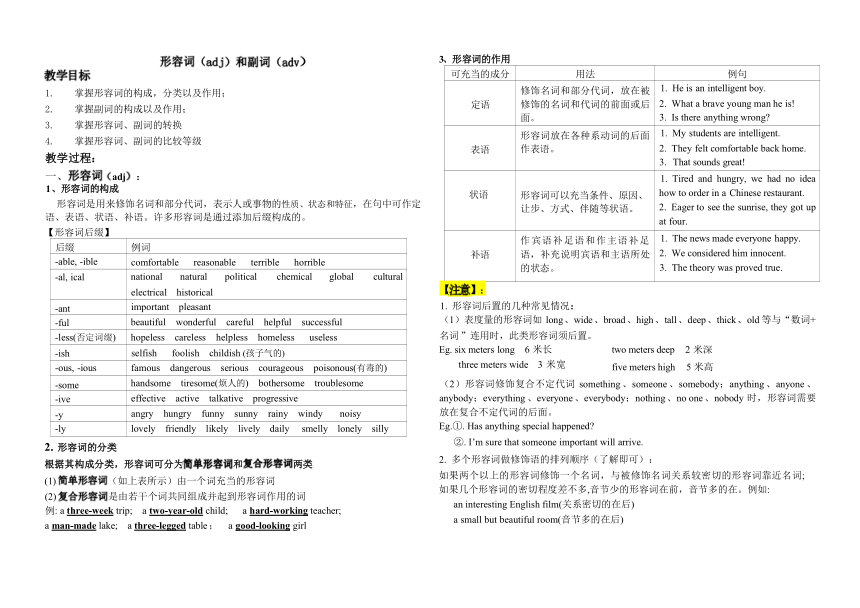
资源简介 形容词(adj)和副词(adv)教学目标1. 掌握形容词的构成,分类以及作用;2. 掌握副词的构成以及作用;3. 掌握形容词、副词的转换4. 掌握形容词、副词的比较等级教学过程:一、形容词(adj):1 、形容词的构成形容词是用来修饰名词和部分代词,表示人或事物的性质、状态和特征,在句中可作定 语、表语、状语、补语。许多形容词是通过添加后缀构成的。【形容词后缀】后缀 例词-able, -ible comfortable reasonable terrible horrible-al, ical national natural political chemical global cultural electrical historical-ant important pleasant-ful beautiful wonderful careful helpful successful-less(否定词缀) hopeless careless helpless homeless useless-ish selfish foolish childish (孩子气的)-ous, -ious famous dangerous serious courageous poisonous(有毒的)-some handsome tiresome(烦人的) bothersome troublesome-ive effective active talkative progressive-y angry hungry funny sunny rainy windy noisy-ly lovely friendly likely lively daily smelly lonely silly形容词的分类根据其构成分类,形容词可分为简单形容词和复合形容词两类(1).简单形容词(如上表所示)由一个词充当的形容词(2).复合形容词是由若干个词共同组成并起到形容词作用的词例: a three-week trip; a two-year-old child; a hard-working teacher;a man-made lake; a three-legged table ; a good-looking girl3、形容词的作用可充当的成分 用法 例句定语 修饰名词和部分代词,放在被 修饰的名词和代词的前面或后 面。 1. He is an intelligent boy. 2. What a brave young man he is! 3. Is there anything wrong 表语 形容词放在各种系动词的后面 作表语。 1. My students are intelligent. 2. They felt comfortable back home. 3. That sounds great!状语 形容词可以充当条件、原因、 让步、方式、伴随等状语。 1. Tired and hungry, we had no idea how to order in a Chinese restaurant. 2. Eager to see the sunrise, they got up at four.补语 作宾语补足语和作主语补足 语,补充说明宾语和主语所处 的状态。 1. The news made everyone happy. 2. We considered him innocent. 3. The theory was proved true.1. 形容词后置的几种常见情况:(1)表度量的形容词如 long 、wide 、broad 、high 、tall 、deep 、thick 、old 等与“数词+名词 ”连用时,此类形容词须后置。 Eg. six meters long 6 米长 three meters wide 3 米宽 two meters deep 2 米深 five meters high 5 米高(2)形容词修饰复合不定代词 something 、someone 、somebody;anything 、anyone 、 anybody;everything 、everyone 、everybody;nothing 、no one 、nobody 时,形容词需要 放在复合不定代词的后面。Eg.①. Has anything special happened ②. I’m sure that someone important will arrive.2. 多个形容词做修饰语的排列顺序(了解即可):如果两个以上的形容词修饰一个名词,与被修饰名词关系较密切的形容词靠近名词; 如果几个形容词的密切程度差不多,音节少的形容词在前,音节多的在。例如:an interesting English film(关系密切的在后)a small but beautiful room(音节多的在后)二、副词(adv):1 、副词的构成用于修饰动词、形容词、副词、介词短语、名词词组或句子,主要用作状语。其构成 规律一般如下:构成 例词形容词+ly clear →clearly complete →completely easy →easily名词+ly hour→hourly week →weekly month →monthly year →yearly某些现在分词或过去分词+ly surprising →surprisingly excited- →excitedly smiling →smilingly hurried →hurriedly2 、副词的作用可修饰的成分 例句修饰动词 1. He studies hard every day. 2. You always misunderstand me.修饰形容词 1. The weather is pleasantly warm. 2. I am terribly tired. 3. I felt very upset.修饰副词 1. He falls far behind in his studies. 2. Evans played very well.修饰介词短语 1. He left shortly after the meeting. 2. Much to my surprise,he's a thief.修饰名词词组 1. They did it in exactly the same way.修饰整个句子 1. Certainly,I will standby you forever. 2. Actually, I've been curious about this question for years.形容词、副词的转换1、一般形容词变副词直接在其后接ly。比如quick的副词就是quickly。2、以辅音字母+le结尾的形容词变副词要去e加y。比如simple的副词就是simply。3、少数以e结尾的形容词变副词要去e加ly。比如true的副词就是truly。但绝大多数以-e结尾的形容词仍然直接加-ly。如polite—politely,wide —widely等。4、以辅音字母+y结尾的形容词变副词要变y为i再加ly。比如happy的副词就是happily。注意:dry---dryly5、以ic结尾的形容词变副词在其后加ally。比如economic的副词就是economically,但public的副词是publicly。6、以l结尾的形容词通常加ly,例如usual的副词为usually;以11结尾的形容词变副词,在其后加y即可,比如dul1的副词就是dully。四、形容词、副词的比较等级:1、形容词变比较级最高级的规格变化:构成 原级 比较级 最高级一般加-er/-est high 高的 higher 更高的 highest 最高的以字母 e 结尾只加-r/-st brave 勇敢的 braver 更高的 bravest 最勇敢的以一个辅音字母结尾的重 读闭音节词,双写这一辅音 字母再加-er/-est big 大的 hot 热的 thin 瘦的 bigger 更大的 hotter 更热的 thinner 更瘦的 biggest 最勇敢的 hottest 最热的 thinnest 最瘦的以“辅音字母+y ”结尾的词, 将 y 变为 i 再加-er/-est busy 忙的 happy 高兴的 busier 较忙的 happier 较高兴的 busiest 最忙的 happiest 最高兴的多音节词在前加 more/most challenging carefully more challenging more carefully most challenging most carefully词尾是-er 结尾的形容词可 在词尾加-er/-est ,也可在前 加 more/most clever 聪明的 cleverer more clever cleverest most clever由形容词加-ly 结尾的副词, 一般在前面加 more/most slowly firmly more slowly more firmly most slowly most firmly2.常见的形容词的不规格变化:原级 比较级 最高级good / well 好的;健康的 better 更好的;更健康的 best 最好的;最健康的bad / ill 坏的 worse 更坏的 worst 最坏的little 少的 less 更少的 least 最少的many 多的 more 更多的 most 最多的far 远的 farther/further 更远的 farthest/furthest 最远的【注意】英语中除少数表示事物性质、属性、方位的形容词(如 right、wrong、excellent、final、 favourite 、extreme 、eastern 等)没有比较级和最高级外,大多数形容词都有比较级和最 高级。比较级表示事物间的比较“较.... 的 ”,最高级表示事物之中的“最... 的 ”。【比较级的常见用法】1. 比较级+and+ 比较级 表示“越来越 … ” 例:The day is becoming longer and longer. 2. the+比较级 … , the+比较级 … 表示:“越 … ,越 … ”例:The warmer the weather is , the better the crops will grow.译:天气越暖和, 庄稼长得越好 【含有最高级的习惯用语】best of all 更好的是 at least 至少 last but not least 最后但却是最重要的是 展开更多...... 收起↑ 资源预览
 资源预览
资源预览
 资源预览
资源预览