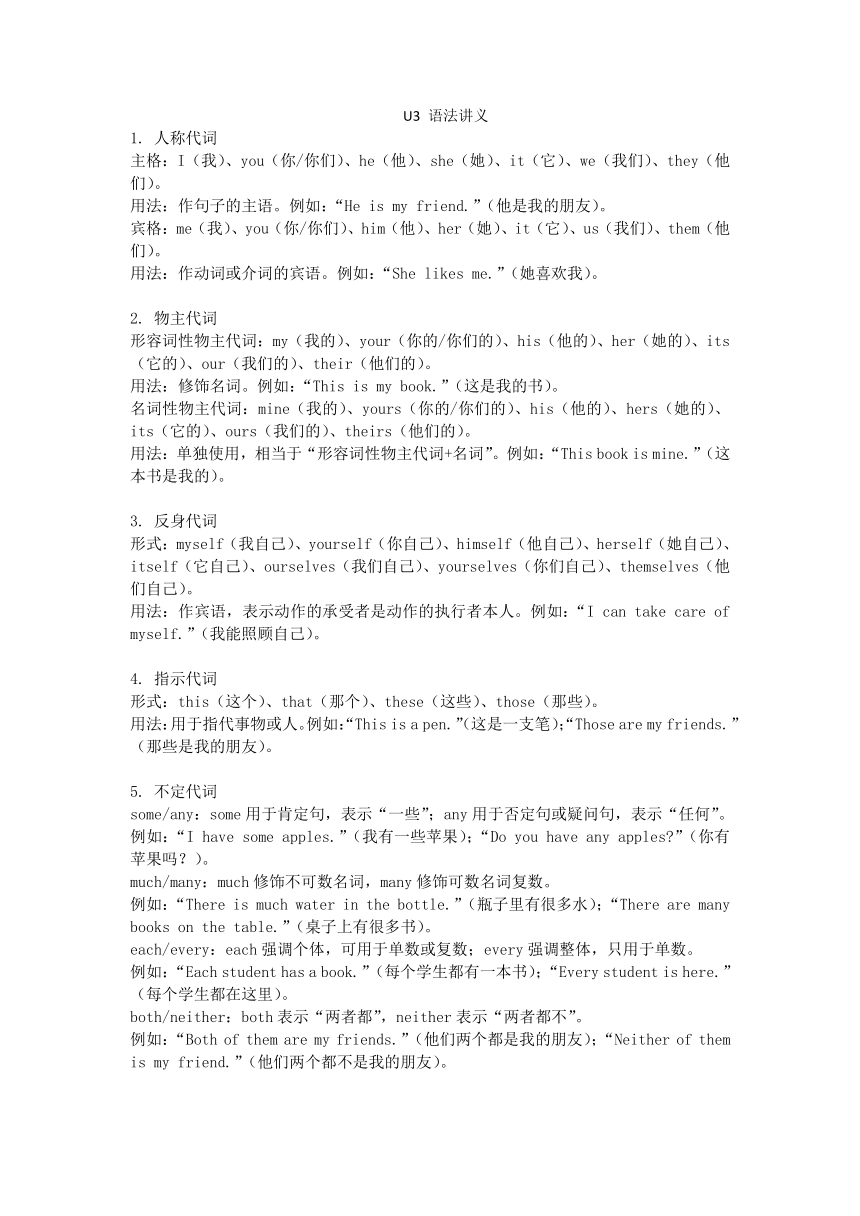
资源简介 U3 语法讲义1. 人称代词主格:I(我)、you(你/你们)、he(他)、she(她)、it(它)、we(我们)、they(他们)。用法:作句子的主语。例如:“He is my friend.”(他是我的朋友)。宾格:me(我)、you(你/你们)、him(他)、her(她)、it(它)、us(我们)、them(他们)。用法:作动词或介词的宾语。例如:“She likes me.”(她喜欢我)。2. 物主代词形容词性物主代词:my(我的)、your(你的/你们的)、his(他的)、her(她的)、its(它的)、our(我们的)、their(他们的)。用法:修饰名词。例如:“This is my book.”(这是我的书)。名词性物主代词:mine(我的)、yours(你的/你们的)、his(他的)、hers(她的)、its(它的)、ours(我们的)、theirs(他们的)。用法:单独使用,相当于“形容词性物主代词+名词”。例如:“This book is mine.”(这本书是我的)。3. 反身代词形式:myself(我自己)、yourself(你自己)、himself(他自己)、herself(她自己)、itself(它自己)、ourselves(我们自己)、yourselves(你们自己)、themselves(他们自己)。用法:作宾语,表示动作的承受者是动作的执行者本人。例如:“I can take care of myself.”(我能照顾自己)。4. 指示代词形式:this(这个)、that(那个)、these(这些)、those(那些)。用法:用于指代事物或人。例如:“This is a pen.”(这是一支笔);“Those are my friends.”(那些是我的朋友)。5. 不定代词some/any:some用于肯定句,表示“一些”;any用于否定句或疑问句,表示“任何”。例如:“I have some apples.”(我有一些苹果);“Do you have any apples ”(你有苹果吗?)。much/many:much修饰不可数名词,many修饰可数名词复数。例如:“There is much water in the bottle.”(瓶子里有很多水);“There are many books on the table.”(桌子上有很多书)。each/every:each强调个体,可用于单数或复数;every强调整体,只用于单数。例如:“Each student has a book.”(每个学生都有一本书);“Every student is here.”(每个学生都在这里)。both/neither:both表示“两者都”,neither表示“两者都不”。例如:“Both of them are my friends.”(他们两个都是我的朋友);“Neither of them is my friend.”(他们两个都不是我的朋友)。疑问代词形式:who(谁)、whom(谁,宾格)、whose(谁的)、what(什么)、which(哪一个)。用法:用于引导特殊疑问句。例如:“Who is that man ”(那个男人是谁?);“Whose book is this ”(这是谁的书?)。7. 关系代词形式:who(指人,作主语或宾语)、whom(指人,作宾语)、whose(指人或物,作定语)、which(指物,作主语或宾语)、that(指人或物,作主语或宾语)。用法:用于引导定语从句,修饰先行词。例如:“The man who is talking to my father is my uncle.”(正在和我父亲说话的那个人是我的叔叔)。同步练习题1.This is not my book. ______ is on the desk.A. Mine B. My C. Me D. I2.Let's go to the park, and you can enjoy ______ there.A. yourself B. yourselves C. me D. us3.There are many apples on the table. You can take ______ you like.A. any B. some C. all D. oneI don't have ______ to say about the movie.something B. anything C. everything D. nothingThe two boys are talking about ______ favorite singers.their B. theirs C. they D. them______ of the two answers is correct.Both B. Either C. Neither D. NoneIs this the book ______ you were looking for who B. which C. whose D. whomThere are many students in the classroom. ______ of them are reading.Some B. Any C. Much D. ManyI don't know ______ is knocking at the door.who B. whom C. whose D. which10..This is the room ______ window is broken.A. whose B. which C. that D. who 展开更多...... 收起↑ 资源预览
 资源预览
资源预览
 资源预览
资源预览